Thank you for visiting SNEWPapers!
Sign up free
Literary
March 31, 1843
Southern Christian Advocate
Charleston, Charleston County, South Carolina
What is this article about?
An essay questioning the common moral of industry from the bee, favoring biblical lessons of trust in providence from ravens and lilies. It praises the bee's wonders as proof of God's goodness, contrasting worldly prudence with spiritual contentment.
Clipping
OCR Quality
98%
Excellent
Full Text
THE BEE.
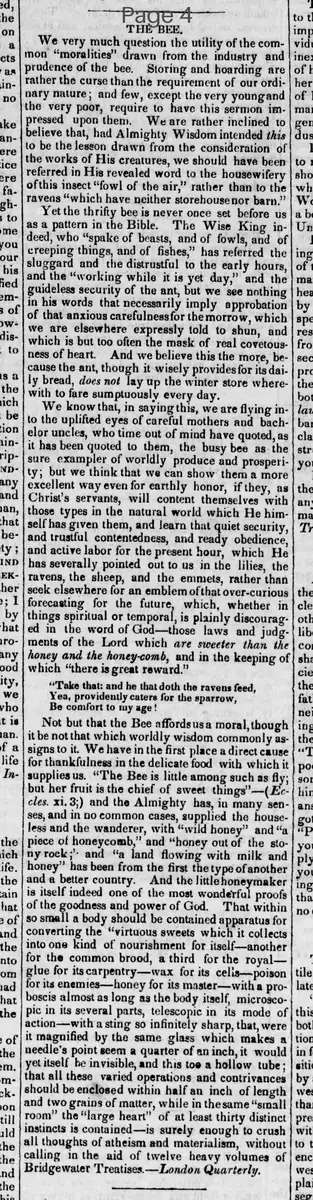
We very much question the utility of the common "moralities" drawn from the industry and prudence of the bee. Storing and hoarding are rather the curse than the requirement of our ordinary nature; and few, except the very young and the very poor, require to have this sermon impressed upon them. We are rather inclined to believe that, had Almighty Wisdom intended this to be the lesson drawn from the consideration of the works of His creatures, we should have been referred in His revealed word to the housewifery of this insect "fowl of the air," rather than to the ravens "which have neither storehouse nor barn." Yet the thrifty bee is never once set before us as a pattern in the Bible. The Wise King indeed, who "spake of beasts, and of fowls, and of creeping things, and of fishes," has referred the sluggard and the distrustful to the early hours, and the "working while it is yet day," and the guideless security of the ant, but we see nothing in his words that necessarily imply approbation of that anxious carefulness for the morrow, which we are elsewhere expressly told to shun, and which is but too often the mask of real covetousness of heart. And we believe this the more, because the ant, though it wisely provides for its daily bread, does not lay up the winter store wherewith to fare sumptuously every day.
We know that, in saying this, we are flying into the uplifted eyes of careful mothers and bachelor uncles, who time out of mind have quoted, as it has been quoted to them, the busy bee as the sure example of worldly prudence and prosperity; but we think that we can show them a more excellent way even for earthly honor, if they, as Christ's servants, will content themselves with those types in the natural world which He himself has given them, and learn that quiet security, and trustful contentedness, and ready obedience, and active labor for the present hour, which He has severally pointed out to us in the lilies, the ravens, the sheep, and the emmets, rather than seek elsewhere for an emblem of that over-curious forecasting of the future, which, whether in things spiritual or temporal, is plainly discouraged in the word of God--those laws and judgments of the Lord which are sweeter than the honey and the honeycomb, and in the keeping of which there is great reward."
"Take that: and he that doth the ravens feed,
Yea, providently caters for the sparrow,
Be comfort to my age!"
Not but that the Bee affords us a moral, though it be not that which worldly wisdom commonly assigns to it. We have in the first place a direct cause for thankfulness in the delicate food with which it supplies us. "The Bee is little among such as fly; but her fruit is the chief of sweet things"--(Eccles. xi.3;) and the Almighty has, in many senses, and in no common cases, supplied the houseless and the wanderer, with "wild honey" and "a piece of honeycomb," and "honey out of the stony rock;" and "a land flowing with milk and honey" has been from the first the type of another and a better country. And the little honey-maker is itself indeed one of the most wonderful proofs of the goodness and power of God. That within so small a body should be contained apparatus for converting the "virtuous sweets which it collects into one kind of nourishment for itself--another for the common brood, a third for the royal--glue for its carpentry--wax for its cells--poison for its enemies--honey for its master--with a proboscis almost as long as the body itself, microscopic in its several parts, telescopic in its mode of action--with a sting so infinitely sharp, that, were it magnified by the same glass which makes a needle's point seem a quarter of an inch, it would yet itself be invisible, and this too a hollow tube; that all these varied operations and contrivances should be enclosed within half an inch of length and two grains of matter, while in the same "small room" the "large heart" of at least thirty distinct instincts is contained--is surely enough to crush all thoughts of atheism and materialism, without calling in the aid of twelve heavy volumes of Bridgewater Treatises.--London Quarterly.
We very much question the utility of the common "moralities" drawn from the industry and prudence of the bee. Storing and hoarding are rather the curse than the requirement of our ordinary nature; and few, except the very young and the very poor, require to have this sermon impressed upon them. We are rather inclined to believe that, had Almighty Wisdom intended this to be the lesson drawn from the consideration of the works of His creatures, we should have been referred in His revealed word to the housewifery of this insect "fowl of the air," rather than to the ravens "which have neither storehouse nor barn." Yet the thrifty bee is never once set before us as a pattern in the Bible. The Wise King indeed, who "spake of beasts, and of fowls, and of creeping things, and of fishes," has referred the sluggard and the distrustful to the early hours, and the "working while it is yet day," and the guideless security of the ant, but we see nothing in his words that necessarily imply approbation of that anxious carefulness for the morrow, which we are elsewhere expressly told to shun, and which is but too often the mask of real covetousness of heart. And we believe this the more, because the ant, though it wisely provides for its daily bread, does not lay up the winter store wherewith to fare sumptuously every day.
We know that, in saying this, we are flying into the uplifted eyes of careful mothers and bachelor uncles, who time out of mind have quoted, as it has been quoted to them, the busy bee as the sure example of worldly prudence and prosperity; but we think that we can show them a more excellent way even for earthly honor, if they, as Christ's servants, will content themselves with those types in the natural world which He himself has given them, and learn that quiet security, and trustful contentedness, and ready obedience, and active labor for the present hour, which He has severally pointed out to us in the lilies, the ravens, the sheep, and the emmets, rather than seek elsewhere for an emblem of that over-curious forecasting of the future, which, whether in things spiritual or temporal, is plainly discouraged in the word of God--those laws and judgments of the Lord which are sweeter than the honey and the honeycomb, and in the keeping of which there is great reward."
"Take that: and he that doth the ravens feed,
Yea, providently caters for the sparrow,
Be comfort to my age!"
Not but that the Bee affords us a moral, though it be not that which worldly wisdom commonly assigns to it. We have in the first place a direct cause for thankfulness in the delicate food with which it supplies us. "The Bee is little among such as fly; but her fruit is the chief of sweet things"--(Eccles. xi.3;) and the Almighty has, in many senses, and in no common cases, supplied the houseless and the wanderer, with "wild honey" and "a piece of honeycomb," and "honey out of the stony rock;" and "a land flowing with milk and honey" has been from the first the type of another and a better country. And the little honey-maker is itself indeed one of the most wonderful proofs of the goodness and power of God. That within so small a body should be contained apparatus for converting the "virtuous sweets which it collects into one kind of nourishment for itself--another for the common brood, a third for the royal--glue for its carpentry--wax for its cells--poison for its enemies--honey for its master--with a proboscis almost as long as the body itself, microscopic in its several parts, telescopic in its mode of action--with a sting so infinitely sharp, that, were it magnified by the same glass which makes a needle's point seem a quarter of an inch, it would yet itself be invisible, and this too a hollow tube; that all these varied operations and contrivances should be enclosed within half an inch of length and two grains of matter, while in the same "small room" the "large heart" of at least thirty distinct instincts is contained--is surely enough to crush all thoughts of atheism and materialism, without calling in the aid of twelve heavy volumes of Bridgewater Treatises.--London Quarterly.
What sub-type of article is it?
Essay
Satire
What themes does it cover?
Religious
Moral Virtue
Nature
What keywords are associated?
Bee Morality
Biblical Providence
Nature Wonders
Gods Goodness
Worldly Prudence
What entities or persons were involved?
London Quarterly
Literary Details
Title
The Bee.
Author
London Quarterly
Subject
Moral Lessons From The Bee And Biblical Providence
Form / Style
Prose Essay With Biblical References
Key Lines
"Take That: And He That Doth The Ravens Feed,
Yea, Providently Caters For The Sparrow,
Be Comfort To My Age!"
"The Bee Is Little Among Such As Fly; But Her Fruit Is The Chief Of Sweet Things" (Eccles. Xi.3;)