Thank you for visiting SNEWPapers!
Sign up free
Alexandria Daily Gazette, Commercial & Political
Alexandria, Virginia
What is this article about?
Thomas Truxtun defends himself in a letter to the editor against the republication of a 1806 letter by Captain James Read implying his involvement in Aaron Burr's conspiracy. He recounts rejecting Burr's overtures to him in July 1806, promptly informing the government via Secretary Dearborn, his important testimony at Burr's 1807 trial in Richmond, and a conversation with President Jefferson affirming his actions, while accusing political rivals of malice and planning to sue Read.
Merged-components note: Continuation of the same letter to the editor by Thomas Truxtun.
Clipping
OCR Quality
Full Text
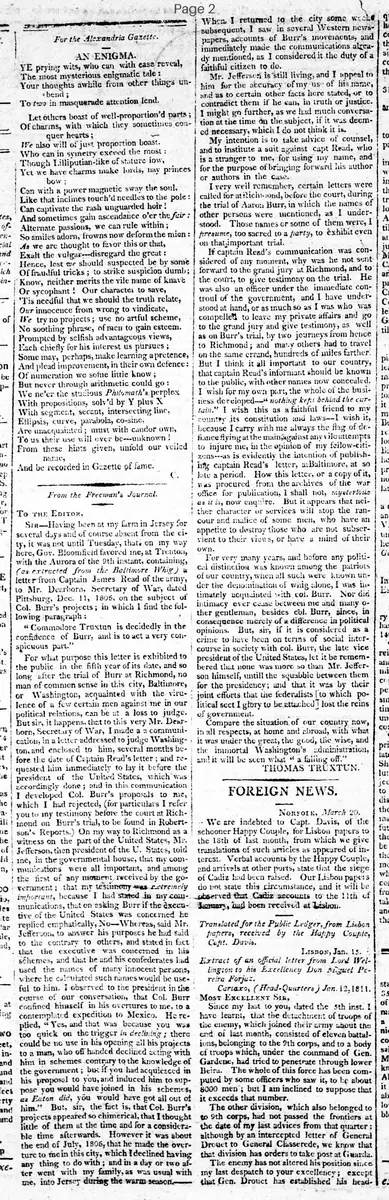
TO THE EDITOR,
SIR--Having been at my farm in Jersey for several days and of course absent from the city, it was not until Tuesday, that; on my way here, Gov. Bloomfield favored me, at Trenton, with the Aurora of the 9th instant, containing, (as extracted from the Baltimore Whig) a letter from Captain James Read of the army, to Mr. Dearborn, Secretary of War, dated Pittsburg, Dec. 11, 1806, on the subject of Col. Burr's projects; in which I find the following paragraph:
"Commodore Truxtun is decidedly in the confidence of Burr, and is to act a very conspicuous part."
For what purpose this letter is exhibited to the public in the fifth year of its date, and so long after the trial of Burr at Richmond, no man of common sense in this city, Baltimore, or Washington, acquainted with the virulence of a few certain men against me in our political relations, can be at a loss to judge.
But sir, it happens, that to this very Mr. Dearborn, Secretary of War, I made a communication, in a letter addressed to judge Washington, and enclosed to him, several months before the date of Captain Read's letter: and requested him immediately to lay it before the president of the United States, which was accordingly done; and in this communication I developed Col. Burr's proposals to me, which I had rejected, (for particulars I refer you to my testimony before the court at Richmond on Burr's trial, to be found in Robertson's Reports.) On my way to Richmond as a witness on the part of the United States, Mr. Jefferson, then president of the U. States, told me, in the governmental house, that my communications were all important, and among the first of any moment, received by the government; that my testimony was extremely important, because I had stated in my communication, that on asking Burr if the executive of the United States was concerned he replied emphatically, No--Whereas, said Mr. Jefferson, to answer his purposes he had said to the contrary to others, and stated in fact that the executive was concerned in his schemes, and that he and his confederates had used the names of many innocent persons, where he calculated such names would be useful to him. I observed to the president in the course of our conversation, that Col. Burr confined himself in his overtures to me, to a contemplated expedition to Mexico. He replied, "Yes, and that was because you was too quick on the trigger in declining; there could be no use in his opening all his projects to a man, who off handed declined acting with him in schemes contrary to the knowledge of the government; but if you had acquiesced in his proposal to you, and induced him to suppose you would have joined in his schemes, as Eaton did, you would have got all out of him." But, sir, the fact is, that Col. Burr's projects appeared so chimerical, that I thought little of them at the time and for a considerable time afterwards. However it was about the end of July, 1806, that he made the overture to me in this city, which I declined having any thing to do with; and in a day or two after went with my family, as was usual with me, into Jersey during the warm season.--When I returned to the city some weeks subsequent, I saw in several Western newspapers, accounts of Burr's movements, and immediately made the communications already mentioned, as I considered it the duty of a faithful citizen to do.
Mr. Jefferson is still living, and I appeal to him for the accuracy of my use of his name, and as to certain other facts here stated, or to contradict them if he can, in truth or justice.
I might go further, as we had much conversation at the time on the subject, if it was deemed necessary, which I do not think it is.
My intention is to take advice of counsel, and to institute a suit against capt Read, who is a stranger to me, for using my name, and for the purpose of bringing forward his author or authors in the Case.
I very well remember, certain letters were called for at Richmond, before the court, during the trial of Aaron Burr., in which the names of other persons were mentioned, as I understood. Those names or some of them were, I presume, too sacred to a party, to exhibit even on that important trial.
If captain Read's communication was considered of any moment, why was he not sent forward to the grand jury at Richmond, and to the court, to give testimony on the trial. He was also an officer under the immediate controul of the government, and I have understood at hand, or as much so as I was who was compelled to leave my private affairs and go to the grand jury and give testimony, as well as on Burr's trial, by two journeys from hence to Richmond; and many others had to travel on the same errand. hundreds of miles farther.
But I think it all important to our country, that captain Read's informant should be known to the public, with other names now concealed.
I wish for my own part, the whole of the business developed--"nothing kept behind the curtain." I wish this as a faithful friend to my country its constitution and laws--I wish it, because I carry with me always the flag of defiance flying at the main, against any villattempts to injure me, in the opinion of my fellow-citizens---as is evidently the intention of publishing captain Read's letter, at Baltimore, at so late a period. How this letter. or a copy of it, was procured from the archives of the war office for publication, I shall not, mysterious as it is, now enquire. But it appears that neither character or services will stop the rancour and malice of some men. who have an appetite to destroy those who are not subservient to their views, or have a mind of their own.
For very many years, and before any political distinction was known among the patriots of our country, when all such were known under the denomination of whig alone, I was intimately acquainted with col. Burr. Nor did intimacy ever cease between me and many other gentleman, besides col. Burr, since, in consequence merely of a difference in political opinions. But, sir, if it is considered as a crime to have been on terms of social intercourse in society with col. Burr, the late vice president of the United States, let it be remembered that none was more so than Mr. Jefferson himself, untill the squabble between them for the presidency; and that it was by their joint efforts that the federalists to which political sect I glory to be attached lost the reins of government.
Compare the situation of our country now, in all respects, at home and abroad, with what it was under the great, the good, the wise, and the immortal Washington's administration, and it will be seen what "a falling off."
THOMAS TRUXTUN.
What sub-type of article is it?
What themes does it cover?
What keywords are associated?
What entities or persons were involved?
Letter to Editor Details
Author
Thomas Truxtun
Recipient
The Editor
Main Argument
truxtun defends his innocence in burr's conspiracy by detailing his rejection of burr's july 1806 overtures for a mexico expedition, his prompt communication to secretary dearborn months before read's letter, his key testimony at burr's richmond trial praised by jefferson, and accuses political enemies of maliciously republishing the old letter to damage him, vowing to sue read to expose sources.
Notable Details