Thank you for visiting SNEWPapers!
Sign up free
Literary
November 29, 1828
The Delaware Register, Or, Farmers', Manufacturers' & Mechanics' Advocate
Wilmington, New Castle County, Delaware
What is this article about?
This essay concludes a discussion on beekeeping, offering practical advice from personal experience on apiary placement, hive construction, swarming management, bee health, diseases, suitable plants for forage, and the economic benefits of raising bees for honey and wax, emphasizing simplicity and profitability.
Merged-components note: This is a single continued essay on the care of bees, spanning pages 1-3 with sequential reading order and continuous text flow.
Clippings
1 of 3
OCR Quality
98%
Excellent
Full Text
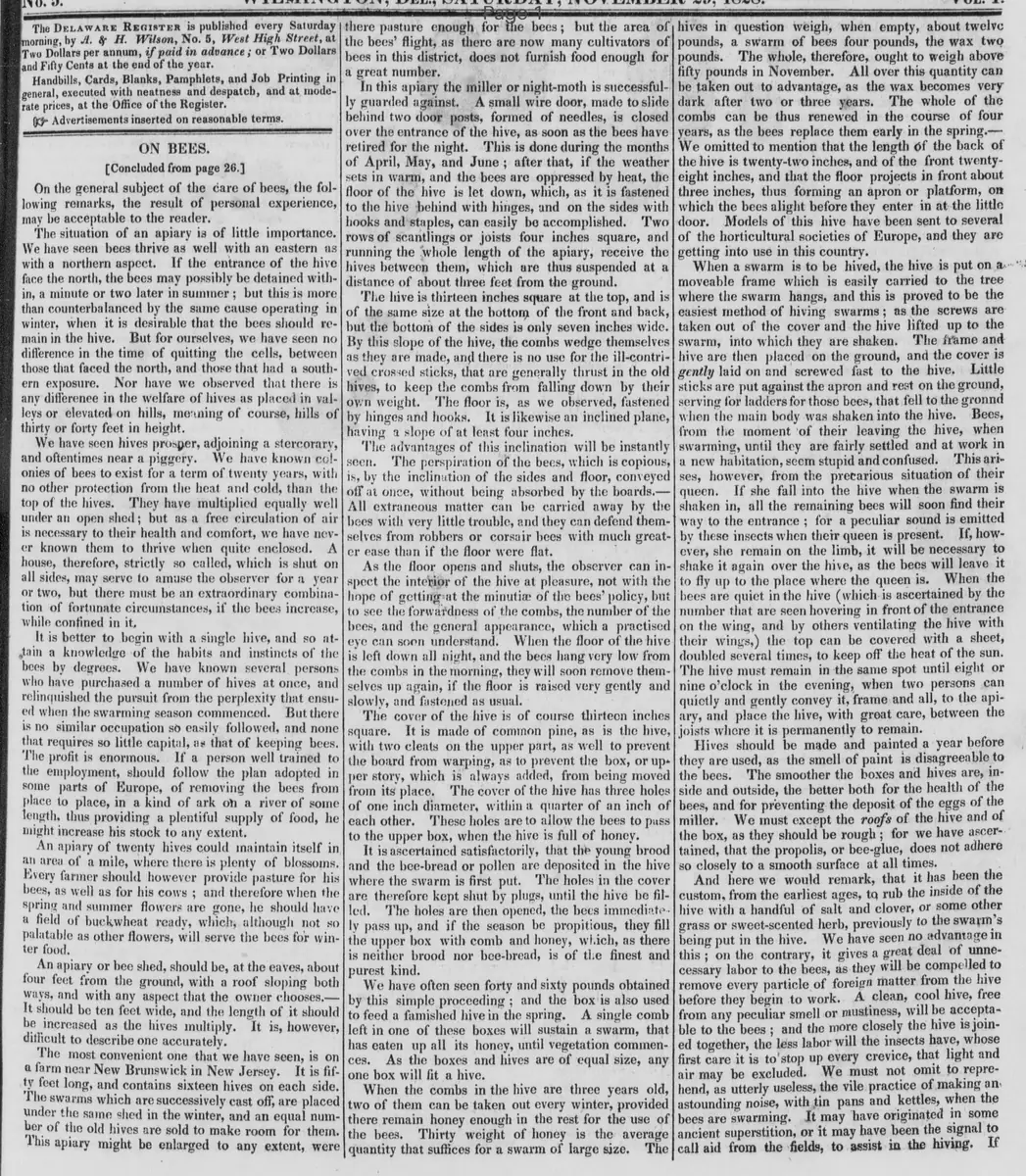
ON BEES.
[Concluded from page 26.]
On the general subject of the care of bees, the following remarks, the result of personal experience, may be acceptable to the reader.
The situation of an apiary is of little importance. We have seen bees thrive as well with an eastern as with a northern aspect. If the entrance of the hive face the north, the bees may possibly be detained within, a minute or two later in summer; but this is more than counterbalanced by the same cause operating in winter, when it is desirable that the bees should remain in the hive. But for ourselves, we have seen no difference in the time of quitting the cells, between those that faced the north, and those that had a southern exposure. Nor have we observed that there is any difference in the welfare of hives as placed in valleys or elevated on hills, meaning of course, hills of thirty or forty feet in height.
We have seen hives prosper, adjoining a stercorary, and oftentimes near a piggery. We have known colonies of bees to exist for a term of twenty years, with no other protection from the heat and cold, than the top of the hives. They have multiplied equally well under an open shed; but as a free circulation of air is necessary to their health and comfort, we have never known them to thrive when quite enclosed. A house, therefore, strictly so called, which is shut on all sides, may serve to amuse the observer for a year or two, but there must be an extraordinary combination of fortunate circumstances, if the bees increase, while confined in it.
It is better to begin with a single hive, and so attain a knowledge of the habits and instincts of the bees by degrees. We have known several persons who have purchased a number of hives at once, and relinquished the pursuit from the perplexity that ensued when the swarming season commenced. But there is no similar occupation so easily followed, and none that requires so little capital, as that of keeping bees.
The profit is enormous. If a person well trained to the employment, should follow the plan adopted in some parts of Europe, of removing the bees from place to place, in a kind of ark on a river of some length, thus providing a plentiful supply of food, he might increase his stock to any extent.
An apiary of twenty hives could maintain itself in an area of a mile, where there is plenty of blossoms. Every farmer should however provide pasture for his bees, as well as for his cows; and therefore when the spring and summer flowers are gone, he should have a field of buckwheat ready, which, although not so palatable as other flowers, will serve the bees for winter food.
An apiary or bee shed, should be, at the eaves, about four feet from the ground, with a roof sloping both ways, and with any aspect that the owner chooses. It should be ten feet wide, and the length of it should be increased as the hives multiply. It is, however, difficult to describe one accurately.
The most convenient one that we have seen, is on a farm near New Brunswick in New Jersey. It is fifty feet long, and contains sixteen hives on each side. The swarms which are successively cast off, are placed under the same shed in the winter, and an equal number of the old hives are sold to make room for them. This apiary might be enlarged to any extent, were there pasture enough for the bees; but the area of the bees' flight, as there are now many cultivators of bees in this district, does not furnish food enough for a great number.
In this apiary the miller or night-moth is successfully guarded against. A small wire door, made to slide behind two door posts, formed of needles, is closed over the entrance of the hive, as soon as the bees have retired for the night. This is done during the months of April, May, and June; after that, if the weather sets in warm, and the bees are oppressed by heat, the floor of the hive is let down, which, as it is fastened to the hive behind with hinges, and on the sides with hooks and staples, can easily be accomplished. Two rows of scantlings or joists four inches square, and running the whole length of the apiary, receive the hives between them, which are thus suspended at a distance of about three feet from the ground.
The hive is thirteen inches square at the top, and is of the same size at the bottom of the front and back, but the bottom of the sides is only seven inches wide. By this slope of the hive, the combs wedge themselves as they are made, and there is no use for the ill-contrived crossed sticks, that are generally thrust in the old hives, to keep the combs from falling down by their own weight. The floor is, as we observed, fastened by hinges and hooks. It is likewise an inclined plane, having a slope of at least four inches.
The advantages of this inclination will be instantly seen. The perspiration of the bees, which is copious, is, by the inclination of the sides and floor, conveyed off at once, without being absorbed by the boards. All extraneous matter can be carried away by the bees with very little trouble, and they can defend themselves from robbers or corsair bees with much greater ease than if the floor were flat.
As the floor opens and shuts, the observer can inspect the interior of the hive at pleasure, not with the hope of getting at the minutia of the bees' policy, but to see the forwardness of the combs, the number of the bees, and the general appearance, which a practised eye can soon understand. When the floor of the hive is left down all night, and the bees hang very low from the combs in the morning, they will soon remove themselves up again, if the floor is raised very gently and slowly, and fastened as usual.
The cover of the hive is of course thirteen inches square. It is made of common pine, as is the hive, with two cleats on the upper part, as well to prevent the board from warping, as to prevent the box, or upper story, which is always added, from being moved from its place. The cover of the hive has three holes of one inch diameter, within a quarter of an inch of each other. These holes are to allow the bees to pass to the upper box, when the hive is full of honey.
It is ascertained satisfactorily, that the young brood and the bee-bread or pollen are deposited in the hive where the swarm is first put. The holes in the cover are therefore kept shut by plugs, until the hive be filled. The holes are then opened, the bees immediately pass up, and if the season be propitious, they fill the upper box with comb and honey, which, as there is neither brood nor bee-bread, is of the finest and purest kind.
We have often seen forty and sixty pounds obtained by this simple proceeding; and the box is also used to feed a famished hive in the spring. A single comb left in one of these boxes will sustain a swarm, that has eaten up all its honey, until vegetation commences. As the boxes and hives are of equal size, any one box will fit a hive.
When the combs in the hive are three years old, two of them can be taken out every winter, provided there remain honey enough in the rest for the use of the bees. Thirty weight of honey is the average quantity that suffices for a swarm of large size. The hives in question weigh, when empty, about twelve pounds, a swarm of bees four pounds, the wax two pounds. The whole, therefore, ought to weigh above fifty pounds in November. All over this quantity can be taken out to advantage, as the wax becomes very dark after two or three years. The whole of the combs can be thus renewed in the course of four years, as the bees replace them early in the spring.
We omitted to mention that the length of the back of the hive is twenty-two inches, and of the front twenty-eight inches, and that the floor projects in front about three inches, thus forming an apron or platform, on which the bees alight before they enter in at the little door. Models of this hive have been sent to several of the horticultural societies of Europe, and they are getting into use in this country.
When a swarm is to be hived, the hive is put on a moveable frame which is easily carried to the tree where the swarm hangs, and this is proved to be the easiest method of hiving swarms; as the screws are taken out of the cover and the hive lifted up to the swarm, into which they are shaken. The frame and hive are then placed on the ground, and the cover is gently laid on and screwed fast to the hive. Little sticks are put against the apron and rest on the ground, serving for ladders for those bees, that fell to the ground when the main body was shaken into the hive. Bees, from the moment of their leaving the hive, when swarming, until they are fairly settled and at work in a new habitation, seem stupid and confused. This arises, however, from the precarious situation of their queen. If she fall into the hive when the swarm is shaken in, all the remaining bees will soon find their way to the entrance; for a peculiar sound is emitted by these insects when their queen is present. If, however, she remain on the limb, it will be necessary to shake it again over the hive, as the bees will leave it to fly up to the place where the queen is. When the bees are quiet in the hive (which is ascertained by the number that are seen hovering in front of the entrance on the wing, and by others ventilating the hive with their wings,) the top can be covered with a sheet, doubled several times, to keep off the heat of the sun. The hive must remain in the same spot until eight or nine o'clock in the evening, when two persons can quietly and gently convey it, frame and all, to the apiary, and place the hive, with great care, between the joists where it is permanently to remain.
Hives should be made and painted a year before they are used, as the smell of paint is disagreeable to the bees. The smoother the boxes and hives are, inside and outside, the better both for the health of the bees, and for preventing the deposit of the eggs of the miller. We must except the roofs of the hive and of the box, as they should be rough: for we have ascertained, that the propolis, or bee-glue, does not adhere so closely to a smooth surface at all times.
And here we would remark, that it has been the custom, from the earliest ages, to rub the inside of the hive with a handful of salt and clover, or some other grass or sweet-scented herb, previously to the swarm's being put in the hive. We have seen no advantage in this; on the contrary, it gives a great deal of unnecessary labor to the bees, as they will be compelled to remove every particle of foreign matter from the hive before they begin to work. A clean, cool hive, free from any peculiar smell or mustiness, will be acceptable to the bees; and the more closely the hive is joined together, the less labor will the insects have, whose first care it is to stop up every crevice, that light and air may be excluded. We must not omit to reprehend, as utterly useless, the vile practice of making an astounding noise, with tin pans and kettles, when the bees are swarming. It may have originated in some ancient superstition, or it may have been the signal to call aid from the fields, to assist in the hiving. If
harmless, it is unnecessary; and everything that tends to encumber the management of bees should be avoided.
Straw hives are unsuitable to our climate, and afford a harbor for all kinds of insects. It is folly to talk of their cheapness. If a man intend to keep bees, he must, in the first place, make the hives in the very best manner; by this we mean, of good materials and of good workmanship. A hive badly joined by an awkward carpenter is worse than a hollow tree.
One half of the labor of the bees, is directed to the repairs of their dwelling.*
It is not asserted that the bees will, of themselves, fall into these hives, or that no trouble or expense is necessary in the management of an apiary. We know that both care and expense are required; but the latter, after the first disbursement, is very trifling. Vigilance and neatness are forever in requisition, and the care of bees, like all other profitable business, cannot be pursued to any advantage, unless it receive daily and minute attention. But have we not accomplished a great deal when we have reduced the thing to this certainty?
But although, as we have before observed, nothing is more simple in theory and practice, than the history and care of bees, yet it requires a constant and unremitted attention, if we aim either at instruction or profit. Can anything be well done and to advantage without these? Varro in his treatise de Re Rustica, is the first who spoke of hives. He wrote upwards of 1870 years ago; and how many different sorts of hives have been constructed since his time, to say nothing of the different theories? We wish to see bees in every garden throughout America, but we have no desire to see the subject encumbered with more than is necessary to advance the pleasure and profit of the pursuit. To the naturalist we will leave discussions of organization and propagation. They are foreign to our purpose, as they only serve to perplex and deter us from the main points. But it is proper to know the most simple mode of managing a hive, and this includes the pasture, or food that is necessary, for its sustenance. Hunger destroys as many bees as the miller. We ought to cultivate such shrubs and plants as the bees like; without this they will starve. The American black willow and the red maple are the first trees that are visited by the bees. They are fond of the crocus, which is the earliest of our bulbous roots: and these we can have in abundance, as they multiply quickly and occupy little space. They are beautiful in themselves, affording a rich treat to the eye; and they flower so early, and are of such bright and vivid colors, that we take as much pleasure in them as the bees do. The stercorary and piggery are next resorted to by these insects. These we presume are their medicine shops, and the extract absorbed from them must be used as a tonic. Blossoms of all kinds, excepting those of the red clover and of the honey-suckle, are excellent food; and the bees especially profit by the increased attention bestowed at present on the cultivation of the peach tree in some parts of this country. They not only drink the nectar and abstract the pollen of the flower, but they appropriate the peach itself. We have seen twenty or thirty bees devour a peach in half an hour: that is, they carried the juices of it to their cells.
The humming-bird alone can reach the bottom of the nectary of the honey suckle, but even here the instinct of the bee is seen. The small birds, such as the wren, make an incision on the outside, near the bottom of the flower, and extract a part of the juices. The bee takes advantage of this opening, and avails itself of what is left.
The scent of the bees is so acute, that every flower which has a powerful odor can be discovered by them at a great distance. Strawberry-blossoms, mignonette, wild and garden thyme, herbs of all kinds, apple, plum, cherry, and above all, raspberry blossoms, and white clover, are delicious food for them, and a thriving orchard and garden and apiary fitly go together.
* A model of the hive which we consider of the best construction, may be seen at the village of the Lebanon Shakers, in the hands of Mr. Daniel Hawken, or at the seat of Theodore Sedgwick, Esq. in Stockbridge. The inventor of this hive has had an opportunity of judging of its merits by experience.
But as the bee seeks only its own gratification in procuring honey and in regulating its household, and as, according to the old proverb, what is one man's meat is another's poison, it sometimes carries honey to its cell which is prejudicial to us. Dr. Barton in his fifth volume of the American Philosophical Transactions, speaks of several plants that yield a poisonous syrup, of which the bees partake without injury, but which has been fatal to man. He has enumerated some of these plants, which ought to be destroyed wherever they are seen, namely, dwarf-laurel great laurel, kalmia latifolia, broad leaved moorwort, Pennsylvania mountain laurel, wild honey suckle (the bees, as we observed cannot get much of this,) and the stramonium or Jamestown weed; which last we should wish to see completely eradicated, as, independently of the poison extracted from its flowers, and from its seeds, which are often eaten by children, it is the ugliest weed that grows, and has the most offensive odor.
The poets, always exalting and magnifying the subjects that they touch, have contributed perhaps more than any other set of writers to mislead our judgment. They endow the bee with memory, and Rogers thinks that it finds its way to the hive by this faculty alone.
Nor is it only with regard to the bee, that poets, the worst entomologists in the world, have led us astray. Cowper says,
'I would not enter on my list of friends,
Though graced with polished manners and fine sense,
The man,
Who needlessly sets foot upon a worm.'
By worm, we wonder if he included the grub-worm. Alas! little did that amiable man think of the mischief that would ensue from this sensibility and tenderness towards insects. He thought that when nature created them, and designed them an 'abode,' that it was a species of cruelty to hunt or harm them, when not actually crawling 'in th' alcove, the chamber, or refectory.' But the harm that the few do, who so inadvertently approach our dwellings, is insignificant when compared to the ravages of every kind of insect, excepting the bee, when in the abode that nature assigned it. This very worm, from which they bid us turn aside when we meet it in our path, after destroying the roots of our pasture and our corn, becomes a winged insect, and continues its mischief to the destruction of our finest fruits.
We really are in a sad plight between our sensibilities and our sense of justice to ourselves. We say that insects have so multiplied, that we can neither raise grain for our cattle, nor fruit for ourselves.
'Keep birds near you,' say the philosophers, 'quit the cruel practice of shooting the harmless songsters of the grove, and you will not only be rewarded by seeing that insects decrease, but you will be charmed by their melody.' But, then, we say in answer, that the birds do not discriminate; that they prefer bees to every other insect, and therefore the birds must die. And in reality we must make war upon those birds, that show the greatest fondness for our little friends. Let us, at least, show our sense of the value of these, by keeping their enemies away, at any rate from their very doors. Let us lessen the chance of their encountering them abroad, by planting the favorite food of the bees as near the apiary as possible; and also lessen the chance of their being drowned, when driven by high winds, as they stoop to drink, by giving them running streams near to their hives.
We have scarcely observed any order in this discussion, setting down our thoughts just as they presented themselves. Had we written a regular work on this subject, we would in the proper place have spoken of the small bees, the aged, and those denominated black. As this essay is short, it will not be difficult for those who have a respect for our opinions, to cull out and methodize the different matter as it occurs, and we can then ramble on with our few remaining observations to the close.
In the hive of a new swarm, during the months of July and August, there are fewer small bees, than in one that has been tenanted for four or five years. The bee, like all other insects, spins itself a covering before it becomes a fly. When it emerges with wings, from its cell, several older bees approach it, feed it with the contents of their stomachs, and then clean out the cell and deposit in it fresh honey. This is their constant practice; and the bee that is just born, as soon as it has been fed and has stretched its wings, flies off to a flower, and commences its labors. But although the bees clean out the cell the moment young bee is born, yet they either find no inconvenience from that part of the film, which the young bee leaves at the bottom of the cell, and which is of a silky nature, or they are unable to detach it. In consequence of this, the cell is not so deep, as the same circumstances occur perpetually, brood alternating with honey, the cells become every year visibly smaller; and, consequently, those bees that are bred in these small cells, of which there is a great number, are never of the full size of those that have had more room. Even the queen eggs, which we say are often deposited in the cells of neuters, and have afterwards larger cells attached to the first, never produce so large a queen bee, as if the cell had been of proper dimensions at first. Thus we see that the contraction of the cell may diminish the size of the bee, even to the extinction of life, just as the contraction of a Chinese shoe reduces the foot even to uselessness; but in neither case will a single new organ be taken from or added to the bee, or a single toe be taken from or added to the foot, whether the cell or shoe be larger or smaller.
A young bee can be readily distinguished from an old one, by the greyish colored down that covers it, and which it loses by the wear and tear of hard labor; and if the bee be not destroyed before the season is over, this down entirely disappears, and the groundwork of the insect is seen, white or black.
On a close examination, very few of these black or aged bees, will be seen at the opening of the spring, as, not having the stamina of those that are younger, they perish from inability to encounter the vicissitudes of winter.
Our seasons are very variable. The scorching droughts of summer deny to plants their accustomed moisture; no honey therefore can be made by the bees at such times, and they are compelled to eat of their winter food. They cluster about the hive, or, deprived of their accustomed labor, they are very restless, and often intrude into a neighboring hive, apparently for the want of employment. In the summer of 1825, during the latter part of July, the heat was so distressing to the bees, the thermometer standing at 92° in the shade, that they seemed to have lost their usual instinct. A number of hives of the old-fashioned patterns, that stood on a bench, were well filled with bees. At two o'clock, for three days in succession, the whole swarm of each hive rushed out, and ran into the adjoining hive, where they remained for a few seconds without apparent offence to the invaded bees, who in their turn flew madly out, and paid the same unceremonious visit to their neighbours. No quarrel ensued, not a bee was killed by these irruptive movements.
They seemed maddened by the heat; and yet the queen was left in the hive, for with all our attention to the sallying parties, we did not see a single queen among them. The same frenzy did not occur in those hives that were suspended upon joists, thus proving that the bees did not suffer so much from heat in those suspended hives, as they did in the flat bottomed ones, that rested on a bench.
Our winters are equally disastrous to the poor bees. Of late years, there have been so many mild days during the cold season, that a great deal of honey has been consumed. These alternations of torpor and animation cause greater exhaustion and loss of physical powers, than would be occasioned by a continuance of uniform torpor. This we infer from the fact, that in Russia, where the winters are uniformly cold, bees do not perish; and in the West Indies where there is perpetual verdure, they are never exhausted.
But although a bee may remain torpid, to a certain extent, for six months in the year without injury, in those climates to which the insect has long been accustomed, yet it could not exist for the same space of time in lower latitudes, where such a period of continuous warm weather would be fatal.
Continued cold rarely occurs. Nature has not constructed
them for every emergency. She has done no more
for them in this particular, than she has for man.-
of climate by degrees; not by an alteration of the
They are compelled to get accustomed to a change
structure of their organs, for that can never occur un-
der any circumstances, but by some change that takes
place in the circulation of the fluids of the body, by
which the system is accommodated to a higher or low-
er temperature. But we leave this part of the ques-
tion to the naturalists learned in the science.
If we are correct in this our opinion, the sugges-
tion of Dr Anderson would not be available in our
climate. If, according to his proposal, bees were to
be kept all winter in an ice house, more causes than
one would operate to the injury of their health, and
consequently to the decrease of their number. The
temperature of an ice-house, unless we are to suppose
the hive to be buried in the ice itself, is much higher
than that which is without the house. The torpor,
therefore, would not be so complete, as to put a stop
to the digestive process. The bees would be compel-
led to eat; and as their food is constantly in contact
with the impure, stagnant air of the ice-house, it
would soon become vitiated and engender diseases.
We know of but two diseases to which the bees are
subject in this country, and they have to our knowl-
edge never occurred at any other season, than the
early part of the spring, dysentery and dyspepsia.--
The latter arises from the indolent, inactive life that
they are compelled to lead, in our variable winters.-
The rule holds good with the most diminutive, as
well as the greatest, in animal life, that 'if we eat
and wish to preserve health, we must work.'
During the last winter (1828.) the bees suffered
more and lost more of their numbers, than has often
been known before. There was scarcely a day, that
they did not sally out to search for employment and
food; but not being properly stimulated, they seldom
returned to the hive. We frequently saw them crawl-
ing on the ground, weak and spiritless; and those that
did return soon perished. On examining the hives,
we observed that nearly all the honey was consumed;
and many of the brood, that in ordinary seasons, are
not hatched until the first part of April, assumed the
fly form at an earlier period and died.
The cure for this disorder the bees take into their
own hands. As soon as the flowers appear, they go
to work; and then it is, that they resort to aperients
and tonics, which they abstract from the floors of the
piggeries.
The other disease proceeds from long confinement
in bad air and from unwholesome food, and is invari-
ably fatal; nor can the bees avert it by any instinct
of their own. We know of no cure for the dysente-
ry, when the bee is seized with it. Those that have it
badly must die. We can restore those that are least
affected, by frequently washing the hives, as far as we
can reach, with weak lye, and by ventilating them and
removing the dead bees.
Much has been said of the danger to be apprehend-
ed from placing an apiary too near our own dwelling.
There is indeed no positive advantage in having it ve-
ry near: but as the person usually engaged in hiving
the bees is occupied with farming affairs, and is not
always present when the bees swarm, it is proper that
the apiary should be within sight of the family. A
bee certainly has frequently attacked a horse, and we
have once or twice heard of one being stung to death.
Considering the great number of hives of bees, it is
really wonderful that more accidents of this kind have
not occurred. But they are exceedingly rare; and
when we know how many hundred horses annually die
from the disease called the botts, which proceeds from
the maggots of the egg, laid by the horse-bee on the
hair of the animal, the very few that suffer from the
sting of the honey-bee do not deserve to be taken into
consideration.
In every point of view, therefore, it appears that
bees should be cultivated. The wax that is consumed,
in this country, in various ways, is enormous, and most
of it is imported. If we may credit Huish, Great
Britain imports from Germany and Italy upwards of
eighty thousand pounds sterling worth of wax annual-
ly. We are unable to say, with any precision, to what
amount it is imported by us; but judging from the
quantity that each family uses in a year, and the amount
employed in various arts, it must be worthy of notice.
It is really disgraceful to such a country as ours to
import wax or honey. We ought ourselves to export
tons of it every year; and we trust that, in the course
of a few years, this improvement will take place. Mas-
sachusetts and Connecticut are well situated, and abun-
dantly supplied with proper food for bees; and their
climate being less variable, is better adapted to their
nature. We spoke of hills of twenty or thirty feet in
height; this only applies to the site of an apiary near
a dwelling. The dwelling itself may be on a hill.-
We have heard of convents situated on mountains, that
have been well stocked with hives. In short, nothing
is wanting but good pasture, good hives, cleanliness,
and attention, to insure a rich reward to those who en-
gage in the pursuit.
Children are naturally very fond of watching the
proceedings of bees, and they would soon learn to take
care of them, if they were not taught to fear them.-
All danger can be guarded against, by making them
wear woollen gloves that are long enough to draw over
their sleeves at the wrist, and a wire cap to cover their
head. They could thus be trained to manage bees;
and training is quite as necessary to the full compre-
hension of the occupation, as it is in the trade of a
carpenter or a shoe-maker.
It would be unjust not to refer again to Mr Butler's
little book, after making it the occasion of expressing
our own thoughts. We shall rejoice if our slender no-
tice of his work should encourage him to put forth a
new edition; and we shall now take leave of the sub-
ject, although it be almost inexhaustible, by an anec-
dote, that we have reserved for the conclusion, that it
may make the deeper impression.
A good old French bishop, in paying his annual visit
to his clergy, was very much afflicted by the represen-
tations they made of their extreme poverty, and which
the appearance of their houses and families corrobo-
rated. Whilst he was deploring the state of things
which had reduced them to this sad condition, he arri-
ved at the house of a curate, who, living amongst a
poorer set of parishioners than any he had yet visited,
would, he feared, be in a still more woful plight than
the others. Contrary, however, to his expectations, he
found appearances very much improved. Every thing
about the house wore the aspect of comfort and plenty.
The good bishop was amazed. 'How is this my friend?'
said he; 'you are the first man I have met with a
cheerful face and a plentiful board. Have you any in-
come independent of your cure?' 'Yes, sir,' said the
clergyman, 'I have; my family would starve on the
pittance I receive from the poor people that I instruct.
Come with me into the garden, and I will show you
the stock that yields me an excellent interest.' On go-
ing to the garden, he showed the bishop a large range
of bee-hives. 'There is the bank from which I draw
an annual dividend. It never stops payment.' Ever
after that memorable visit, when any of his clergy
complained to the bishop of poverty, he would say to
them, 'Keep bees, keep bees:' and we shall bid our
readers adieu with the same advice.
[Concluded from page 26.]
On the general subject of the care of bees, the following remarks, the result of personal experience, may be acceptable to the reader.
The situation of an apiary is of little importance. We have seen bees thrive as well with an eastern as with a northern aspect. If the entrance of the hive face the north, the bees may possibly be detained within, a minute or two later in summer; but this is more than counterbalanced by the same cause operating in winter, when it is desirable that the bees should remain in the hive. But for ourselves, we have seen no difference in the time of quitting the cells, between those that faced the north, and those that had a southern exposure. Nor have we observed that there is any difference in the welfare of hives as placed in valleys or elevated on hills, meaning of course, hills of thirty or forty feet in height.
We have seen hives prosper, adjoining a stercorary, and oftentimes near a piggery. We have known colonies of bees to exist for a term of twenty years, with no other protection from the heat and cold, than the top of the hives. They have multiplied equally well under an open shed; but as a free circulation of air is necessary to their health and comfort, we have never known them to thrive when quite enclosed. A house, therefore, strictly so called, which is shut on all sides, may serve to amuse the observer for a year or two, but there must be an extraordinary combination of fortunate circumstances, if the bees increase, while confined in it.
It is better to begin with a single hive, and so attain a knowledge of the habits and instincts of the bees by degrees. We have known several persons who have purchased a number of hives at once, and relinquished the pursuit from the perplexity that ensued when the swarming season commenced. But there is no similar occupation so easily followed, and none that requires so little capital, as that of keeping bees.
The profit is enormous. If a person well trained to the employment, should follow the plan adopted in some parts of Europe, of removing the bees from place to place, in a kind of ark on a river of some length, thus providing a plentiful supply of food, he might increase his stock to any extent.
An apiary of twenty hives could maintain itself in an area of a mile, where there is plenty of blossoms. Every farmer should however provide pasture for his bees, as well as for his cows; and therefore when the spring and summer flowers are gone, he should have a field of buckwheat ready, which, although not so palatable as other flowers, will serve the bees for winter food.
An apiary or bee shed, should be, at the eaves, about four feet from the ground, with a roof sloping both ways, and with any aspect that the owner chooses. It should be ten feet wide, and the length of it should be increased as the hives multiply. It is, however, difficult to describe one accurately.
The most convenient one that we have seen, is on a farm near New Brunswick in New Jersey. It is fifty feet long, and contains sixteen hives on each side. The swarms which are successively cast off, are placed under the same shed in the winter, and an equal number of the old hives are sold to make room for them. This apiary might be enlarged to any extent, were there pasture enough for the bees; but the area of the bees' flight, as there are now many cultivators of bees in this district, does not furnish food enough for a great number.
In this apiary the miller or night-moth is successfully guarded against. A small wire door, made to slide behind two door posts, formed of needles, is closed over the entrance of the hive, as soon as the bees have retired for the night. This is done during the months of April, May, and June; after that, if the weather sets in warm, and the bees are oppressed by heat, the floor of the hive is let down, which, as it is fastened to the hive behind with hinges, and on the sides with hooks and staples, can easily be accomplished. Two rows of scantlings or joists four inches square, and running the whole length of the apiary, receive the hives between them, which are thus suspended at a distance of about three feet from the ground.
The hive is thirteen inches square at the top, and is of the same size at the bottom of the front and back, but the bottom of the sides is only seven inches wide. By this slope of the hive, the combs wedge themselves as they are made, and there is no use for the ill-contrived crossed sticks, that are generally thrust in the old hives, to keep the combs from falling down by their own weight. The floor is, as we observed, fastened by hinges and hooks. It is likewise an inclined plane, having a slope of at least four inches.
The advantages of this inclination will be instantly seen. The perspiration of the bees, which is copious, is, by the inclination of the sides and floor, conveyed off at once, without being absorbed by the boards. All extraneous matter can be carried away by the bees with very little trouble, and they can defend themselves from robbers or corsair bees with much greater ease than if the floor were flat.
As the floor opens and shuts, the observer can inspect the interior of the hive at pleasure, not with the hope of getting at the minutia of the bees' policy, but to see the forwardness of the combs, the number of the bees, and the general appearance, which a practised eye can soon understand. When the floor of the hive is left down all night, and the bees hang very low from the combs in the morning, they will soon remove themselves up again, if the floor is raised very gently and slowly, and fastened as usual.
The cover of the hive is of course thirteen inches square. It is made of common pine, as is the hive, with two cleats on the upper part, as well to prevent the board from warping, as to prevent the box, or upper story, which is always added, from being moved from its place. The cover of the hive has three holes of one inch diameter, within a quarter of an inch of each other. These holes are to allow the bees to pass to the upper box, when the hive is full of honey.
It is ascertained satisfactorily, that the young brood and the bee-bread or pollen are deposited in the hive where the swarm is first put. The holes in the cover are therefore kept shut by plugs, until the hive be filled. The holes are then opened, the bees immediately pass up, and if the season be propitious, they fill the upper box with comb and honey, which, as there is neither brood nor bee-bread, is of the finest and purest kind.
We have often seen forty and sixty pounds obtained by this simple proceeding; and the box is also used to feed a famished hive in the spring. A single comb left in one of these boxes will sustain a swarm, that has eaten up all its honey, until vegetation commences. As the boxes and hives are of equal size, any one box will fit a hive.
When the combs in the hive are three years old, two of them can be taken out every winter, provided there remain honey enough in the rest for the use of the bees. Thirty weight of honey is the average quantity that suffices for a swarm of large size. The hives in question weigh, when empty, about twelve pounds, a swarm of bees four pounds, the wax two pounds. The whole, therefore, ought to weigh above fifty pounds in November. All over this quantity can be taken out to advantage, as the wax becomes very dark after two or three years. The whole of the combs can be thus renewed in the course of four years, as the bees replace them early in the spring.
We omitted to mention that the length of the back of the hive is twenty-two inches, and of the front twenty-eight inches, and that the floor projects in front about three inches, thus forming an apron or platform, on which the bees alight before they enter in at the little door. Models of this hive have been sent to several of the horticultural societies of Europe, and they are getting into use in this country.
When a swarm is to be hived, the hive is put on a moveable frame which is easily carried to the tree where the swarm hangs, and this is proved to be the easiest method of hiving swarms; as the screws are taken out of the cover and the hive lifted up to the swarm, into which they are shaken. The frame and hive are then placed on the ground, and the cover is gently laid on and screwed fast to the hive. Little sticks are put against the apron and rest on the ground, serving for ladders for those bees, that fell to the ground when the main body was shaken into the hive. Bees, from the moment of their leaving the hive, when swarming, until they are fairly settled and at work in a new habitation, seem stupid and confused. This arises, however, from the precarious situation of their queen. If she fall into the hive when the swarm is shaken in, all the remaining bees will soon find their way to the entrance; for a peculiar sound is emitted by these insects when their queen is present. If, however, she remain on the limb, it will be necessary to shake it again over the hive, as the bees will leave it to fly up to the place where the queen is. When the bees are quiet in the hive (which is ascertained by the number that are seen hovering in front of the entrance on the wing, and by others ventilating the hive with their wings,) the top can be covered with a sheet, doubled several times, to keep off the heat of the sun. The hive must remain in the same spot until eight or nine o'clock in the evening, when two persons can quietly and gently convey it, frame and all, to the apiary, and place the hive, with great care, between the joists where it is permanently to remain.
Hives should be made and painted a year before they are used, as the smell of paint is disagreeable to the bees. The smoother the boxes and hives are, inside and outside, the better both for the health of the bees, and for preventing the deposit of the eggs of the miller. We must except the roofs of the hive and of the box, as they should be rough: for we have ascertained, that the propolis, or bee-glue, does not adhere so closely to a smooth surface at all times.
And here we would remark, that it has been the custom, from the earliest ages, to rub the inside of the hive with a handful of salt and clover, or some other grass or sweet-scented herb, previously to the swarm's being put in the hive. We have seen no advantage in this; on the contrary, it gives a great deal of unnecessary labor to the bees, as they will be compelled to remove every particle of foreign matter from the hive before they begin to work. A clean, cool hive, free from any peculiar smell or mustiness, will be acceptable to the bees; and the more closely the hive is joined together, the less labor will the insects have, whose first care it is to stop up every crevice, that light and air may be excluded. We must not omit to reprehend, as utterly useless, the vile practice of making an astounding noise, with tin pans and kettles, when the bees are swarming. It may have originated in some ancient superstition, or it may have been the signal to call aid from the fields, to assist in the hiving. If
harmless, it is unnecessary; and everything that tends to encumber the management of bees should be avoided.
Straw hives are unsuitable to our climate, and afford a harbor for all kinds of insects. It is folly to talk of their cheapness. If a man intend to keep bees, he must, in the first place, make the hives in the very best manner; by this we mean, of good materials and of good workmanship. A hive badly joined by an awkward carpenter is worse than a hollow tree.
One half of the labor of the bees, is directed to the repairs of their dwelling.*
It is not asserted that the bees will, of themselves, fall into these hives, or that no trouble or expense is necessary in the management of an apiary. We know that both care and expense are required; but the latter, after the first disbursement, is very trifling. Vigilance and neatness are forever in requisition, and the care of bees, like all other profitable business, cannot be pursued to any advantage, unless it receive daily and minute attention. But have we not accomplished a great deal when we have reduced the thing to this certainty?
But although, as we have before observed, nothing is more simple in theory and practice, than the history and care of bees, yet it requires a constant and unremitted attention, if we aim either at instruction or profit. Can anything be well done and to advantage without these? Varro in his treatise de Re Rustica, is the first who spoke of hives. He wrote upwards of 1870 years ago; and how many different sorts of hives have been constructed since his time, to say nothing of the different theories? We wish to see bees in every garden throughout America, but we have no desire to see the subject encumbered with more than is necessary to advance the pleasure and profit of the pursuit. To the naturalist we will leave discussions of organization and propagation. They are foreign to our purpose, as they only serve to perplex and deter us from the main points. But it is proper to know the most simple mode of managing a hive, and this includes the pasture, or food that is necessary, for its sustenance. Hunger destroys as many bees as the miller. We ought to cultivate such shrubs and plants as the bees like; without this they will starve. The American black willow and the red maple are the first trees that are visited by the bees. They are fond of the crocus, which is the earliest of our bulbous roots: and these we can have in abundance, as they multiply quickly and occupy little space. They are beautiful in themselves, affording a rich treat to the eye; and they flower so early, and are of such bright and vivid colors, that we take as much pleasure in them as the bees do. The stercorary and piggery are next resorted to by these insects. These we presume are their medicine shops, and the extract absorbed from them must be used as a tonic. Blossoms of all kinds, excepting those of the red clover and of the honey-suckle, are excellent food; and the bees especially profit by the increased attention bestowed at present on the cultivation of the peach tree in some parts of this country. They not only drink the nectar and abstract the pollen of the flower, but they appropriate the peach itself. We have seen twenty or thirty bees devour a peach in half an hour: that is, they carried the juices of it to their cells.
The humming-bird alone can reach the bottom of the nectary of the honey suckle, but even here the instinct of the bee is seen. The small birds, such as the wren, make an incision on the outside, near the bottom of the flower, and extract a part of the juices. The bee takes advantage of this opening, and avails itself of what is left.
The scent of the bees is so acute, that every flower which has a powerful odor can be discovered by them at a great distance. Strawberry-blossoms, mignonette, wild and garden thyme, herbs of all kinds, apple, plum, cherry, and above all, raspberry blossoms, and white clover, are delicious food for them, and a thriving orchard and garden and apiary fitly go together.
* A model of the hive which we consider of the best construction, may be seen at the village of the Lebanon Shakers, in the hands of Mr. Daniel Hawken, or at the seat of Theodore Sedgwick, Esq. in Stockbridge. The inventor of this hive has had an opportunity of judging of its merits by experience.
But as the bee seeks only its own gratification in procuring honey and in regulating its household, and as, according to the old proverb, what is one man's meat is another's poison, it sometimes carries honey to its cell which is prejudicial to us. Dr. Barton in his fifth volume of the American Philosophical Transactions, speaks of several plants that yield a poisonous syrup, of which the bees partake without injury, but which has been fatal to man. He has enumerated some of these plants, which ought to be destroyed wherever they are seen, namely, dwarf-laurel great laurel, kalmia latifolia, broad leaved moorwort, Pennsylvania mountain laurel, wild honey suckle (the bees, as we observed cannot get much of this,) and the stramonium or Jamestown weed; which last we should wish to see completely eradicated, as, independently of the poison extracted from its flowers, and from its seeds, which are often eaten by children, it is the ugliest weed that grows, and has the most offensive odor.
The poets, always exalting and magnifying the subjects that they touch, have contributed perhaps more than any other set of writers to mislead our judgment. They endow the bee with memory, and Rogers thinks that it finds its way to the hive by this faculty alone.
Nor is it only with regard to the bee, that poets, the worst entomologists in the world, have led us astray. Cowper says,
'I would not enter on my list of friends,
Though graced with polished manners and fine sense,
The man,
Who needlessly sets foot upon a worm.'
By worm, we wonder if he included the grub-worm. Alas! little did that amiable man think of the mischief that would ensue from this sensibility and tenderness towards insects. He thought that when nature created them, and designed them an 'abode,' that it was a species of cruelty to hunt or harm them, when not actually crawling 'in th' alcove, the chamber, or refectory.' But the harm that the few do, who so inadvertently approach our dwellings, is insignificant when compared to the ravages of every kind of insect, excepting the bee, when in the abode that nature assigned it. This very worm, from which they bid us turn aside when we meet it in our path, after destroying the roots of our pasture and our corn, becomes a winged insect, and continues its mischief to the destruction of our finest fruits.
We really are in a sad plight between our sensibilities and our sense of justice to ourselves. We say that insects have so multiplied, that we can neither raise grain for our cattle, nor fruit for ourselves.
'Keep birds near you,' say the philosophers, 'quit the cruel practice of shooting the harmless songsters of the grove, and you will not only be rewarded by seeing that insects decrease, but you will be charmed by their melody.' But, then, we say in answer, that the birds do not discriminate; that they prefer bees to every other insect, and therefore the birds must die. And in reality we must make war upon those birds, that show the greatest fondness for our little friends. Let us, at least, show our sense of the value of these, by keeping their enemies away, at any rate from their very doors. Let us lessen the chance of their encountering them abroad, by planting the favorite food of the bees as near the apiary as possible; and also lessen the chance of their being drowned, when driven by high winds, as they stoop to drink, by giving them running streams near to their hives.
We have scarcely observed any order in this discussion, setting down our thoughts just as they presented themselves. Had we written a regular work on this subject, we would in the proper place have spoken of the small bees, the aged, and those denominated black. As this essay is short, it will not be difficult for those who have a respect for our opinions, to cull out and methodize the different matter as it occurs, and we can then ramble on with our few remaining observations to the close.
In the hive of a new swarm, during the months of July and August, there are fewer small bees, than in one that has been tenanted for four or five years. The bee, like all other insects, spins itself a covering before it becomes a fly. When it emerges with wings, from its cell, several older bees approach it, feed it with the contents of their stomachs, and then clean out the cell and deposit in it fresh honey. This is their constant practice; and the bee that is just born, as soon as it has been fed and has stretched its wings, flies off to a flower, and commences its labors. But although the bees clean out the cell the moment young bee is born, yet they either find no inconvenience from that part of the film, which the young bee leaves at the bottom of the cell, and which is of a silky nature, or they are unable to detach it. In consequence of this, the cell is not so deep, as the same circumstances occur perpetually, brood alternating with honey, the cells become every year visibly smaller; and, consequently, those bees that are bred in these small cells, of which there is a great number, are never of the full size of those that have had more room. Even the queen eggs, which we say are often deposited in the cells of neuters, and have afterwards larger cells attached to the first, never produce so large a queen bee, as if the cell had been of proper dimensions at first. Thus we see that the contraction of the cell may diminish the size of the bee, even to the extinction of life, just as the contraction of a Chinese shoe reduces the foot even to uselessness; but in neither case will a single new organ be taken from or added to the bee, or a single toe be taken from or added to the foot, whether the cell or shoe be larger or smaller.
A young bee can be readily distinguished from an old one, by the greyish colored down that covers it, and which it loses by the wear and tear of hard labor; and if the bee be not destroyed before the season is over, this down entirely disappears, and the groundwork of the insect is seen, white or black.
On a close examination, very few of these black or aged bees, will be seen at the opening of the spring, as, not having the stamina of those that are younger, they perish from inability to encounter the vicissitudes of winter.
Our seasons are very variable. The scorching droughts of summer deny to plants their accustomed moisture; no honey therefore can be made by the bees at such times, and they are compelled to eat of their winter food. They cluster about the hive, or, deprived of their accustomed labor, they are very restless, and often intrude into a neighboring hive, apparently for the want of employment. In the summer of 1825, during the latter part of July, the heat was so distressing to the bees, the thermometer standing at 92° in the shade, that they seemed to have lost their usual instinct. A number of hives of the old-fashioned patterns, that stood on a bench, were well filled with bees. At two o'clock, for three days in succession, the whole swarm of each hive rushed out, and ran into the adjoining hive, where they remained for a few seconds without apparent offence to the invaded bees, who in their turn flew madly out, and paid the same unceremonious visit to their neighbours. No quarrel ensued, not a bee was killed by these irruptive movements.
They seemed maddened by the heat; and yet the queen was left in the hive, for with all our attention to the sallying parties, we did not see a single queen among them. The same frenzy did not occur in those hives that were suspended upon joists, thus proving that the bees did not suffer so much from heat in those suspended hives, as they did in the flat bottomed ones, that rested on a bench.
Our winters are equally disastrous to the poor bees. Of late years, there have been so many mild days during the cold season, that a great deal of honey has been consumed. These alternations of torpor and animation cause greater exhaustion and loss of physical powers, than would be occasioned by a continuance of uniform torpor. This we infer from the fact, that in Russia, where the winters are uniformly cold, bees do not perish; and in the West Indies where there is perpetual verdure, they are never exhausted.
But although a bee may remain torpid, to a certain extent, for six months in the year without injury, in those climates to which the insect has long been accustomed, yet it could not exist for the same space of time in lower latitudes, where such a period of continuous warm weather would be fatal.
Continued cold rarely occurs. Nature has not constructed
them for every emergency. She has done no more
for them in this particular, than she has for man.-
of climate by degrees; not by an alteration of the
They are compelled to get accustomed to a change
structure of their organs, for that can never occur un-
der any circumstances, but by some change that takes
place in the circulation of the fluids of the body, by
which the system is accommodated to a higher or low-
er temperature. But we leave this part of the ques-
tion to the naturalists learned in the science.
If we are correct in this our opinion, the sugges-
tion of Dr Anderson would not be available in our
climate. If, according to his proposal, bees were to
be kept all winter in an ice house, more causes than
one would operate to the injury of their health, and
consequently to the decrease of their number. The
temperature of an ice-house, unless we are to suppose
the hive to be buried in the ice itself, is much higher
than that which is without the house. The torpor,
therefore, would not be so complete, as to put a stop
to the digestive process. The bees would be compel-
led to eat; and as their food is constantly in contact
with the impure, stagnant air of the ice-house, it
would soon become vitiated and engender diseases.
We know of but two diseases to which the bees are
subject in this country, and they have to our knowl-
edge never occurred at any other season, than the
early part of the spring, dysentery and dyspepsia.--
The latter arises from the indolent, inactive life that
they are compelled to lead, in our variable winters.-
The rule holds good with the most diminutive, as
well as the greatest, in animal life, that 'if we eat
and wish to preserve health, we must work.'
During the last winter (1828.) the bees suffered
more and lost more of their numbers, than has often
been known before. There was scarcely a day, that
they did not sally out to search for employment and
food; but not being properly stimulated, they seldom
returned to the hive. We frequently saw them crawl-
ing on the ground, weak and spiritless; and those that
did return soon perished. On examining the hives,
we observed that nearly all the honey was consumed;
and many of the brood, that in ordinary seasons, are
not hatched until the first part of April, assumed the
fly form at an earlier period and died.
The cure for this disorder the bees take into their
own hands. As soon as the flowers appear, they go
to work; and then it is, that they resort to aperients
and tonics, which they abstract from the floors of the
piggeries.
The other disease proceeds from long confinement
in bad air and from unwholesome food, and is invari-
ably fatal; nor can the bees avert it by any instinct
of their own. We know of no cure for the dysente-
ry, when the bee is seized with it. Those that have it
badly must die. We can restore those that are least
affected, by frequently washing the hives, as far as we
can reach, with weak lye, and by ventilating them and
removing the dead bees.
Much has been said of the danger to be apprehend-
ed from placing an apiary too near our own dwelling.
There is indeed no positive advantage in having it ve-
ry near: but as the person usually engaged in hiving
the bees is occupied with farming affairs, and is not
always present when the bees swarm, it is proper that
the apiary should be within sight of the family. A
bee certainly has frequently attacked a horse, and we
have once or twice heard of one being stung to death.
Considering the great number of hives of bees, it is
really wonderful that more accidents of this kind have
not occurred. But they are exceedingly rare; and
when we know how many hundred horses annually die
from the disease called the botts, which proceeds from
the maggots of the egg, laid by the horse-bee on the
hair of the animal, the very few that suffer from the
sting of the honey-bee do not deserve to be taken into
consideration.
In every point of view, therefore, it appears that
bees should be cultivated. The wax that is consumed,
in this country, in various ways, is enormous, and most
of it is imported. If we may credit Huish, Great
Britain imports from Germany and Italy upwards of
eighty thousand pounds sterling worth of wax annual-
ly. We are unable to say, with any precision, to what
amount it is imported by us; but judging from the
quantity that each family uses in a year, and the amount
employed in various arts, it must be worthy of notice.
It is really disgraceful to such a country as ours to
import wax or honey. We ought ourselves to export
tons of it every year; and we trust that, in the course
of a few years, this improvement will take place. Mas-
sachusetts and Connecticut are well situated, and abun-
dantly supplied with proper food for bees; and their
climate being less variable, is better adapted to their
nature. We spoke of hills of twenty or thirty feet in
height; this only applies to the site of an apiary near
a dwelling. The dwelling itself may be on a hill.-
We have heard of convents situated on mountains, that
have been well stocked with hives. In short, nothing
is wanting but good pasture, good hives, cleanliness,
and attention, to insure a rich reward to those who en-
gage in the pursuit.
Children are naturally very fond of watching the
proceedings of bees, and they would soon learn to take
care of them, if they were not taught to fear them.-
All danger can be guarded against, by making them
wear woollen gloves that are long enough to draw over
their sleeves at the wrist, and a wire cap to cover their
head. They could thus be trained to manage bees;
and training is quite as necessary to the full compre-
hension of the occupation, as it is in the trade of a
carpenter or a shoe-maker.
It would be unjust not to refer again to Mr Butler's
little book, after making it the occasion of expressing
our own thoughts. We shall rejoice if our slender no-
tice of his work should encourage him to put forth a
new edition; and we shall now take leave of the sub-
ject, although it be almost inexhaustible, by an anec-
dote, that we have reserved for the conclusion, that it
may make the deeper impression.
A good old French bishop, in paying his annual visit
to his clergy, was very much afflicted by the represen-
tations they made of their extreme poverty, and which
the appearance of their houses and families corrobo-
rated. Whilst he was deploring the state of things
which had reduced them to this sad condition, he arri-
ved at the house of a curate, who, living amongst a
poorer set of parishioners than any he had yet visited,
would, he feared, be in a still more woful plight than
the others. Contrary, however, to his expectations, he
found appearances very much improved. Every thing
about the house wore the aspect of comfort and plenty.
The good bishop was amazed. 'How is this my friend?'
said he; 'you are the first man I have met with a
cheerful face and a plentiful board. Have you any in-
come independent of your cure?' 'Yes, sir,' said the
clergyman, 'I have; my family would starve on the
pittance I receive from the poor people that I instruct.
Come with me into the garden, and I will show you
the stock that yields me an excellent interest.' On go-
ing to the garden, he showed the bishop a large range
of bee-hives. 'There is the bank from which I draw
an annual dividend. It never stops payment.' Ever
after that memorable visit, when any of his clergy
complained to the bishop of poverty, he would say to
them, 'Keep bees, keep bees:' and we shall bid our
readers adieu with the same advice.
What sub-type of article is it?
Essay
What themes does it cover?
Agriculture Rural
Commerce Trade
Nature
What keywords are associated?
Beekeeping
Apiary
Hives
Honey Production
Bee Management
Wax
Swarming
Diseases
Pasture For Bees
Profit From Bees
Literary Details
Title
On Bees.
Subject
Care Of Bees And Beekeeping Practices
Form / Style
Prose Essay On Apiculture
Key Lines
The Profit Is Enormous. If A Person Well Trained To The Employment, Should Follow The Plan Adopted In Some Parts Of Europe, Of Removing The Bees From Place To Place, In A Kind Of Ark On A River Of Some Length, Thus Providing A Plentiful Supply Of Food, He Might Increase His Stock To Any Extent.
Every Farmer Should However Provide Pasture For His Bees, As Well As For His Cows; And Therefore When The Spring And Summer Flowers Are Gone, He Should Have A Field Of Buckwheat Ready, Which, Although Not So Palatable As Other Flowers, Will Serve The Bees For Winter Food.
'Keep Birds Near You,' Say The Philosophers, 'Quit The Cruel Practice Of Shooting The Harmless Songsters Of The Grove, And You Will Not Only Be Rewarded By Seeing That Insects Decrease, But You Will Be Charmed By Their Melody.' But, Then, We Say In Answer, That The Birds Do Not Discriminate; That They Prefer Bees To Every Other Insect, And Therefore The Birds Must Die.