Thank you for visiting SNEWPapers!
Sign up free
Daily National Intelligencer
Washington, District Of Columbia
What is this article about?
Newspaper report from Washington on February 16, 1820, announcing upcoming publication of Missouri Question debate in Congress, expressing concern over the Bankrupt Bill being sidelined, and detailing proceedings from February 15 in Senate and House, including speeches against restriction, bill reports, and resolutions on public lands, roads, and publications.
Clipping
OCR Quality
Full Text
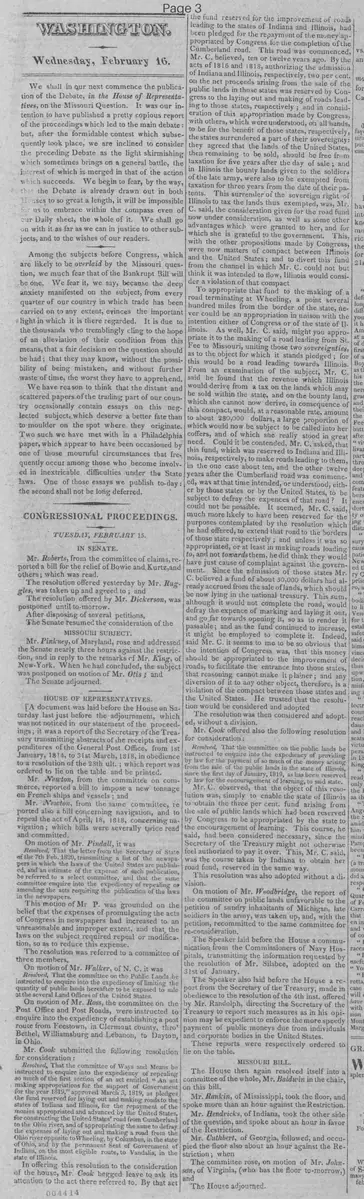
Wednesday, February 16.
We shall in our next commence the publication of the Debate, in the House of Representatives, on the Missouri Question. It was our intention to have published a pretty copious report of the proceedings which led to the main debate: but, after the formidable contest which subsequently took place, we are inclined to consider the preceding Debate as the light skirmishing which sometimes brings on a general battle, the interest of which is merged in that of the action which succeeds. We begin to fear, by the way, that the Debate is already drawn out in both Houses to so great a length, it will be impossible for us to embrace within the compass even of our Daily sheet, the whole of it. We shall go on with it as far as we can in justice to other subjects, and to the wishes of our readers.
Among the subjects before Congress, which are likely to be overlaid by the Missouri question, we much fear that of the Bankrupt Bill will be one. We fear it, we say, because the deep anxiety manifested on the subject, from every quarter of our country in which trade has been carried on to any extent, evinces the important light in which it is there regarded. It is due to the thousands who tremblingly cling to the hope of an alleviation of their condition from this means, that a fair decision on the question should be had; that they may know, without the possibility of being mistaken, and without further waste of time, the worst they have to apprehend.
We have reason to think that the distant and scattered papers of the trading part of our country occasionally contain essays on this neglected subject, which deserve a better fate than to moulder on the spot where they originate. Two such we have met with in a Philadelphia paper, which appear to have been occasioned by one of those mournful circumstances that frequently occur among those who become involved in inextricable difficulties under the State laws. One of those essays we publish to-day: the second shall not be long deferred.
CONGRESSIONAL PROCEEDINGS.
TUESDAY, FEBRUARY 15.
IN SENATE.
Mr. Roberts, from the committee of claims, reported a bill for the relief of Bowie and Kurtz, and others; which was read.
The resolution offered yesterday by Mr. Ruggles, was taken up and agreed to; and
The resolution offered by Mr. Dickerson, was postponed until to-morrow.
After disposing of several petitions,
The Senate resumed the consideration of the
MISSOURI SUBJECT.
Mr. Pinkney, of Maryland, rose and addressed the Senate nearly three hours against the restriction, and in reply to the remarks of Mr. King, of New-York. When he had concluded, the subject was postponed on motion of Mr. Otis; and
The Senate adjourned.
HOUSE OF REPRESENTATIVES.
A document was laid before the House on Saturday last just before the adjournment, which was not noticed in our statement of the proceedings; it was a report of the Secretary of the Treasury transmitting abstracts of the receipts and expenditures of the General Post Office, from 1st January, 1814, to 31st March, 1818, in obedience to a resolution of the 28th ult.; which report was ordered to lie on the table and be printed.
Mr. Newton, from the committee on commerce, reported a bill to impose a new tonnage on French ships and vessels; and
Mr. Newton, from the same committee, reported also a bill concerning navigation, and to repeal the act of April, 18, 1818, concerning navigation; which bills were severally twice read and committed.
On motion of Mr. Pindall. it was
Resolved, That the letter from the Secretary of State of the 7th Feb. 1820, transmitting a list of the newspapers in which the laws of the United States are published, and an estimate of the expense of such publication.
be referred to a select committee, and that the same committee enquire into the expediency of repealing or amending the acts requiring the publication of the laws in the newspapers.
This motion of Mr. P. was grounded on the belief that the expenses of promulgating the acts of Congress in newspapers had increased to an unreasonable and improper extent, and that the laws on the subject required repeal or modification, so as to reduce this expense.
The resolution was referred to a committee of three members,
On motion of Mr. Walker, of N. C. it was
Resolved, That the committee on the Public Lands be instructed to enquire into the expediency of limiting the quantity of public lands hereafter to be exposed to sale at the several Land Offices of the United States.
On motion of Mr. Ross, the committee on the Post Office and Post Roads, were instructed to enquire into the expediency of establishing a post route from Feestown, in Clermont county, thro' Bethel, Williamsburg and Lebanon, to Dayton, in Ohio.
Mr. Cook submitted the following resolution for consideration :
Resolved, That the committee of Ways and Means be instructed to enquire into the expediency of repealing so much of the first section of an act entitled "An act making appropriations for the support of Government for the year 1819," approved March 3, 1819, as pledges the fund reserved for laying out and making roads to the states of Indiana and Illinois, for the repayment of the monies appropriated and advanced by the United States, for constructing the United States' road from Cumberland to the Ohio river, and of appropriating the same to defray the expenses of laying out and making a road from the Ohio river opposite to Wheeling, by Columbus, in the state of Ohio, and by the permanent Seat of Government of Indiana, on the most eligible route, to Vandalia, in the state of Illinois.
In offering this resolution to the consideration of the house, Mr. Cook begged leave to ask its attention to the act there referred to. By that act the fund reserved for the improvement of roads leading to the states of Indiana and Illinois, had been pledged for the repayment of the money appropriated by Congress for the completion of the Cumberland road. "This road was commenced,
Mr. C. believed, ten or twelve years ago. By the acts of 1816 and 1818, authorizing the admission of Indiana and Illinois, respectively, two per cent. on the net proceeds arising from the sale of the public lands in those states was reserved by Congress to the laying out and making of roads leading to those states, respectively ; and in consideration of this appropriation made by Congress, with others, which were understood, on all hands, to be for the benefit of those states, respectively, the states surrendered a part of their sovereignty: they agreed that the lands of the United States, then remaining to be sold, should be free from taxation for five years after the day of sale; and in Illinois the bounty lands given to the soldiers of the late army, were also to be exempted from taxation for three years from the date of their patents. This surrender of the sovereign right of Illinois to tax the lands thus exempted, was, Mr. C. said, the consideration given for the road fund now under consideration, as well as some other advantages which were granted to her, and for which she is grateful to the government. This, with the other propositions made by Congress, were now matters of compact between Illinois and the United States: and to divert this fund from the channel in which Mr. C. could not but think it was intended to flow, Illinois would consider a violation of that compact
To appropriate that fund to the making of a road terminating at Wheeling, a point several hundred miles from the border of the state, never could be an appropriation in unison with the intention either of Congress or of the state of Illinois. As well, Mr. C. said, might you appropriate it to the making of a road leading from St. Fee to Missouri, uniting those two sovereignties, as to the object for which it stands pledged; for this would be a road leading towards Illinois.
From an examination of the subject, Mr. C. said he found that the revenue which Illinois would derive from a tax on the lands which may be sold within the state, and on the bounty land, which she cannot now derive, in consequence of this compact, would, at a reasonable rate, amount to about 280,000 dollars, a large proportion of which would now be subject to be called into her coffers, and of which she really stood in great need. Could it be contended, Mr. C. asked, that this fund, which was reserved to Indiana and Illinois, respectively, to make roads leading to them, in the one case about ten, and the other twelve years after the Cumberland road was commenced, was at that time intended, or understood, either by those states or by the United States, to be subject to defray the expences of that road? It could not be possible. It seemed, Mr. C. said, much more likely to have been reserved for the purposes contemplated by the resolution which he had offered, to extend that road to the borders of those state respectively ; and unless it was so appropriated, or at least in making roads leading to, and not towards them, he did think they would have just cause of complaint against the government. Since the admission of those states Mr. C. believed a fund of about 50,000 dollars had already accrued from the sale of lands, which should be now lying in the national treasury. This sum, although it would not complete the road, would defray the expence of marking and laying it out, and go far towards opening it, so as to render it passable; and as the fund continued to increase, it might be employed to complete it. Indeed, said Mr. C. it seems to me to be so obvious that the intention of Congress was, that this money should be appropriated to the improvement of roads, to facilitate the entrance into those states, that reasoning cannot make it plainer; and any diversion of it to any other object, therefore, is a violation of the compact between those states and the United States. He trusted that the resolution would be considered and adopted
The resolution was then considered and adopted, without a division.
Mr. Cook offered also the following resolution for consideration:
Resolved, That the committee on the public lands be instructed to enquire into the expediency of providing by law for the payment of so much of the money arising from the sale of the public lands in the state of Illinois, since the first day of January, 1819, as has been reserved by law for the encouragement of learning, to said state.
Mr. C. observed, that the object of this resolution was, simply to enable the state of Illinois to obtain the three per cent. fund arising from the sale of public lands which had been reserved by Congress to be appropriated by the state to the encouragement of learning. This course, he said, had been considered necessary, since the Secretary of the Treasury might not otherwise feel authorized to pay it over. This, Mr. C. said, was the course taken by Indiana to obtain her road fund, reserved in the same way.
This resolution was also adopted without a division.
On motion of Mr. Woodbridge, the report of the committee on public lands unfavorable to the petition of sundry inhabitants of Michigan, late soldiers in the army, was taken up, and, with the petition, recommitted to the same committee for re-consideration.
The Speaker laid before the House a communication from the Commissioners of Navy Hospitals, transmitting the information requested by the resolution of Mr. Silsbee, adopted on the 31st of January.
The Speaker also laid before the House a report from the Secretary of the Treasury, made in obedience to the resolution of the 4th inst. offered by Mr. Randolph, directing the Secretary of the Treasury to report such measures as in his opinion may be expedient to enforce the more speedy payment of public moneys due from individuals and corporate bodies in the United States.
These reports were respectively ordered to lie on the table.
MISSOURI BILL.
The House then again resolved itself into a committee of the whole, Mr. Baldwin in the chair, on this bill.
Mr. Rankin, of Mississippi, took the floor, and spoke more than an hour against the Restriction.
Mr. Hendricks, of Indiana, took the other side of the question, and spoke about an hour in favor of the Restriction.
Mr. Cuthbert, of Georgia, followed, and occupied the floor also about an hour against the Restriction: when
The committee rose, on motion of Mr. Johnson, of Virginia, (who has the floor to-morrow,) and
What sub-type of article is it?
What keywords are associated?
What entities or persons were involved?
Where did it happen?
Domestic News Details
Primary Location
Washington
Event Date
Tuesday, February 15
Key Persons
Outcome
resolutions adopted without division; bills reported and committed; missouri subject postponed; speeches against and for restriction; reports ordered to lie on table.
Event Details
Congressional proceedings in Senate and House including reports on bills for relief, tonnage, navigation; resolutions on publication expenses, public lands sales, post routes, road funds for Indiana and Illinois, education fund for Illinois; debate on Missouri Bill with speeches by Pinkney, Rankin, Hendricks, Cuthbert against restriction.