Thank you for visiting SNEWPapers!
Sign up free
The Atlanta Inquirer
Atlanta, Fulton County, Georgia
What is this article about?
Inquirer report on 1960 Rome Olympics: US basketball team dominates round-robin finals undefeated, led by Oscar Robertson and Jerry Lucas. Dramatic broad jump final sees Ralph Boston set Olympic record, Bo Roberson secures silver with comeback jump. Reflections on US track team's unexpected performance despite strong roster.
Clipping
OCR Quality
Full Text
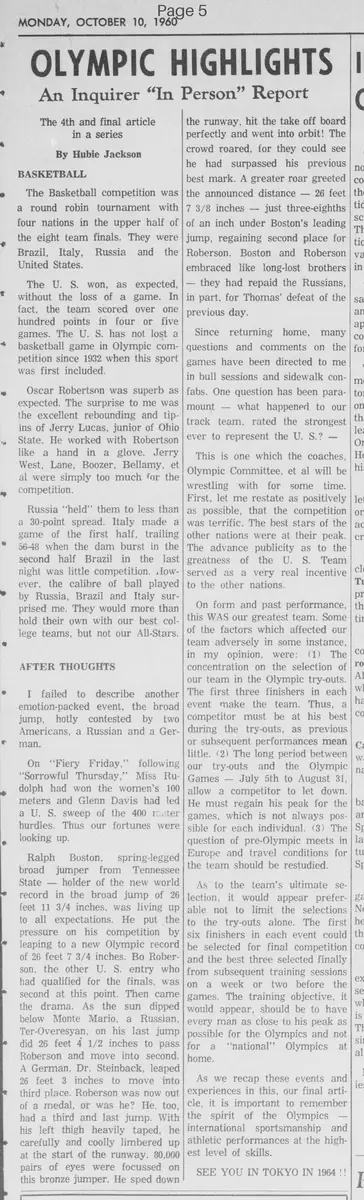
OLYMPIC HIGHLIGHTS
An Inquirer "In Person" Report
The 4th and final article in a series
By Hubie Jackson
BASKETBALL
The Basketball competition was a round robin tournament with four nations in the upper half of the eight team finals. They were Brazil, Italy, Russia and the United States.
The U. S. won, as expected, without the loss of a game. In fact, the team scored over one hundred points in four or five games. The U. S. has not lost a basketball game in Olympic competition since 1932 when this sport was first included.
Oscar Robertson was superb as expected. The surprise to me was the excellent rebounding and tip-ins of Jerry Lucas, junior of Ohio State. He worked with Robertson like a hand in a glove. Jerry West, Lane, Boozer, Bellamy, et al were simply too much for the competition.
Russia "held" them to less than a 30-point spread. Italy made a game of the first half, trailing 56-48 when the dam burst in the second half. Brazil in the last night was little competition. However, the calibre of ball played by Russia, Brazil and Italy surprised me. They would more than hold their own with our best college teams, but not our All-Stars.
AFTER THOUGHTS
I failed to describe another emotion-packed event, the broad jump, hotly contested by two Americans, a Russian and a German.
On "Fiery Friday," following "Sorrowful Thursday," Miss Rudolph had won the women's 100 meters and Glenn Davis had led a U. S. sweep of the 400 meter hurdles. Thus our fortunes were looking up.
Ralph Boston, spring-legged broad jumper from Tennessee State - holder of the new world record in the broad jump of 26 feet 11 3/4 inches, was living up to all expectations. He put the pressure on his competition by leaping to a new Olympic record of 26 feet 7 3/4 inches. Bo Roberson, the other U. S. entry who had qualified for the finals, was second at this point. Then came the drama. As the sun dipped below Monte Mario, a Russian, Ter-Ovanesyan, on his last jump did 26 feet 4 1/2 inches to pass Roberson and move into second. A German, Dr. Steinback, leaped 26 feet 3 inches to move into third place. Roberson was now out of a medal, or was he? He, too, had a third and last jump. With his left thigh heavily taped, he carefully and coolly limbered up at the start of the runway. 80,000 pairs of eyes were focussed on this bronze jumper. He sped down the runway, hit the take off board perfectly and went into orbit! The crowd roared, for they could see he had surpassed his previous best mark. A greater roar greeted the announced distance - 26 feet 7 3/8 inches - just three-eighths of an inch under Boston's leading jump, regaining second place for Roberson. Boston and Roberson embraced like long-lost brothers — they had repaid the Russians, in part, for Thomas' defeat of the previous day.
Since returning home, many questions and comments on the games have been directed to me in bull sessions and sidewalk confabs. One question has been paramount - what happened to our track team, rated the strongest ever to represent the U. S.? This is one which the coaches, Olympic Committee, et al will be wrestling with for some time.
First, let me restate as positively as possible, that the competition was terrific. The best stars of the other nations were at their peak. The advance publicity as to the greatness of the U. S. Team served as a very real incentive to the other nations.
On form and past performance, this WAS our greatest team. Some of the factors which affected our team adversely in some instance in my opinion, were: (1) The concentration on the selection of our team in the Olympic try-outs. The first three finishers in each event make the team. Thus, a competitor must be at his best during the try-outs, as previous or subsequent performances mean little. (2) The long period between our try-outs and the Olympic Games - July 5th to August 31 allow a competitor to let down. He must regain his peak for the games, which is not always possible for each individual. (3) The question of pre-Olympic meets in Europe and travel conditions for the team should be restudied.
As to the team's ultimate selection, it would appear preferable not to limit the selections to the try-outs alone. The first six finishers in each event could be selected for final competition and the best three selected finally from subsequent training sessions on a week or two before the games. The training objective, it would appear, should be to have every man as close to his peak as possible for the Olympics and not for a "national" Olympics at home.
As we recap these events and experiences in this, our final article, it is important to remember the spirit of the Olympics international sportsmanship and athletic performances at the highest level of skills.
SEE YOU IN TOKYO IN 1964!
What sub-type of article is it?
What themes does it cover?
What keywords are associated?
What entities or persons were involved?
Where did it happen?
Story Details
Key Persons
Location
Rome, Italy
Event Date
1960
Story Details
US basketball team wins gold undefeated in round-robin finals against Brazil, Italy, Russia; Oscar Robertson excels, Jerry Lucas surprises with rebounding. In broad jump, Ralph Boston sets Olympic record at 26' 7 3/4"; Bo Roberson regains silver with 26' 7 3/8" on final jump despite injury, edging out Russian and German competitors. Reflections on US track team's underperformance despite strong roster, suggesting improvements in selection and training.