Thank you for visiting SNEWPapers!
Sign up free
Norfolk Gazette And Publick Ledger
Norfolk, Virginia
What is this article about?
In the U.S. Senate impeachment trial of Judge Samuel Chase on February 22, Mr. Key defends against charges of misconduct in the Callender sedition trial, arguing Chase's interruptions, expressions, and actions were justified and not criminal.
Clipping
OCR Quality
Full Text
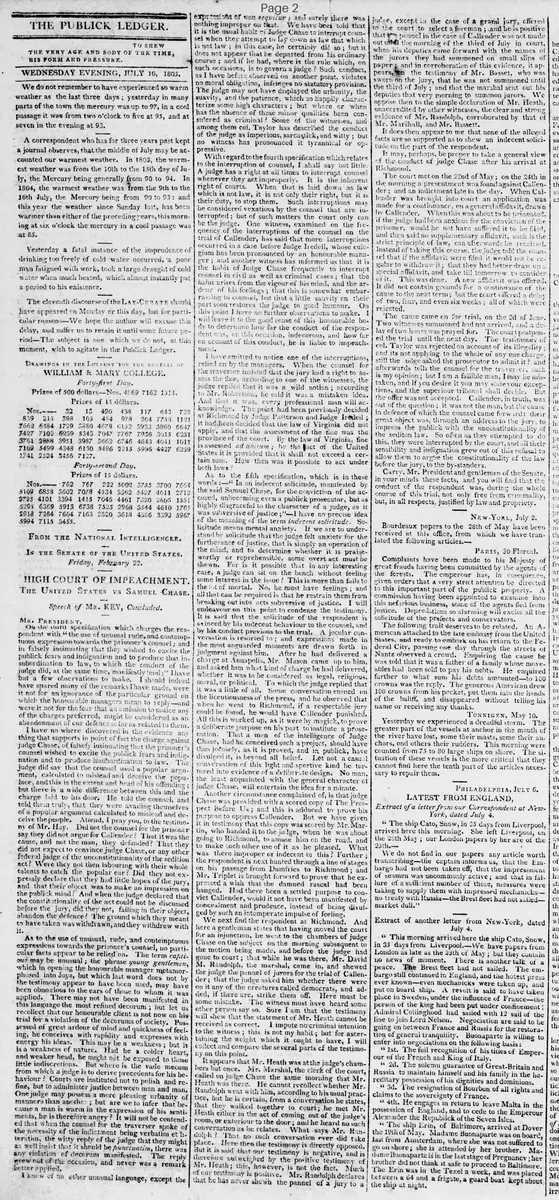
In the Senate of the United States.
Friday, February 22.
HIGH COURT OF IMPEACHMENT.
The United States vs. Samuel Chase.
Speech of MR. KEY, Concluded.
MR. PRESIDENT,
On the third specification which charges the respondent with "the use of unusual rude, and contemptuous expression towards the prisoner's counsel; and in falsely insinuating that they wished to excite the publick fears and indignation and to produce that insubordination to law, to which the conduct of the judge did, at the same time, manifestly tend;" I have but a few observations to make. I should indeed have spared many of the remarks I have made, were it not for an ignorance of the particular ground on which the honourable managers mean to reply—and were it not for the fear that an omission to notice any of the charges preferred, might be considered as an abandonment of our defence so far as related to them.
I have no where discovered in the evidence any thing that supports in point of fact the charge against judge Chase, of falsely insinuating that the prisoner's counsel wished to excite the publick fears and indignation and to produce insubordination to law. The judge did say that the counsel used a popular argument, calculated to mislead and deceive the populace, and this is the extent and head of his offending; but there is a wide difference between this and the charge laid to his door. He told the counsel, and told them truly, that they were availing themselves of a popular argument calculated to mislead and deceive the people. Attend, I pray you, to the testimony of Mr. Hay. Did not the counsel for the prisoner say they did not argue for Callender? That it was the cause, and not the man, they defended? That they did not expect to convince judge Chase, or any other federal judge of the unconstitutionality of the sedition act? Were they not then labouring with their whole talents to catch the popular ear? Did they not expressly declare that they had little hopes of the jury, and that their object was to make an impression on the publick mind? And when the judge declared that the constitutionality of the act could not be discussed before the jury, did they not, failing in their object, abandon the defence? The ground which they meant to have taken was withdrawn, and they withdrew with it.
As to the use of unusual, rude, and contemptuous expressions towards the prisoner's counsel, no particular facts appear to be relied on. The term factious may be unusual; the phrase young gentlemen, which in opening the honourable manager metamorphosed into boys, but which last word does not by the testimony appear to have been used, may have been obnoxious to the ears of those to whom it was applied. There may not have been manifested in this language the most refined decorum; but let us recollect that our honourable client is not now on his trial for a violation of the decorums of society. Possessed of great ardour of mind and quickness of feeling, he conceives with rapidity and expresses with energy his ideas. This may be a weakness; but it is a weakness of nature. Had he a colder heart, and weaker head, he might not be exposed to those little indiscretions. But where is the vade mecum from which a judge is to derive precedents for his behaviour? Courts are instituted not to polish and refine, but to administer justice between man and man. One judge may possess a more pleasing urbanity of manners than another; but are we to infer that because a man is warm in the expression of his sentiments, he is therefore angry? It will not be contended that when the counsel for the traverser spoke of the necessity of the indictment being verbatim et literatim, the witty reply of the judge that they might as well insist that it should be punctuatim, there was any violation of decorum manifested. The reply grew out of the occasion, and never was a remark better applied.
I know of no other unusual language; except the expressions of non sequitur: and surely there was nothing improper on that. We have been told that it is the usual habit of Judge Chase to interrupt counsel when they attempt to lay down as law that which is not law; in this case, he certainly did so; but it does not appear that he departed from his ordinary course; and if he had, where is the rule which, on such occasions, is to govern a judge? Such conduct, as I have before observed on another point, violates no moral obligation, infringes no statutory provision. The judge may not have displayed the urbanity, the suavity, and the patience, which so happily characterize some high characters; but where or when has the absence of these minor qualities been considered as criminal? Some of the witnesses, and among them col. Taylor has described the conduct of the judge as imperious, sarcastick, and witty; but no witness has pronounced it tyrannical or oppressive.
With regard to the fourth specification which relates to the interruption of counsel, I shall say but little. A judge has a right at all times to interrupt counsel whenever they act improperly. It is the inherent right of courts. When that is laid down as law which is not law, it is not only their right, but it is their duty, to stop them. Such interruptions may be considered vexatious by the counsel that are interrupted: but of such matters the court only can be the judge. One witness examined on the frequency of the interruptions of the counsel on the trial of Callender, has said that more interruptions occurred in a case before Judge Iredell, whose eulogium has been pronounced by an honourable manager; and another witness has informed us that it is the habit of Judge Chase frequently to interrupt counsel in civil as well as criminal cases; that the habit arises from the vigour of his mind, and the ardour of his feelings; that this is somewhat embarrassing to counsel, but that a little suavity on their part soon restores the judge to good humour. On this point I have no further observations to make. I will leave it to the good sense of this honourable body to determine how far the conduct of the respondent was, on this occasion, indecorous, and how far on account of this conduct, he is liable to impeachment.
I have omitted to notice one of the interruptions, relied on by the managers. When the counsel for the traverser insisted that the jury had a right to assess the fine, according to one of the witnesses, the judge replied that it was a wild notion; according to Mr. Robertson, he said it was a mistaken idea. And that it was, every professional man will acknowledge. The point had been previously decided at Richmond by Judge Patterson and Judge Iredell; it had been decided that the law of Virginia did not apply, and that the assessment of the fine was the province of the court. By the law of Virginia, fine is assessed ad libitum; by the act of the United States it is provided that it shall not exceed a certain sum. How then was it possible to act under both laws?
As to the fifth specification, which is in these words: "In an indecent solicitude, manifested by the said Samuel Chase, for the conviction of the accused, unbecoming even a publick prosecutor, but as highly disgraceful to the character of a judge, as it was subversive of justice;"—I have no precise idea of the meaning of the term indecent solicitude. Solicitude means mental anxiety. If we are to understand by solicitude that the judge felt anxiety for the furtherance of justice, that is simply an operation of the mind, and to determine whether it is praiseworthy or reprehensible, some overt act must be shewn. For is it possible that in any interesting case, a judge can sit on the bench without feeling some interest in the issue? This is more than falls to the lot of mortal. No, he must have feelings; and all that can be required is that he restrain them from breaking out into acts subversive of justice. I will endeavour on this point to condense the testimony.
It is said that the solicitude of the respondent is evinced by his indecent behaviour to the counsel, and by his conduct previous to the trial. A jocular conversation is resorted to; and expressions made in the most unguarded moments are drawn forth in judgment against him. After he had delivered a charge at Annapolis, Mr. Mason came up to him, and asked him what kind of charge he had delivered, whether it was to be considered as legal, religious, moral, or political. To which the judge replied that it was a little of all. Some conversation ensued on the licentiousness of the press, and he observed that when he went to Richmond, if a respectable jury could be found, he would have Callender punished. All this is worked up, as it were by magick, to prove a deliberate purpose on his part to institute a prosecution. That a man of the intelligence of Judge Chase, had he conceived such a project, should have thus jocosely, as it is proved, and in publick, have divulged it, is beyond all belief. Let not a casual conversation of this light and sportive kind be tortured into evidence of a deliberate design. No man, the least acquainted with the general character of judge Chase, will entertain the idea for a minute.
Another circumstance complained of, is that judge Chase was provided with a scored copy of The Prospect Before Us; and this is adduced to prove his purpose to oppress Callender. But we have given it in testimony that this copy was scored by Mr. Martin, who handed it to the judge, when he was about going to Richmond, to amuse him on the road, and to make such other use of it as he pleased. What was there improper or indecent in this? Further; the respondent is next hunted through a line of stages on his passage from Dumfries to Richmond; and Mr. Triplet is brought forward to prove that he expressed a wish that the damned rascal had been hanged. Had there been a settled purpose to convict Callender, would it not have been manifested by concealment and prudence, instead of being divulged by such an intemperate impulse of feeling.
We next find the respondent at Richmond. And here a gentleman states that having moved the court for an injunction, he went to the chambers of judge Chase on the subject on the morning subsequent to the motion being made, and before the judge had gone to court; that while he was there, Mr. David M. Randolph, the marshal, came in, and shewed the judge the pannel of jurors for the trial of Callender; that the judge asked him whether there were on it any of the creatures called democrats, and added, if there are, strike them off. Here must be some mistake. The witness must have heard some other person say so. Sure I am that the testimony will shew that the statement of Mr. Heath cannot be received as correct. I impute no criminal intention to the witness; this is not my habit; but for ascertaining the weight which it ought to have, I will collect and compare the several parts of the testimony on this point.
It appears that Mr. Heath was at the judge's chambers but once. Mr. Marshal, the clerk of the court, called on judge Chase the same morning that Mr. Heath was there. He cannot recollect whether Mr. Randolph went with him, according to his usual practice, but he is certain, from a conversation he states, that they walked together to court; he met Mr. Heath either in the act of coming out of the judge's room, or exterior to the door; and he heard no such conversation as he relates. What says Mr. Randolph? That no such conversation ever did take place. Here then the testimony is directly opposed. But it is said that our testimony is negative, and is therefore outweighed by the positive testimony of Mr. Heath; this, however, is not the fact. Much of our testimony is positive. Mr. Randolph declares that he has never shewn the pannel of a jury to a judge, except in the case of a grand jury, offered to the court to select a foreman; and he is positive that pannel in the case of Callender was not made out till the morning of the third of July in court, when his deputies came forward with the names of the jurors they had summoned on small slips of paper; and in corroboration of this evidence, it appears, on the testimony of Mr. Basset, who was sworn on the jury, that he was not summoned until the third of July; and that the marshal sent out his deputies that very morning to summon jurors. We oppose then to the simple declaration of Mr. Heath, unaccredited by other witnesses, the clear and strong evidence of Mr. Randolph, corroborated by that of Mr. Marshall, and Mr. Bassett.
It does then appear to me that none of the alleged facts are so supported as to shew an indecent solicitude on the part of the respondent.
It may, perhaps, be proper to take a general view of the conduct of judge Chase after his arrival at Richmond.
The court met on the 22nd of May; on the 24th in the morning a presentment was found against Callender; and an indictment late in the day. When Callender was brought into court an application was made for a continuance, on a general affidavit, drawn by Callender. When this was about to be presented, if the judge had been anxious for the conviction of the prisoner, would he not have suffered it to be filed, and then said no supplementary affidavit, such is the strict principle of law, can afterwards be received. Instead of taking this course, the judge told the counsel that if the affidavit were filed it would not be regular to withdraw it; that they had better draw up a special affidavit, and take till tomorrow to consider of it. This was done. A new affidavit was offered, It did not contain grounds for a continuance of the cause to the next term; but the court offered a delay of two, four, and even six weeks; all of which were rejected.
The cause came on for trial, on the 2d of June. Two witnesses summoned had not arrived, and a delay of two hours was prayed for. The court postponed the trial until the next day. The testimony of col. Taylor was rejected on account of its illegality; and its not applying to the whole of any one charge, still the judge asked the prosecutor to admit it? and afterwards tells the counsel for the traverser, such is my opinion; but I am a fallible man, I may be mistaken, and if you desire it you may state your exceptions, and the superior tribunal shall decide. But the offer was not accepted. Callender, in truth, was out of the question; it was not the man, but the cause in defence of which the counsel came forward: their great object was, through an address to the jury, to impress the publick with the unconstitutionality of the sedition law. So often as they attempted to do this, they were interrupted by the court, and all their sensibility and indignation grew out of this refusal to allow them to argue the constitutionality of the law before the jury, to the by-standers.
Carry, Mr. President and gentlemen of the Senate, in your minds these facts, and you will find that the conduct of the respondent was, during the whole course of this trial, not only free from criminality, but, in all respects, justified by law and propriety.
What sub-type of article is it?
What themes does it cover?
What keywords are associated?
What entities or persons were involved?
Where did it happen?
Story Details
Key Persons
Location
Senate Of The United States
Event Date
Friday, February 22
Story Details
MR. KEY concludes his defense speech in the impeachment trial of Judge Samuel Chase, addressing specifications regarding rude expressions toward counsel, interruptions, and indecent solicitude for Callender's conviction. He argues the evidence does not support the charges, emphasizing Chase's conduct was lawful and appropriate during the sedition trial in Richmond.