Thank you for visiting SNEWPapers!
Sign up free
The National Intelligencer And Washington Advertiser
Washington, District Of Columbia
What is this article about?
A Constantinople physician critiques claims in German journals that cowpox vaccination protects against the plague, arguing lack of evidence, citing cases like Professor Valli's infection despite inoculation, and noting failed local experiments that caused smallpox deaths and damaged vaccine's reputation.
Clipping
OCR Quality
Full Text
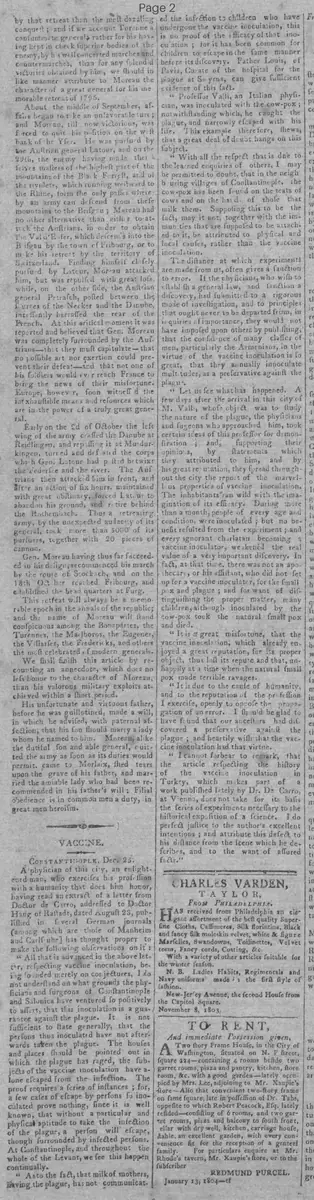
Constantinople, Dec. 25.
A physician of this city, an enlightened man, who exercises his profession with a humanity that does him honor, having read an extract of a letter from Doctor de Curro, addressed to Doctor Haug of Rastadt, dated August 23, published in several German journals (among which are those of Manheim and Carlsruhe) has thought proper to make the following observations on it:
"All that is advanced in the above letter, respecting vaccine inoculation, being founded merely on conjectures, I do not understand on what grounds the physicians and surgeons of Constantinople and Salonica have ventured so positively to assert, that this inoculation is a guarantee against the plague. It is not sufficient to state generally, that the persons thus inoculated have not afterwards taken the plague. The houses and places should be pointed out in which the plague has raged, the subjects of the vaccine inoculation have alone escaped from the infection. The proof requires a series of instances; for, a few cases of escape by persons so inoculated prove nothing, since it is well known, that without a particular and physical aptitude to take the infection of the plague, a person will escape, though surrounded by infected persons. At Constantinople, and throughout the whole of the Levant, we see this happen continually.
"As to the fact, that milk of mothers having the plague, has not communicated the infection to children who have undergone the vaccine inoculation, this is no proof of the efficacy of that inoculation; for it has been common for children to escape in the same manner before its discovery. Father Louis, of Pavia, Curate of the hospital for the plague at Smyrna, can give sufficient evidence of this fact.
"Professor Valli, an Italian physician, was inoculated with the cow-pox; notwithstanding which, he caught the plague, and narrowly escaped with his life. This example therefore, shows, that a great deal of doubt hangs on this subject.
"With all the respect that is due to the learned enquiries of others, I may be permitted to doubt, that in the neighbouring villages of Constantinople, the cow pox has been found on the teats of Cows and on the hands of those that milk them. Supposing this to be the fact, may it not, together with the immunities that are supposed to be attached to it, be attributed to physical and local causes, rather than the vaccine inoculation.
The distance at which experiments are made from us, often gives occasion to error. If the physicians, who wish to establish a general law, and sanction a discovery, had submitted to a rigorous mode of investigation, and to principles that ought never to be departed from, in inquiries of importance, they would not have imposed upon others by publishing, that the confidence of many classes of men, particularly the Armenians, in the virtue of the vaccine inoculation is so great, that they annually inoculate multitudes, as a preservative against the plague.
"Let us see what has happened. A few days after the arrival in this city of M. Valli, whose object was to study the nature of the plague, the physicians and surgeons who approached him, took certain ideas of this professor or demonstration; and supporting their opinions, by statements which they attributed to him, and by his great reputation, they spread throughout the city the report of the marvellous properties of vaccine inoculation. The inhabitants ran wild with the imagination of its efficacy. During more than a month, people of every age and condition, were inoculated; but no benefit resulted from the experiment; and every ignorant charlatan becoming a vaccine inoculator, weakened the real value of a very important discovery. In fact, at that time, there was not an apothecary, or his assistant, who did not set up for a vaccine inoculator, for the small pox and plague; and for want of distinguishing the proper matter, many children, although inoculated by the cow-pox took the natural small pox and died.
"It is a great misfortune, that the vaccine inoculation, which already enjoyed a great reputation, for its proper object, thus lost its repute and that, unhappily at a time when the natural small pox made terrible ravages.
"It is due to the cause of humanity, and to the reputation of the profession I exercise, openly to oppose the propagation of an error. I should be glad to have found that our ancestors had discovered a preservative against the plague; and heartily wish that the vaccine inoculation had that virtue.
"I cannot forbear to remark, that the article respecting the history of the vaccine inoculation in Turkey, which makes part of a work published lately by Dr. De Carro, at Vienna, does not take for its basis the series of experiments necessary to the historical exposition of a science. I do perfect justice to the author's excellent intentions; and attribute this defect to his distance from the scene which he describes, and to the want of assured facts."
What sub-type of article is it?
What keywords are associated?
What entities or persons were involved?
Where did it happen?
Foreign News Details
Primary Location
Constantinople
Event Date
Dec. 25
Key Persons
Outcome
vaccine inoculation experiments failed to protect against plague; improper practices led to many children contracting and dying from natural smallpox; vaccine lost reputation amid smallpox ravages.
Event Details
A local physician publishes observations doubting the efficacy of cowpox vaccination as a preservative against the plague, critiquing published claims from Doctor de Curro's letter and local experiments inspired by Professor Valli's visit, which resulted in widespread but ineffective inoculations and deaths from smallpox.