Thank you for visiting SNEWPapers!
Sign up free
Editorial
October 10, 1846
The Caledonian
Saint Johnsbury, Caledonia County, Vermont
What is this article about?
This editorial mocks Locofoco defenses of the new tariff, claiming it harms businesses despite protections for industries like wool and iron. It cites specific cases of factory shutdowns, job losses, and reduced wool prices in Pennsylvania, New York, and elsewhere, contrasting with the Whig tariff of 1842.
Clipping
OCR Quality
98%
Excellent
Full Text
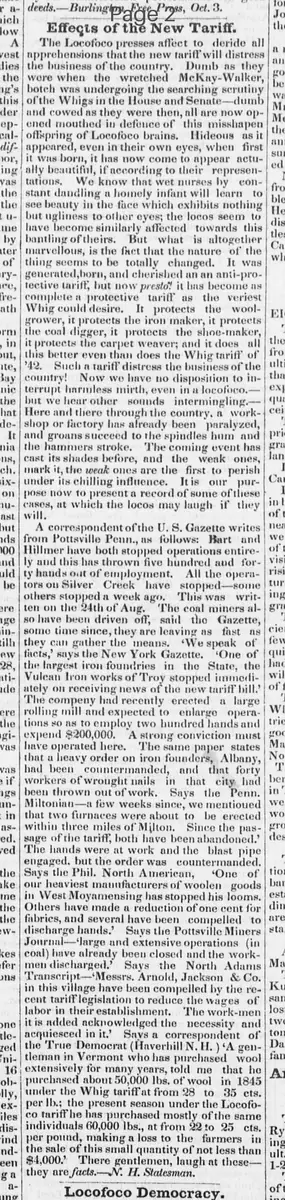
Effects of the New Tariff.
The Locofoco presses affect to deride all apprehensions that the new tariff will distress the business of the country. Dumb as they were when the wretched McKay-Walker botch was undergoing the searching scrutiny of the Whigs in the House and Senate—dumb and cowed as they were then, all are now open mouthed in defence of this misshapen offspring of Locofoco brains. Hideous as it appeared, even in their own eyes, when first it was born, it has now come to appear actually beautiful, if according to their representations. We know that wet nurses by constant dandling a homely infant will learn to see beauty in the face which exhibits nothing but ugliness to other eyes; the locos seem to have become similarly affected towards this bantling of theirs. But what is altogether marvellous, is the fact that the nature of the thing seems to be totally changed. It was generated, born, and cherished as an anti-protective tariff, but now presto! it has become as complete a protective tariff as the veriest Whig could desire. It protects the wool-grower, it protects the iron maker, it protects the coal digger, it protects the shoe-maker, it protects the carpet weaver; and it does all this better even than does the Whig tariff of '42. Such a tariff distress the business of the country! Now we have no disposition to interrupt harmless mirth, even in a locofoco—but we hear other sounds intermingling. Here and there through the country, a work-shop or factory has already been paralyzed, and groans succeed to the spindles hum and the hammers stroke. The coming event has cast its shades before, and the weak ones mark it, the weak ones are the first to perish under its chilling influence. It is our purpose now to present a record of some of these cases, at which the locos may laugh if they will.
A correspondent of the U. S. Gazette writes from Pottsville Penn., as follows: Bart and Hillmer have both stopped operations entirely and this has thrown five hundred and forty hands out of employment. All the operators on Silver Creek have stopped—some others stopped a week ago. This was written on the 24th of Aug. The coal miners also have been driven off, said the Gazette, some time since, they are leaving as fast as they can gather the means. We speak of facts, says the New York Gazette. One of the largest iron foundries in the State, the Vulcan Iron works of Troy stopped immediately on receiving news of the new tariff bill. The company had recently erected a large rolling mill and expected to enlarge operations so as to employ two hundred hands and expend $200,000. A strong conviction must have operated here. The same paper states that a heavy order on iron founders, Albany, had been countermanded, and that forty workers of wrought nails in that city had been thrown out of work. Says the Penn. Miltonian—a few weeks since, we mentioned that two furnaces were about to be erected within three miles of Milton. Since the passage of the tariff, both have been abandoned. The hands were at work and the blast pipe engaged, but the order was countermanded. Says the Phil. North American. One of our heaviest manufacturers of woolen goods in West Moyamensing has stopped his looms. Others have made a reduction of one cent for fabrics, and several have been compelled to discharge hands. Says the Pottsville Miners Journal—Large and extensive operations (in coal) have already been closed and the workmen discharged. Says the North Adams Transcript—Messrs. Arnold, Jackson & Co. in this village have been compelled by the recent tariff legislation to reduce the wages of labor in their establishment. The workmen it is added acknowledged the necessity and acquiesced in it. Says a correspondent of the True Democrat (Haverhill N.H.) 'A gentleman in Vermont who has purchased wool extensively for many years, told me that he purchased about 50,000 lbs. of wool in 1845 under the Whig tariff at from 28 to 35 cts. per lb.; the present season under the Locofoco tariff he has purchased mostly of the same individuals 60,000 lbs., at from 22 to 25 cts. per pound, making a loss to the farmers in the sale of this small quantity of not less than $4,000.' There gentlemen, laugh at these—they are facts.—N. H. Statesman.
The Locofoco presses affect to deride all apprehensions that the new tariff will distress the business of the country. Dumb as they were when the wretched McKay-Walker botch was undergoing the searching scrutiny of the Whigs in the House and Senate—dumb and cowed as they were then, all are now open mouthed in defence of this misshapen offspring of Locofoco brains. Hideous as it appeared, even in their own eyes, when first it was born, it has now come to appear actually beautiful, if according to their representations. We know that wet nurses by constant dandling a homely infant will learn to see beauty in the face which exhibits nothing but ugliness to other eyes; the locos seem to have become similarly affected towards this bantling of theirs. But what is altogether marvellous, is the fact that the nature of the thing seems to be totally changed. It was generated, born, and cherished as an anti-protective tariff, but now presto! it has become as complete a protective tariff as the veriest Whig could desire. It protects the wool-grower, it protects the iron maker, it protects the coal digger, it protects the shoe-maker, it protects the carpet weaver; and it does all this better even than does the Whig tariff of '42. Such a tariff distress the business of the country! Now we have no disposition to interrupt harmless mirth, even in a locofoco—but we hear other sounds intermingling. Here and there through the country, a work-shop or factory has already been paralyzed, and groans succeed to the spindles hum and the hammers stroke. The coming event has cast its shades before, and the weak ones mark it, the weak ones are the first to perish under its chilling influence. It is our purpose now to present a record of some of these cases, at which the locos may laugh if they will.
A correspondent of the U. S. Gazette writes from Pottsville Penn., as follows: Bart and Hillmer have both stopped operations entirely and this has thrown five hundred and forty hands out of employment. All the operators on Silver Creek have stopped—some others stopped a week ago. This was written on the 24th of Aug. The coal miners also have been driven off, said the Gazette, some time since, they are leaving as fast as they can gather the means. We speak of facts, says the New York Gazette. One of the largest iron foundries in the State, the Vulcan Iron works of Troy stopped immediately on receiving news of the new tariff bill. The company had recently erected a large rolling mill and expected to enlarge operations so as to employ two hundred hands and expend $200,000. A strong conviction must have operated here. The same paper states that a heavy order on iron founders, Albany, had been countermanded, and that forty workers of wrought nails in that city had been thrown out of work. Says the Penn. Miltonian—a few weeks since, we mentioned that two furnaces were about to be erected within three miles of Milton. Since the passage of the tariff, both have been abandoned. The hands were at work and the blast pipe engaged, but the order was countermanded. Says the Phil. North American. One of our heaviest manufacturers of woolen goods in West Moyamensing has stopped his looms. Others have made a reduction of one cent for fabrics, and several have been compelled to discharge hands. Says the Pottsville Miners Journal—Large and extensive operations (in coal) have already been closed and the workmen discharged. Says the North Adams Transcript—Messrs. Arnold, Jackson & Co. in this village have been compelled by the recent tariff legislation to reduce the wages of labor in their establishment. The workmen it is added acknowledged the necessity and acquiesced in it. Says a correspondent of the True Democrat (Haverhill N.H.) 'A gentleman in Vermont who has purchased wool extensively for many years, told me that he purchased about 50,000 lbs. of wool in 1845 under the Whig tariff at from 28 to 35 cts. per lb.; the present season under the Locofoco tariff he has purchased mostly of the same individuals 60,000 lbs., at from 22 to 25 cts. per pound, making a loss to the farmers in the sale of this small quantity of not less than $4,000.' There gentlemen, laugh at these—they are facts.—N. H. Statesman.
What sub-type of article is it?
Economic Policy
Partisan Politics
What keywords are associated?
New Tariff
Locofoco Tariff
Protective Tariff
Business Distress
Factory Closures
Job Losses
Wool Prices
Iron Industry
Coal Operations
What entities or persons were involved?
Locofocos
Whigs
Mckay Walker
U. S. Gazette
Vulcan Iron Works
Penn. Miltonian
Phil. North American
Pottsville Miners Journal
North Adams Transcript
True Democrat
Editorial Details
Primary Topic
Negative Effects Of The New Locofoco Tariff On Business And Employment
Stance / Tone
Strongly Critical Of Locofoco Tariff, Supportive Of Whig Protective Measures
Key Figures
Locofocos
Whigs
Mckay Walker
U. S. Gazette
Vulcan Iron Works
Penn. Miltonian
Phil. North American
Pottsville Miners Journal
North Adams Transcript
True Democrat
Key Arguments
Locofoco Presses Deride Apprehensions Of Tariff Distress
Tariff Originally Anti Protective But Now Claimed Protective
Examples Of Factories Stopping Operations And Discharging Workers
Coal Miners Leaving Due To Tariff
Iron Foundries Halting Expansion
Wool Prices Lower Under New Tariff, Loss To Farmers