Thank you for visiting SNEWPapers!
Sign up free
Story
May 14, 1917
The Evening Herald
Klamath Falls, Klamath County, Oregon
What is this article about?
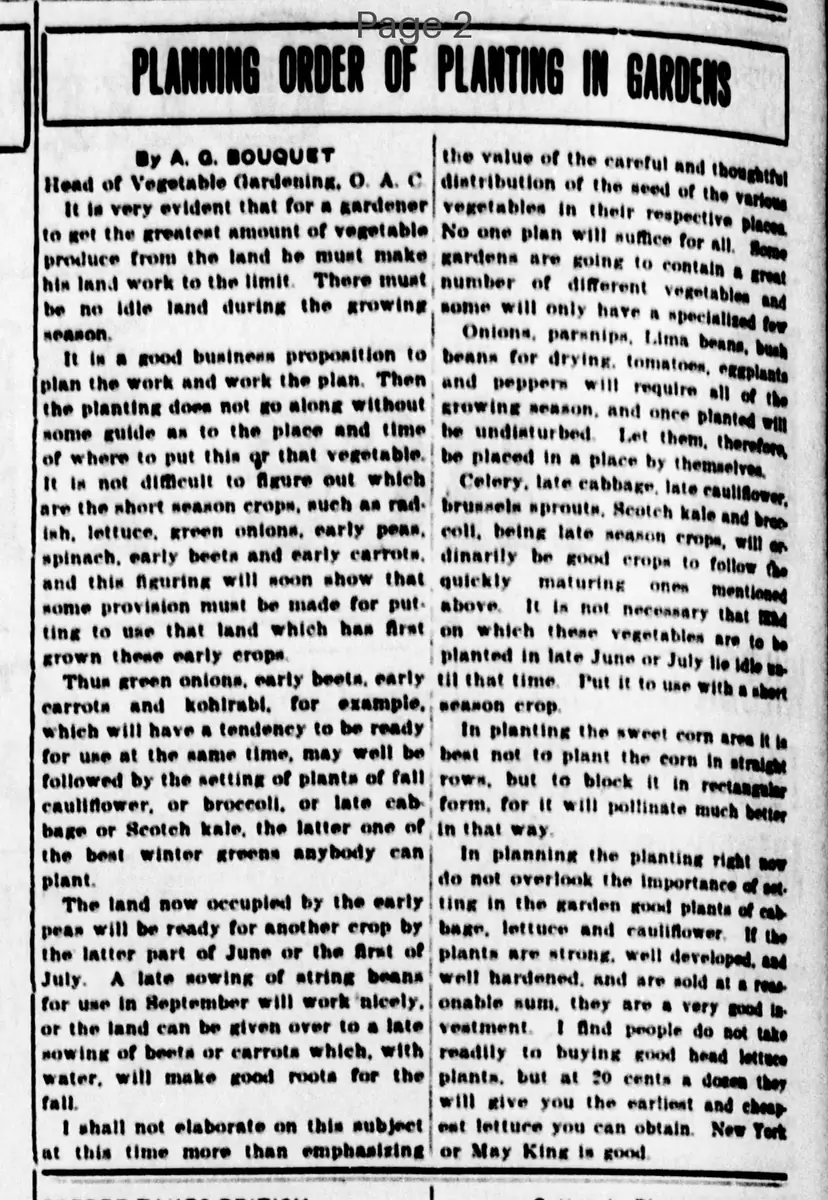
Article by A. Q. Bouquet on planning vegetable garden planting order for maximum yield, emphasizing succession cropping with early and late season vegetables like radishes, peas, followed by broccoli, cabbage, and tips on corn planting and buying transplants.
Merged-components note: Title and continuing text form a single coherent gardening advice story.
Clipping
OCR Quality
95%
Excellent
Full Text
PLANNING
ORDER OF PLANTING
GARDENS
By A. Q. Bouquet
Head of Vegetable Gardening, O. A. C.
It is very evident that for a gardener to get the greatest amount of vegetable produce from the land he must make his land work to the limit. There must be no idle land during the growing season.
It is a good business proposition to plan the work and work the plan. Then the planting does not go along without some guide as to the place and time of where to put this or that vegetable.
It is not difficult to figure out which are the short season crops, such as radish, lettuce, green onions, early peas, spinach, early beets and early carrots, and this figuring will soon show that some provision must be made for putting to use that land which has first grown these early crops.
Thus green onions, early beets, early carrots and kohlrabi, for example, which will have a tendency to be ready for use at the same time, may well be followed by the setting of plants of fall cauliflower, or broccoli, or late cabbage or Scotch kale, the latter one of the best winter greens anybody can plant.
The land now occupied by the early peas will be ready for another crop by the latter part of June or the first of July. A late sowing of string beans starting for use in September will work nicely, or the land can be given over to a late sowing of beets or carrots which, with water, will make good roots for the fall.
I shall not elaborate on this subject at this time more than emphasizing the value of the careful and thoughtful distribution of the seed of the various vegetables in their respective places.
No one plan will suffice for all. Some gardens are going to contain a great number of different vegetables and some will only have a specialized for onions, parsnips, lima beans, bush beans for drying, tomatoes, eggplants and peppers will require all of the growing season, and once planted will be undisturbed. Let them, therefore, be placed in a place by themselves.
Celery, late cabbage, late cauliflower, brussels sprouts, Scotch kale and broccoli, being late season crops, will ordinarily be good crops to follow the quickly maturing ones mentioned above.
It is not necessary that the land on which these vegetables are to be planted in late June or July be idle no til that time. Put it to use with a short season crop.
In planting the sweet corn area it is best not to plant the corn in straight rows, but to block it in rectangular form, for it will pollinate much better in that way.
In planning the planting right do not overlook the importance of setting in the garden good plants of cabbage, lettuce and cauliflower. If the plants are strong, well developed, and well hardened, and are sold at a reasonable sum, they are a very good investment. I find people do not take readily to buying good head lettuce plants, but at 20 cents a dozen they will give you the earliest and cheapest head lettuce you can obtain. New York or May King is good.
In planting the sweet corn area it is best not to plant the corn in straight rows, but to block it in rectangular form, for it will pollinate much better in that way.
ORDER OF PLANTING
GARDENS
By A. Q. Bouquet
Head of Vegetable Gardening, O. A. C.
It is very evident that for a gardener to get the greatest amount of vegetable produce from the land he must make his land work to the limit. There must be no idle land during the growing season.
It is a good business proposition to plan the work and work the plan. Then the planting does not go along without some guide as to the place and time of where to put this or that vegetable.
It is not difficult to figure out which are the short season crops, such as radish, lettuce, green onions, early peas, spinach, early beets and early carrots, and this figuring will soon show that some provision must be made for putting to use that land which has first grown these early crops.
Thus green onions, early beets, early carrots and kohlrabi, for example, which will have a tendency to be ready for use at the same time, may well be followed by the setting of plants of fall cauliflower, or broccoli, or late cabbage or Scotch kale, the latter one of the best winter greens anybody can plant.
The land now occupied by the early peas will be ready for another crop by the latter part of June or the first of July. A late sowing of string beans starting for use in September will work nicely, or the land can be given over to a late sowing of beets or carrots which, with water, will make good roots for the fall.
I shall not elaborate on this subject at this time more than emphasizing the value of the careful and thoughtful distribution of the seed of the various vegetables in their respective places.
No one plan will suffice for all. Some gardens are going to contain a great number of different vegetables and some will only have a specialized for onions, parsnips, lima beans, bush beans for drying, tomatoes, eggplants and peppers will require all of the growing season, and once planted will be undisturbed. Let them, therefore, be placed in a place by themselves.
Celery, late cabbage, late cauliflower, brussels sprouts, Scotch kale and broccoli, being late season crops, will ordinarily be good crops to follow the quickly maturing ones mentioned above.
It is not necessary that the land on which these vegetables are to be planted in late June or July be idle no til that time. Put it to use with a short season crop.
In planting the sweet corn area it is best not to plant the corn in straight rows, but to block it in rectangular form, for it will pollinate much better in that way.
In planning the planting right do not overlook the importance of setting in the garden good plants of cabbage, lettuce and cauliflower. If the plants are strong, well developed, and well hardened, and are sold at a reasonable sum, they are a very good investment. I find people do not take readily to buying good head lettuce plants, but at 20 cents a dozen they will give you the earliest and cheapest head lettuce you can obtain. New York or May King is good.
In planting the sweet corn area it is best not to plant the corn in straight rows, but to block it in rectangular form, for it will pollinate much better in that way.
What sub-type of article is it?
Gardening Advice
Agricultural Instruction
What keywords are associated?
Gardening
Planting Order
Vegetables
Succession Cropping
Early Crops
Late Crops
Sweet Corn
What entities or persons were involved?
A. Q. Bouquet
Story Details
Key Persons
A. Q. Bouquet
Story Details
Advice on sequencing early and late vegetable plantings to maximize garden productivity, including specific crop successions and tips for corn and transplants.