Thank you for visiting SNEWPapers!
Sign up free
Story
July 21, 1962
The Mississippi Enterprise
Jackson, Hinds County, Mississippi
What is this article about?
A religious lesson on Jeremiah chapters 27-28, 37, 38:1-6, discussing God's transfer of power to Gentiles, the duty to pay taxes, Jeremiah's call for realistic surrender to Babylonian invasion, avoidance of futile alliances with Egypt, and the inadequacy of narrow patriotism in favor of a divine global brotherhood.
Clipping
OCR Quality
98%
Excellent
Full Text
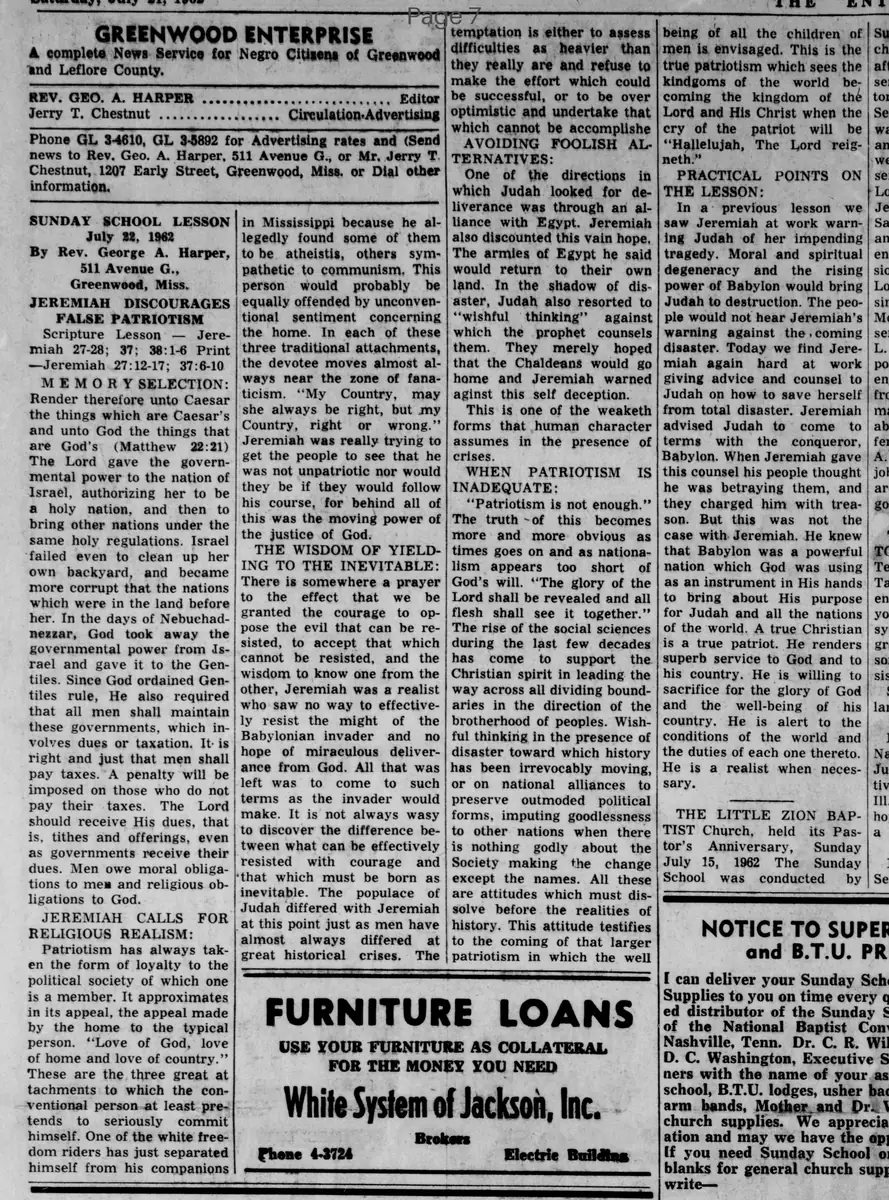
Scripture Lesson - Jeremiah 27-28; 37; 38:1-6
Print -Jeremiah 27:12-17; 37:6-10
MEMORY SELECTION:
Render therefore unto Caesar the things which are Caesar's and unto God the things that are God's (Matthew 22:21)
The Lord gave the governmental power to the nation of Israel, authorizing her to be a holy nation, and then to bring other nations under the same holy regulations. Israel failed even to clean up her own backyard, and became more corrupt than the nations which were in the land before her. In the days of Nebuchadnezzar, God took away the governmental power from Israel and gave it to the Gentiles. Since God ordained Gentiles rule, He also required that all men shall maintain these governments, which involves dues or taxation. It is right and just that men shall pay taxes. A penalty will be imposed on those who do not pay their taxes. The Lord should receive His dues, that is, tithes and offerings, even as governments receive their dues. Men owe moral obligations to men and religious obligations to God.
JEREMIAH CALLS FOR RELIGIOUS REALISM:
Patriotism has always taken the form of loyalty to the political society of which one is a member. It approximates in its appeal, the appeal made by the home to the typical person.
"Love of God, love of home and love of country."
These are the three great attachments to which the conventional person at least pretends to seriously commit himself. One of the white freedom riders has just separated himself from his companions in Mississippi because he allegedly found some of them to be atheists, others sympathetic to communism. This person would probably be equally offended by unconventional sentiment concerning the home. In each of these three traditional attachments, the devotee moves almost always near the zone of fanaticism. "My Country, may she always be right, but my Country, right or wrong."
Jeremiah was really trying to get the people to see that he was not unpatriotic nor would they be if they would follow his course, for behind all of this was the moving power of the justice of God.
THE WISDOM OF YIELDING TO THE INEVITABLE:
There is somewhere a prayer to the effect that we be granted the courage to oppose the evil that can be resisted, to accept that which cannot be resisted, and the wisdom to know one from the other. Jeremiah was a realist who saw no way to effectively resist the might of the Babylonian invader and no hope of miraculous deliverance from God. All that was left was to come to such terms as the invader would make. It is not always easy to discover the difference between what can be effectively resisted with courage and that which must be borne as inevitable. The populace of Judah differed with Jeremiah at this point just as men have almost always differed at great historical crises. The temptation is either to assess difficulties as heavier than they really are and refuse to make the effort which could be successful, or to be over optimistic and undertake that which cannot be accomplished.
AVOIDING FOOLISH ALTERNATIVES:
One of the directions in which Judah looked for deliverance was through an alliance with Egypt. Jeremiah also discounted this vain hope. The armies of Egypt he said would return to their own land. In the shadow of disaster, Judah also resorted to "wishful thinking" against which the prophet counsels them. They merely hoped that the Chaldeans would go home and Jeremiah warned against this self deception. This is one of the weakest forms that human character assumes in the presence of crises.
WHEN PATRIOTISM IS INADEQUATE:
"Patriotism is not enough."
The truth of this becomes more and more obvious as time goes on and as nationalism appears too short of God's will. "The glory of the Lord shall be revealed and all flesh shall see it together."
The rise of the social sciences during the last few decades has come to support the Christian spirit in leading the way across all dividing boundaries in the direction of the brotherhood of peoples. Wishful thinking in the presence of disaster toward which history has been irrevocably moving, or on national alliances to preserve outmoded political forms, imputing godlessness to other nations when there is nothing godly about the society making the change except the names. All these are attitudes which must dissolve before the realities of history. This attitude testifies to the coming of that larger patriotism in which the well being of all the children of men is envisaged. This is the true patriotism which sees the kingdoms of the world becoming the kingdom of the Lord and His Christ when the cry of the patriot will be "Hallelujah, The Lord reigneth."
PRACTICAL POINTS ON THE LESSON:
In a previous lesson we saw Jeremiah at work warning Judah of her impending tragedy. Moral and spiritual degeneracy and the rising power of Babylon would bring Judah to destruction. The people would not hear Jeremiah's warning against the coming disaster. Today we find Jeremiah again hard at work giving advice and counsel to Judah on how to save herself from total disaster. Jeremiah advised Judah to come to terms with the conqueror, Babylon. When Jeremiah gave this counsel his people thought he was betraying them, and they charged him with treason. But this was not the case with Jeremiah. He knew that Babylon was a powerful nation which God was using as an instrument in His hands to bring about His purpose for Judah and all the nations of the world. A true Christian is a true patriot. He renders superb service to God and to his country. He is willing to sacrifice for the glory of God and the well-being of his country. He is alert to the conditions of the world and the duties of each one thereto. He is a realist when necessary.
Print -Jeremiah 27:12-17; 37:6-10
MEMORY SELECTION:
Render therefore unto Caesar the things which are Caesar's and unto God the things that are God's (Matthew 22:21)
The Lord gave the governmental power to the nation of Israel, authorizing her to be a holy nation, and then to bring other nations under the same holy regulations. Israel failed even to clean up her own backyard, and became more corrupt than the nations which were in the land before her. In the days of Nebuchadnezzar, God took away the governmental power from Israel and gave it to the Gentiles. Since God ordained Gentiles rule, He also required that all men shall maintain these governments, which involves dues or taxation. It is right and just that men shall pay taxes. A penalty will be imposed on those who do not pay their taxes. The Lord should receive His dues, that is, tithes and offerings, even as governments receive their dues. Men owe moral obligations to men and religious obligations to God.
JEREMIAH CALLS FOR RELIGIOUS REALISM:
Patriotism has always taken the form of loyalty to the political society of which one is a member. It approximates in its appeal, the appeal made by the home to the typical person.
"Love of God, love of home and love of country."
These are the three great attachments to which the conventional person at least pretends to seriously commit himself. One of the white freedom riders has just separated himself from his companions in Mississippi because he allegedly found some of them to be atheists, others sympathetic to communism. This person would probably be equally offended by unconventional sentiment concerning the home. In each of these three traditional attachments, the devotee moves almost always near the zone of fanaticism. "My Country, may she always be right, but my Country, right or wrong."
Jeremiah was really trying to get the people to see that he was not unpatriotic nor would they be if they would follow his course, for behind all of this was the moving power of the justice of God.
THE WISDOM OF YIELDING TO THE INEVITABLE:
There is somewhere a prayer to the effect that we be granted the courage to oppose the evil that can be resisted, to accept that which cannot be resisted, and the wisdom to know one from the other. Jeremiah was a realist who saw no way to effectively resist the might of the Babylonian invader and no hope of miraculous deliverance from God. All that was left was to come to such terms as the invader would make. It is not always easy to discover the difference between what can be effectively resisted with courage and that which must be borne as inevitable. The populace of Judah differed with Jeremiah at this point just as men have almost always differed at great historical crises. The temptation is either to assess difficulties as heavier than they really are and refuse to make the effort which could be successful, or to be over optimistic and undertake that which cannot be accomplished.
AVOIDING FOOLISH ALTERNATIVES:
One of the directions in which Judah looked for deliverance was through an alliance with Egypt. Jeremiah also discounted this vain hope. The armies of Egypt he said would return to their own land. In the shadow of disaster, Judah also resorted to "wishful thinking" against which the prophet counsels them. They merely hoped that the Chaldeans would go home and Jeremiah warned against this self deception. This is one of the weakest forms that human character assumes in the presence of crises.
WHEN PATRIOTISM IS INADEQUATE:
"Patriotism is not enough."
The truth of this becomes more and more obvious as time goes on and as nationalism appears too short of God's will. "The glory of the Lord shall be revealed and all flesh shall see it together."
The rise of the social sciences during the last few decades has come to support the Christian spirit in leading the way across all dividing boundaries in the direction of the brotherhood of peoples. Wishful thinking in the presence of disaster toward which history has been irrevocably moving, or on national alliances to preserve outmoded political forms, imputing godlessness to other nations when there is nothing godly about the society making the change except the names. All these are attitudes which must dissolve before the realities of history. This attitude testifies to the coming of that larger patriotism in which the well being of all the children of men is envisaged. This is the true patriotism which sees the kingdoms of the world becoming the kingdom of the Lord and His Christ when the cry of the patriot will be "Hallelujah, The Lord reigneth."
PRACTICAL POINTS ON THE LESSON:
In a previous lesson we saw Jeremiah at work warning Judah of her impending tragedy. Moral and spiritual degeneracy and the rising power of Babylon would bring Judah to destruction. The people would not hear Jeremiah's warning against the coming disaster. Today we find Jeremiah again hard at work giving advice and counsel to Judah on how to save herself from total disaster. Jeremiah advised Judah to come to terms with the conqueror, Babylon. When Jeremiah gave this counsel his people thought he was betraying them, and they charged him with treason. But this was not the case with Jeremiah. He knew that Babylon was a powerful nation which God was using as an instrument in His hands to bring about His purpose for Judah and all the nations of the world. A true Christian is a true patriot. He renders superb service to God and to his country. He is willing to sacrifice for the glory of God and the well-being of his country. He is alert to the conditions of the world and the duties of each one thereto. He is a realist when necessary.
What sub-type of article is it?
Historical Event
Biography
What themes does it cover?
Moral Virtue
Providence Divine
Justice
What keywords are associated?
Jeremiah
Babylon
Patriotism
Surrender
Divine Providence
Taxes
What entities or persons were involved?
Jeremiah
Nebuchadnezzar
God
Lord
Where did it happen?
Judah
Story Details
Key Persons
Jeremiah
Nebuchadnezzar
God
Lord
Location
Judah
Event Date
Days Of Nebuchadnezzar
Story Details
Jeremiah advises Judah to surrender to Babylon as God's instrument, emphasizing religious realism, yielding to inevitable, avoiding foolish alliances, and true patriotism aligned with God's will, including paying taxes to governments and tithes to God.