Thank you for visiting SNEWPapers!
Sign up free
Palladium Of Virginia And The Pacific Monitor
Lewisburg, Greenbrier County, West Virginia
What is this article about?
Dr. John Simpkins writes to Dr. Richard H. Henry on October 20, 1825, defending his prior publication and accusing Henry of illiberality, fraud, and unprofessional conduct in cases involving patients Smithe, Harford, Dorman, and Hunter's Ben. Includes affidavits from Sarah and Henry Harford contradicting Henry's claims.
Clipping
OCR Quality
Full Text
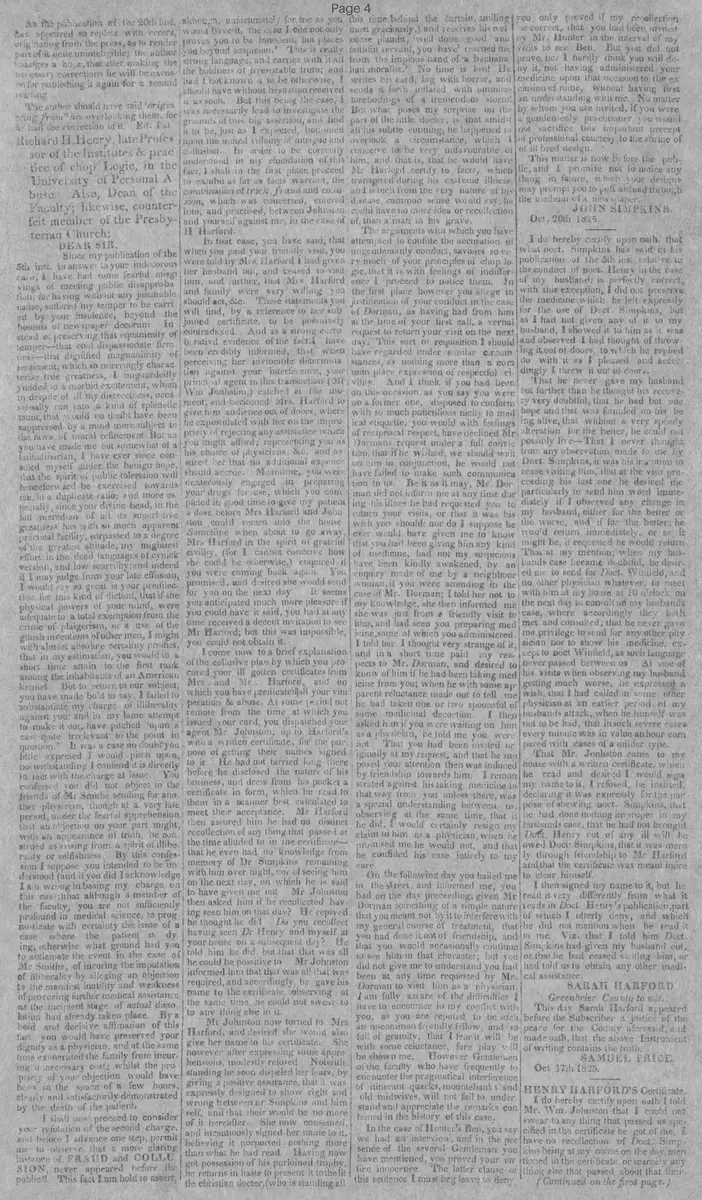
The author should have said 'originating from' his overlooking them, for he had the correction of it. Ed. Pal.
Richard H. Henry, late Professor of the Institutes & practice of chop Logic, in the University of Personal Abuse; also, Dean of the Faculty; likewise, counterfeit member of the Presbyterian Church:
DEAR SIR.
Since my publication of the 5th inst. in answer to your indecorous call, I have had some fearful misgivings of meeting public disapprobation, for having without any justifiable cause, suffered my temper to be carried by your insolence, beyond the bounds of newspaper decorum. Instead of preserving that equanimity of temper—that cool dispassionate firmness—that dignified magnanimity of sentiment, which so unerringly characterises true greatness, I unguardedly yielded to a morbid excitement, which in despite of all my discreetness, occasionally run into a kind of splenetic taunt, that would no doubt have been suppressed by a mind more subject to the laws of moral refinement. But as you have made me out somewhat of a latitudinarian, I have ever since consoled myself under the benign hope, that the spirit of public toleration will henceforward be exercised towards me, in a duplicate ratio; and more especially, since your divine head, in the full meridian of all its superlative greatness has with so much apparent practical facility, surpassed to a degree of the greatest altitude, my mightiest effort in the dead languages of cynic version, and low scurrility: and indeed if I may judge from your late effusion, I would say so great is your predilection for this kind of diction, that if the physical powers of your mind, were adequate to a total exemption from the crime of plagiarism, or a use of the gibberish inventions of other men, I might with almost absolute certainty predict, that in my estimation, you would in a short time attain to the first rank among the inhabitants of an American kennel. But to return to our subject. You have made bold to say, I failed to substantiate my charge of illiberality against you: and in my lame attempt to make it out, have pitched upon a case quite irrelevant to the point in question. It was a case no doubt you little expected I would pitch upon, notwithstanding I contend it is directly in point with the charge at issue. You confessed you did not object to the friends of Mr. Smithe sending for another physician, though at a very late period, under the fearful apprehension that an objection on your part might, with an appearance of truth, be construed as arising from a spirit of illiberality or selfishness. By this confession I suppose you intended to be understood (and if you did I acknowledge I am wrong in basing my charge on this case;) that although a member of the faculty, you are not sufficiently profound in medical science, to prognosticate with certainty the issue of a case where the patient is dying; otherwise what ground had you to anticipate the event in the case of Mr. Smithe, of incurring the imputation of illiberality by alleging an objection to the manifest inutility and weakness of procuring further medical assistance as the incipient stage of actual dissolution had already taken place. By a bold and decisive affirmation of this fact you would have preserved your dignity as a physician, and at the same time exonerated the family from incurring unnecessary cost; whilst the propriety of your objection would have been in the space of a few hours, clearly and satisfactorily demonstrated by the death of the patient.
I shall now proceed to consider your refutation of the second charge, and before I advance one step, permit me to observe, that a more glaring instance of FRAUD and COLLUSION, never appeared before the public! This act I am bold to assert,
although, unfortunately for me as you would have it, the case I cite not only proves you to be innocent, but places you beyond suspicion. This is really strong language, and carries with it all the boldness of irresistible truth; and had I not known it to be otherwise, I should have without hesitation received it as such. But this being the case, I was necessarily led to investigate the grounds of this big assertion, and find it to be, just as I expected, bottomed upon the united villainy of intrigue and collusion. In order to be correctly understood in my elucidation of this fact, I shall in the first place proceed to exhibit as far as facts warrant, the combination of trick, fraud and collusion, which was concerted, entered into, and practised, between Johnston and yourself against me, in the case of H. Harford.
In that case, you have said, that when you paid your friendly visit, you were told by Mrs. Harford I had given her husband out, and ceased to visit him, and further, that Mrs. Harford and family were very willing you should act, &c. These statements you will find, by a reference to her subjoined certificate, to be positively contradicted. And as a strong corroborative evidence of the fact, have been credibly informed, that when perceiving her invincible determination against your interference, your principal agent in this transaction (Mr. Wm. Johnston) catched at the moment, and beckoned Mrs. Harford to give him audience out of doors, where he expostulated with her on the impropriety of rejecting any assistance which you might afford; representing you as his choice of physicians, &c. and assured her that no additional expense should accrue. Meantime, you were dexterously engaged in preparing your drugs for use, which you completed in good time to give my patient a dose before Mrs. Harford and Johnston could return into the house. Sometime when about to go away, Mrs. Harford in the spirit of grateful civility, (for I cannot conceive how she could be otherwise,) enquired if you were coming back again. You promised, and desired she would send for you on the next day. It seems you anticipated much more pleasure if you could have it said, you had at any time received a decent invitation to see Mr. Harford: but this was impossible, you could not obtain it.
I come now to a brief explanation of the collusive plan by which you procured your ill gotten certificates from Mrs. and Mr. Harford, and on which you have predicated all your vituperation & abuse. At some period not remote from the time at which you issued your card, you dispatched your agent Mr. Johnston, up to Harford's with a written certificate, for the purpose of getting their names signed to it. He had not tarried long there before he disclosed the nature of his business, and drew from his pocket a certificate in form, which he read to them in a manner best calculated to meet their acceptance. Mr. Harford then assured him he had no distinct recollection of any thing that passed at the time alluded to in the certificate—that he even had no knowledge from memory of Dr. Simpkins remaining with him over night, nor of seeing him on the next day, on which he is said to have given me out. Mr. Johnston then asked him if he recollected having seen him on that day? He replied he thought he did. Do you recollect having seen Dr. Henry and myself at your house on a subsequent day? He told him he did, but that that was all he could be positive to. Mr. Johnston informed him that that was all that was required, and accordingly he gave his name to the certificate, observing at the same time, he could not swear to anything else in it.
Mr. Johnston now turned to Mrs. Harford, and desired she would also give her name to his certificate. She however after expressing some apprehensions, modestly refused. Notwithstanding he soon dispelled her fears, by giving a positive assurance, that it was expressly designed to show right and wrong between Dr. Simpkins and himself, and that there would be no more of it hereafter. She now consented, and incautiously signed her name to it, believing it purported nothing more than what he had read. Having now got possession of his purloined trophy, he returns in haste to present it to the little christian doctor, (who is standing all this time behind the curtain, smiling most graciously) and receives his well come plaudit. 'Well done good and faithful servant. You have rescued me from the impious hand of a bacchanalian moralist?' No time is lost! He writes his card, big with horror, and sends it forth inflated with ominous forebodings of a tremendous storm!
But what poses my surprise on the part of the little doctor, is that amidst all his subtle cunning, he happened to overlook a circumstance, which I conceive to be very unfavourable to him, and that is, that he would have Mr. Harford certify to facts, which transpired during his extreme illness, and which from the very nature of his disease, common sense would say, he could have no more idea or recollection of, than a man in his grave.
The arguments with which you have attempted to confute the accusation of ungentlemanly conduct, savours so very much of your principles of chop logic, that it is with feelings of indifference I proceed to notice them. In the first place however you allege in justification of your conduct in the case of Dorman, as having had from him at the time of your first call, a verbal request to return your visit on the next day. This sort of requisition I should have regarded under similar circumstances, as nothing more than a common place expression of respectful civility. And I think if you had been on this occasion, as you say you were on a former one, disposed to conform with so much punctilious nicety to medical etiquette, you would with feelings of reciprocal respect, have declined Mr. Dorman's request under a full conviction, that if he wished we should wait on him in conjunction, he would not have failed to make such communication to us. Be it as it may, Mr. Dorman did not inform me at any time during his illness he had requested you to return your visits, or that it was his wish you should: nor do I suppose he ever would have given me to know that you had been giving him any kind of medicine, had not my suspicions have been kindly awakened, by an enquiry made of me by a neighbour woman, if you were attending in the case of Mr. Dorman; I told her not to my knowledge, she then informed me she was just from a friendly visit to him, and had seen you preparing medicine, some of which you administered. I told her I thought very strange of it, and in a short time paid my respects to Mr. Dorman, and desired to know of him if he had been taking medicine from you; when he with some apparent reluctance made out to tell me he had taken one or two spoonsful of some medicinal decoction. I then asked him if you were waiting on him as a physician, he told me you were not. That you had been invited originally at my request, and that he supposed your attention then was induced by friendship towards him. I remonstrated against his taking medicine in that way from you unless there was a special understanding between us, observing at the same time, that if he did, I would certainly resign my claim to him as a physician, when he promised me he would not, and that he confided his case entirely to my care.
On the following day you hailed me in the street, and informed me, you had on the day preceding, given Mr. Dorman something of a simple nature that you meant not by it to interfere with my general course of treatment, that you had done it out of friendship, and that you would occasionally continue to see him in that character; but you did not give me to understand you had been at any time requested by Mr. Dorman to visit him as a physician.
I am fully aware of the difficulties I have to encounter in my conflict with you, as you are reputed to be such an uncommon friendly fellow, and so full of gratuity, that I fear it will be with some reluctance, fair play will be shown me. However Gentlemen of the faculty who have frequently to encounter the pragmatical interference of itinerant quacks, mountebanks and old midwives, will not fail to understand and appreciate the remarks contained in the history of this case.
In the case of Hunter's Ben, you say we had an interview, and in the presence of the several Gentlemen you have mentioned, you proved your entire innocence. The latter clause of this sentence I must beg leave to deny.
you only proved if my recollection be correct, that you had been invited by Mr. Hunter in the interval of my visits to see Ben. But you did not prove, nor hardly think you will deny it, not having administered your medicine upon that occasion to the exclusion of mine, without having first an understanding with me. No matter by whom you are invited, if you were a gentlemanly practitioner you would not sacrifice this important precept of professional courtesy, to the shrine of ill bred design.
This matter is now before the public, and I promise not to notice anything in future, which your designs may prompt you to pass abroad through the medium of a newspaper.
JOHN SIMPKINS.
Oct. 20th 1825.
I do hereby certify upon oath, that what Doct. Simpkins has said in his publication of the 5th inst. relative to the conduct of Doct. Henry in the case of my husband, is perfectly correct, with this exception, I did not preserve the medicine which he left expressly for the use of Doct. Simpkins, but as I had not given any of it to my husband, I showed it to him as it was and observed I had thought of throwing it out of doors, to which he replied do with it as I pleased and accordingly I threw it out of doors. That he never gave my husband out further than he thought his recovery very doubtful, that he had but one hope and that was founded on his being alive, that without a very speedy alteration for the better, he could not possibly live—That I never thought from any observation made to me by Doct. Simpkins, it was his intention to cease visiting him, that at the visit preceding his last one he desired me particularly to send him word immediately if I observed any change in my husband, either for the better or the worse, and if for the better: he would return immediately, or as it might be, he requested he would return at my mention; when my husband's case became doubtful, he desired me to send for Doct. Winfield, and no other physician whatever, to meet with him at my house at 10 o'clock on the next day to consult on my husband's case, where accordingly they both met and consulted; that he never gave me privilege to send for any other physician nor to show his medicine, except to Doct. Winfield, as such language never passed between us. At one of his visits when observing my husband getting much worse, he expressed a wish, that I had called in some other physician at an earlier period of my husband's attack, when he himself was not to be had, that in such severe cases every minute was in value an hour compared with cases of a milder type.
That Mr. Johnston came to my house with a written certificate, which he read and desired I would sign my name to it, I refused, he insisted, declaring it was expressly for the purpose of shewing Doct. Simpkins, that he had done nothing improper in my husband's case, that he had not brought Doct. Henry out of any ill will he owed Doct. Simpkins, that it was merely through friendship to Mr. Harford and that the certificate was meant entirely to clear himself,
I then signed my name to it, but he read it very differently from what it reads in Doct. Henry's publication, part of which I utterly deny, and which he did not mention when he read it to me. Viz. that I told him Doct. Simpkins had given my husband out, or that he had ceased visiting him, or had told us to obtain any other medical assistance.
SARAH HARFORD.
Greenbrier County to wit.
This day Sarah Harford appeared before the Subscriber a justice of the peace of the County aforesaid, and made oath, that the above Instrument of writing contains the truth.
SAMUEL PRICE.
Oct 17th 1825.
HENRY HARFORD'S Certificate.
I do hereby certify upon oath I told Mr. Wm. Johnston that I could not swear to any thing that passed as specified in the certificate he got of me, have no recollection of Doct. Simpkins being at my house on the day mentioned in the certificate, or scarcely anything else that passed about that time.
(Continued on the first page-)
What sub-type of article is it?
What themes does it cover?
What keywords are associated?
What entities or persons were involved?
Letter to Editor Details
Author
John Simpkins
Recipient
Richard H. Henry
Main Argument
dr. simpkins defends his prior accusations against dr. henry, charging him with illiberality in the smithe case, fraud and collusion in the harford case via manipulated certificates, and ungentlemanly interference in the dorman and hunter cases, supported by harford affidavits.
Notable Details