Thank you for visiting SNEWPapers!
Sign up free
Norfolk Gazette And Publick Ledger
Norfolk, Virginia
What is this article about?
British government sends George Henry Rose on special mission to America amid recall of Admiral Berkeley from American station, criticized as appeasement undermining naval impressment rights; King's proclamation of 16th inst. seen as evasion.
Merged-components note: This is a single continuous article excerpt from Cobbett's Weekly Register on British politics and the American situation, split across columns on page 2; the text flows mid-sentence.
Clipping
OCR Quality
Full Text
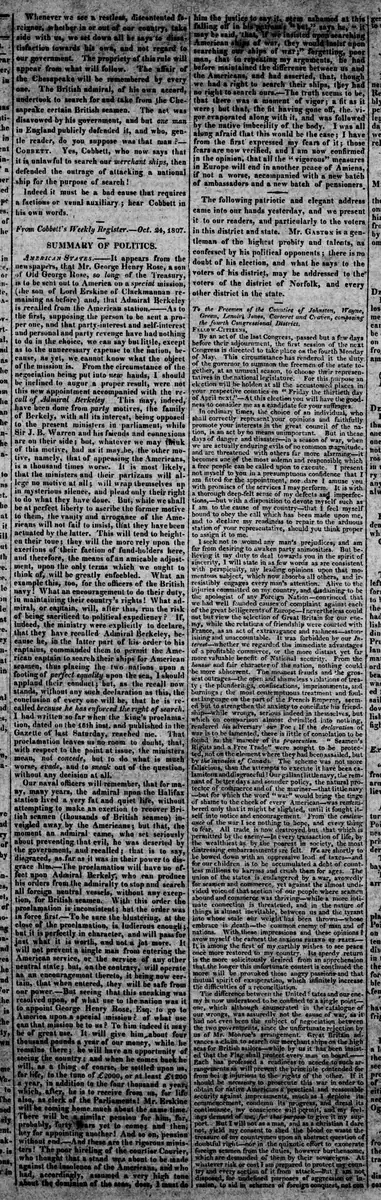
American States.—It appears from the newspapers, that Mr. George Henry Rose, a son of Old George Rose, so long of the Treasury, is to be sent out to America on a special mission, (the son of Lord Erskine of Clackmannan remaining as before) and, that Admiral Berkeley is recalled from the American station.—As to the first, supposing the person to be sent a proper one, and that party-interest and self-interest and personal and party revenge have had nothing to do in the choice, we can say but little, except as to the unnecessary expense to the nation, because, as yet, we cannot know what the object of the mission is. From the circumstance of the negotiation being put into new hands, I should be inclined to augur a proper result, were not this new appointment accompanied with the recall of Admiral Berkeley. This may, indeed, have been done from party motives, the family of Berkeley, with all its interest, being opposed to the present ministers in parliament, while Sir J. B. Warren and his friends and connexions are on their side; but, whatever we may think of this motive, bad as it may be, the other motive, namely, that of appeasing the Americans, is a thousand times worse. It is most likely, that the ministers and their partisans will allege no motive at all; will wrap themselves up in mysterious silence, and plead only their right to do what they have done. But, while we shall be at perfect liberty to ascribe the former motive to them, the vanity and arrogance of the Americans will not fail to insist, that they have been actuated by the latter. This will tend to heighten their tone: they will the more rely upon the exertions of their faction of fund-holders here, and therefore, the means of an amicable adjustment, upon the only terms which we ought to think of, will be greatly enfeebled. What an example this, too, for the officers of the British navy! What an encouragement to do their duty, in maintaining their country's rights! What admiral, or captain, will, after this, run the risk of being sacrificed to political expediency? If, indeed, the ministry were explicitly to declare that they have recalled Admiral Berkeley, because he, in the latter part of his order to his captains, commanded them to permit the American captain to search their ships for American seamen, thus placing the two nations upon a footing of perfect equality upon the sea, I should applaud their conduct; but, as the recall now stands, without any such declaration as this, the conclusion of every one will be, that he is recalled because he has enforced the right of search.
I had written so far when the King's proclamation, dated on the 16th inst. and published in the Gazette of last Saturday, reached me. That proclamation leaves us no room to doubt, that, with respect to the point at issue, the ministers mean, not concede, but to do what is much worse, evade, and to sneak out of the question without any decision at all.
Our naval officers will remember, that for many, many years, the admiral upon the Halifax station lived a very fat and quiet life, without attempting to make an exertion to recover British seamen (thousands of British seamen) inveigled away by the Americans; but that, the moment an admiral came, who set seriously about preventing that evil, he was deserted by the government, and recalled; that is, to say, disgraced, as far as it was in their power to disgrace him. The proclamation will have no effect upon Admiral Berkeley, who can produce his orders from the admiralty to stop and search all foreign neutral vessels, without any exception, for British seamen. With this order the proclamation is inconsistent; but the order was in force first. To be sure the blustering, at the close of the proclamation, is ludicrous enough; but it is perfectly in character, and will pass for just what it is worth, and not a jot more. It will not prevent a single man from entering the American service, or the service of any other neutral state; but, on the contrary, will operate as an encouragement thereto, it being now certain, that when entered, they will be safe from our power. But seeing that this sneaking was resolved upon, of what use to the nation was it to appoint George Henry Rose, Esq. to go to America upon a special mission? Of what use can that mission be to us? To him indeed it may be of great use. It will give him about four thousand pounds a year of our money, while he remains there. He will have an opportunity of seeing the country; and when he comes back he will, as a thing of course, be settled upon us, for life, to the tune of £2000, or at least £1200 a year, in addition to the four thousand a year, which, after he is to receive from us, for life also as clerk of the Parliaments. Mr. Erskine will be coming home much about the same time. There will be similar pension for him for, probably, forty years yet to come; and then, hey for appointing another! And so on, pension without end. And these are the rigorous ministers! The poor hireling of the courtier Courier, who thought that a stand was about to be made against the insolence of the Americans, and who had, accordingly, assumed a very high tone about the dominion of the seas, does, I must do him the justice to say, seem ashamed at this falling off.
may be said, that Sir G. wanted to insist upon searching American ships of war they would insist upon searching our ships of war forgetting, poor man, that in repeating my arguments, he had before maintained the difference between us and the Americans, and had asserted, that, though we had a right to search their ships, they had no right to search ours. The truth seems to be, that there was a moment of vigor; a fit as it were; but that, the fit having gone off, the vigor evaporated along with it, and was followed by the native imbecility of the body. I was all along afraid that this would be the case; I have from the first expressed my fears of it; those fears are now verified, and I am now confirmed in the opinion, that all the "vigorous" measures in Europe will end in another peace of Amiens, if not a worse, accompanied with a new batch of ambassadors and a new batch of pensioners.
What sub-type of article is it?
What keywords are associated?
What entities or persons were involved?
Where did it happen?
Foreign News Details
Primary Location
American States
Event Date
16th Inst.
Key Persons
Outcome
admiral berkeley recalled from american station; special mission to america by mr. george henry rose; king's proclamation dated 16th inst. evading the impressment issue without concession.
Event Details
Mr. George Henry Rose to be sent to America on special mission while Lord Erskine remains; Admiral Berkeley recalled, possibly to appease Americans or due to party motives; commentary criticizes the recall for undermining British naval rights of search; King's proclamation published, seen as evasion rather than concession on impressment of British seamen.