Thank you for visiting SNEWPapers!
Sign up free
Alexandria Daily Advertiser
Alexandria, Virginia
What is this article about?
In a House of Representatives debate on December 10, Mr. Elliot criticizes the Senate bill for funding 257 gun boats as an inefficient, expensive substitute for a proper navy, mocking executive suggestions and highlighting war finance burdens.
Merged-components note: Merged continuation of Mr. Elliot's speech on gun boats across pages 2 and 3, including embedded financial tables that are integral to the narrative and calculations.
Clippings
1 of 2
OCR Quality
Full Text
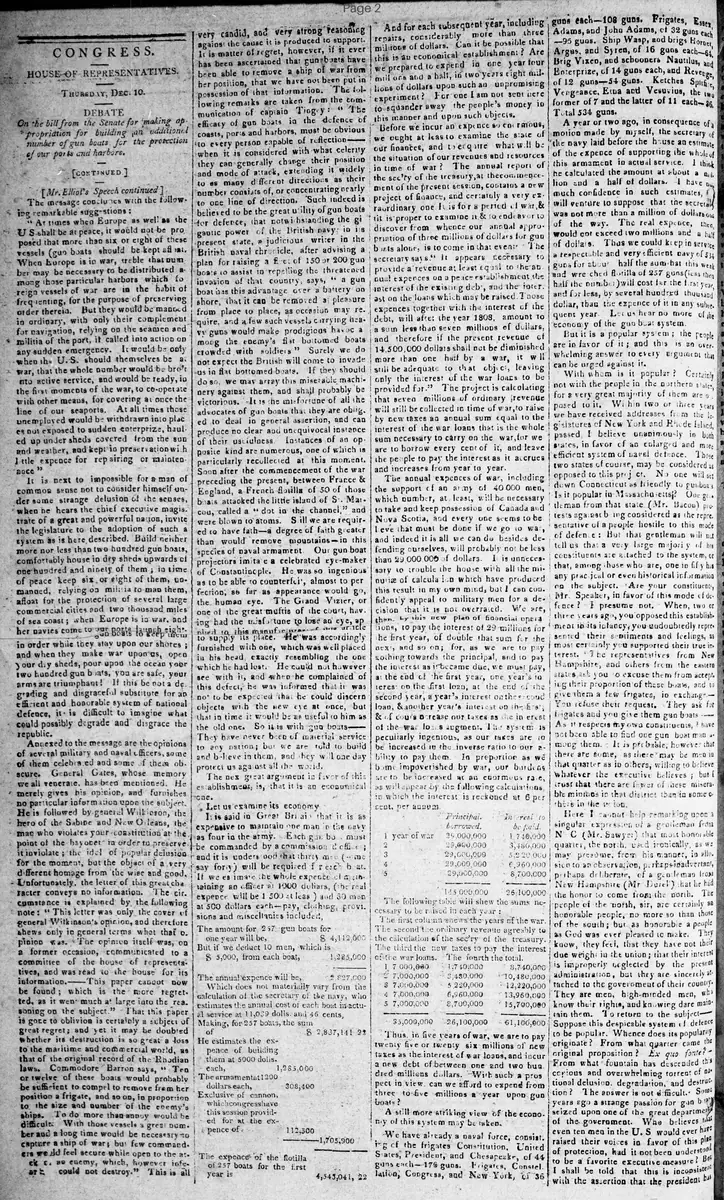
HOUSE OF REPRESENTATIVES.
Thursday, Dec. 10.
DEBATE
On the bill from the Senate for making appropriation for building an additional number of gun boats, for the protection of our ports and harbors.
[Continued.]
[Mr. Elliot's Speech continued.]
The message concludes with the following remarkable suggestions:
"At times when Europe as well as the U. S. shall be at peace, it would not be proper that more than six or eight of these vessels (gun boats) should be kept afloat. When Europe is in war, treble that number may be necessary to be distributed among those particular harbors which foreign vessels of war are in the habit of frequenting, for the purpose of preserving order therein. But they would be manned in ordinary, with only their complement for navigation, relying on the seamen and militia of the port, if called into action on any sudden emergency. It would be only when the U. S. should themselves be at war, that the whole number would be brought into active service, and would be ready, in the first moments of the war, to co-operate with other means, for covering at once the line of our seaports. At all times those unemployed would be withdrawn into places not exposed to sudden enterprise, hauled up under sheds covered from the sun and weather, and kept in preservation with little expense for repairing or maintenance."
It is next to impossible for a man of common sense not to consider himself under some strange delusion of the senses, when he hears the chief executive magistrate of a great and powerful nation, invite the legislature to the adoption of such a system as is here described. Build neither more nor less than two hundred gun boats, comfortably house in dry sheds upwards of one hundred and ninety of them; in time of peace keep six or eight of them, unmanned, relying on militia to man them, afloat for the protection of several large commercial cities and two thousand miles of sea coast; when Europe is in war, and her navies come to our ports launch eight gun boats to keep them in order while they stay upon our shores; and when they make war upon us, open your dry sheds, pour upon the ocean your two hundred gun boats, you are safe, your arms are triumphant! If this be not a degrading and disgraceful substitute for an efficient and honorable system of national defence, it is difficult to imagine what could possibly degrade and disgrace the republic.
Annexed to the message are the opinions of several military and naval officers, some of them celebrated and some of them obscure. General Gates, whose memory we all venerate, has been mentioned. He merely gives his opinion, and furnishes no particular information upon the subject. He is followed by General Wilkinson, the hero of the Sabine and New Orleans, the man who violates your constitution at the point of the bayonet in order to preserve it; the idol of popular delusion for the moment, but the object of a very different homage from the wise and good. Unfortunately, the letter of this great character conveys no information. The circumstance is explained by the following note: "This letter was only the cover of General Wilkinson's opinion, and therefore shows only in general terms what that opinion was. The opinion itself was, on a former occasion, communicated to a committee of the house of representatives, and was read to the house for its information. This paper cannot now be found; which is the more regretted, as it went much at large into the reasoning on the subject." That this paper is gone to oblivion is certainly a subject of great regret; and yet it may be doubted whether its destruction is so great a loss to the maritime and commercial world, as that of the original record of the Rhodian laws. Commodore Barron says, "Ten or twelve of these boats would probably be sufficient to compel to remove from her position a frigate, and so on, in proportion to the size and number of the enemy's ships. To do more than annoy would be difficult. With those vessels a great number and a long time would be necessary to capture a ship of war; but few commanders would feel secure while open to the attack of an enemy, which, however inferior, could not destroy." This is all very candid, and very strong reasoning against the cause it is produced to support.
It is matter of regret, however, if it ever be ascertained that gun boats have been able to remove a ship of war from her position, that we have not been put in possession of that information. The following remarks are taken from the communication of Captain Tingry: "The efficacy of gun boats in the defence of coasts, ports and harbors, must be obvious to every person capable of reflection, when it is considered with what celerity they can generally change their position and mode of attack, extending it widely to as many different directions as their number consists of, or concentrating nearly to one line of direction. Such indeed is believed to be the great utility of gun boats for defence, that notwithstanding the gigantic power of the British navy in its present state, a judicious writer in the British naval chronicle, after advising a plan for raising a fleet of 150 or 200 gun boats to assist in repelling the threatened invasion of that country, says, 'a gun boat has this advantage over a battery on shore, that it can be removed at pleasure from place to place, as occasion may require, and a few such vessels carrying heavy guns would make prodigious havoc among the enemy's flat bottomed boats crowded with soldiers.' Surely we do not expect the British will come to invade us in flat bottomed boats. If they should do so, we may array this miserable machinery against them, and shall probably be victorious. It is the misfortune of all the advocates of gun boats that they are obliged to deal in general assertion, and can produce no clear and unequivocal instance of their usefulness. Instances of an opposite kind are numerous, one of which is particularly recollected at this moment. Soon after the commencement of the war preceding the present, between France & England, a French flotilla of 50 of those boats attacked the little island of St. Marcou, called a 'dot in the channel' and were blown to atoms. Still we are required to have faith—a degree of faith greater than would remove mountains—in this species of naval armament. Our gun boat projectors imitate a celebrated eye-maker of Constantinople. He was so ingenious as to be able to counterfeit, almost to perfection, so far as appearance would go, the human eye. The Grand Vizier, or one of the great muftis of the court, having had the misfortune to lose an eye, applied to this manufacturer for an article to supply its place. He was accordingly furnished with one, which was well placed in his head, exactly resembling the one which he had lost. He could not however see with it, and when he complained of this defect, he was informed that it was not to be expected that he could discern objects with the new eye at once, but that in time it would be as useful to him as the old one. So it is with gun boats. They have never been of material service to any nation; but we are told to build and believe in them, and they will one day protect us against all the world.
The next great argument in favor of this establishment, is, that it is an economical one.
Let us examine its economy:
It is said in Great Britain that it is as expensive to maintain one man in the navy as four in the army. Each gun boat must be commanded by a commissioned officer, and it is understood that thirty men (I say only) will be required for each boat. If we estimate the whole expense of maintaining an officer at 1000 dollars, (the real expense will be 1500 at least) and 30 men at 500 dollars each—pay, clothing, provisions and miscellanies included.
The amount for 257 gun boats for one year will be,
$4,112,000
But if we deduct 10 men, which is $5,000, from each boat,
1,285,000
The annual expense will be,
$2,827,000
Which does not materially vary from the calculation of the secretary of the navy, who estimates the annual cost of each boat in actual service at $1,039 dolls. and 46 cents,
Making for 257 boats, the sum
of
$2,837,141 22
He estimates the expense of building them at 5000 dolls. each,
1,285,000
The armament $200 dollars each,
308,100
Exclusive of cannon, which Congress have this session provided for at the expense of,
112,500
---1,705,900
The expense of the flotilla of 257 boats for the first year is
4,543,041, 22
And for each subsequent year, including repairs, considerably more than three millions of dollars. Can it be possible that this is an economical establishment? Are we prepared to expend in one year four millions and a half, in two years eight millions of dollars upon such an unpromising experiment? For one I am not sent here to squander away the people's money in this manner and upon such subjects.
Before we incur an expense so enormous, we ought at least to examine the state of our finances, and inquire what will be the situation of our revenues and resources in time of war? The annual report of the secretary of the treasury, at the commencement of the present session, contains a new project of finance, and certainly a very extraordinary one. It is for a period of war, and it is proper to examine it, and endeavor to discover from whence our annual appropriation of three millions of dollars for gun boats alone, is to come in that event. The secretary says, "it appears necessary to provide a revenue at least equal to the annual expenses on a peace establishment the interest of the existing debt, and the interest on the loans which may be raised. Those expenses together with the interest of the debt, will after the year 1808, amount to a sum less than seven millions of dollars, and therefore if the present revenue of $14,500,000 dollars shall not be diminished more than one half by a war, it will still be adequate to that object, leaving only the interest of the war loans to be provided for." The project is calculating that seven millions of ordinary revenue will still be collected in time of war, to raise by new taxes an annual sum equal to the interest of the war loans that is the whole sum necessary to carry on the war, for we are to borrow every cent of it, and leave the people to pay the interest as it accrues and increases from year to year.
The annual expenses of war, including the support of an army of 40,000 men, which number, at least, will be necessary to take and keep possession of Canada and Nova Scotia, and every one seems to believe that must be done if we go to war, and indeed it is all we can do besides defending ourselves, will probably not be less than $20,000,000 of dollars. It is unnecessary to trouble the house with all the minutiæ of calculation which have produced this result in my own mind, but I can confidently appeal to military men for a decision that it is not overrated. We are, then, by this new plan of financial operations, to pay the interest of $20 millions for the first year, of double that sum for the next, and so on; for, as we are to pay nothing towards the principal, and to pay the interest as it becomes due, we must pay, at the end of the first year, one year's interest on the first loan, at the end of the second year, a year's interest on the second loan, & another year's interest on the first; & of course increase our taxes as the interest of the war loans augment. This system is peculiarly ingenious, as our taxes are to be increased in the inverse ratio to our ability to pay them. In proportion as we become impoverished by war, our burdens are to be increased at an enormous rate, as will appear by the following calculations, in which the interest is reckoned at 6 per cent. per annum.
The following table will show the sums necessary to be raised in each year:
The first column shows the years of the war
The second the ordinary revenue agreeably to the calculation of the sec'y of the treasury.
The third the new taxes to pay the interest of the war loans. The fourth the total.
| Principal. | Interest to be paid. | |
| 1 year of war | 29,000,000 | 1,740,000 |
| 2 | 29,000,000 | 3,480,000 |
| 3 | 29,000,000 | 5,220,000 |
| 4 | 29,000,000 | 6,960,000 |
| 5 | 29,000,000 | 8,700,000 |
| 1,450,000,000 | 26,100,000 |
| 1 | 7,000,000 | 1,740,000 | 8,740,000 |
| 2 | 7,000,000 | 3,480,000 | 10,480,000 |
| 3 | 7,000,000 | 5,220,000 | 12,220,000 |
| 4 | 7,000,000 | 6,960,000 | 13,960,000 |
| 5 | 7,000,000 | 8,700,000 | 15,700,000 |
35,000,000 26,100,000 61,100,000
Thus, in five years of war, we are to pay twenty five or twenty six millions of new taxes as the interest of war loans, and incur a new debt of between one and two hundred millions dollars. With such a prospect in view, can we afford to expend from three to five millions a year upon gun boats?
A still more striking view of the economy of this system may be taken.
We have already a naval force, consisting of the frigates Constitution, United States, President, and Chesapeake, of 44 guns each—176 guns. Frigates, Constellation, Congress, and New-York, of 36 guns each—108 guns. Frigates, Essex, Adams, and John Adams, of 32 guns each—96 guns. Ship Wasp, and brigs Hornet, Argus, and Syren, of 16 guns each—64. Brig Vixen, and schooners Nautilus, and Enterprise, of 14 guns each, and Revenge, of 12 guns—54 guns. Ketches Vengeance, Etna and Vesuvius, the two former of 7 and the latter of 11 each—25. Total 534 guns.
A year or two ago, in consequence of a motion made by myself, the secretary of the navy laid before the house an estimate of the expense of supporting the whole of this armament in actual service. I think he calculated the amount at about a million and a half of dollars. I have so much confidence in such estimates, will venture to suppose that the secretary was not more than a million of dollars out of the way. The real expense, then, would not exceed two millions and a half of dollars. Thus we could keep in service a respectable and very efficient navy of 534 guns for about half the sum that this weak and wretched flotilla of 257 guns (less than half the number) will cost for the first year, and for less, by several hundred thousand dollars, than the expense of it in any subsequent year. Let us hear no more of the economy of the gun boat system.
But it is a popular system; the people are in favor of it; and this is an overwhelming answer to every argument that can be urged against it.
With whom is it popular? Certainly not with the people in the northern states, for a very great majority of them are opposed to it. Within two or three years we have received addresses from the legislatures of New York and Rhode Island passed, I believe unanimously in both states, in favor of an enlarged and more efficient system of naval defence. Those two states of course, may be considered as opposed to this project. No one will set down Connecticut as friendly to gunboats. Is it popular in Massachusetts? One gentleman from that state (Mr. Bacon) protests against being considered as the representative of a people hostile to this mode of defence: But that gentleman will not tell us that a very large majority of his constituents are attached to the system, or that, among those who are, one in fifty has any practical or even historical information on the subject. Are your constituents, Mr. Speaker, in favor of this mode of defence? I presume not. When two or three years ago, you opposed this establishment in its infancy, you undoubtedly represented their sentiments and feelings, as most certainly you supported their true interest. The representatives from New Hampshire, and others from the eastern states, ask you to excuse them from accepting their proportion of these boats, and to give them a few frigates, in exchange. You refuse their request. They ask for frigates and you give them gun boats.—As it respects my own constituents, I have not been able to find one gun boat man among them. It is probable, however that there are some, as there may be men in that quarter as in others, willing to believe whatever the executive believes: but I trust that there are fewer of these miserable minions in that district than in some others in the nation.
Here I cannot help remarking upon a singular expression of a gentleman from N. C. (Mr. Sawyer) that most honorable quarter, the north, used ironically, as we may presume, from his manner, in allusion to an observation, perhaps inadvertant, perhaps deliberate, of a gentleman from New Hampshire (Mr. Dore) that he had the honor to come from the north. The people of the north, sir, are certainly an honorable people, no more so than those of the south; but as honorable a people as God was ever pleased to make. They know, they feel, that they have not their due weight in the union: that their interest is improperly neglected by the present administration, but they are sincerely attached to the government of their country. They are men, high-minded men, who know their rights, and knowing dare maintain them. To return to the subject—
Suppose this despicable system of defence to be popular. Whence does its popularity originate? From what quarter came the original proposition? Ex quo fonte?—From what fountain has descended this curious and overwhelming torrent of national delusion, degradation, and destruction? The answer is not difficult.—Some years ago a strange passion for gun boats seized upon one of the great departments of the government. Who believes that even ten men in the U. S. would ever have raised their voices in favor of this plan of protection, had it not been understood to be a favorite executive measure? But I shall be told that this is inconsistent with the assertion that the president but
It is true that he recommends nothing at present. Every one knows the fact.
He talks of a moveable force upon the water.
This is very clear to those who understand the subject. But the president's motives are more inscrutable, more inexplicable.
A committee is appointed to enquire what the executive wishes. One of his secretaries tells them that "it is believed, that, for the protection of our ports and harbors, there ought to be built 188 additional gun boats."
What are the grounds of this belief?
Why does not the secretary give any information upon the subject? Why not communicate some information as to the utility of defence, for which he proposes the subject? Why not undertake to advocate, upon the belief of the secretary, that we vote away five millions of the people's money? Upon what is it believed? Do we legislate, do we vote away millions upon the belief of the secretary of the navy? Certainly not.
We all know that this business has long been done upon the belief of the President.
It is but little less disgraceful, however, even crowded by the executive; you have long had upon your tables even the executive apportionment to every port, bay and inlet on your coast, of these weak, wretched contemptible gun boats; and this before it had been intimated to you that an appropriation of money was wanted for the purpose. I do not understand too well this mode of legislation or rather I understand the purpose I do not understand. Or rather I appropriate of money was wanted for the republican government. It is miserable management despicable legislation we are sent here to carry into effect the will and the wishes of the president. Let him express that will and those wishes in constitutional way. and not in a secret, sideways manner through the intervention secretaries and committees.
[Speech to be continued.]
What sub-type of article is it?
What themes does it cover?
What keywords are associated?
What entities or persons were involved?
Where did it happen?
Story Details
Key Persons
Location
House Of Representatives
Event Date
Thursday, Dec. 10.
Story Details
Mr. Elliot's speech criticizes the executive's gun boat proposal as delusional, ineffective, and economically burdensome, contrasting it with the existing navy and warning of war finance strains, urging a proper naval defense system.