Thank you for visiting SNEWPapers!
Sign up free
The Daily Phoenix
Columbia, Richland County, South Carolina
What is this article about?
Analysis of France's recent elections: Government under Thiers sustained by coalition of Orleanists, Bourbonists, and Napoleonists to suppress the Commune, despite limited true Republican support. Highlights temporary stability and hope for future development over partisan strife.
Clipping
OCR Quality
Full Text
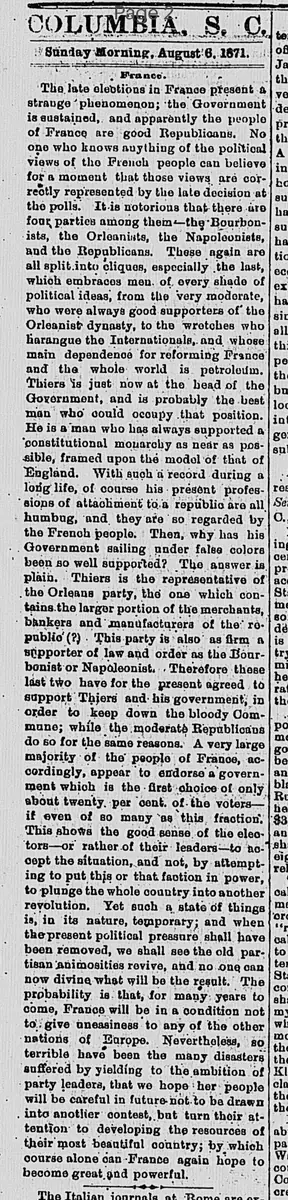
Sunday Morning, August 6, 1871.
The late elections in France present a strange phenomenon; the Government is sustained, and apparently the people of France are good Republicans. No one who knows anything of the political views of the French people can believe for a moment that those views are correctly represented by the late decision at the polls. It is notorious that there are four parties among them—the Bourbonists, the Orleanists, the Napoleonists, and the Republicans. These again are all split into cliques, especially the last, which embraces men of every shade of political ideas, from the very moderate, who were always good supporters of the Orleanist dynasty, to the wretches who harangue the Internationals, and whose main dependence for reforming France and the whole world is petroleum.
Thiers is just now at the head of the Government, and is probably the best man who could occupy that position. He is a man who has always supported a constitutional monarchy as near as possible, framed upon the model of that of England. With such a record during a long life, of course his present professions of attachment to a republic are all humbug, and they are so regarded by the French people. Then, why has his Government, sailing under false colors, been so well supported? The answer is plain. Thiers is the representative of the Orleans party, the one which contains the larger portion of the merchants, bankers and manufacturers of the republic(?). This party is also as firm a supporter of law and order as the Bourbonist or Napoleonist. Therefore these last two have for the present agreed to support Thiers and his government; in order to keep down the bloody Commune; while the moderate Republicans do so for the same reasons. A very large majority of the people of France, accordingly, appear to endorse a government which is the first choice of only about twenty per cent. of the voters—if even of so many as this fraction.
This shows the good sense of the electors—or rather of their leaders—to accept the situation, and not, by attempting to put this or that faction in power, to plunge the whole country into another revolution. Yet such a state of things is, in its nature, temporary; and when the present political pressure shall have been removed, we shall see the old partisan animosities revive, and no one can now divine what will be the result. The probability is that, for many years to come, France will be in a condition not to give uneasiness to any of the other nations of Europe. Nevertheless, so terrible have been the many disasters suffered by yielding to the ambition of party leaders, that we hope her people will be careful in future not to be drawn into another contest, but turn their attention to developing the resources of their most beautiful country; by which course alone can France again hope to become great and powerful.
What sub-type of article is it?
What keywords are associated?
What entities or persons were involved?
Where did it happen?
Foreign News Details
Primary Location
France
Event Date
The Late Elections
Key Persons
Outcome
government sustained by coalition of orleanists, bourbonists, napoleonists, and moderate republicans to suppress the commune; temporary stability achieved
Event Details
Recent French elections show apparent Republican support but actually reflect coalition backing for Thiers' government to maintain order against revolutionary threats; political parties include Bourbonists, Orleanists, Napoleonists, and divided Republicans; situation seen as temporary with hope for future development over partisan conflict.