Thank you for visiting SNEWPapers!
Sign up free
Editorial
January 18, 1848
Hillsdale Whig Standard
Hillsdale, Hillsdale County, Michigan
What is this article about?
Editorial criticizes Gen. Cass's anti-Wilmot Proviso letter as a presidential bid move, linking him to failing Polk administration policies, especially the costly Mexican War leading to massive national debt.
Clipping
OCR Quality
98%
Excellent
Full Text
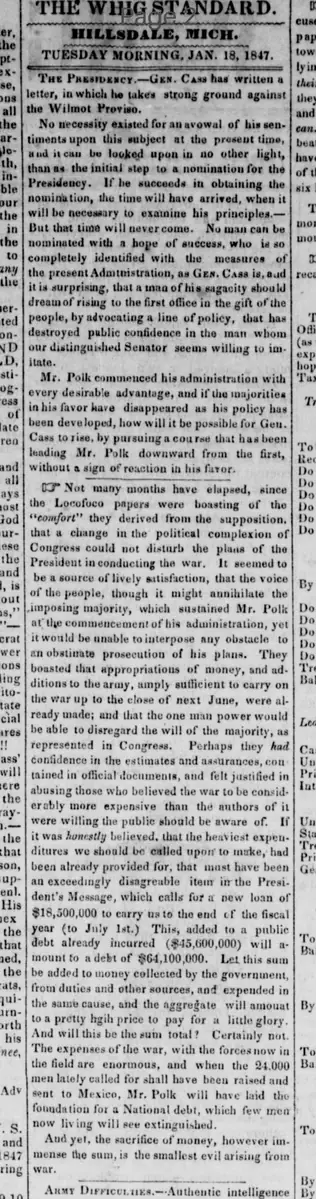
The Presidency,—Gen. Cass has written a letter, in which he takes strong ground against the Wilmot Proviso.
No necessity existed for an avowal of his sentiments upon this subject at the present time, and it can be looked upon in no other light, than as the initial step to a nomination for the Presidency. If he succeeds in obtaining the nomination, the time will have arrived, when it will be necessary to examine his principles.—But that time will never come. No man can be nominated with a hope of success, who is so completely identified with the measures of the present Administration, as Gen. Cass is, and it is surprising, that a man of his sagacity should dream of rising to the first office in the gift of the people, by advocating a line of policy, that has destroyed public confidence in the man whom our distinguished Senator seems willing to imitate.
Mr. Polk commenced his administration with every desirable advantage, and if the majorities in his favor have disappeared as his policy has been developed, how will it be possible for Gen. Cass to rise, by pursuing a course that has been leading Mr. Polk downward from the first, without a sign of reaction in his favor.
Not many months have elapsed, since the Locofoco papers were boasting of the "comfort" they derived from the supposition, that a change in the political complexion of Congress could not disturb the plans of the President in conducting the war. It seemed to be a source of lively satisfaction, that the voice of the people, though it might annihilate the imposing majority, which sustained Mr. Polk at the commencement of his administration, yet it would be unable to interpose any obstacle to an obstinate prosecution of his plans. They boasted that appropriations of money, and additions to the army, amply sufficient to carry on the war up to the close of next June, were already made; and that the one man power would be able to disregard the will of the majority, as represented in Congress. Perhaps they had confidence in the estimates and assurances, contained in official documents, and felt justified in abusing those who believed the war to be considerably more expensive than the authors of it were willing the public should be aware of. If it was honestly believed, that the heaviest expenditures we should be called upon to make, had been already provided for, that must have been an exceedingly disagreeable item in the President's Message, which calls for a new loan of $18,500,000 to carry us to the end of the fiscal year (to July 1st.) This, added to a public debt already incurred ($45,600,000) will amount to a debt of $64,100,000. Let this sum be added to money collected by the government, from duties and other sources, and expended in the same cause, and the aggregate will amount to a pretty high price to pay for a little glory.
And will this be the sum total? Certainly not. The expenses of the war, with the forces now in the field are enormous, and when the 24,000 men lately called for shall have been raised and sent to Mexico, Mr. Polk will have laid the foundation for a National debt, which few men now living will see extinguished.
And yet, the sacrifice of money, however immense the sum, is the smallest evil arising from war.
No necessity existed for an avowal of his sentiments upon this subject at the present time, and it can be looked upon in no other light, than as the initial step to a nomination for the Presidency. If he succeeds in obtaining the nomination, the time will have arrived, when it will be necessary to examine his principles.—But that time will never come. No man can be nominated with a hope of success, who is so completely identified with the measures of the present Administration, as Gen. Cass is, and it is surprising, that a man of his sagacity should dream of rising to the first office in the gift of the people, by advocating a line of policy, that has destroyed public confidence in the man whom our distinguished Senator seems willing to imitate.
Mr. Polk commenced his administration with every desirable advantage, and if the majorities in his favor have disappeared as his policy has been developed, how will it be possible for Gen. Cass to rise, by pursuing a course that has been leading Mr. Polk downward from the first, without a sign of reaction in his favor.
Not many months have elapsed, since the Locofoco papers were boasting of the "comfort" they derived from the supposition, that a change in the political complexion of Congress could not disturb the plans of the President in conducting the war. It seemed to be a source of lively satisfaction, that the voice of the people, though it might annihilate the imposing majority, which sustained Mr. Polk at the commencement of his administration, yet it would be unable to interpose any obstacle to an obstinate prosecution of his plans. They boasted that appropriations of money, and additions to the army, amply sufficient to carry on the war up to the close of next June, were already made; and that the one man power would be able to disregard the will of the majority, as represented in Congress. Perhaps they had confidence in the estimates and assurances, contained in official documents, and felt justified in abusing those who believed the war to be considerably more expensive than the authors of it were willing the public should be aware of. If it was honestly believed, that the heaviest expenditures we should be called upon to make, had been already provided for, that must have been an exceedingly disagreeable item in the President's Message, which calls for a new loan of $18,500,000 to carry us to the end of the fiscal year (to July 1st.) This, added to a public debt already incurred ($45,600,000) will amount to a debt of $64,100,000. Let this sum be added to money collected by the government, from duties and other sources, and expended in the same cause, and the aggregate will amount to a pretty high price to pay for a little glory.
And will this be the sum total? Certainly not. The expenses of the war, with the forces now in the field are enormous, and when the 24,000 men lately called for shall have been raised and sent to Mexico, Mr. Polk will have laid the foundation for a National debt, which few men now living will see extinguished.
And yet, the sacrifice of money, however immense the sum, is the smallest evil arising from war.
What sub-type of article is it?
Partisan Politics
War Or Peace
Economic Policy
What keywords are associated?
Presidential Nomination
Gen Cass
Wilmot Proviso
Mexican War
National Debt
Polk Administration
War Expenses
What entities or persons were involved?
Gen. Cass
Mr. Polk
Locofoco Papers
Congress
Editorial Details
Primary Topic
Criticism Of Gen. Cass's Presidential Ambitions And Ties To Polk's War Policies
Stance / Tone
Strongly Critical Of Cass And Polk Administration
Key Figures
Gen. Cass
Mr. Polk
Locofoco Papers
Congress
Key Arguments
Cass's Letter Against Wilmot Proviso Signals Presidential Bid
Cass Too Tied To Failing Polk Policies For Success
Polk's War Prosecution Ignores Public Will And Creates Massive Debt
New Loan Of $18,500,000 Adds To $64,100,000 Debt
War Expenses Will Lead To Enduring National Debt
Financial Sacrifice Is The Smallest Evil Of War