Thank you for visiting SNEWPapers!
Sign up free
Alexandria Gazette
Alexandria, Alexandria County, District Of Columbia
What is this article about?
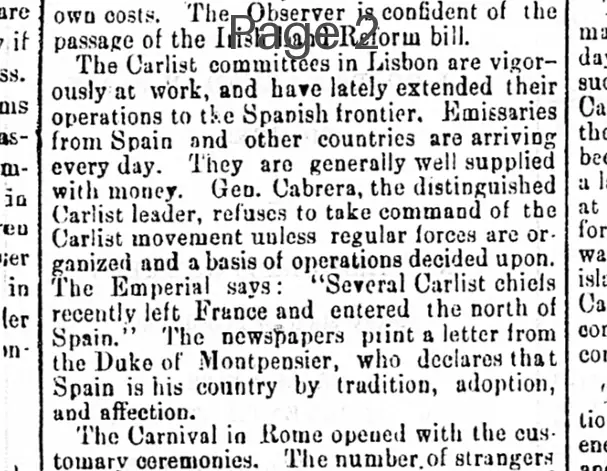
Carlist committees in Lisbon are active, extending operations to the Spanish frontier with arriving emissaries well-funded. Leader Geo. Cabrera refuses command without organized forces. Carlist chiefs entered north Spain from France; Duke of Montpensier affirms his ties to Spain.
Clipping
OCR Quality
Full Text
The Imperial says: "Several Carlist chiefs recently left France and entered the north of Spain." The newspapers print a letter from the Duke of Montpensier, who declares that Spain is his country by tradition, adoption, and affection.
What sub-type of article is it?
What keywords are associated?
What entities or persons were involved?
Where did it happen?
Foreign News Details
Primary Location
Lisbon, Spanish Frontier, North Of Spain
Key Persons
Event Details
Carlist committees in Lisbon are vigorously working and extending operations to the Spanish frontier, with daily arrivals of well-supplied emissaries from Spain and other countries. Geo. Cabrera refuses command unless regular forces are organized and a basis of operations decided. Several Carlist chiefs recently left France for north Spain. Duke of Montpensier declares Spain as his country by tradition, adoption, and affection.