Thank you for visiting SNEWPapers!
Sign up free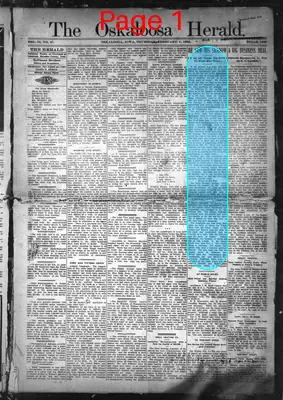
Story
February 4, 1904
The Oskaloosa Herald
Oskaloosa, Mahaska County, Iowa
What is this article about?
Article explains Groundhog Day tradition: if the groundhog sees its shadow on February 2, six more weeks of winter follow. Discusses date disputes, Roman origins in feasts for Februus and Lupercalia, and Christian adaptation to Candlemas Day.
Clipping
OCR Quality
95%
Excellent
Full Text
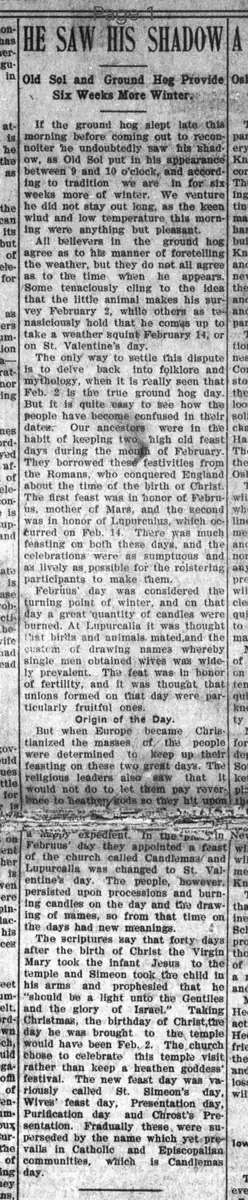
HE SAW HIS SHADOW
Old Sol and Ground Hog Provide
Six Weeks More Winter,
If the ground hog slept late this morning before coming out to reconnoiter he undoubtedly saw his shadow, as Old Sol put in his appearance between 9 and 10 o'clock, and according to tradition we are in for six weeks more of winter. We venture he did not stay out long, as the keen wind and low temperature this morning were anything but pleasant.
All believers in the ground hog agree as to his manner of foretelling the weather, but they do not all agree as to the time when he appears. Some tenaciously cling to the idea that the little animal makes his survey February 2, while others as tenaciously hold that he comes up to take a weather squint February 14, or on St. Valentine's day.
The only way to settle this dispute is to delve back into folklore and mythology, when it is really seen that Feb. 2 is the true ground hog day. But it is quite easy to see how the people have become confused in their dates. Our ancestors were in the habit of keeping two high old feast days during the month of February. They borrowed these festivities from the Romans, who conquered England about the time of the birth of Christ.
The first feast was in honor of Februus, mother of Mars, and the second was in honor of Lupercal, which occurred on Feb. 14. There was much feasting on both these days, and the celebrations were as sumptuous and as lively as possible for the roistering participants to make them.
Februus' day was considered the turning point of winter, and on that day a great quantity of candles were burned. At Lupercalia it was thought that birds and animals mated, and the custom of drawing names whereby single men obtained wives was widely prevalent. The feast was in honor of fertility, and it was thought that unions formed on that day were particularly fruitful ones.
Origin of the Day.
But when Europe became Christianized the masses of the people were determined to keep up their feasting on these two great days. The religious leaders also saw that it would not do to let them pay reverence to heathen gods so they hit upon a happy expedient. In the place of Februus' day they appointed a feast of the church called Candlemas, and Lupercalia was changed to St. Valentine's day. The people, however, persisted upon processions and burning candles on the day and the drawing of names, so from that time on the days had new meanings.
The scriptures say that forty days after the birth of Christ the Virgin Mary took the infant Jesus to the temple and Simeon took the child in his arms and prophesied that he "should be a light unto the Gentiles and the glory of Israel." Taking Christmas, the birthday of Christ, the day he was brought to the temple would have been Feb. 2. The church chose to celebrate this temple visit rather than keep a heathen goddess' festival. The new feast day was variously called St. Simeon's day, Wives' feast day, Presentation day, Purification day and Christ's Presentation. Gradually these were superseded by the name which yet prevails in Catholic and Episcopalian communities, which is Candlemas day.
Old Sol and Ground Hog Provide
Six Weeks More Winter,
If the ground hog slept late this morning before coming out to reconnoiter he undoubtedly saw his shadow, as Old Sol put in his appearance between 9 and 10 o'clock, and according to tradition we are in for six weeks more of winter. We venture he did not stay out long, as the keen wind and low temperature this morning were anything but pleasant.
All believers in the ground hog agree as to his manner of foretelling the weather, but they do not all agree as to the time when he appears. Some tenaciously cling to the idea that the little animal makes his survey February 2, while others as tenaciously hold that he comes up to take a weather squint February 14, or on St. Valentine's day.
The only way to settle this dispute is to delve back into folklore and mythology, when it is really seen that Feb. 2 is the true ground hog day. But it is quite easy to see how the people have become confused in their dates. Our ancestors were in the habit of keeping two high old feast days during the month of February. They borrowed these festivities from the Romans, who conquered England about the time of the birth of Christ.
The first feast was in honor of Februus, mother of Mars, and the second was in honor of Lupercal, which occurred on Feb. 14. There was much feasting on both these days, and the celebrations were as sumptuous and as lively as possible for the roistering participants to make them.
Februus' day was considered the turning point of winter, and on that day a great quantity of candles were burned. At Lupercalia it was thought that birds and animals mated, and the custom of drawing names whereby single men obtained wives was widely prevalent. The feast was in honor of fertility, and it was thought that unions formed on that day were particularly fruitful ones.
Origin of the Day.
But when Europe became Christianized the masses of the people were determined to keep up their feasting on these two great days. The religious leaders also saw that it would not do to let them pay reverence to heathen gods so they hit upon a happy expedient. In the place of Februus' day they appointed a feast of the church called Candlemas, and Lupercalia was changed to St. Valentine's day. The people, however, persisted upon processions and burning candles on the day and the drawing of names, so from that time on the days had new meanings.
The scriptures say that forty days after the birth of Christ the Virgin Mary took the infant Jesus to the temple and Simeon took the child in his arms and prophesied that he "should be a light unto the Gentiles and the glory of Israel." Taking Christmas, the birthday of Christ, the day he was brought to the temple would have been Feb. 2. The church chose to celebrate this temple visit rather than keep a heathen goddess' festival. The new feast day was variously called St. Simeon's day, Wives' feast day, Presentation day, Purification day and Christ's Presentation. Gradually these were superseded by the name which yet prevails in Catholic and Episcopalian communities, which is Candlemas day.
What sub-type of article is it?
Curiosity
Historical Event
What themes does it cover?
Nature
Providence Divine
Social Manners
What keywords are associated?
Groundhog Day
Shadow Prediction
Winter Weather
Candlemas
Folklore Origins
Roman Feasts
What entities or persons were involved?
Ground Hog
Old Sol
Februus
Virgin Mary
Simeon
Story Details
Key Persons
Ground Hog
Old Sol
Februus
Virgin Mary
Simeon
Event Date
February 2
Story Details
The groundhog sees its shadow on February 2, predicting six more weeks of winter. The article traces the tradition's origins to Roman feasts for Februus and Lupercalia, adapted by Christians to Candlemas Day, explaining date confusion with St. Valentine's Day.