Thank you for visiting SNEWPapers!
Sign up free
Literary
April 20, 1811
Alexandria Daily Gazette, Commercial & Political
Alexandria, Virginia
What is this article about?
Humorous essay from 'The Mactwistopedia' defining 'bull' as a blunder, citing Shakespeare, Pope, and fictional sage Hum Whang. It provides examples of linguistic blunders from Irish, English, Scottish, Welsh, American, German, and Chinese sources to argue that such errors are universal, not confined to any nation.
Clipping
OCR Quality
92%
Excellent
Full Text
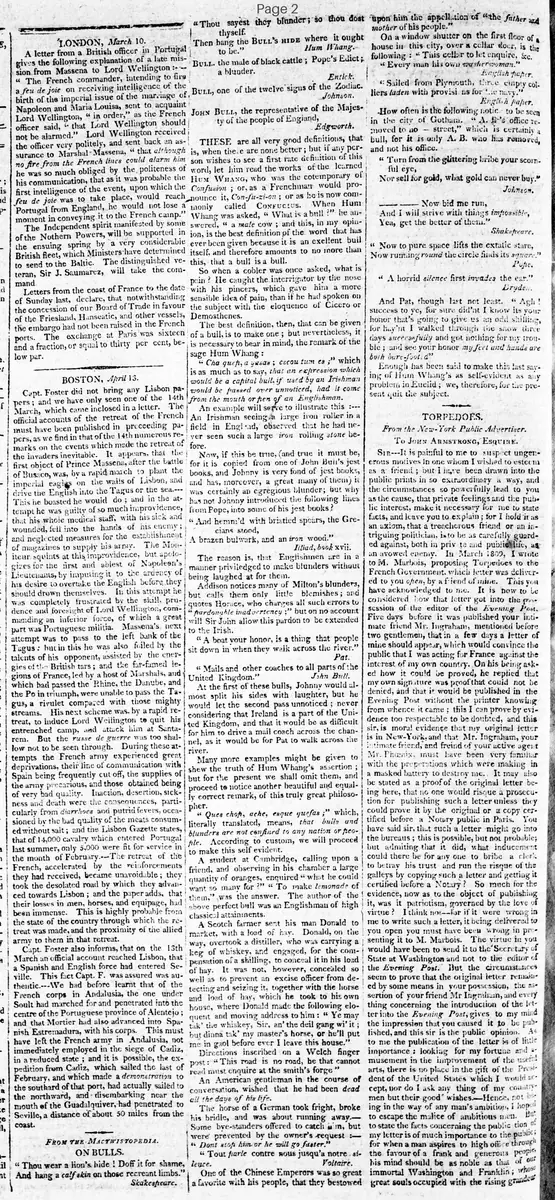
FROM THE MACTWISTOPEDIA.
ON BULLS.
" Thou wear a lion's hide ! Doff it for shame,
And hang a calf skin on those recreant limbs."
Shakespeare.
" Thou sayest they blunder; so thou dost
thyself.
Then hang the Bull's hide where it ought
to be."
Hum Whang.
Bull.. the male of black cattle ; Pope's Edict;
a blunder.
Entick.
Bull, one of the twelve signs of the Zodiac.
Johnson.
John Bull, the representative of the Majes-
ty of the people of England,
.Edgworth.
THESE are all very good definitions, that
is, when there are none better: but if any per-
son wishes to see a first rate definition of this
word, let him read the works of the learned
Hum Whang, who was the cotemporary of
Confusion ; or, as a Frenchman would pro-
nounce it, Con-fu-zi-on ; or as he is now com-
monly called Confucius. When Hum
Whang was asked, " What is a bull ?" he an-
swered, " a male cow ; and this, in my opin-
ion, is the best definition of the word that has
ever been given because it is an excellent bull
itself, and therefore amounts to no more than
this,that a bull is a bull.
So when a cobler was once asked, what is
pain ? He caught the interrigator by the nose
with his pincers, which gave him a more
sensible idea of pain, than if he had spoken on
the subject with the eloquence of Cicero or
Demosthenes.
The best definition. then, that can be given
of a bull, is to make one ; but nevertheless, it
is necessary to bear in mind, the remark of the
sage Hum Whang :
" Cha quefh, a yusas; cscou tum es ;" which
is as much as to say, that an expression which
would be a capital bull. if used by an Irishman
would be passed over unnoticed, had it come
from the mouth or pen of an Englishman.
An example will serve to illustrate this :--
An Irishman seeing a large iron roller in a
field in England, observed that he had ne-
ver seen such a large iron rolling stone be-
fore.
Now, if this be true, (and true it must be,
for it is copied from one of John Bull's jest
books, and Johnny is very fond of jest books,
and has, moreover, a great many of them) it
was certainly an egregious blunder; but why
has not Johnny introduced the following lines
from Pope, into some of his jest books?
" And hemn'd with bristled spears, the Gre-
cians stood,
A brazen bulwark, and an iron wood."
Iliad, book xvii.
The reason is, that Englishmen are in a
manner privileged to make blunders without
being laughed at for them.
Addison notices many of Milton's blunders,
but calls them only little blemishes; and
quotes Horace, who charges all such errors to
"pardonable inattention :" but on no account
will Sir John allow this pardon to be extended
to the Irish.
" A boat your honor, is a thing that people
sit down in when they walk across the river."
Pat.
" Mails and other coaches to all parts of the
United Kingdom."
John Bull.
At the first of these bulls, Johnny would al-
most split his sides with laughter, but he
would let the second pass unnoticed; never
considering that Ireland is a part of the Uni-
ted Kingdom, and that it would be as difficult
for him to drive a mail coach across the chan-
nel, as it would be for Pat to walk across the
river.
Many more examples might be given to
shew the truth of Hum Whang's assertion ;
but for the present we shall omit them, and
proceed to notice another beautiful and equal-
ly correct remark, of this truly great philoso-
pher.
" Ques chop, ache, csque yuefas ;" which,
literally translated, means, that bulls and
blunders are not confined to any nation or peo-
ple. According to custom, we will proceed
to make this self evident.
A student at Cambridge, calling upon a
friend, and observing in his chamber a large
quantity of oranges, enquired " what he could
want so many for ?" " To make lemonade of
them," was the answer. The author of the
above perfect bull was an Englishman of high
classical attainments.
A Scotch farmer sent his man Donald to
market, with a load of hay. Donald, on the
way, overtook a distiller, who was carrying a
keg of whiskey, and engaged, for the com-
pensation of a shilling, to conceal it in his load
of hay. It was not, however, concealed so
well as to prevent an excise officer from de-
tecting and seizing it, together with the horse
and load of hay, which he took to his own
house, where Donald made the following elo-
quent and moving address to him: " Ye may
tak'the whiskey, Sir, an' the deil gang wi'it ;
but dinna tak' ny master's horse, or he'll put
me in gaol before ever I leave this house."
Directions inscribed on a Welch finger
post: " This road is no road, be that cannot
read must enquire at the smith's forge
An American gentleman in the course of
conversation, wished that he had been dead
all the days of his life.
The horse of a German took fright, broke
his bridle, and was about running away.-
Some by-standers offered to catch him, but
were' prevented by the owner's request :-
" Dont stop him or he will go faster."
" Tout fiarle contre nous jusqu'a notre si-
leuce."
Voltaire.
One of the Chinese Emperors was so great
a favorite with his people, that they bestowed
upon him the appellation of "the Sage
mother of his people.'
On a window shutter on the first floor of a
house in this city, over a cellar door, is the
following : " This cellar to let enquire, &c.
" Every man his own washerwoman.'
English paper.
" Sailed from Plymouth, three empty col-
liers laden with provisions for the navy."
English paper.
How often is the following notice - to be seen
in the city of Gotham. " A. B's office re-
moved to no - street," which is certainly a
bull, for it is only A. B. who has removed,
and not his office.
" Turn from the glittering bribe your scorn.
ful eye,
Nor sell for gold, what gold can never buy."
Johnson.
.-- Now bid me run,
And I will strive with things impossible,
Yea, get the better of them.
Shakespeare.
" Now to pure space lifts the extatic stare,
Now ruming round the circle finds its square."
Pope.
" A horrid silence first invades the ear."
Dryden.
And Pat, though last not least. " Agh !
success to ye, for sure did'nt I know its your
honor's that's going to give us an odd shilling.
for hay'nt I walked through the show three
days successfully and got nothing for my trou-
ble; and see your honor my feet and hands are
both bare-footed"
Enough has been said to make this last say.
ing of Hum Whang's as self-evident as any
problem in Euclid; we, therefore, for the pre-
sent quit the subject
ON BULLS.
" Thou wear a lion's hide ! Doff it for shame,
And hang a calf skin on those recreant limbs."
Shakespeare.
" Thou sayest they blunder; so thou dost
thyself.
Then hang the Bull's hide where it ought
to be."
Hum Whang.
Bull.. the male of black cattle ; Pope's Edict;
a blunder.
Entick.
Bull, one of the twelve signs of the Zodiac.
Johnson.
John Bull, the representative of the Majes-
ty of the people of England,
.Edgworth.
THESE are all very good definitions, that
is, when there are none better: but if any per-
son wishes to see a first rate definition of this
word, let him read the works of the learned
Hum Whang, who was the cotemporary of
Confusion ; or, as a Frenchman would pro-
nounce it, Con-fu-zi-on ; or as he is now com-
monly called Confucius. When Hum
Whang was asked, " What is a bull ?" he an-
swered, " a male cow ; and this, in my opin-
ion, is the best definition of the word that has
ever been given because it is an excellent bull
itself, and therefore amounts to no more than
this,that a bull is a bull.
So when a cobler was once asked, what is
pain ? He caught the interrigator by the nose
with his pincers, which gave him a more
sensible idea of pain, than if he had spoken on
the subject with the eloquence of Cicero or
Demosthenes.
The best definition. then, that can be given
of a bull, is to make one ; but nevertheless, it
is necessary to bear in mind, the remark of the
sage Hum Whang :
" Cha quefh, a yusas; cscou tum es ;" which
is as much as to say, that an expression which
would be a capital bull. if used by an Irishman
would be passed over unnoticed, had it come
from the mouth or pen of an Englishman.
An example will serve to illustrate this :--
An Irishman seeing a large iron roller in a
field in England, observed that he had ne-
ver seen such a large iron rolling stone be-
fore.
Now, if this be true, (and true it must be,
for it is copied from one of John Bull's jest
books, and Johnny is very fond of jest books,
and has, moreover, a great many of them) it
was certainly an egregious blunder; but why
has not Johnny introduced the following lines
from Pope, into some of his jest books?
" And hemn'd with bristled spears, the Gre-
cians stood,
A brazen bulwark, and an iron wood."
Iliad, book xvii.
The reason is, that Englishmen are in a
manner privileged to make blunders without
being laughed at for them.
Addison notices many of Milton's blunders,
but calls them only little blemishes; and
quotes Horace, who charges all such errors to
"pardonable inattention :" but on no account
will Sir John allow this pardon to be extended
to the Irish.
" A boat your honor, is a thing that people
sit down in when they walk across the river."
Pat.
" Mails and other coaches to all parts of the
United Kingdom."
John Bull.
At the first of these bulls, Johnny would al-
most split his sides with laughter, but he
would let the second pass unnoticed; never
considering that Ireland is a part of the Uni-
ted Kingdom, and that it would be as difficult
for him to drive a mail coach across the chan-
nel, as it would be for Pat to walk across the
river.
Many more examples might be given to
shew the truth of Hum Whang's assertion ;
but for the present we shall omit them, and
proceed to notice another beautiful and equal-
ly correct remark, of this truly great philoso-
pher.
" Ques chop, ache, csque yuefas ;" which,
literally translated, means, that bulls and
blunders are not confined to any nation or peo-
ple. According to custom, we will proceed
to make this self evident.
A student at Cambridge, calling upon a
friend, and observing in his chamber a large
quantity of oranges, enquired " what he could
want so many for ?" " To make lemonade of
them," was the answer. The author of the
above perfect bull was an Englishman of high
classical attainments.
A Scotch farmer sent his man Donald to
market, with a load of hay. Donald, on the
way, overtook a distiller, who was carrying a
keg of whiskey, and engaged, for the com-
pensation of a shilling, to conceal it in his load
of hay. It was not, however, concealed so
well as to prevent an excise officer from de-
tecting and seizing it, together with the horse
and load of hay, which he took to his own
house, where Donald made the following elo-
quent and moving address to him: " Ye may
tak'the whiskey, Sir, an' the deil gang wi'it ;
but dinna tak' ny master's horse, or he'll put
me in gaol before ever I leave this house."
Directions inscribed on a Welch finger
post: " This road is no road, be that cannot
read must enquire at the smith's forge
An American gentleman in the course of
conversation, wished that he had been dead
all the days of his life.
The horse of a German took fright, broke
his bridle, and was about running away.-
Some by-standers offered to catch him, but
were' prevented by the owner's request :-
" Dont stop him or he will go faster."
" Tout fiarle contre nous jusqu'a notre si-
leuce."
Voltaire.
One of the Chinese Emperors was so great
a favorite with his people, that they bestowed
upon him the appellation of "the Sage
mother of his people.'
On a window shutter on the first floor of a
house in this city, over a cellar door, is the
following : " This cellar to let enquire, &c.
" Every man his own washerwoman.'
English paper.
" Sailed from Plymouth, three empty col-
liers laden with provisions for the navy."
English paper.
How often is the following notice - to be seen
in the city of Gotham. " A. B's office re-
moved to no - street," which is certainly a
bull, for it is only A. B. who has removed,
and not his office.
" Turn from the glittering bribe your scorn.
ful eye,
Nor sell for gold, what gold can never buy."
Johnson.
.-- Now bid me run,
And I will strive with things impossible,
Yea, get the better of them.
Shakespeare.
" Now to pure space lifts the extatic stare,
Now ruming round the circle finds its square."
Pope.
" A horrid silence first invades the ear."
Dryden.
And Pat, though last not least. " Agh !
success to ye, for sure did'nt I know its your
honor's that's going to give us an odd shilling.
for hay'nt I walked through the show three
days successfully and got nothing for my trou-
ble; and see your honor my feet and hands are
both bare-footed"
Enough has been said to make this last say.
ing of Hum Whang's as self-evident as any
problem in Euclid; we, therefore, for the pre-
sent quit the subject
What sub-type of article is it?
Satire
Essay
What themes does it cover?
Social Manners
What keywords are associated?
Bulls
Blunders
Hum Whang
Irish Bulls
English Blunders
National Stereotypes
Language Errors
What entities or persons were involved?
From The Mactwistopedia.
Literary Details
Title
On Bulls.
Author
From The Mactwistopedia.
Subject
Definitions And Examples Of 'Bulls' Or Blunders
Form / Style
Satirical Essay With Quotations And Anecdotes
Key Lines
" A Male Cow ; And This, In My Opinion, Is The Best Definition Of The Word That Has Ever Been Given Because It Is An Excellent Bull Itself, And Therefore Amounts To No More Than This,That A Bull Is A Bull."
" Cha Quefh, A Yusas; Cscou Tum Es ;" Which Is As Much As To Say, That An Expression Which Would Be A Capital Bull. If Used By An Irishman Would Be Passed Over Unnoticed, Had It Come From The Mouth Or Pen Of An Englishman.
" Ques Chop, Ache, Csque Yuefas ;" Which, Literally Translated, Means, That Bulls And Blunders Are Not Confined To Any Nation Or People.