Thank you for visiting SNEWPapers!
Sign up free
Daily National Intelligencer
Washington, District Of Columbia
What is this article about?
In London's House of Commons on February 8, MP Brougham demands papers on two 1815 treaties: one between Austria, Russia, and Prussia (ratified December 25), suspecting anti-non-Christian powers intent, and another dated January 6 involving France and Austria. Foreign Secretary Castlereagh defends the first as benevolent and tolerant, refusing to discuss the second.
Clipping
OCR Quality
Full Text
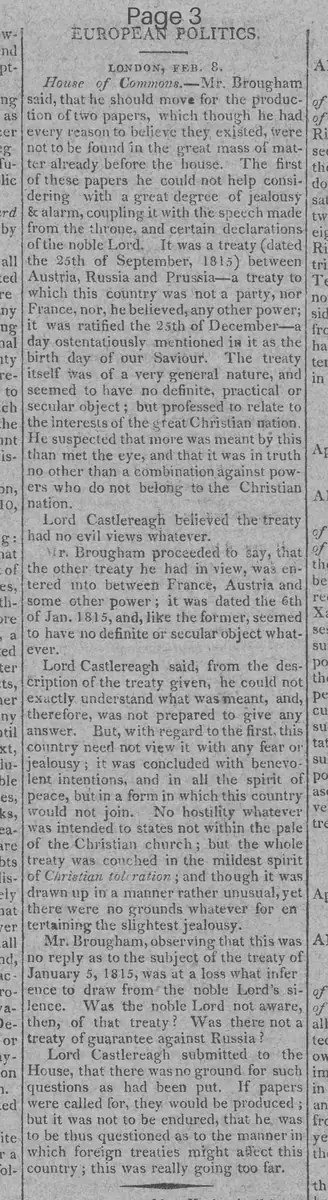
LONDON, FEB. 8.
House of Commons.-Mr. Brougham said, that he should move for the production of two papers, which though he had every reason to believe they existed, were not to be found in the great mass of matter already before the house. The first of these papers he could not help considering with a great degree of jealousy & alarm, coupling it with the speech made from the throne, and certain declarations of the noble Lord. It was a treaty (dated the 25th of September, 1815) between Austria, Russia and Prussia-a treaty to which this country was not a party, nor France, nor, he believed, any other power; it was ratified the 25th of December a day ostentatiously mentioned in it as the birth day of our Saviour. The treaty itself was of a very general nature, and seemed to have no definite, practical or secular object; but professed to relate to the interests of the great Christian nation. He suspected that more was meant by this than met the eye, and that it was in truth no other than a combination against powers who do not belong to the Christian nation.
Lord Castlereagh believed the treaty had no evil views whatever.
Mr. Brougham proceeded to say, that the other treaty he had in view, was entered into between France, Austria and some other power: it was dated the 6th of Jan. 1815, and, like the former, seemed to have no definite or secular object whatever.
Lord Castlereagh said, from the description of the treaty given, he could not exactly understand what was meant, and, therefore, was not prepared to give any answer. But, with regard to the first, this country need not view it with any fear or jealousy; it was concluded with benevolent intentions, and in all the spirit of peace, but in a form in which this country would not join. No hostility whatever was intended to states not within the pale of the Christian church: but the whole treaty was couched in the mildest spirit of Christian toleration ; and though it was drawn up in a manner rather unusual, yet there were no grounds whatever for entertaining the slightest jealousy.
Mr. Brougham, observing that this was no reply as to the subject of the treaty of January 5, 1815, was at a loss what inference to draw from the noble Lord's silence. Was the noble Lord not aware, then, of that treaty? Was there not a treaty of guarantee against Russia ?
Lord Castlereagh submitted to the House, that there was no ground for such questions as had been put. If papers were called for, they would be produced; but it was not to be endured, that he was to be thus questioned as to the manner in which foreign treaties might affect this country; this was really going too far.
What sub-type of article is it?
What keywords are associated?
What entities or persons were involved?
Where did it happen?
Foreign News Details
Primary Location
Austria, Russia, Prussia
Event Date
February 8
Key Persons
Outcome
papers on the treaties to be produced; castlereagh defends the september 1815 treaty as benevolent and peaceful, with no comment on the january 1815 treaty.
Event Details
In the House of Commons, Mr. Brougham moves for two treaty papers: one dated September 25, 1815, between Austria, Russia, and Prussia, ratified December 25, 1815, suspecting it as a Christian alliance against non-Christian powers; the other dated January 6, 1815, between France, Austria, and others. Lord Castlereagh assures the first has no evil intent, is peaceful and tolerant, but Britain did not join; he avoids discussing the second, stating papers will be provided if requested and rejecting further questioning.