Thank you for visiting SNEWPapers!
Sign up free
Literary
February 22, 1822
The Rhode Island American, And General Advertiser
Providence, Providence County, Rhode Island
What is this article about?
A visionary poem depicting the poet's dream of Napoleon's death and burial on St. Helena, reflecting on his rise to power, military conquests, sufferings in exile, and enduring legacy as a cautionary tale of ambition and a model of perseverance for societal good.
Clipping
OCR Quality
98%
Excellent
Full Text
Miscellany.
FROM THE BOSTON PALLADIUM
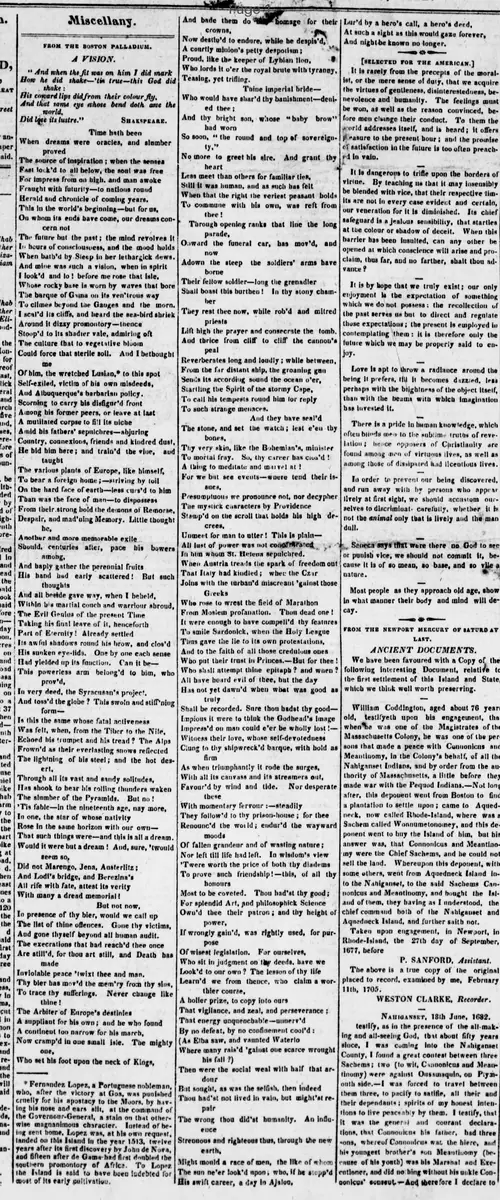
A VISION.
"And when the fit was on him I did mark
How he did shake—'tis true, this God did shake:
His coward lips did from their colour fly.
And that same eye whose beam doth awe the world,
Did lose its lustre."
SHAKSPEARE.
Time hath been
When dreams were oracles, and slumber proved
The source of inspiration; when the senses
Fast lock'd to all below, the soul was free
For impress from on high, and man awoke
Fraught with futurity—to nations round
Herald and chronicle of coming years.
This in the world's beginning—but for us,
On whom its ends have come, our dreams concern not
The future but the past; the mind revolves it
In hours of consciousness, and the mood holds
When bath'd by Sleep in her lethargick dews.
And such was such a vision, when in spirit
I look'd and lo! before me rose that isle,
Whose rocky base is worn by waves that bore
The bark of Gama on its vent'rous way
To climes beyond the Ganges and the morn.
I scal'd its cliffs, and heard the sea-bird shriek
Around its dizzy promontory—thence
Stoop'd to its shadier vale, admiring oft
The culture that to vegetative bloom
Could force that sterile soil. And I bethought me
Of him, the wretched Lusian,* to this spot
Self-exiled, victim of his own misdeeds,
And Albuquerque's barbarian policy.
Scorning to carry his disfigur'd front
Among his former peers, or leave at last
A mutilated corpse to fill its niche
Amid his fathers' sepulchres—abjuring
Country, connexions, friends and kindred dust,
He hid him here; and train'd the vine, and taught
The various plants of Europe, like himself,
To bear a foreign home;—striving by toil
On the hard face of earth—less curs'd to him
Than was the face of man—to dispossess
From their strong hold the demons of Remorse,
Despair, and madd'ning Memory. Little thought he,
Another and more memorable exile
Should, centuries after, pace his bowers among,
And haply gather the perennial fruits
His hand had early scattered! But such thoughts
And all beside gave way, when I beheld,
Within his martial couch and warrior shroud,
The Evil Genius of the present Time
Taking his final leave of it, henceforth
Part of Eternity! Already settled
Its awful shadows round his brow, and clos'd
His sunken eye-lids. One by one each sense
Had yielded up its function. Can it be—
This powerless arm belong'd to him, who prov'd,
In very deed, the Syracusan's project,
And toss'd the globe? This swoln and stiff'ning form—
Is this the same whose fatal activeness
Was felt, when, from the Tiber to the Nile,
Echoed his trumpet and his tread? The Alps
Frown'd as their everlasting snows reflected
The lightning of his steel; and the hot desert,
Through all its vast and sandy solitudes,
Has shook to hear his rolling thunders waken
The slumber of the Pyramids. But no!
'Tis fable—in the nineteenth age, nay more,
In one, the star of whose nativity
Rose in the same horizon with our own—
That such things were—and this is all a dream.
Would it were but a dream! And, sure, 'twould seem so,
Did not Marengo, Jena, Austerlitz;
And Lodi's bridge, and Berezina's
All rife with fate, attest its verity
With many a dread memorial!
But not now,
In presence of thy bier, would we call up
The list of thine offences. Gone thy victims,
And gone thyself beyond all human audit.
The execrations that had reach'd thee once
Are still'd, for thou art still, and Death has made
Inviolable peace 'twixt thee and man.
Thy bier has mov'd the mem'ry from thy sins,
To trace thy sufferings. Never change like thine!
The Arbiter of Europe's destinies
A suppliant for his own; and he who found
A continent too narrow for his march,
Now cramp'd in one small isle. The mighty one,
Who set his foot upon the neck of Kings,
And bade them do his homage: for their crowns.
Now destin'd to endure, while he despis'd,
A courtly minion's petty despotism;
Proud, like the keeper of Lybian lion,
Who lords it o'er the royal brute with tyranny
Teasing, yet trifling. Thine imperial bride—
Who would have shar'd thy banishment—denied thee;
And thy bright son, whose "baby brow"
Had worn
So soon, "the round and top of sovereignty."
No more to greet his sire. And grant thy heart
Less meet than others for familiar tear,
Still it was human, and as such has felt
When that the right the veriest peasant holds
To commune with his own, was rent from thee!
Through opening ranks that line the long parade,
Onward the funeral car, has mov'd, and now
Adown the steep the soldiers' arms have borne
Their fellow soldier—long the grenadier
Shall boast this burthen! In thy stony chamber
They rest thee now, while rob'd and mitred priests
Lift high the prayer and consecrate the tomb,
And thrice from cliff to cliff the cannon peal
Reverberates long and loudly; while between,
From the far distant ship, the groaning gun
Sends its according sound the ocean o'er,
Startling the Spirit of the stormy Cape,
To call his tempests round him for reply
To such strange menaces.
And they have seal'd
The stone, and set the watch; lest e'en thy bones,
Thy very skin, like the Bohemian's, minister
To mortal fray. So, thy career has clos'd!
A thing to meditate and marvel at!
For we but see events—where tend their issues
Presumptuous we pronounce not, nor decypher
The mystick characters by Providence
Stamp'd on the scroll that holds his high decrees,
Upmeet for man to utter! This is plain—
All lust of power was not concentrated
In him whom St. Helena sepulchred.
When Austria treads the spark of freedom out
That Italy had kindled; where the Czar
Joins with the turban'd miscreant 'gainst those Greeks
Who rose to wrest the field of Marathon
From Moslem profanation. Thou dead one!
It were enough to have compell'd thy features
To smile Sardonick, when the Holy League
Thus gave the lie to its own protestations,
And to the faith of all those credulous ones
Who put their trust in Princes,—But for thee
Who shall attempt thine epitaph? and weep?
All have heard evil of thee, but the day
Has not yet dawn'd when what was good as truly
Shall be recorded. Sure thou hadst thy good—
Impious it were to think the Godhead's image
Impress'd on man could e'er be wholly lost!—
Witness their love, whose self-devotedness
Clung to thy shipwreck'd bark, with hold as firm
As when triumphantly it rode the surges,
With all its canvass and its streamers out,
Favour'd by wind and tide. Nor desperate these
With momentary fervour:—steadily
They follow'd to thy prison-house; for thee
Renounc'd the world; endur'd the wayward moods
Of fallen grandeur and of wasting nature;
Nor left till life had left. In wisdom's view
'Twere worth the price of both thy diadems
To prove such friendship!—this, of all thy honours
Most to be coveted. Thou had'st thy good;
For splendid Art, and philosophick Science
Owed thee their patron; and thy height of power,
If wrongly gain'd, was rightly used, for purpose
Of wisest legislation. For ourselves,
Who sit in judgment on thy deeds, have we
Look'd to our own? The lesson of thy life
Learn'd we from thence, who claim a worthier course,
A holier prize, to copy into ours
That vigilance, and zeal, and perseverance;
That energy unquenchable—unerv'd
By no defeat, by no confinement cool'd:
(As Elba saw, and vaunted Waterloo
Where many rais'd 'gainst one scarce wrought his fall?)
Then were the social weal with half that ardour
But sought, as was the selfish, then indeed
Thou hadst not lived in vain, but might'st repair
The wrong thou didst humanity. An influence
Strenuous and righteous thus, through the new earth,
Might mould a race of men, the like of whom
The sun ne'er look'd upon; who, if he stopp'd
His swift career, a day in Ajalon,
Lur'd by a hero's call, a hero's deed.
At such a sight as this would gaze forever,
And night be known no longer.
FROM THE BOSTON PALLADIUM
A VISION.
"And when the fit was on him I did mark
How he did shake—'tis true, this God did shake:
His coward lips did from their colour fly.
And that same eye whose beam doth awe the world,
Did lose its lustre."
SHAKSPEARE.
Time hath been
When dreams were oracles, and slumber proved
The source of inspiration; when the senses
Fast lock'd to all below, the soul was free
For impress from on high, and man awoke
Fraught with futurity—to nations round
Herald and chronicle of coming years.
This in the world's beginning—but for us,
On whom its ends have come, our dreams concern not
The future but the past; the mind revolves it
In hours of consciousness, and the mood holds
When bath'd by Sleep in her lethargick dews.
And such was such a vision, when in spirit
I look'd and lo! before me rose that isle,
Whose rocky base is worn by waves that bore
The bark of Gama on its vent'rous way
To climes beyond the Ganges and the morn.
I scal'd its cliffs, and heard the sea-bird shriek
Around its dizzy promontory—thence
Stoop'd to its shadier vale, admiring oft
The culture that to vegetative bloom
Could force that sterile soil. And I bethought me
Of him, the wretched Lusian,* to this spot
Self-exiled, victim of his own misdeeds,
And Albuquerque's barbarian policy.
Scorning to carry his disfigur'd front
Among his former peers, or leave at last
A mutilated corpse to fill its niche
Amid his fathers' sepulchres—abjuring
Country, connexions, friends and kindred dust,
He hid him here; and train'd the vine, and taught
The various plants of Europe, like himself,
To bear a foreign home;—striving by toil
On the hard face of earth—less curs'd to him
Than was the face of man—to dispossess
From their strong hold the demons of Remorse,
Despair, and madd'ning Memory. Little thought he,
Another and more memorable exile
Should, centuries after, pace his bowers among,
And haply gather the perennial fruits
His hand had early scattered! But such thoughts
And all beside gave way, when I beheld,
Within his martial couch and warrior shroud,
The Evil Genius of the present Time
Taking his final leave of it, henceforth
Part of Eternity! Already settled
Its awful shadows round his brow, and clos'd
His sunken eye-lids. One by one each sense
Had yielded up its function. Can it be—
This powerless arm belong'd to him, who prov'd,
In very deed, the Syracusan's project,
And toss'd the globe? This swoln and stiff'ning form—
Is this the same whose fatal activeness
Was felt, when, from the Tiber to the Nile,
Echoed his trumpet and his tread? The Alps
Frown'd as their everlasting snows reflected
The lightning of his steel; and the hot desert,
Through all its vast and sandy solitudes,
Has shook to hear his rolling thunders waken
The slumber of the Pyramids. But no!
'Tis fable—in the nineteenth age, nay more,
In one, the star of whose nativity
Rose in the same horizon with our own—
That such things were—and this is all a dream.
Would it were but a dream! And, sure, 'twould seem so,
Did not Marengo, Jena, Austerlitz;
And Lodi's bridge, and Berezina's
All rife with fate, attest its verity
With many a dread memorial!
But not now,
In presence of thy bier, would we call up
The list of thine offences. Gone thy victims,
And gone thyself beyond all human audit.
The execrations that had reach'd thee once
Are still'd, for thou art still, and Death has made
Inviolable peace 'twixt thee and man.
Thy bier has mov'd the mem'ry from thy sins,
To trace thy sufferings. Never change like thine!
The Arbiter of Europe's destinies
A suppliant for his own; and he who found
A continent too narrow for his march,
Now cramp'd in one small isle. The mighty one,
Who set his foot upon the neck of Kings,
And bade them do his homage: for their crowns.
Now destin'd to endure, while he despis'd,
A courtly minion's petty despotism;
Proud, like the keeper of Lybian lion,
Who lords it o'er the royal brute with tyranny
Teasing, yet trifling. Thine imperial bride—
Who would have shar'd thy banishment—denied thee;
And thy bright son, whose "baby brow"
Had worn
So soon, "the round and top of sovereignty."
No more to greet his sire. And grant thy heart
Less meet than others for familiar tear,
Still it was human, and as such has felt
When that the right the veriest peasant holds
To commune with his own, was rent from thee!
Through opening ranks that line the long parade,
Onward the funeral car, has mov'd, and now
Adown the steep the soldiers' arms have borne
Their fellow soldier—long the grenadier
Shall boast this burthen! In thy stony chamber
They rest thee now, while rob'd and mitred priests
Lift high the prayer and consecrate the tomb,
And thrice from cliff to cliff the cannon peal
Reverberates long and loudly; while between,
From the far distant ship, the groaning gun
Sends its according sound the ocean o'er,
Startling the Spirit of the stormy Cape,
To call his tempests round him for reply
To such strange menaces.
And they have seal'd
The stone, and set the watch; lest e'en thy bones,
Thy very skin, like the Bohemian's, minister
To mortal fray. So, thy career has clos'd!
A thing to meditate and marvel at!
For we but see events—where tend their issues
Presumptuous we pronounce not, nor decypher
The mystick characters by Providence
Stamp'd on the scroll that holds his high decrees,
Upmeet for man to utter! This is plain—
All lust of power was not concentrated
In him whom St. Helena sepulchred.
When Austria treads the spark of freedom out
That Italy had kindled; where the Czar
Joins with the turban'd miscreant 'gainst those Greeks
Who rose to wrest the field of Marathon
From Moslem profanation. Thou dead one!
It were enough to have compell'd thy features
To smile Sardonick, when the Holy League
Thus gave the lie to its own protestations,
And to the faith of all those credulous ones
Who put their trust in Princes,—But for thee
Who shall attempt thine epitaph? and weep?
All have heard evil of thee, but the day
Has not yet dawn'd when what was good as truly
Shall be recorded. Sure thou hadst thy good—
Impious it were to think the Godhead's image
Impress'd on man could e'er be wholly lost!—
Witness their love, whose self-devotedness
Clung to thy shipwreck'd bark, with hold as firm
As when triumphantly it rode the surges,
With all its canvass and its streamers out,
Favour'd by wind and tide. Nor desperate these
With momentary fervour:—steadily
They follow'd to thy prison-house; for thee
Renounc'd the world; endur'd the wayward moods
Of fallen grandeur and of wasting nature;
Nor left till life had left. In wisdom's view
'Twere worth the price of both thy diadems
To prove such friendship!—this, of all thy honours
Most to be coveted. Thou had'st thy good;
For splendid Art, and philosophick Science
Owed thee their patron; and thy height of power,
If wrongly gain'd, was rightly used, for purpose
Of wisest legislation. For ourselves,
Who sit in judgment on thy deeds, have we
Look'd to our own? The lesson of thy life
Learn'd we from thence, who claim a worthier course,
A holier prize, to copy into ours
That vigilance, and zeal, and perseverance;
That energy unquenchable—unerv'd
By no defeat, by no confinement cool'd:
(As Elba saw, and vaunted Waterloo
Where many rais'd 'gainst one scarce wrought his fall?)
Then were the social weal with half that ardour
But sought, as was the selfish, then indeed
Thou hadst not lived in vain, but might'st repair
The wrong thou didst humanity. An influence
Strenuous and righteous thus, through the new earth,
Might mould a race of men, the like of whom
The sun ne'er look'd upon; who, if he stopp'd
His swift career, a day in Ajalon,
Lur'd by a hero's call, a hero's deed.
At such a sight as this would gaze forever,
And night be known no longer.
What sub-type of article is it?
Poem
Vision Or Dream
What themes does it cover?
Political
War Peace
Moral Virtue
What keywords are associated?
Napoleon
Exile
St Helena
Vision
Power
Legacy
War
Remorse
What entities or persons were involved?
From The Boston Palladium
Literary Details
Title
A Vision.
Author
From The Boston Palladium
Form / Style
Visionary Elegy In Verse
Key Lines
Time Hath Been
When Dreams Were Oracles, And Slumber Proved
The Source Of Inspiration; When The Senses
Fast Lock'd To All Below, The Soul Was Free
For Impress From On High, And Man Awoke
Fraught With Futurity—To Nations Round
Herald And Chronicle Of Coming Years.
This Swoln And Stiff'ning Form—
Is This The Same Whose Fatal Activeness
Was Felt, When, From The Tiber To The Nile,
Echoed His Trumpet And His Tread?
Would It Were But A Dream! And, Sure, 'Twould Seem So,
Did Not Marengo, Jena, Austerlitz;
And Lodi's Bridge, And Berezina's
All Rife With Fate, Attest Its Verity
With Many A Dread Memorial!
Thou Had'st Thy Good;
For Splendid Art, And Philosophick Science
Owed Thee Their Patron; And Thy Height Of Power,
If Wrongly Gain'd, Was Rightly Used, For Purpose
Of Wisest Legislation.