Thank you for visiting SNEWPapers!
Sign up free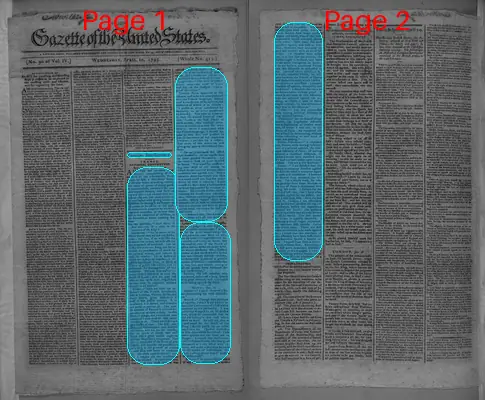
Gazette Of The United States
New York, New York County, New York
What is this article about?
Debates in the French National Convention on January 19 and 21, 1793, regarding whether to delay the execution of King Louis XVI, featuring speeches by Manuel, Condorcet, Brissot, Legendre, Thomas Paine, Lelard, Barrere, and others; later discussions on threats and accusations among members.
Merged-components note: Seamless continuation of the French Convention debate from page 1 to page 2.
Clippings
1 of 2
OCR Quality
Full Text
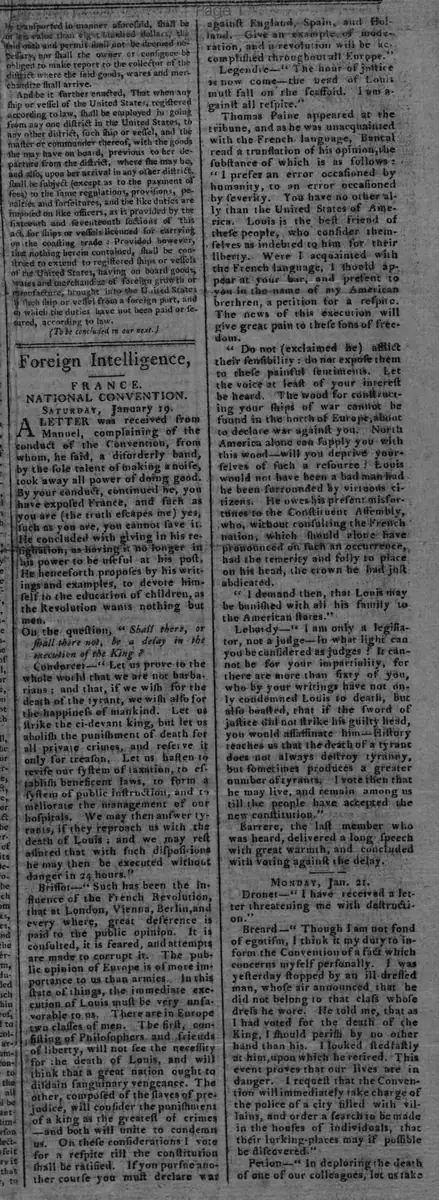
SATURDAY, January 19.
A LETTER was received from Manuel, complaining of the conduct of the Convention, from whom, he said, a disorderly band, by the sole talent of making a noise, took away all power of doing good. By your conduct, continued he, you have exposed France, and such as you are (the truth escapes me) yes, such as you are, you cannot save it. He concluded with giving in his resignation, as having it no longer in his power to be useful at his post. He henceforth proposes by his writings and examples, to devote himself to the education of children, as the Revolution wants nothing but men.
On the question, "Shall there, or shall there not, be a delay in the execution of the King?"
Condorcet- "Let us prove to the whole world that we are not barbarians; and that, if we wish for the death of the tyrant, we wish also for the happiness of mankind. Let us strike the ci-devant king, but let us abolish the punishment of death for all private crimes, and reserve it only for treason. Let us hasten to revise our system of taxation, to establish beneficent laws, to form a system of public instruction, and to meliorate the management of our hospitals. We may then answer tyrants, if they reproach us with the death of Louis; and we may rest assured that with such dispositions he may then be executed without danger in 24 hours."
Brissot- "Such has been the influence of the French Revolution, that at London, Vienna, Berlin, and everywhere, great deference is paid to the public Opinion. It is consulted, it is feared, and attempts are made to corrupt it. The public opinion of Europe is of more importance to us than armies. In this state of things, the immediate execution of Louis must be very unfavorable to us. There are in Europe two classes of men. The first, consisting of Philosophers and friends of liberty, will not see the necessity for the death of Louis, and will think that a great nation ought to disdain sanguinary vengeance. The other, composed of the slaves of prejudice, will consider the punishment of a king as the greatest of crimes -and both will unite to condemn us. On these considerations I vote for a respite till the constitution shall be ratified. If you pursue another course you must declare war against England, Spain, and Holland. --Give an example of moderation, and a revolution will be accomplished throughout all Europe."
Legendre- "The hour of justice is now come the head of Louis must fall on the scaffold. I am against all respite."
Thomas Paine appeared at the tribune, and as he was unacquainted with the French language, Bancal read a translation of his opinion, the substance of which is as follows:
"I prefer an error occasioned by humanity, to an error occasioned by severity. You have no other ally than the United States of America. Louis is the best friend of these people, who consider themselves as indebted to him for their liberty. Were I acquainted with the French language, I should appear at your bar, and present to you in the name of my American brethren, a petition for a respite. The news of this execution will give great pain to these sons of freedom.
"Do not (exclaimed he) afflict their sensibility: do not expose them to these painful sentiments. Let the voice at least of your interest be heard. The wood for constructing your ships of war cannot be found in the north of Europe, about to declare war against you. North America alone can supply you with this wood-will you deprive yourselves of such a resource? Louis would not have been a bad man had he been surrounded by virtuous citizens. He owes his present misfortunes to the Constituent Assembly, who, without consulting the French nation, which should alone have pronounced on such an occurrence, had the temerity and folly to place, on his head, the crown he had just abdicated.
"I demand then, that Louis may be banished with all his family to the American states."
Lelard- "I am only a legislator, not a judge--In what light can you be considered as judges? It cannot be for your impartiality, for there are more than sixty of you, who by your writings have not only condemned Louis to death, but also boasted, that if the sword of justice did not strike his guilty head, you would assassinate him History teaches us that the death of a tyrant does not always destroy tyranny, but sometimes produces a greater number of tyrants; I vote then that he may live, and remain among us till the people have accepted the new constitution."
Barrere, the last member who was heard, delivered a long speech with great warmth, and concluded with voting against the delay.
MONDAY, Jan. 21.
Drouet- "I have received a letter threatening me with destruction."
Breard- "Though I am not fond of egotism, I think it my duty to inform the Convention of a fact which concerns myself personally. I was yesterday stopped by an ill-dressed man, whose air announced that he did not belong to that class whose dress he wore. He told me, that as I had voted for the death of the King, I should perish by no other hand than his. I looked steadfastly at him, upon which he retired. This event proves that our lives are in danger. I request that the Convention will immediately take charge of the police of a city filled with villains, and order a search to be made in the houses of individuals, that their lurking-places may if possible be discovered."
Petion- "In deploring the death of one of our colleagues, let us take
Care, citizens, that our indignation be not lost to the public. Whoever reflects upon what passes, has reason to lament how many persons suspect and detest, who, if they were acquainted, would mutually esteem each other. Here men, the most opposite, equally wish well to freedom; however, they mutually regard one another with an air of suspicion. [A Member here called out, in a time like the present, the feeble ought to be silent, and leave to the more courageous to speak.] I do not believe, continued Petion, that this discourse is addressed to me. [Several voices called it is.] It is most, resumed Petion, an alliance between the friends of liberty and those of tyranny which I desire: the alliance is impossible; I demand freedom of opinion, tranquility and confidence; I demand that there be no denunciation without proof. If there is any man in this Assembly, who can advance against me anything, at which a man of honor ought to blush, let him advance—I dare him to the assertion. Talien—You are reproached with having insulted Pelletier in your printed opinion. Thuriot—On the second of September; the Legislative Assembly sent a deputation of twelve members, of whom I was one, to the Mayor of Paris: we remained till two o'clock in the morning, without Petion informing us one word of what was passing. Collot d'Herbois—I reproach you, Petion, with having calumniated in a printed opinion, the Electoral Assembly of Paris; of having printed a thousand falsehoods, in which I would have detected you, if I had not been absent upon a commission. You are a vile slanderer. Petion—I am satisfied that the system of calumny levelled against me discloses itself in a manner equally open and scandalous. I have not for several days mounted the tribune. For a whole week, he who has perhaps done some services to the city of Paris is threatened with losing his head. I declare for the first and last time, that I have often exposed myself for the public, and that I will do it still. As to the fact cited by Thuriot, I am astonished that he did not mention all the circumstances before the deputation reached my house; the mischief was irreparable and already known to all the world. The fact quoted by Collot is equally incorrect. I have not printed vague calumnies, my opinions still remain, Collot may attack them. There are still other accusations to be made against me; I know that two members of this Assembly have been sufficiently abandoned to spread a horrid report; I expect from them a denunciation without fear. Returning to the still more important discussion in which we are engaged, I vote against visiting private houses, calculated to terrify the inhabitants of a city already deserted.
What sub-type of article is it?
What keywords are associated?
What entities or persons were involved?
Where did it happen?
Foreign News Details
Primary Location
Paris
Event Date
Saturday, January 19 And Monday, Jan. 21
Key Persons
Outcome
debate on delaying the execution of king louis xvi; various members vote for or against respite; no final outcome stated; reports of threats to members' lives.
Event Details
Manuel resigns from the Convention, criticizing its conduct. Debate on delaying the King's execution includes speeches by Condorcet advocating abolition of death penalty for private crimes, Brissot urging respite for European public opinion, Legendre demanding immediate execution, Thomas Paine (via translation) proposing banishment to America, Lelard voting for life until constitution ratification, and Barrere against delay. On January 21, Drouet and Breard report personal threats; Petion defends against accusations from Talien, Thuriot, and Collot d'Herbois, voting against house searches.