Thank you for visiting SNEWPapers!
Sign up free
Story
December 24, 1788
The Daily Advertiser
New York, New York County, New York
What is this article about?
Correspondence between the Duchess of Kingston and comedian Sam Foote in 1775 over his satirical play 'Trip to Calais,' where he attempts to suppress it for money but fails amid mutual insults.
Clipping
OCR Quality
98%
Excellent
Full Text
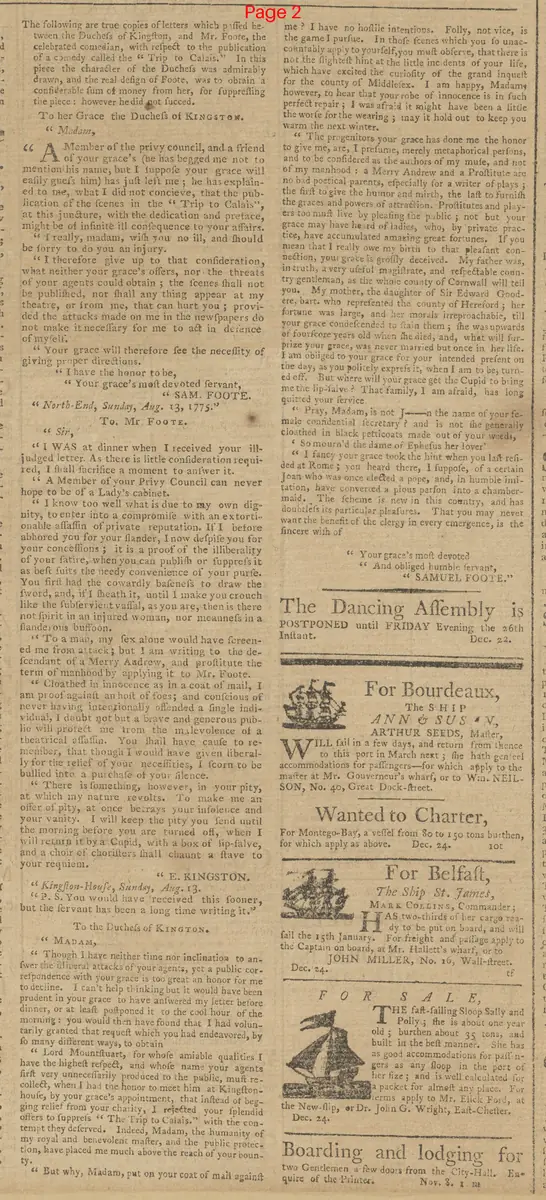
The following are true copies of letters which passed between the Duchess of Kingston, and Mr. Foote, the celebrated comedian, with respect to the publication of a comedy called the "Trip to Calais." In this piece the character of the Duchess was admirably drawn, and the real design of Foote, was to obtain a considerable sum of money from her, for suppressing the piece: however he did not succeed.
To her Grace the Duchess of KINGSTON.
"Madam,
A Member of the privy council, and a friend of your grace's (he has begged me not to mention his name, but I suppose your grace will easily guess him) has just left me; he has explained to me, what I did not conceive, that the publication of the scenes in the "Trip to Calais," at this juncture, with the dedication and preface, might be of infinite ill consequence to your affairs.
I really, madam, wish you no ill, and should be sorry to do you an injury.
I therefore give up to that consideration, what neither your grace's offers, nor the threats of your agents could obtain; the scenes shall not be published, nor shall any thing appear at my theatre, or from me, that can hurt you; provided the attacks made on me in the newspapers do not make it necessary for me to act in defence of myself.
Your grace will therefore see the necessity of giving proper directions.
I have the honor to be,
Your grace's most devoted servant,
SAM. FOOTE.
North-End, Sunday, Aug. 13, 1775."
To Mr. FOOTE.
Sir,
I WAS at dinner when I received your ill-judged letter. As there is little consideration required, I shall sacrifice a moment to answer it.
A Member of your Privy Council can never hope to be of a Lady's cabinet.
I know too well what is due to my own dignity, to enter into a compromise with an extortionable assassin of private reputation. If I before abhorred you for your slander, I now despise you for your concessions; it is a proof of the illiberality of your satire, when you can publish or suppress it as best suits the needy convenience of your purse.
You first had the cowardly baseness to draw the sword, and, if I sheath it, until I make you crouch like the subservient vassal, as you are, then is there not spirit in an injured woman, nor meanness in a slandrous buffoon.
To a man, my sex alone would have screened me from attack; but I am writing to the descendant of a Merry Andrew, and prostitute the term of manhood by applying it to Mr. Foote.
Clothed in innocence as in a coat of mail, I am proof against a host of foes; and conscious of never having intentionally offended a single individual, I doubt not but a brave and generous public will protect me from the malevolence of a theatrical assassin. You shall have cause to remember, that though I would have given liberally for the relief of your necessities, I scorn to be bullied into a purchase of your silence.
There is something, however, in your pity, at which my nature revolts. To make me an offer of pity, at once betrays your insolence and your vanity. I will keep the pity you send until the morning before you are turned off, when I will return it by a Cupid, with a box of lip-salve, and a choir of choristers shall chaunt a stave to your requiem.
E. KINGSTON.
Kingston-House, Sunday, Aug. 13.
P. S. You would have received this sooner, but the servant has been a long time writing it.
To the Duchess of KINGSTON.
"MADAM,
Though I have neither time nor inclination to answer the illiberal attacks of your agents, yet a public correspondence with your grace is too great an honor for me to decline. I can't help thinking but it would have been prudent in your grace to have answered my letter before dinner, or at least postponed it to the cool hour of the morning: you would then have found that I had voluntarily granted that request which you had endeavored, by so many different ways, to obtain.
Lord Mountstuart, for whose amiable qualities I have the highest respect, and whose name your agents first very unnecessarily produced to the public, must recollect, when I had the honor to meet him at Kingston-house, by your grace's appointment, that instead of begging relief from your charity, I rejected your splendid offers to suppress "The Trip to Calais." with the contempt they deserved. Indeed, Madam, the humanity of my royal and benevolent master, and the public protection, have placed me much above the reach of your bounty.
But why, Madam, put on your coat of mail against me? I have no hostile intentions. Folly, not vice, is the game I pursue. In those scenes which you so unconscionably apply to yourself, you must observe, that there is not the slightest hint at the little incidents of your life, which have excited the curiosity of the grand inquest for the county of Middlesex. I am happy, Madam, however, to hear that your robe of innocence is in such perfect repair; I was afraid it might have been a little the worse for the wearing; may it hold out to keep you warm the next winter.
The progenitors your grace has done me the honor to give me, are, I presume, merely metaphorical persons, and to be considered as the authors of my muse, and not of my manhood: a Merry Andrew and a Prostitute are no bad poetical parents, especially for a writer of plays; the first to give the humor and mirth, the last to furnish the graces and powers of attraction. Prostitutes and players too must live by pleasing the public; not but your grace may have heard of ladies, who, by private practice, have accumulated amazing great fortunes. If you mean that I really owe my birth to that pleasant connection, your grace is grossly deceived. My father was, in truth, a very useful magistrate, and respectable country gentleman, as the whole county of Cornwall will tell you. My mother, the daughter of Sir Edward Goodere, bart. who represented the county of Hereford; her fortune was large, and her morals irreproachable, till your grace condescended to stain them; she was upwards of fourscore years old when she died, and, what will surprise your grace, was never married but once in her life.
I am obliged to your grace for your intended present on the day, as you politely express it, when I am to be, turned off. But where will your grace get the Cupid to bring me the lip-salve? That family, I am afraid, has long quitted your service.
Pray, Madam, is not I---n the name of your female confidential secretary? and is not he generally clothed in black petticoats made out of your weeds,
So mourn'd the dame of Ephesus her lover.
I fancy your grace took the hint when you last resided at Rome; you heard there, I suppose, of a certain Joan who was once elected a pope, and, in humble imitation, have converted a pious parson into a chamber-maid. The scheme is new in this country, and has doubtless its particular pleasures. That you may never want the benefit of the clergy in every emergence, is the sincere wish of
Your grace's most devoted
And obliged humble servant,
SAMUEL FOOTE."
To her Grace the Duchess of KINGSTON.
"Madam,
A Member of the privy council, and a friend of your grace's (he has begged me not to mention his name, but I suppose your grace will easily guess him) has just left me; he has explained to me, what I did not conceive, that the publication of the scenes in the "Trip to Calais," at this juncture, with the dedication and preface, might be of infinite ill consequence to your affairs.
I really, madam, wish you no ill, and should be sorry to do you an injury.
I therefore give up to that consideration, what neither your grace's offers, nor the threats of your agents could obtain; the scenes shall not be published, nor shall any thing appear at my theatre, or from me, that can hurt you; provided the attacks made on me in the newspapers do not make it necessary for me to act in defence of myself.
Your grace will therefore see the necessity of giving proper directions.
I have the honor to be,
Your grace's most devoted servant,
SAM. FOOTE.
North-End, Sunday, Aug. 13, 1775."
To Mr. FOOTE.
Sir,
I WAS at dinner when I received your ill-judged letter. As there is little consideration required, I shall sacrifice a moment to answer it.
A Member of your Privy Council can never hope to be of a Lady's cabinet.
I know too well what is due to my own dignity, to enter into a compromise with an extortionable assassin of private reputation. If I before abhorred you for your slander, I now despise you for your concessions; it is a proof of the illiberality of your satire, when you can publish or suppress it as best suits the needy convenience of your purse.
You first had the cowardly baseness to draw the sword, and, if I sheath it, until I make you crouch like the subservient vassal, as you are, then is there not spirit in an injured woman, nor meanness in a slandrous buffoon.
To a man, my sex alone would have screened me from attack; but I am writing to the descendant of a Merry Andrew, and prostitute the term of manhood by applying it to Mr. Foote.
Clothed in innocence as in a coat of mail, I am proof against a host of foes; and conscious of never having intentionally offended a single individual, I doubt not but a brave and generous public will protect me from the malevolence of a theatrical assassin. You shall have cause to remember, that though I would have given liberally for the relief of your necessities, I scorn to be bullied into a purchase of your silence.
There is something, however, in your pity, at which my nature revolts. To make me an offer of pity, at once betrays your insolence and your vanity. I will keep the pity you send until the morning before you are turned off, when I will return it by a Cupid, with a box of lip-salve, and a choir of choristers shall chaunt a stave to your requiem.
E. KINGSTON.
Kingston-House, Sunday, Aug. 13.
P. S. You would have received this sooner, but the servant has been a long time writing it.
To the Duchess of KINGSTON.
"MADAM,
Though I have neither time nor inclination to answer the illiberal attacks of your agents, yet a public correspondence with your grace is too great an honor for me to decline. I can't help thinking but it would have been prudent in your grace to have answered my letter before dinner, or at least postponed it to the cool hour of the morning: you would then have found that I had voluntarily granted that request which you had endeavored, by so many different ways, to obtain.
Lord Mountstuart, for whose amiable qualities I have the highest respect, and whose name your agents first very unnecessarily produced to the public, must recollect, when I had the honor to meet him at Kingston-house, by your grace's appointment, that instead of begging relief from your charity, I rejected your splendid offers to suppress "The Trip to Calais." with the contempt they deserved. Indeed, Madam, the humanity of my royal and benevolent master, and the public protection, have placed me much above the reach of your bounty.
But why, Madam, put on your coat of mail against me? I have no hostile intentions. Folly, not vice, is the game I pursue. In those scenes which you so unconscionably apply to yourself, you must observe, that there is not the slightest hint at the little incidents of your life, which have excited the curiosity of the grand inquest for the county of Middlesex. I am happy, Madam, however, to hear that your robe of innocence is in such perfect repair; I was afraid it might have been a little the worse for the wearing; may it hold out to keep you warm the next winter.
The progenitors your grace has done me the honor to give me, are, I presume, merely metaphorical persons, and to be considered as the authors of my muse, and not of my manhood: a Merry Andrew and a Prostitute are no bad poetical parents, especially for a writer of plays; the first to give the humor and mirth, the last to furnish the graces and powers of attraction. Prostitutes and players too must live by pleasing the public; not but your grace may have heard of ladies, who, by private practice, have accumulated amazing great fortunes. If you mean that I really owe my birth to that pleasant connection, your grace is grossly deceived. My father was, in truth, a very useful magistrate, and respectable country gentleman, as the whole county of Cornwall will tell you. My mother, the daughter of Sir Edward Goodere, bart. who represented the county of Hereford; her fortune was large, and her morals irreproachable, till your grace condescended to stain them; she was upwards of fourscore years old when she died, and, what will surprise your grace, was never married but once in her life.
I am obliged to your grace for your intended present on the day, as you politely express it, when I am to be, turned off. But where will your grace get the Cupid to bring me the lip-salve? That family, I am afraid, has long quitted your service.
Pray, Madam, is not I---n the name of your female confidential secretary? and is not he generally clothed in black petticoats made out of your weeds,
So mourn'd the dame of Ephesus her lover.
I fancy your grace took the hint when you last resided at Rome; you heard there, I suppose, of a certain Joan who was once elected a pope, and, in humble imitation, have converted a pious parson into a chamber-maid. The scheme is new in this country, and has doubtless its particular pleasures. That you may never want the benefit of the clergy in every emergence, is the sincere wish of
Your grace's most devoted
And obliged humble servant,
SAMUEL FOOTE."
What sub-type of article is it?
Deception Fraud
Historical Event
Curiosity
What themes does it cover?
Deception
Social Manners
Justice
What keywords are associated?
Duchess Of Kingston
Sam Foote
Trip To Calais
Comedy Satire
Extortion Attempt
Letter Exchange
1775 Correspondence
What entities or persons were involved?
Duchess Of Kingston
Sam Foote
Where did it happen?
Kingston House, North End
Story Details
Key Persons
Duchess Of Kingston
Sam Foote
Location
Kingston House, North End
Event Date
Aug. 13, 1775
Story Details
Exchange of letters between the Duchess of Kingston and Sam Foote regarding his comedy 'Trip to Calais,' which satirizes her. Foote offers to suppress it to avoid harming her affairs, but she rejects it indignantly, accusing him of extortion. Foote responds defending his intentions and mocking her.