Thank you for visiting SNEWPapers!
Sign up free
Literary
November 27, 1858
The Kansas Herald Of Freedom
Wakarusa, Lawrence, Shawnee County, Douglas County, Kansas
What is this article about?
A detailed essay by W. Gilpin describing the physical geography of the Cordillera of the Sierra Madre in North America, highlighting its vast scale, rivers, parks, mountains, and significance to continental unity and empire, dated August 6, 1858, from Independence, Missouri.
Clipping
OCR Quality
95%
Excellent
Full Text
Miscellany.
From the New York Times.
Physical Geography of North America.
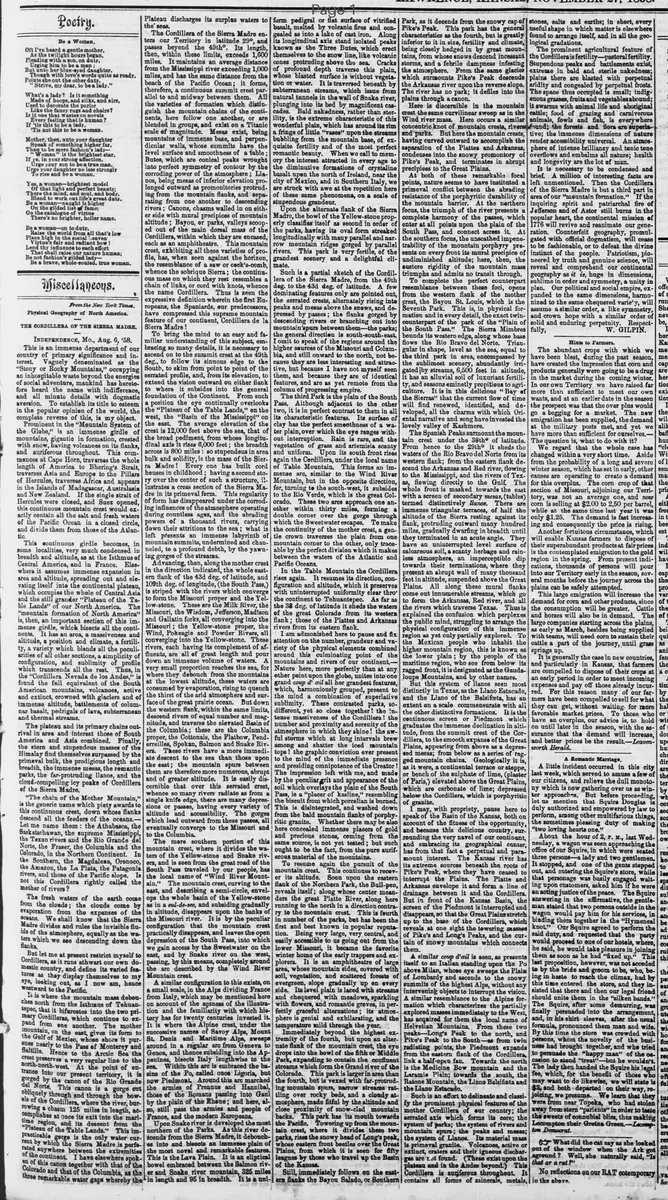
THE CORDILLERA OF THE SIERRA MADRE.
Independence, Mo., Aug. 6, '58.
This is an immense department of our country of primary significance and interest. Vaguely denominated as the "Stony or Rocky Mountains," occupying an inhospitable waste beyond the energies of social adventure, mankind has heretofore heard the name with indifference, and all minute details with dogmatic aversion. To establish its title to esteem in the popular opinion of the world, the complete reverse of this, is my object.
Prominent in the "Mountain System of the Globe," is an immense girdle of mountains, gigantic in formation, crested with snow, having volcanoes on its flanks, and auriferous throughout. This commences at Cape Horn, traverses the whole length of America to Bering's Strait, traverses Asia and Europe to the Pillars of Hercules, traverses Africa and appears in the Islands of Madagascar, Australasia and New Zealand. If the single strait of Hercules were closed, and Suez opened, this continuous mountain crest would exactly contain all the salt and fresh waters of the Pacific Ocean in a closed circle, and divide them from those of the Atlantic.
This continuous girdle becomes, in some localities, very much condensed in breadth and altitude, as at the Isthmus of Central America, and in France. Elsewhere it assumes immense expansion in area and altitude, spreading out and elevating itself into the continental plateau, which occupies the whole of Central Asia and the still grander "Plateau of the Table Lands" of our North America. The "mountain formation of North America" is, then, an important section of this immense girdle, which bisects all the continents. It has an area, a massiveness and altitude, a position and climate, a fertility, a variety which blends all the peculiarities of all other sections, a simplicity of configuration, and sublimity of profile which transcends all the rest. Thus, in the "Cordillera Nevada de los Andes," is found the full equivalent of the South American mountains, volcanoes, active and extinct, crowned with glaciers and of immense altitude, battlements of columnar basalt, pedregals of lava, subterranean and thermal streams.
The plateau and its primary chains outrival in areas and interest those of South America and Asia combined. Finally the stern and stupendous masses of the Himalaya find themselves surpassed by the primeval bulk, the prodigious length and breadth, the immense mesas, the romantic parks, the far-protruding llanos, and the cloud-compelling icy peaks of Cordillera of the Sierra Madre.
"The chain of the Mother Mountain," is the generic name which piety awards to this continuous crest, down whose flanks descend all the feeders of the oceans.— Let me name them: the Athabasca, the Saskatschawan, the supreme Mississippi, the Texan rivers and the Rio Grande del Norte, the Fraser, the Columbia and the Colorado, in the Northern Continent. In the Southern, the Magdalena, Orinoco, the Amazon, the La Plata, the Patagonian rivers, and those of the Pacific slope. Is not this Cordillera rightly called the mother of rivers?
The fresh waters of the earth come from the clouds: the clouds come by evaporation from the expanses of the oceans. We shall know that the Sierra Madre divides and rules the invisible fluids of the atmosphere, equally as the waters which we see descending down the flanks.
But let me at present restrict myself to Cordillera, as it runs athwart our own domestic country, and define its varied features as they display themselves to my eye, looking out, as I now am, hence westward to the Pacific.
It is where the mountain mass debouches north from the Isthmus of Tehuantepec, that it bifurcates into the two primary Cordilleras, which continue to expand from one another. The mother mountain, on the east, gives its form to the Gulf of Mexico, whose shore it pursues nearly to the Pass of Monterey and Saltillo. Hence to the Arctic Sea the crest preserves a very regular line to the north-north-west. At the point of entrance into our present territory, it is gorged by the canon of the Rio Grande del Norte. This canon is a gorge cut obliquely through and through the bowels of the Cordillera, where the river, burrowing a chasm 125 miles in length, accomplishes at once its exit into the maritime region, and its descent from the Plateau of the Table Lands."
This practicable gorge is the only water current by which the Sierra Madre is perforated anywhere between the extremities of the continent.
The ends of this canon together with that of the Colorado and that of the Columbia, as the three remarkable water gaps whereby the Plateau discharges its surplus waters to the seas.
The Cordillera of the Sierra Madre enters our Territory in latitude 29, and passes beyond the 49th. Its length, then, within these limits, exceeds 1,600 miles. It maintains an average distance from the Mississippi river exceeding 1,000 miles, and has the same distance from the beach of the Pacific Ocean; it forms, therefore, a continuous summit crest parallel to and midway between them. All the varieties of formation which distinguish the mountain chains of the continents, here follow one another, or are blended in groups, and exist on a Titanic scale of magnitude. Mesas exist, being mountains of immense base, and perpendicular walls, whose summits have the level surface and smoothness of a table; Butes, which are conical peaks wrought into perfect symmetry of contour by the corroding power of the atmosphere; Llanos, being mesas of inferior elevation prolonged outward as promontories protruding from the mountain flanks, and separating from one another to descending rivers; Canons, chasms walled in on either side with mural precipices of mountain altitude; Bayou, or parks, valleys scooped out of the main dorsal mass of the Cordillera, within which they are encased, each as an amphitheatre. This mountain crest, exhibiting all these varieties of profile, has, when seen against the horizon, the resemblance of a saw or cock's-comb, whence the sobriquet Sierra: the continuous mass on which they rest resembles a chain of links, or cord with knots, whence the name Cordillera. Thus is seen the expressive definition wherein the first Europeans, the Spaniards, our predecessors, have compressed this supreme mountain feature of our continent, Cordillera de la Sierra Madre!
To bring the mind to an easy and familiar understanding of this subject, embracing so many details, it is necessary to ascend on to the summit crest at the 49th deg., to follow its sinuous edge to the South, to skim from point to point of the serrated profile, and, from its elevation, to extend the vision outward on either flank to where it subsides into the general foundation of the Continent. From such a position the eye continually overlooks the "Plateau of the Table Lands," on the west, the "Basin of the Mississippi" on the east. The average elevation of the crest is 12,000 feet above the sea, that of the broad pediment, from whose longitudinal axis it rises 6,000 feet; the breadth across is 800 miles: so stupendous in area, bulk and solidity, is the mass of the Sierra Madre! Every one has built cord houses in childhood; having a second story over the center of such a structure, illustrates a cross section of the Sierra Madre in its primeval form. This regularity of form has disappeared under the corroding influences of the atmosphere operating during countless ages, and the abrading powers of a thousand rivers, carrying down their attritions to the sea; what is left presents an immense labyrinth of mountain summits, undermined and channeled, to a profound depth, by the yawning gorges of the streams.
Advancing, then, along the mother crest in the direction indicated, the whole eastern flank of the 43d deg. of latitude, and 109th deg. of longitude, (the South Pass,) is striped with the rivers which converge to form the Missouri proper and the Yellowstone. These are the Milk River, the Missouri, the Wisdom, Jefferson, Madison and Gallatin forks, all converging into the Missouri: the Yellowstone proper, the Wind, Pokeagie and Powder Rivers, all converging into the Yellowstone. These rivers, each having its complement of affluents, are all of great length and pour down an immense volume of waters. A very small proportion reaches the sea, for where they debouch from the mountains at the lowest altitude, these waters are consumed by evaporation, rising to quench the thirst of the arid atmosphere and surface of the great prairie ocean. But down the western flank, within the same limits, descend rivers of equal number and magnitude, and traverse the elevated Basin of the Columbia: these are the Columbia proper, the Cottonwood, the Flatbow, Pend d'Oreilles, Spokan, Salmon and Snake Rivers. These rivers have a more immediate descent to the sea than those upon the east; the mountain spurs between them are therefore more numerous, abrupt and of greater altitude. It is easily discernible that over this serrated crest, whence so many rivers radiate as from a single knife edge, there are many depressions or passes, having every variety of altitude and accessibility. The gorges which lead outward from these passes, all eventually converge to the Missouri and to the Columbia.
The more southern portion of this mountain crest, where it divides the waters of the Yellowstone and Snake rivers, and is seen from the great road of the South Pass traveled by our people, has the local name of "Wind River Mountain." The mountain crest, curving to the east, and describing a semi-circle, envelops the whole basin of the Yellowstone as in a cul-de-sac, and subsiding gradually in altitude, disappears upon the banks of the Missouri river. It is by the peculiar configuration that the mountain crest practically disappears, and leaves the open depression of the South Pass, into which we gain access by the Sweetwater on the east, and by Snake river on the west, passing, by this means, completely around the arc described by the Wind River Mountain crest.
A similar configuration to this exists, on a small scale, in the Alps dividing France from Italy, which may be mentioned here on account of the aptness of the illustration and the familiarity with which history has for twenty centuries invested it. It is where the Alpine crest, under the successive names of Savoy Alps, Mount St. Denis and Maritime Alps, sweeps around in a regular arc from Geneva to Genoa, and thence subsiding into the Apennines, bisects Italy lengthwise to the sea. Within this arc is embraced the basin of the Po, called once Liguria, but now Piedmont. Around this arc marched the armies of Brennus and Hannibal, those of the Romans passing into Gaul by the plain of the Rhone; and here, also, still pass the armies and people of France, and the modern Europeans.
Upon Snake river is developed the most northern of the Parks. As this river descends from the Sierra Madre, it debouches into and bisects an immense plain of the most novel and remarkable features. This is the Lava Plain. It is an elliptical bowl embraced between the Salmon river and Snake river mountain, 325 miles in length and 95 in breadth. It is a uniform pedregal or flat surface of vitrified basalt, melted by volcanic fires and congealed as into a lake of cast iron. Along its longitudinal axis stand isolated peaks known as the Three Butes, which erect themselves to the snow line, like volcanic cones protruding above the sea. Cracks of profound depth traverse this plain whose blasted surface is without vegetation or water. It is traversed beneath by subterranean streams, which issue from natural tunnels in the wall of Snake river plunging into its bed by magnificent cascades. Bald nakedness, rather than sterility, is the extreme characteristic of this wonderful plain, which has around its rim a fringe of little "oases" upon the streams bubbling from the mountain base, of exquisite fertility and of the most perfect romantic beauty. When we call to memory the interest attracted in every age to the diminutive formations of crystalline basalt upon the north of Ireland, near the city of Mexico, and in Southern Italy, we are struck with awe at the repetition here of these same phenomena, on a scale of stupendous grandeur.
Upon the alternate flank of the Sierra Madre, the bowl of the Yellowstone properly classifies itself as second in order of the parks, having its oval form streaked longitudinally with many parallel and narrow mountain ridges gorged by parallel rivers. This park is very fertile, of the grandest scenery and a delightful climate.
Such is a partial sketch of the Cordillera of the Sierra Madre, from the 49th deg. to the 43d deg. of latitude. A few dominating features only are pointed out, the serrated crests, alternately rising into peaks and mesas above the snows, and depressed by passes; the flanks gorged by descending rivers or branching out into mountain spurs between them-the parks; the general direction is south-south-east. I omit to speak of the regions around the higher sources of the Missouri and Columbia, and still onward to the north, not because they are less interesting and attractive, but because I have not myself seen them, and because they are of identical features, and are as yet remote from the column of progressing empire.
The third Park is the plain of the South Pass. Although adjacent to the other two, it is in perfect contrast to them in all its characteristic features. Its surface of clay has the perfect smoothness of a water plain, over which the eye ranges without interruption. Rain is rare, and the vegetation of grass and artemisia scanty and uniform. Upon its south front rises again the Cordillera, under the local name of Table Mountain. This forms an immense arc, similar to the Wind River Mountain, but in the opposite direction, for, turning to the south-west, it subsides to the Rio Verde, which is the great Colorado. These two arcs approach one another within thirty miles, forming a double corner over the gorge through which the Sweetwater escapes. To make the continuity of the mother crest, a gentle crown traverses the plain from one mountain corner to the other, only traceable by the perfect division which it makes between the waters of the Atlantic and Pacific Oceans.
In the Table Mountain the Cordillera rises again. It resumes its direction, configuration and altitude, which it preserves with uninterrupted uniformity clear through the continent to Tehuantepec. As far as the 38 deg. of latitude it sheds the waters of the great Colorado from its western flank: those of the Platte and Arkansas rivers from its eastern flank.
I am admonished here to pause and fix attention on the number, grandeur and variety of the physical elements combined around this culminating point of the mountains and rivers of our continent,— Nature here, more perfectly than at any other point upon the globe, unites into one grand coup d'oeil all her grandest features, which, harmoniously grouped, present to the mind a combination of superlative sublimity. These contrasted parks, so different, yet so close together! the intense massiveness of the Cordillera! the number and proximity and serenity of the atmosphere in which they shine! the awful storms which at long intervals brew among and shatter the iced mountain tops! the graphic conviction ever present to the mind of the immediate presence and presiding omnipotence of the Creator! The impression left with me, and made by the peculiar grit and appearance of the soil which overlays the plain of the South Pass, is a "placer of kaolin," resembling the biscuit from which porcelain is burned. This is disintegrated, and washed down from the bald mountain flanks of porphyritic granite. Whether there may be also here concealed immense placers of gold and precious stones, coming from the same source, is not yet tested; but such ought to be the fact, from the pure auriferous material of the mountains.
To resume again the pursuit of the mountain crest. This continues to recover its altitude. Soon upon the eastern flank of the Northern Park, the Bull-pen, reveals itself; along whose center meanders the great Platte River, along here running to the north in a direction contrary to the mountain crest. This is fourth in number of the parks, but has been the first and best known in popular reputation. Being very large, very central, and easily accessible to us going out from the lower Missouri, it became the favorite winter home of the early trappers and explorers. It is an amphitheatre of large area, whose mountain sides, covered with soil, vegetation, and scattered forests of evergreen, slope gradually up on every side. Its level plain is laced with streams and chequered with meadows, sparkling with flowers, and romantic groves, in perfectly graceful alternations; its atmosphere is genial and exhilarating, and the temperature mild through the year.
Immediately beyond the highest extremity of the fourth, but upon an alternate flank of the mountain crest, the eye drops into the bowl of the fifth or Middle Park, expanding to contain the confluent streams which form the Grand river of the Colorado. This park is larger in area than the fourth, but is vexed with far-protruding mountain spurs, narrow streams rattling over rocky beds, and a cloudy atmosphere, made fitful by the altitude and close proximity of snow-clad mountain backs. This park has its mouth towards the Pacific. Towering up from the mountain crest, where it divides these two parks, rises the snowy head of Long's peak whose eastern front beetles over the Great Plains, from which it is seen for fifty leagues by those who travel up the Basin of the Kansas.
Still, immediately follows on the eastern flanks the Bayou Salado, or Southern Park, as it descends from the snowy cap of Pike's Peak. This park has the general characteristics as the fourth, but is greatly inferior to it in size, fertility and climate being closely hedged in by great mountains, from whose snows descend incessant storms, and a febrile dampness infesting the atmosphere. From the same glacier which surrounds Pike's Peak descends the Arkansas river upon the reverse slope. The river has no park: it defiles into the plains through a canon.
Here is discernible in the mountain crest the same curvilinear sweep as in the Wind river mass. Here occurs a similar concentric knot of mountain crests, rivers and parks. But here the mountain crests, having curved outward to accomplish the separation of the Platte and Arkansas, condenses into the snowy promontory of Pike's Peak, and terminates in abrupt precipices to the Great Plains.
At both of these remarkable focal points, nature seems to have instituted a primeval conflict between the abrading resistance of the rivers and the porphyritic durability of the mountain barrier. At the northern focus, the triumph of the river presents a complete harmony of the passes, which enter at all points upon the plain of the South Pass, and connect across it. At the southern focus, the unscathed impenetrability of the mountain porphyry presents on every front its mural precipice of undiminished altitude; here, then, the austere rigidity of the mountain mass triumphs and admits no transit through.
To complete the perfect counterpart resemblance between these foci, opens from the western flank of the mother crest, the Bayou St. Louis, which is the Seventh Park. This is, in physical formation and in every detail, the exact twin counterpart of the park of the "Plain of the South Pass." The Sierra Mimbres bounds its western edge, along whose base flows the Rio Bravo del Norte. Triangular in shape, level as the sea, equal to the third park in area, encompassed by the sublimest scenery, abundantly irrigated by streams, 6,500 feet in altitude, it has an alluvial soil of luxuriant fertility, and seasons eminently propitious to agriculture. It is in this delicious "Bay of the Sierras" that the current flow of time will find renewed, identified, and developed, all the charms with which Oriental narrative and song have invested the lovely valley of Cashmere.
The Spanish Peaks surmount the mountain crest under the 38th of latitude. From hence to the 29th it sheds the waters of the Rio Bravo del Norte from its western flank; from the eastern flank descend the Arkansas and Red river, flowing to the Mississippi, and the rivers of Texas, flowing directly to the Gulf. The whole front is masked towards the east with a screen of secondary mesas, (tables) termed distinctively llanos. There are immense triangular terraces, of half the altitude of the Sierra resting against its flank, protruding outward many hundred miles, gradually dwarfing in breadth until they terminated in an acute angle. They have an uninterrupted level surface of calcareous soil, a scanty herbage and rainless atmosphere, an imperceptible dip towards their terminations, where they present an abrupt wall of many thousand feet in altitude, suspended above the Great Plains. All along these mural flanks come out innumerable streams, which go to form the Arkansas, Red river, and all the rivers which traverse Texas. Thus is explained the confusion which perplexes the public mind, struggling to arrange the physical configuration of this immense region as yet only partially explored. To the Mexican people who inhabit the higher mountain region, this is known as the lower plain; by the people of the maritime region, who see from below its ragged front, it is designated as the Guadalupe Mountains, and by other names.
But this system of llanos seen most distinctly in Texas, as the Llano Estacado, and the Llano of the Balsifoeta, has an extent on a scale commensurate with all the other distinctive formations. It is the continuous screen or Piedmont which graduates the immense declination in altitude, from the summit crest of the Cordillera, to the smooth expanse of the Great Plains, appearing from above as a depressed mesas; from below as a series of ragged mountain chains. Geologically it is, as it were, a continental terrace or steppe, or bench of the sulphate of lime, (plaster of Paris.) elevated above the Great Plains, which are carbonate of lime; depressed below the Cordilleras, which is porphyritic granite.
I may, with propriety, pause here to speak of the Basin of the Kansas, both on account of the fitness of the opportunity, and because this delicious country, surrounding the very navel of our continent, and embracing its geographical center, has from that fact a perpetual and paramount interest. The Kansas river has its extreme sources beneath the roots of Pike's Peak, where they have ceased to interrupt the Plains. The Platte and Arkansas envelope it and form a line of drainage between it and the Cordillera. But in front of the Kansas Basin, the screen of the Piedmont is interrupted and disappears, so that the Great Plains stretch up to the base of the Cordillera, which reveals at one sight the towering masses of Pike's and Long's Peaks, and the curtain of snowy mountains which connects them.
A similar coup d'oeil is seen, as presents itself to an Italian standing upon the Po above Milan, whose eye sweeps the Plain of Lombardy and ascends to the snowy summits of the highest Alps, without any intervening objects to interrupt the vision. A similar resemblance to the Alpine formation which characterizes the partially explored masses immediately to the West, has acquired for them the local name of Helvetian Mountains. From these two peaks—Long's Peak to the north, and Pike's Peak to the South—from twin radiating points, the Piedmont expands from the eastern flank of the Cordillera like a half-open fan. Towards the north is the Medicine Bow mountain and the Laramie Plain; towards the south, the Raton Mountain, the Llano Balsifoeta and the Llano Estacado.
Such is an effort to delineate and classify the prominent physical features of the mother Cordillera of our country; the serrated axis which forms its core; the system of parks; the system of rivers and mountain spurs; the peaks and mesas; the system of Llanos. Its material mass is primeval granite. Volcanoes, active or extinct, craters and their igneous discharges are not found. (These exist upon the plateau and in the Andes beyond.) This Cordillera is auriferous throughout. It contains all forms of minerals, metals, stones, salts and earths; in short, every useful shape in which matter is elsewhere found to arrange itself, and in all the geological gradations.
The prominent agricultural feature of the Cordillera is fertility—pastoral fertility Stupendous peaks and battlements exist extreme in bald and sterile nakedness; plains there are blasted with perpetual aridity and congealed by perpetual frosts. The space thus occupied is small; indigenous grasses, fruits and vegetables abound: it swarms with animal life and aboriginal cattle; food of grazing and carnivorous animals, fowls and fish, is everywhere found: the forests and flora are superlative: the immense dimensions of nature render accessibility universal. An atmosphere of intense brilliancy and tonic tone overflows and embalms all nature: health and longevity are the lot of man.
It is necessary to be condensed and brief. A million of interesting facts are left unmentioned. Then the Cordillera of the Sierra Madre is but a third part in area of our "mountain formation." If the inquiring spirit and patriarchal fire of Jefferson and of Astor still burns in the popular heart, the continental mission 1776 will revive and reanimate our generation. Counterfeit geography, promulgated with official dogmatism, will cease to be fashionable, or to defeat the divine instinct of the people. Patriotism, pioneered by truth and genuine science, will reveal and comprehend our continental geography as it is, huge in dimensions, sublime in order and symmetry, a unity in plan. Our political and social empire, expanded to the same dimensions, harmonized to the same chequered variety, will assume a similar order, a like symmetry and crown hope with a similar order of solid and enduring perpetuity.
Respectfully,
W. GILPIN.
From the New York Times.
Physical Geography of North America.
THE CORDILLERA OF THE SIERRA MADRE.
Independence, Mo., Aug. 6, '58.
This is an immense department of our country of primary significance and interest. Vaguely denominated as the "Stony or Rocky Mountains," occupying an inhospitable waste beyond the energies of social adventure, mankind has heretofore heard the name with indifference, and all minute details with dogmatic aversion. To establish its title to esteem in the popular opinion of the world, the complete reverse of this, is my object.
Prominent in the "Mountain System of the Globe," is an immense girdle of mountains, gigantic in formation, crested with snow, having volcanoes on its flanks, and auriferous throughout. This commences at Cape Horn, traverses the whole length of America to Bering's Strait, traverses Asia and Europe to the Pillars of Hercules, traverses Africa and appears in the Islands of Madagascar, Australasia and New Zealand. If the single strait of Hercules were closed, and Suez opened, this continuous mountain crest would exactly contain all the salt and fresh waters of the Pacific Ocean in a closed circle, and divide them from those of the Atlantic.
This continuous girdle becomes, in some localities, very much condensed in breadth and altitude, as at the Isthmus of Central America, and in France. Elsewhere it assumes immense expansion in area and altitude, spreading out and elevating itself into the continental plateau, which occupies the whole of Central Asia and the still grander "Plateau of the Table Lands" of our North America. The "mountain formation of North America" is, then, an important section of this immense girdle, which bisects all the continents. It has an area, a massiveness and altitude, a position and climate, a fertility, a variety which blends all the peculiarities of all other sections, a simplicity of configuration, and sublimity of profile which transcends all the rest. Thus, in the "Cordillera Nevada de los Andes," is found the full equivalent of the South American mountains, volcanoes, active and extinct, crowned with glaciers and of immense altitude, battlements of columnar basalt, pedregals of lava, subterranean and thermal streams.
The plateau and its primary chains outrival in areas and interest those of South America and Asia combined. Finally the stern and stupendous masses of the Himalaya find themselves surpassed by the primeval bulk, the prodigious length and breadth, the immense mesas, the romantic parks, the far-protruding llanos, and the cloud-compelling icy peaks of Cordillera of the Sierra Madre.
"The chain of the Mother Mountain," is the generic name which piety awards to this continuous crest, down whose flanks descend all the feeders of the oceans.— Let me name them: the Athabasca, the Saskatschawan, the supreme Mississippi, the Texan rivers and the Rio Grande del Norte, the Fraser, the Columbia and the Colorado, in the Northern Continent. In the Southern, the Magdalena, Orinoco, the Amazon, the La Plata, the Patagonian rivers, and those of the Pacific slope. Is not this Cordillera rightly called the mother of rivers?
The fresh waters of the earth come from the clouds: the clouds come by evaporation from the expanses of the oceans. We shall know that the Sierra Madre divides and rules the invisible fluids of the atmosphere, equally as the waters which we see descending down the flanks.
But let me at present restrict myself to Cordillera, as it runs athwart our own domestic country, and define its varied features as they display themselves to my eye, looking out, as I now am, hence westward to the Pacific.
It is where the mountain mass debouches north from the Isthmus of Tehuantepec, that it bifurcates into the two primary Cordilleras, which continue to expand from one another. The mother mountain, on the east, gives its form to the Gulf of Mexico, whose shore it pursues nearly to the Pass of Monterey and Saltillo. Hence to the Arctic Sea the crest preserves a very regular line to the north-north-west. At the point of entrance into our present territory, it is gorged by the canon of the Rio Grande del Norte. This canon is a gorge cut obliquely through and through the bowels of the Cordillera, where the river, burrowing a chasm 125 miles in length, accomplishes at once its exit into the maritime region, and its descent from the Plateau of the Table Lands."
This practicable gorge is the only water current by which the Sierra Madre is perforated anywhere between the extremities of the continent.
The ends of this canon together with that of the Colorado and that of the Columbia, as the three remarkable water gaps whereby the Plateau discharges its surplus waters to the seas.
The Cordillera of the Sierra Madre enters our Territory in latitude 29, and passes beyond the 49th. Its length, then, within these limits, exceeds 1,600 miles. It maintains an average distance from the Mississippi river exceeding 1,000 miles, and has the same distance from the beach of the Pacific Ocean; it forms, therefore, a continuous summit crest parallel to and midway between them. All the varieties of formation which distinguish the mountain chains of the continents, here follow one another, or are blended in groups, and exist on a Titanic scale of magnitude. Mesas exist, being mountains of immense base, and perpendicular walls, whose summits have the level surface and smoothness of a table; Butes, which are conical peaks wrought into perfect symmetry of contour by the corroding power of the atmosphere; Llanos, being mesas of inferior elevation prolonged outward as promontories protruding from the mountain flanks, and separating from one another to descending rivers; Canons, chasms walled in on either side with mural precipices of mountain altitude; Bayou, or parks, valleys scooped out of the main dorsal mass of the Cordillera, within which they are encased, each as an amphitheatre. This mountain crest, exhibiting all these varieties of profile, has, when seen against the horizon, the resemblance of a saw or cock's-comb, whence the sobriquet Sierra: the continuous mass on which they rest resembles a chain of links, or cord with knots, whence the name Cordillera. Thus is seen the expressive definition wherein the first Europeans, the Spaniards, our predecessors, have compressed this supreme mountain feature of our continent, Cordillera de la Sierra Madre!
To bring the mind to an easy and familiar understanding of this subject, embracing so many details, it is necessary to ascend on to the summit crest at the 49th deg., to follow its sinuous edge to the South, to skim from point to point of the serrated profile, and, from its elevation, to extend the vision outward on either flank to where it subsides into the general foundation of the Continent. From such a position the eye continually overlooks the "Plateau of the Table Lands," on the west, the "Basin of the Mississippi" on the east. The average elevation of the crest is 12,000 feet above the sea, that of the broad pediment, from whose longitudinal axis it rises 6,000 feet; the breadth across is 800 miles: so stupendous in area, bulk and solidity, is the mass of the Sierra Madre! Every one has built cord houses in childhood; having a second story over the center of such a structure, illustrates a cross section of the Sierra Madre in its primeval form. This regularity of form has disappeared under the corroding influences of the atmosphere operating during countless ages, and the abrading powers of a thousand rivers, carrying down their attritions to the sea; what is left presents an immense labyrinth of mountain summits, undermined and channeled, to a profound depth, by the yawning gorges of the streams.
Advancing, then, along the mother crest in the direction indicated, the whole eastern flank of the 43d deg. of latitude, and 109th deg. of longitude, (the South Pass,) is striped with the rivers which converge to form the Missouri proper and the Yellowstone. These are the Milk River, the Missouri, the Wisdom, Jefferson, Madison and Gallatin forks, all converging into the Missouri: the Yellowstone proper, the Wind, Pokeagie and Powder Rivers, all converging into the Yellowstone. These rivers, each having its complement of affluents, are all of great length and pour down an immense volume of waters. A very small proportion reaches the sea, for where they debouch from the mountains at the lowest altitude, these waters are consumed by evaporation, rising to quench the thirst of the arid atmosphere and surface of the great prairie ocean. But down the western flank, within the same limits, descend rivers of equal number and magnitude, and traverse the elevated Basin of the Columbia: these are the Columbia proper, the Cottonwood, the Flatbow, Pend d'Oreilles, Spokan, Salmon and Snake Rivers. These rivers have a more immediate descent to the sea than those upon the east; the mountain spurs between them are therefore more numerous, abrupt and of greater altitude. It is easily discernible that over this serrated crest, whence so many rivers radiate as from a single knife edge, there are many depressions or passes, having every variety of altitude and accessibility. The gorges which lead outward from these passes, all eventually converge to the Missouri and to the Columbia.
The more southern portion of this mountain crest, where it divides the waters of the Yellowstone and Snake rivers, and is seen from the great road of the South Pass traveled by our people, has the local name of "Wind River Mountain." The mountain crest, curving to the east, and describing a semi-circle, envelops the whole basin of the Yellowstone as in a cul-de-sac, and subsiding gradually in altitude, disappears upon the banks of the Missouri river. It is by the peculiar configuration that the mountain crest practically disappears, and leaves the open depression of the South Pass, into which we gain access by the Sweetwater on the east, and by Snake river on the west, passing, by this means, completely around the arc described by the Wind River Mountain crest.
A similar configuration to this exists, on a small scale, in the Alps dividing France from Italy, which may be mentioned here on account of the aptness of the illustration and the familiarity with which history has for twenty centuries invested it. It is where the Alpine crest, under the successive names of Savoy Alps, Mount St. Denis and Maritime Alps, sweeps around in a regular arc from Geneva to Genoa, and thence subsiding into the Apennines, bisects Italy lengthwise to the sea. Within this arc is embraced the basin of the Po, called once Liguria, but now Piedmont. Around this arc marched the armies of Brennus and Hannibal, those of the Romans passing into Gaul by the plain of the Rhone; and here, also, still pass the armies and people of France, and the modern Europeans.
Upon Snake river is developed the most northern of the Parks. As this river descends from the Sierra Madre, it debouches into and bisects an immense plain of the most novel and remarkable features. This is the Lava Plain. It is an elliptical bowl embraced between the Salmon river and Snake river mountain, 325 miles in length and 95 in breadth. It is a uniform pedregal or flat surface of vitrified basalt, melted by volcanic fires and congealed as into a lake of cast iron. Along its longitudinal axis stand isolated peaks known as the Three Butes, which erect themselves to the snow line, like volcanic cones protruding above the sea. Cracks of profound depth traverse this plain whose blasted surface is without vegetation or water. It is traversed beneath by subterranean streams, which issue from natural tunnels in the wall of Snake river plunging into its bed by magnificent cascades. Bald nakedness, rather than sterility, is the extreme characteristic of this wonderful plain, which has around its rim a fringe of little "oases" upon the streams bubbling from the mountain base, of exquisite fertility and of the most perfect romantic beauty. When we call to memory the interest attracted in every age to the diminutive formations of crystalline basalt upon the north of Ireland, near the city of Mexico, and in Southern Italy, we are struck with awe at the repetition here of these same phenomena, on a scale of stupendous grandeur.
Upon the alternate flank of the Sierra Madre, the bowl of the Yellowstone properly classifies itself as second in order of the parks, having its oval form streaked longitudinally with many parallel and narrow mountain ridges gorged by parallel rivers. This park is very fertile, of the grandest scenery and a delightful climate.
Such is a partial sketch of the Cordillera of the Sierra Madre, from the 49th deg. to the 43d deg. of latitude. A few dominating features only are pointed out, the serrated crests, alternately rising into peaks and mesas above the snows, and depressed by passes; the flanks gorged by descending rivers or branching out into mountain spurs between them-the parks; the general direction is south-south-east. I omit to speak of the regions around the higher sources of the Missouri and Columbia, and still onward to the north, not because they are less interesting and attractive, but because I have not myself seen them, and because they are of identical features, and are as yet remote from the column of progressing empire.
The third Park is the plain of the South Pass. Although adjacent to the other two, it is in perfect contrast to them in all its characteristic features. Its surface of clay has the perfect smoothness of a water plain, over which the eye ranges without interruption. Rain is rare, and the vegetation of grass and artemisia scanty and uniform. Upon its south front rises again the Cordillera, under the local name of Table Mountain. This forms an immense arc, similar to the Wind River Mountain, but in the opposite direction, for, turning to the south-west, it subsides to the Rio Verde, which is the great Colorado. These two arcs approach one another within thirty miles, forming a double corner over the gorge through which the Sweetwater escapes. To make the continuity of the mother crest, a gentle crown traverses the plain from one mountain corner to the other, only traceable by the perfect division which it makes between the waters of the Atlantic and Pacific Oceans.
In the Table Mountain the Cordillera rises again. It resumes its direction, configuration and altitude, which it preserves with uninterrupted uniformity clear through the continent to Tehuantepec. As far as the 38 deg. of latitude it sheds the waters of the great Colorado from its western flank: those of the Platte and Arkansas rivers from its eastern flank.
I am admonished here to pause and fix attention on the number, grandeur and variety of the physical elements combined around this culminating point of the mountains and rivers of our continent,— Nature here, more perfectly than at any other point upon the globe, unites into one grand coup d'oeil all her grandest features, which, harmoniously grouped, present to the mind a combination of superlative sublimity. These contrasted parks, so different, yet so close together! the intense massiveness of the Cordillera! the number and proximity and serenity of the atmosphere in which they shine! the awful storms which at long intervals brew among and shatter the iced mountain tops! the graphic conviction ever present to the mind of the immediate presence and presiding omnipotence of the Creator! The impression left with me, and made by the peculiar grit and appearance of the soil which overlays the plain of the South Pass, is a "placer of kaolin," resembling the biscuit from which porcelain is burned. This is disintegrated, and washed down from the bald mountain flanks of porphyritic granite. Whether there may be also here concealed immense placers of gold and precious stones, coming from the same source, is not yet tested; but such ought to be the fact, from the pure auriferous material of the mountains.
To resume again the pursuit of the mountain crest. This continues to recover its altitude. Soon upon the eastern flank of the Northern Park, the Bull-pen, reveals itself; along whose center meanders the great Platte River, along here running to the north in a direction contrary to the mountain crest. This is fourth in number of the parks, but has been the first and best known in popular reputation. Being very large, very central, and easily accessible to us going out from the lower Missouri, it became the favorite winter home of the early trappers and explorers. It is an amphitheatre of large area, whose mountain sides, covered with soil, vegetation, and scattered forests of evergreen, slope gradually up on every side. Its level plain is laced with streams and chequered with meadows, sparkling with flowers, and romantic groves, in perfectly graceful alternations; its atmosphere is genial and exhilarating, and the temperature mild through the year.
Immediately beyond the highest extremity of the fourth, but upon an alternate flank of the mountain crest, the eye drops into the bowl of the fifth or Middle Park, expanding to contain the confluent streams which form the Grand river of the Colorado. This park is larger in area than the fourth, but is vexed with far-protruding mountain spurs, narrow streams rattling over rocky beds, and a cloudy atmosphere, made fitful by the altitude and close proximity of snow-clad mountain backs. This park has its mouth towards the Pacific. Towering up from the mountain crest, where it divides these two parks, rises the snowy head of Long's peak whose eastern front beetles over the Great Plains, from which it is seen for fifty leagues by those who travel up the Basin of the Kansas.
Still, immediately follows on the eastern flanks the Bayou Salado, or Southern Park, as it descends from the snowy cap of Pike's Peak. This park has the general characteristics as the fourth, but is greatly inferior to it in size, fertility and climate being closely hedged in by great mountains, from whose snows descend incessant storms, and a febrile dampness infesting the atmosphere. From the same glacier which surrounds Pike's Peak descends the Arkansas river upon the reverse slope. The river has no park: it defiles into the plains through a canon.
Here is discernible in the mountain crest the same curvilinear sweep as in the Wind river mass. Here occurs a similar concentric knot of mountain crests, rivers and parks. But here the mountain crests, having curved outward to accomplish the separation of the Platte and Arkansas, condenses into the snowy promontory of Pike's Peak, and terminates in abrupt precipices to the Great Plains.
At both of these remarkable focal points, nature seems to have instituted a primeval conflict between the abrading resistance of the rivers and the porphyritic durability of the mountain barrier. At the northern focus, the triumph of the river presents a complete harmony of the passes, which enter at all points upon the plain of the South Pass, and connect across it. At the southern focus, the unscathed impenetrability of the mountain porphyry presents on every front its mural precipice of undiminished altitude; here, then, the austere rigidity of the mountain mass triumphs and admits no transit through.
To complete the perfect counterpart resemblance between these foci, opens from the western flank of the mother crest, the Bayou St. Louis, which is the Seventh Park. This is, in physical formation and in every detail, the exact twin counterpart of the park of the "Plain of the South Pass." The Sierra Mimbres bounds its western edge, along whose base flows the Rio Bravo del Norte. Triangular in shape, level as the sea, equal to the third park in area, encompassed by the sublimest scenery, abundantly irrigated by streams, 6,500 feet in altitude, it has an alluvial soil of luxuriant fertility, and seasons eminently propitious to agriculture. It is in this delicious "Bay of the Sierras" that the current flow of time will find renewed, identified, and developed, all the charms with which Oriental narrative and song have invested the lovely valley of Cashmere.
The Spanish Peaks surmount the mountain crest under the 38th of latitude. From hence to the 29th it sheds the waters of the Rio Bravo del Norte from its western flank; from the eastern flank descend the Arkansas and Red river, flowing to the Mississippi, and the rivers of Texas, flowing directly to the Gulf. The whole front is masked towards the east with a screen of secondary mesas, (tables) termed distinctively llanos. There are immense triangular terraces, of half the altitude of the Sierra resting against its flank, protruding outward many hundred miles, gradually dwarfing in breadth until they terminated in an acute angle. They have an uninterrupted level surface of calcareous soil, a scanty herbage and rainless atmosphere, an imperceptible dip towards their terminations, where they present an abrupt wall of many thousand feet in altitude, suspended above the Great Plains. All along these mural flanks come out innumerable streams, which go to form the Arkansas, Red river, and all the rivers which traverse Texas. Thus is explained the confusion which perplexes the public mind, struggling to arrange the physical configuration of this immense region as yet only partially explored. To the Mexican people who inhabit the higher mountain region, this is known as the lower plain; by the people of the maritime region, who see from below its ragged front, it is designated as the Guadalupe Mountains, and by other names.
But this system of llanos seen most distinctly in Texas, as the Llano Estacado, and the Llano of the Balsifoeta, has an extent on a scale commensurate with all the other distinctive formations. It is the continuous screen or Piedmont which graduates the immense declination in altitude, from the summit crest of the Cordillera, to the smooth expanse of the Great Plains, appearing from above as a depressed mesas; from below as a series of ragged mountain chains. Geologically it is, as it were, a continental terrace or steppe, or bench of the sulphate of lime, (plaster of Paris.) elevated above the Great Plains, which are carbonate of lime; depressed below the Cordilleras, which is porphyritic granite.
I may, with propriety, pause here to speak of the Basin of the Kansas, both on account of the fitness of the opportunity, and because this delicious country, surrounding the very navel of our continent, and embracing its geographical center, has from that fact a perpetual and paramount interest. The Kansas river has its extreme sources beneath the roots of Pike's Peak, where they have ceased to interrupt the Plains. The Platte and Arkansas envelope it and form a line of drainage between it and the Cordillera. But in front of the Kansas Basin, the screen of the Piedmont is interrupted and disappears, so that the Great Plains stretch up to the base of the Cordillera, which reveals at one sight the towering masses of Pike's and Long's Peaks, and the curtain of snowy mountains which connects them.
A similar coup d'oeil is seen, as presents itself to an Italian standing upon the Po above Milan, whose eye sweeps the Plain of Lombardy and ascends to the snowy summits of the highest Alps, without any intervening objects to interrupt the vision. A similar resemblance to the Alpine formation which characterizes the partially explored masses immediately to the West, has acquired for them the local name of Helvetian Mountains. From these two peaks—Long's Peak to the north, and Pike's Peak to the South—from twin radiating points, the Piedmont expands from the eastern flank of the Cordillera like a half-open fan. Towards the north is the Medicine Bow mountain and the Laramie Plain; towards the south, the Raton Mountain, the Llano Balsifoeta and the Llano Estacado.
Such is an effort to delineate and classify the prominent physical features of the mother Cordillera of our country; the serrated axis which forms its core; the system of parks; the system of rivers and mountain spurs; the peaks and mesas; the system of Llanos. Its material mass is primeval granite. Volcanoes, active or extinct, craters and their igneous discharges are not found. (These exist upon the plateau and in the Andes beyond.) This Cordillera is auriferous throughout. It contains all forms of minerals, metals, stones, salts and earths; in short, every useful shape in which matter is elsewhere found to arrange itself, and in all the geological gradations.
The prominent agricultural feature of the Cordillera is fertility—pastoral fertility Stupendous peaks and battlements exist extreme in bald and sterile nakedness; plains there are blasted with perpetual aridity and congealed by perpetual frosts. The space thus occupied is small; indigenous grasses, fruits and vegetables abound: it swarms with animal life and aboriginal cattle; food of grazing and carnivorous animals, fowls and fish, is everywhere found: the forests and flora are superlative: the immense dimensions of nature render accessibility universal. An atmosphere of intense brilliancy and tonic tone overflows and embalms all nature: health and longevity are the lot of man.
It is necessary to be condensed and brief. A million of interesting facts are left unmentioned. Then the Cordillera of the Sierra Madre is but a third part in area of our "mountain formation." If the inquiring spirit and patriarchal fire of Jefferson and of Astor still burns in the popular heart, the continental mission 1776 will revive and reanimate our generation. Counterfeit geography, promulgated with official dogmatism, will cease to be fashionable, or to defeat the divine instinct of the people. Patriotism, pioneered by truth and genuine science, will reveal and comprehend our continental geography as it is, huge in dimensions, sublime in order and symmetry, a unity in plan. Our political and social empire, expanded to the same dimensions, harmonized to the same chequered variety, will assume a similar order, a like symmetry and crown hope with a similar order of solid and enduring perpetuity.
Respectfully,
W. GILPIN.
What sub-type of article is it?
Essay
What themes does it cover?
Nature
Patriotism
Political
What keywords are associated?
Cordillera
Sierra Madre
North America
Mountains
Rivers
Parks
Geography
Plateau
Mesas
Llanos
What entities or persons were involved?
W. Gilpin
Literary Details
Title
The Cordillera Of The Sierra Madre
Author
W. Gilpin
Subject
Physical Geography Of North America
Form / Style
Descriptive Geographical Essay
Key Lines
"The Chain Of The Mother Mountain," Is The Generic Name Which Piety Awards To This Continuous Crest, Down Whose Flanks Descend All The Feeders Of The Oceans.
Nature Here, More Perfectly Than At Any Other Point Upon The Globe, Unites Into One Grand Coup D'oeil All Her Grandest Features, Which, Harmoniously Grouped, Present To The Mind A Combination Of Superlative Sublimity.
Patriotism, Pioneered By Truth And Genuine Science, Will Reveal And Comprehend Our Continental Geography As It Is, Huge In Dimensions, Sublime In Order And Symmetry, A Unity In Plan.