Thank you for visiting SNEWPapers!
Sign up free
The Massachusetts Spy
Worcester, Worcester County, Massachusetts
What is this article about?
This editorial discusses the early contest for the U.S. presidency following James Monroe's term, favoring John Quincy Adams for his qualifications but noting his disadvantages as a New Englander amid sectional and partisan divisions. It criticizes William H. Crawford's support in the North as driven by political deals rather than merit, highlighting issues in his Treasury management.
Merged-components note: Continuation of the editorial piece on 'THE NEXT PRESIDENT' across page break; the second component starts mid-sentence connecting directly to the first. Label changed from 'story' to 'editorial' for the merged component as it is an opinion piece on politics.
Clippings
1 of 2
OCR Quality
Full Text
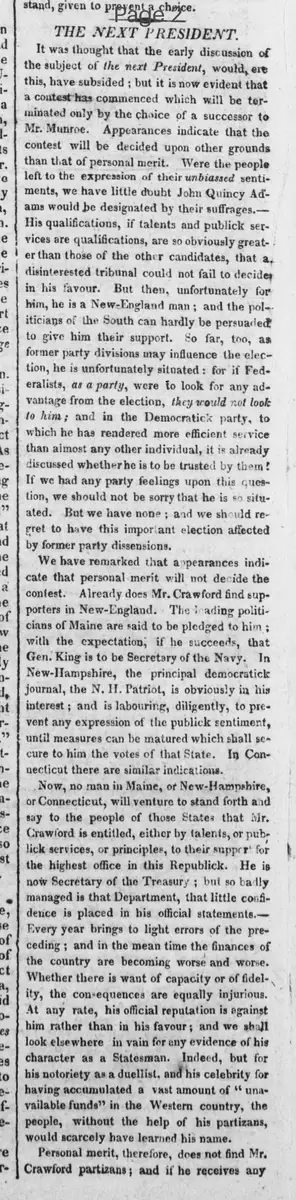
It was thought that the early discussion of the subject of the next President, would, ere this, have subsided ; but it is now evident that a contest has commenced which will be terminated only by the choice of a successor to Mr. Monroe. Appearances indicate that the contest will be decided upon other grounds than that of personal merit. Were the people left to the expression of their unbiassed sentiments, we have little doubt John Quincy Adams would be designated by their suffrages.— His qualifications, if talents and publick services are qualifications, are so obviously greater than those of the other candidates, that a disinterested tribunal could not fail to decide in his favour. But then, unfortunately for him, he is a New-England man; and the politicians of the South can hardly be persuaded to give him their support. So far, too, as former party divisions may influence the election, he is unfortunately situated : for if Federalists, as a party, were to look for any advantage from the election, they would not look to him: and in the Democratick party, to which he has rendered more efficient service than almost any other individual, it is already discussed whether he is to be trusted by them! If we had any party feelings upon this question, we should not be sorry that he is so situated. But we have none ; and we should regret to have this important election affected by former party dissensions.
We have remarked that appearances indicate that personal merit will not decide the contest. Already does Mr. Crawford find supporters in New-England. The leading politicians of Maine are said to be pledged to him ; with the expectation, if he succeeds, that Gen. King is to be Secretary of the Navy. In New-Hampshire, the principal democratick journal, the N. H. Patriot, is obviously in his interest; and is labouring, diligently, to prevent any expression of the publick sentiment, until measures can be matured which shall secure to him the votes of that State. In Connecticut there are similar indications.
Now, no man in Maine, or New-Hampshire, or Connecticut, will venture to stand forth and say to the people of those States that Mr. Crawford is entitled, either by talents, or publick services, or principles, to their support for the highest office in this Republick. He is now Secretary of the Treasury ; but so badly managed is that Department, that little confidence is placed in his official statements.— Every year brings to light errors of the preceding : and in the mean time the finances of the country are becoming worse and worse. Whether there is want of capacity or of fidelity, the consequences are equally injurious. At any rate, his official reputation is against him rather than in his favour: and we shall look elsewhere in vain for any evidence of his character as a Statesman. Indeed, but for his notoriety as a duellist, and his celebrity for having accumulated a vast amount of "unavailable funds" in the Western country, the people, without the help of his partizans, would scarcely have learned his name.
Personal merit, therefore, does not find Mr. Crawford partizans; and if he receives any support from New-England, it must be from bargain and sale, or from a desire to prostrate that section of the Union still lower in the political scale.
votes in the Northern States it must be owing to the management of individuals who have some expectations of personal advantage from his elevation. We should think, by the way, that the people of Maine and of New-Hampshire would not silently look on, while measures may be in operation to secure their voice for a man for whom they, certainly, can feel no predilection, and who has done nothing to recommend himself to their favour.
At the South, Mr. Crawford's qualifications may be justly appreciated; and, still, he may be the Southern candidate. If it be found he has taken measures to secure a part of the New-England votes he will the better recommend himself to support there. The Southern States will never support a Northern man for the Presidency, while they can succeed in dividing the votes of the North. They accomplish their objects by union.—When will the politicians of the North learn wisdom from their example?
What sub-type of article is it?
What keywords are associated?
What entities or persons were involved?
Editorial Details
Primary Topic
Contest For The Presidency Succeeding James Monroe
Stance / Tone
Supportive Of John Quincy Adams, Critical Of Sectional Politics And William H. Crawford
Key Figures
Key Arguments