Thank you for visiting SNEWPapers!
Sign up free
The Virginia Gazette
Richmond, Williamsburg, Richmond County, Virginia
What is this article about?
In a satirical letter dated March 1, 1752, from Mount Pleasant, Walter Dymocke Anonymous submits 'Remarks on the Virginia PINDAR' to the printer for publication, mockingly critiquing a poet's divine poems and preface for catering to the unrefined majority while banishing heathen deities from Christian poetry.
Clipping
OCR Quality
Full Text
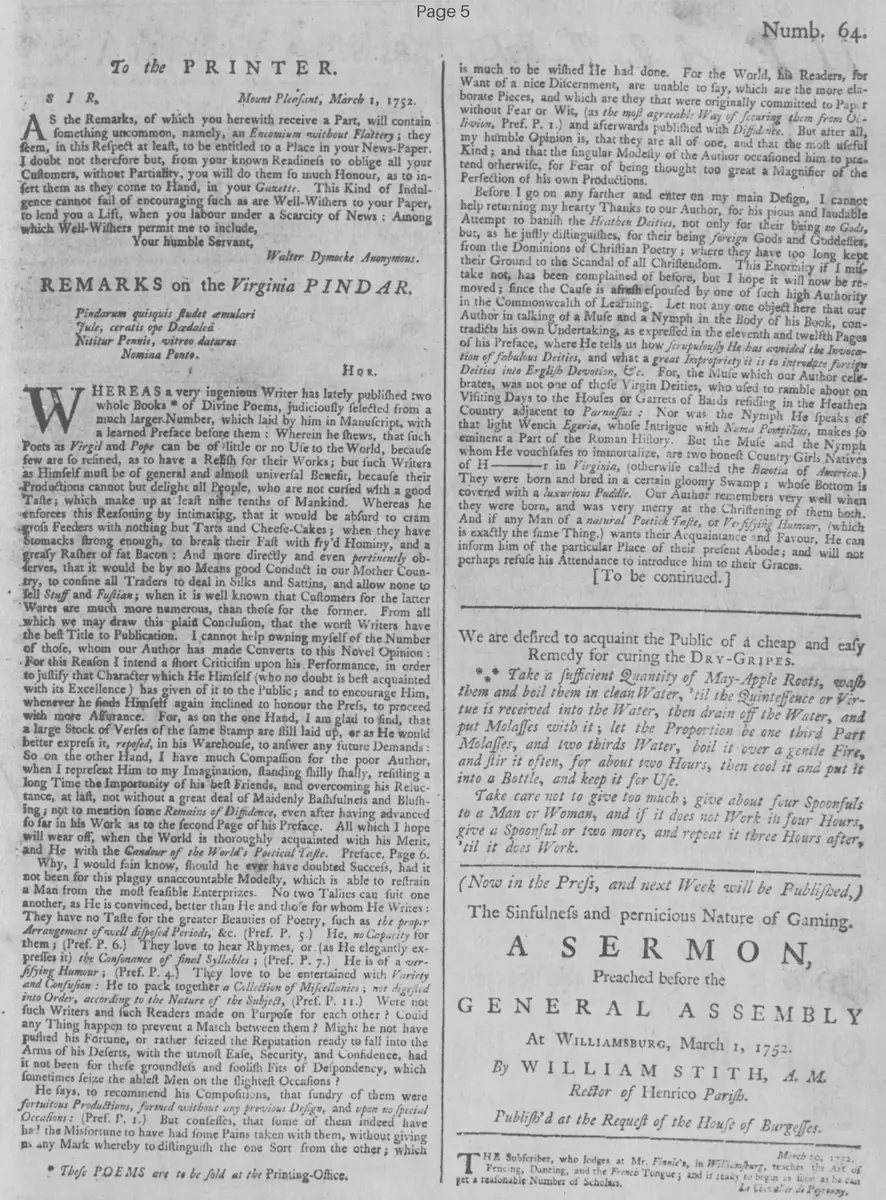
SIR,
Mount Pleasant, March 1, 1752.
As the Remarks, of which you herewith receive a Part, will contain
something uncommon, namely, an Encomium without Flattery; they
seem, in this Respect at least, to be entitled to a Place in your News-Paper.
I doubt not therefore but, from your known Readiness to oblige all your
Customers, without Partiality, you will do them so much Honour, as to insert
them as they come to Hand, in your Gazette. This Kind of Indulgence
cannot fail of encouraging such as are Well-Wishers to your Paper,
to lend you a Lift, when you labour under a Scarcity of News. Among
which Well-Wishers permit me to include,
Your humble Servant,
Walter Dymocke Anonymous.
REMARKS on the Virginia PINDAR.
Pindarum quisquis studet aemulari
Fule, ceratis ope Dædalea
Nititur Pennæ, vitreo daturus
Nomina ponto.
HOR.
WHEREAS a very ingenious Writer has lately published two
whole Books of Divine Poems, judiciously selected from a
much larger Number, which lay by him in Manuscript, with
a learned Preface before them. Wherein he shews, that such
Poets as Virgil and Pope can be of little or no Use to the World, because
few are so refined, as to have a Relish for their Works; but such Writers
as Himself must be of general and almost universal Benefit, because their
Productions cannot but delight all People, who are not cursed with a good
Taste; which make up at least nine tenths of Mankind.
Whereas he
enforces this Reasoning by intimating, that it would be absurd to cram
gross Feeders with nothing but Tarts and Cheese-Cakes; when they have
Stomacks strong enough, to break their Fast with fry'd Hominy, and a
greasy Rasher of fat Bacon. And more directly and even pertinently observes,
that it would be by no Means good Conduct in our Mother Country,
to confine all Traders to deal in Silks and Sattins, and allow none to
sell Stuff and Fustian; when it is well known that Customers for the latter
Wares are much more numerous, than those for the former. From all
which we may draw this plain Conclusion, that the worst Writers have
the best Title to Publication.
I cannot help owning myself of the Number
of those, whom our Author has made Converts to this Novel Opinion.
For this Reason I intend a short Criticism upon his Performance, in order
to justify that Character which He Himself (who no doubt is best acquainted
with its Excellence) has given of it to the Public; and to encourage Him,
whenever he finds Himself again inclined to honour the Press, to proceed
with more Assurance.
For, as on the one Hand, I am glad to find, that
a large Stock of Verses of the same Stamp are still laid up, or as He would
better express it, reposed, in his Warehouse, to answer any future Demands.
So on the other Hand, I have much Compassion for the poor Author,
when I represent Him to my Imagination, standing shyly silly, resisting a
long Time the Importunity of his best Friends, and overcoming his Reluctance,
at last, not without a great deal of Maidenly Bashfulness and Blushing;
not to mention some Remains of Diffidence, even after having advanced
so far in his Work as to the second Page of his Preface. All which I hope
will wear off, when the World is thoroughly acquainted with his Merit,
and He with the Candour of the World's Poetical Taste.
Preface, Page 6.
Why, I would fain know, should he ever have doubted Success, had it
not been for this plaguy unaccountable Modesty, which is able to restrain
a Man from the most feasible Enterprizes.
No two Tallies can suit one
another, as He is convinced, better than He and those for whom He Writes.
They have no Taste for the greater Beauties of Poetry, such as the proper
Arrangement of well disposed Periods, &c. (Pref. P. 5.) He, no Capacity for
them; (Pref. P. 6.) They love to hear Rhymes, Or. (as He elegantly expresses
it) the Consonance of final Syllables; (Pref. P. 7.) He is of a versifying
Humour; (Pref. P. 4.) They love to be entertained with Variety
and Confusion: He to pack together a Collection of Miscellanies; not digested
into Order, according to the Nature of the Subject, (Pref. P. 11.) Were not
such Writers and such Readers made on Purpose for each other? Could
any Thing happen to prevent a Match between them? Might he not have
pushed his Fortune, or rather seized the Reputation ready to fall into the
Arms of his Deserts, with the utmost Ease, Security, and Confidence, had
it not been for these groundless and foolish Fits of Despondency, which
sometimes seize the ablest Men on the slightest Occasions?
He says, to recommend his Compositions, that sundry of them were
fortuitous Productions, formed without any previous Design, and upon no special
Occasions: (Pref. P. 1.) But confesses, that some of them indeed have
had the Misfortune to have had some Pains taken with them, without giving
us any Mark whereby to distinguish the one Sort from the other; which
These POEMS are to be sold at the Printing-Office.
Numb. 64.
is much to be wished He had done. For the World, his Readers, for
Want of a nice Discernment, are unable to say, which are the more elaborate
Pieces, and which are they that were originally committed to Paper
without Fear or Wit, (as the most agreeable Way of Securing them from Ob-
livion, Pref. P.1.) and afterwards published with Diffidence. But after all,
my humble Opinion is, that they are all of one, and that the most useful
Kind; and that the singular Modesty of the Author occasioned him to pretend
otherwise, for Fear of being thought too great a Magnifier of the
Perfection of his own Productions.
Before I go on any farther and enter on my main Design, I cannot
help returning my hearty Thanks to our Author, for his pious and laudable
Attempt to banish the Heathen Deities, not only for their being no Gods,
but, as he justly distinguishes, for their being foreign Gods and Goddesses,
from the Dominions of Christian Poetry; where they have too long kept
their Ground to the Scandal of all Christendom. This Enormity if I mistake
not, has been complained of before, but I hope it will now be removed;
since the Cause is afresh espoused by one of such high Authority
in the Commonwealth of Learning.
Let not any one object here that our
Author in talking of a Muse and a Nymph in the Body of his Book, con-
tradicts his own Undertaking, as expressed in the eleventh and twelfth Pages
of his Preface, where He tells us how scrupulously He has avoided the Invocation
of fabulous Deities, and what a great Impropriety it is to introduce foreign
Deities into English Devotion, &c.
For, the Muse which our Author celebrates,
was not one of those Virgin Deities, who used to ramble about on
Visiting Days to the Houses or Garrets of Bards residing in the Heathen
Country adjacent to Parnassus: Nor was the Nymph He speaks of
that light Wench Egeria, whose Intrigue with Numa Pompilius, makes so
eminent a Part of the Roman History. But the Muse and the Nymph
whom He vouchsafes to immortalize, are two honest Country Girls Natives
in Virginia, (otherwise called the Bœotia of America.)
They were born and bred in a certain gloomy Swamp; whose Bottom is
covered with a luxurious Puddle. Our Author remembers very well when
they were born, and was very merry at the Christening of them both.
And if any Man of a natural Poetick Taste, or Versifying Humour, (which
is exactly the same Thing,) wants their Acquaintance and Favour, He can
inform him of the particular Place of their present Abode; and will not
perhaps refuse his Attendance to introduce him to their Graces.
[To be continued.]
What sub-type of article is it?
What themes does it cover?
What keywords are associated?
What entities or persons were involved?
Letter to Editor Details
Author
Walter Dymocke Anonymous
Recipient
To The Printer.
Main Argument
the letter satirically endorses the virginia pindar's simplistic divine poems as beneficial for the majority lacking refined taste, mocks his preface's arguments on poetic utility and modesty, and praises his effort to exclude heathen deities from christian poetry while redefining muses as local virginia figures.
Notable Details