Thank you for visiting SNEWPapers!
Sign up free
Carroll Free Press
Carrollton, Carroll County, Ohio
What is this article about?
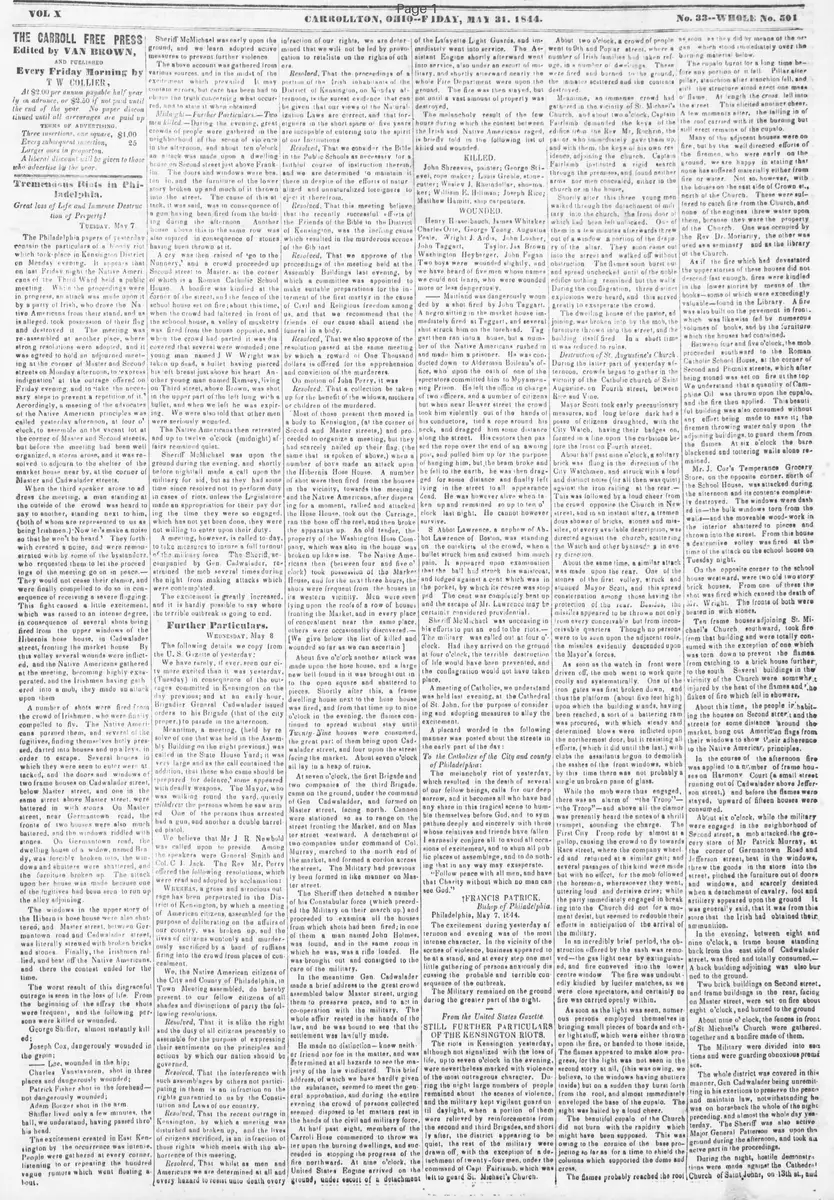
The 1844 Kensington Riots in Philadelphia erupted on May 6 when Irish immigrants attacked a Native American meeting, leading to clashes, shootings, and mob violence over several days. Multiple deaths and injuries occurred, with widespread property destruction including the burning of Catholic churches like St. Michael's and St. Augustine's, and numerous homes. Military and officials intervened to restore order.
Merged-components note: This is a continuation of the story about the Philadelphia riots across pages 1 and 2; relabeled to domestic_news as it fits local/national news reporting.
Clippings
1 of 2
OCR Quality
Full Text
Great loss of Life and Immense Destruction of Property!
Tuesday, May 7.
The Philadelphia papers of yesterday contain the particulars of a bloody riot which took place in Kensington District on Monday evening. It appears that on last Friday night the Native Americans of the Third Ward held a public meeting. While the proceedings were in progress, an attack was made upon it by a party of Irish, who drove the Native Americans from their stand, and as is alleged, took possession of their flag and destroyed it. The meeting was re-assembled at another place, where strong resolutions were adopted, and it was agreed to hold an adjourned meeting at the corner of Master and Second streets on Monday afternoon, to 'express indignation' at the outrage offered on Friday evening, and to take the necessary steps to prevent a repetition of it.
Accordingly, a meeting of the advocates of the Native American principles was called yesterday afternoon, at four o'clock, to assemble on the vacant lot at the corner of Master and Second streets, but before the meeting had been well organized, a storm arose, and it was resolved to adjourn to the shelter of the market house near by, at the corner of Master and Cadwalader streets.
When the third speaker arose to address the meeting, a man standing at the outside of the crowd was heard to say to another, standing next to him, (both of whom are represented to us as being Irishmen.): "Now let'em make a noise so that he won't be heard." They forthwith created a noise, and were remonstrated with by some of the bystanders, who requested them to let the proceedings of the meeting go on in peace.
They would not cease their clamor, and were finally compelled to do so in consequence of receiving a severe flogging. This fight caused a little excitement, which was raised to an intense degree, in consequence of several shots being fired from the upper windows of the Hibernia Hose House, in Cadwalader street, fronting the market house.
By this volley several wounds were inflicted, and the Native Americans gathered at the meeting, becoming highly exasperated, and the Irishmen having gathered into a mob, they made an attack upon them.
A number of shots were fired from the crowd of Irishmen, who were finally compelled to fly. The Native Americans pursued them, and several of the fugitives, finding themselves hotly pressed, darted into houses and up alleys, in order to escape. Several houses in which they were seen to enter were attacked, and the doors and windows of two frame houses on Cadwalader street, below Master street, and one in the same street above Master street, were battered in with stones. On Master street, near Germantown road, the fronts of two houses were also much battered, and the windows riddled with stones. On Germantown road, the dwelling house of a widow, named Brady, was forcibly broken into, the windows and shutters were shattered, and the furniture broken up. The attack upon her house was made because one of the fugitives had been seen to run up the alley adjoining.
The windows in the upper story of the Hibernia Hose House were also shattered, and Master street, between Germantown road and Cadwalader street, was literally strewed with broken bricks and stones. Finally, the Irishmen rallied, and beat off the Native Americans, and there the contest ended for the time.
The worst result of this disgraceful outrage is seen in the loss of life. From the beginning of the affray the shots were frequent, and the following persons were killed or wounded.
George Shifler, almost instantly killed;
Joseph Cox, dangerously wounded in the groin;
Lee, wounded in the hip;
Charles Vanstavoren, shot in three places and dangerously wounded;
Patrick Fisher, shot in the forehead - not dangerously wounded;
Adam Boozer, shot in the arm.
Shifler lived only a few minutes, the ball, we understand, having passed through his head.
The excitement created in East Kensington by the occurrence was intense. People were gathered at every corner, listening to or repeating the hundred vague rumors which went floating about.
Sheriff McMichael was early upon the ground, and we learn adopted active measures to prevent further violence. The above account was gathered from various sources, and in the midst of the excitement which prevailed. It may contain errors, but care has been had to obtain the truth concerning what occurred, and to state it when obtained.
Midnight - Further Particulars. - Two men killed - During the evening, great crowds of people were gathered in the neighborhood of the scene of violence in the afternoon, and about ten o'clock an attack was made upon a dwelling house on Second street just above Franklin. The doors and windows were beaten in, and the furniture of the lower story broken up and much of it thrown into the street. The cause of this attack, it was said, was in consequence of a gun having been fired from the building during the afternoon. Another house towards this in the same row was also injured in consequence of stones having been thrown at it.
A cry was then raised of 'go to the Nunnery,' and a crowd proceeded up Second street to Master, at the corner of which is a Roman Catholic School House. A bonfire was kindled at the corner of the street, and the fence of the school house set on fire; about this time, when the crowd had faltered in front of the school house, a volley of musketry was fired from the house opposite, and when the crowd had parted it was discovered that several were wounded: one young man named J. W. Wright was taken up dead, a bullet having pierced his left breast just above his heart. Another young man named Ramsey, living on Third street, above Brown, was shot in the upper part of the left lung with a bullet, and when we left he was expiring. We were also told that other men were seriously wounded.
The Native Americans then retreated and up to twelve o'clock (midnight) affairs remained quiet.
Sheriff McMichael was upon the ground during the evening, and shortly before nightfall made a call upon the military for aid, but as they had some time since resolved not to perform duty in cases of riot, unless the Legislature made an appropriation for their pay during the time they were so engaged, which has not yet been done, they were not willing to enter upon their duty. A meeting, however, is called to-day, to take measures to insure a full turnout of the military force.
The Sheriff, accompanied by Gen. Cadwalader, restrained the mob several times during the night from making attacks which were contemplated. The excitement is greatly increased, and it is hardly possible to say where the terrible outbreak is going to end.
Further Particulars.
Wednesday, May 8.
The following details we copy from the U.S. Gazette of yesterday:
We have rarely, if ever, seen our city more excited than it was yesterday, (Tuesday) in consequence of the outrages committed in Kensington on the day previous; and at an early hour, Brigadier General Cadwalader issued orders to his Brigade (that of the city proper,) to parade in the afternoon.
Meantime, a meeting, (held by resolve of one that was held in the Assembly Building on the night previous,) was called in the State House Yard; it was very large and as the call contained the addition, that those who came should be 'prepared for defence,' some appeared with deadly weapons. The Mayor, who was walking round the yard, quietly withdrew the persons whom he saw armed. One of the persons thus arrested had a gun, and another a double barrelled pistol.
We believe that Mr. J. R. Newbold was called upon to preside. Among the speakers were General Smith and Col. C. J. Jack. The Rev. Mr. Perry offered the following resolutions, which were read and adopted by acclamation:
WHEREAS, a gross and atrocious outrage has been perpetrated in the District of Kensington, by which a meeting of American citizens, assembled for the purpose of deliberating on the affairs of our country, was broken up, and the lives of citizens wantonly and murderously sacrificed by a band of ruffians firing into the crowd from places of concealment.
We, the Native American citizens of the City and County of Philadelphia, In Town Meeting assembled, do hereby present to our fellow citizens of all shades and distinctions of party the following resolutions.
Resolved, That it is alike the right and the duty of all citizens peaceably to assemble for the purpose of expressing their sentiments on the principles and actions by which our nation should be governed.
Resolved, That the interference with such assemblages by others not participating in them is an infraction on the rights guaranteed to us by the Constitution and Laws of our country.
Resolved, That the recent outrage in Kensington, by which a meeting was disturbed and broken up, and the lives of citizens sacrificed, is an infraction of those rights which meets with the abhorrence of this meeting.
Resolved, That whilst as men and Americans we are determined at all and every hazard to resist unto death every infraction of our rights, we are determined that we will not be led by provocation to retaliate on the rights of others.
Resolved, That the proceedings of a portion of the Irish inhabitants of the District of Kensington, on Monday afternoon, is the surest evidence that can be given that our views of the Naturalization Laws are correct, and that foreigners in the short space of five years are incapable of entering into the spirit of our Institutions.
Resolved, That we consider the Bible in the Public Schools as necessary for a faithful course of instruction therein, and we are determined to maintain it there in despite of the efforts of naturalized and unnaturalized foreigners to eject it therefrom.
Resolved, That this meeting believe that the recently successful efforts of the Friends of the Bible in the District of Kensington, was the inciting cause which resulted in the murderous scenes of the 6th inst.
Resolved, That we approve of the proceedings of the meeting held at the Assembly Buildings last evening, by which a committee was appointed to make suitable preparations for the interment of the first martyr in the cause of Civil and Religious freedom among us, and that we recommend that the friends of our cause shall attend the funeral in a body.
Resolved, That we also approve of the resolution passed at the same meeting by which a reward of One Thousand dollars is offered for the apprehension and conviction of the murderers.
On motion of John Perry, it was Resolved, 'That a collection be taken up for the benefit of the widows, mothers or children of the murdered.'
Most of those present then moved in a body to Kensington, (at the corner of Second and Master streets,) and proceeded to organize a meeting, but they had scarcely nailed up their flag, (the same that is spoken of above,) when a number of boys made an attack upon the Hibernia Hose House. A number of shots were then fired from the houses in the vicinity, towards the meeting and the Native Americans, after dispersing for a moment, rallied and attacked the Hose House, took out the Carriage, ran the hose off the reel, and then broke the apparatus up. An old tender, the property of the Washington Hose Company, which was also in the house was broken up likewise. The Native Americans then (between four and five o'clock) took possession of the Market House, and for the next three hours, the shots were frequent from the houses in its western vicinity. Men were seen lying upon the roofs of a row of houses fronting the Market, and in every place of concealment near the same place, others were occasionally discovered.
We give below the list of killed and wounded so far as we can ascertain.
About five o'clock another attack was made upon the hose house, and a large pew bell found in it was brought out into the open square and shattered to pieces. Shortly after this, a frame dwelling house next to the hose house was fired, and from that time up to nine o'clock in the evening, the flames continued to spread without stay until Twenty-Nine houses were consumed, the great part of them being upon Cadwalader street, and four upon the street facing the market. About seven o'clock all lay in a heap of ruins.
At seven o'clock, the first Brigade and two companies of the third Brigade, came on the ground, under the command of Gen. Cadwalader, and formed on Master street, facing north. Cannon were stationed so as to range on the street fronting the Market, and on Master street westward. A detachment of two companies under command of Col. Murray, marched to the north end of the market, and formed a cordon across the street. The Military had previously been formed in like manner on Master street.
The Sheriff then detached a number of his Constabulary force (which preceded the Military on their march up,) and proceeded to examine all the houses from which shots had been fired: in one of them a man named John Holmes, was found, and in the same room in which he was, was a rifle loaded. He was brought out and consigned to the care of the military.
In the meantime Gen. Cadwalader made a brief address to the great crowd assembled below Master street, urging them to preserve peace, and to act in co-operation with the military. The whole affair rested in the hands of the law, and he was bound to see that the settlement was lawfully made. He made no distinction - knew neither friend nor foe in the matter, and was determined at all hazards to see the majesty of the law vindicated. This brief address, of which we have hardly given the substance, seemed to meet the general approbation, and during the entire evening the crowd of persons collected seemed disposed to let matters rest in the hands of the civil and military force.
At half past eight, members of the Carroll Hose commenced to throw water upon the burning dwellings, and succeeded in stopping the progress of the fire northward. At nine o'clock, the United States Engine arrived on the ground, under escort of a detachment of the Lafayette Light Guards, and immediately went into service. The Assistant Engine shortly afterward went into service, also under an escort of military, and shortly afterward nearly the whole Fire Department were upon the ground. The fire was then stayed, but not until a vast amount of property was destroyed.
The melancholy result of the few hours during which the contest between the Irish and Native Americans raged, is briefly told in the following list of killed and wounded.
KILLED.
John Shreeves, painter; George Stivel, rope maker; Louis Greble, stone-cutter; Wesley J. Rheindollar, shoemaker; William E. Hillman; Joseph Rice; Matthew Hammitt, ship carpenter.
WOUNDED.
Henry Hessebach, James Whitaker, Charles Orte, George Young, Augustus Peale, Wright J. Ardis, John Lusher, John Taggart, Taylor, Jas. Brown, Washington Hleyberger, John Fagan.
Two boys were wounded slightly, and we have heard of five men whose names we could not learn, who were wounded more or less dangerously.
Maitland was dangerously wounded by a shot fired by John Taggart. A negro sitting in the market house immediately fired at Taggart, and several shot struck him on the forehead. Taggart then ran into a house, but a number of the Native Americans rushed in and made him a prisoner. He was conducted down to Alderman Boileau's office, who upon the oath of one of the spectators committed him to Moyamensing Prison. He left the office in charge of two officers, and a number of citizens but when near Beaver street the crowd took him violently out of the hands of his conductors, tied a rope around his neck, and dragged him some distance along the street. His captors then passed the rope over the end of an awning post, and pulled him up for the purpose of hanging him, but the beam broke and he fell to the earth, he was then dragged for some distance and finally left lying in the street to all appearance dead. He was however alive when taken up and remained so up to ten o'clock last night. He cannot however survive.
S. Abbot Lawrence, a nephew of Abbot Lawrence of Boston, was standing on the outskirts of the crowd, when a bullet struck him and caused him much pain. It appeared upon examination that the ball had struck his waistcoat, and lodged against a cent which was in the pocket, by which its course was stopped. The cent was completely bent up and the escape of Mr. Lawrence may certainly be considered providential.
Sheriff McMichael was unceasing in his efforts to put an end to the riots. The military was called out at four o'clock. Had they arrived on the ground at four o'clock, the terrible destruction of life would have been prevented, and the conflagration would not have taken place.
A meeting of Catholics, we understand was held last evening, at the Cathedral of St. John, for the purpose of considering and adopting measures to allay the excitement.
A placard worded in the following manner was posted about the streets in the early part of the day:
To the Catholics of the City and County of Philadelphia:
The melancholy riot of yesterday, which resulted in the death of several of our fellow beings, calls for our deep sorrow, and it becomes all who have had any share in this tragical scene to humble themselves before God, and to sympathise deeply and sincerely with those whose relatives and friends have fallen. I earnestly conjure all to avoid all occasions of excitement, and to shun all public places of assemblage, and to do nothing that in any way may exasperate.
"Follow peace with all men, and have that Charity without which no man can see God."
FRANCIS PATRICK,
Bishop of Philadelphia.
Philadelphia, May 7, 1844.
The excitement during yesterday afternoon and evening was of the most intense character. In the vicinity of the scenes of violence, business appeared to be at a stand, and at every step one met little gatherings of persons anxiously discussing the probable and terrible consequences of the outbreak.
The Military remained on the ground during the greater part of the night.
From the United States Gazette.
STILL FURTHER PARTICULARS OF THE KENSINGTON RIOTS.
The riots in Kensington yesterday, although not signalized with the loss of life, up to seven o'clock in the evening, were nevertheless marked with violence of the most outrageous character.
During the night large numbers of people remained about the scenes of violence, and the military kept vigilant guard until daylight, when a portion of them were relieved by reinforcements from the second and third Brigades, and shortly after, the district appearing to be quiet, the rest of the military were drawn off, with the exception of a detachment of twenty-four men, under the command of Capt. Fairlamb, which was left to guard St. Michael's Church.
About two o'clock, a crowd of people went to Sixth and Poplar street, where a number of Irish families had taken refuge, in a number of dwellings. These were fired and burned to the ground, the inmates scattered and the contents destroyed.
Meanwhile, an immense crowd had gathered in the vicinity of St. Michael's Church, and about two o'clock, Captain Fairlamb demanded the keys of the edifice from the Rev. Mr. Rochrin, the pastor, who immediately gave them up, and with them, the keys of his own residence, adjoining the church. Captain Fairlamb instituted a rigid search through the premises, and found neither arms nor men concealed, either in the church or in the house.
Shortly after this three young men walked through the detachment of military into the church, the front door of which had been left unlocked. One of them in a few minutes afterwards threw out of a window a portion of the drapery of the altar. They soon came out into the street and walked off without obstruction. The flames soon burst out and spread unchecked until of the noble edifice nothing remained but the walls.
During the conflagration, three distinct explosions were heard, and this served greatly to exasperate the crowd.
The dwelling house of the pastor, adjoining, was broken into by the mob, the furniture thrown into the street, and the building itself fired. In a short time it was reduced to ruins.
Destruction of St. Augustine's Church.
During the latter part of yesterday afternoon, crowds began to gather in the vicinity of the Catholic church of Saint Augustine, on Fourth street, between Race and Vine.
Mayor Scott took early precautionary measures, and long before dark had a posse of citizens draughted, with the City Watch, having their badges on, formed in a line upon the curbstone before the front on Fourth street.
About half past nine o'clock, a solitary brick was flung in the direction of the City Watchmen, and struck with a loud and distinct noise (for all then was quiet) against the Iron railing at the rear. This was followed by a loud cheer from the crowd opposite the Church in New street, and in an instant after, a tremendous shower of bricks, stones and missiles, of every available description, was directed against the church, scattering the Watch and other bystanders in every direction.
About the same time, a similar attack was made upon the rear. One of the stones of the first volley struck and stunned Mayor Scott, and this spread consternation among those having the protection of the rear. Besides, the missiles appeared to be thrown not only from every conceivable but from inconceivable quarters. Though no persons were to be seen upon the adjacent roofs, the missiles evidently descended upon the Mayor's forces.
As soon as the watch in front were driven off, the mob went to work quite coolly and systematically. One of the iron gates was first broken down, and thus the platform (about five feet high) upon which the building stands, having been reached, a sort of a battering ram was procured, with which steady and determined blows were inflicted upon the northermost door, but it resisting all efforts, (which it did until the last,) with clubs the assailants begun to demolish the sashes of the front windows, which by this time there was not probably a single unbroken pane of glass.
While the mob were thus engaged, there was an alarm of "the Troop" - the Troop" - and above all the clamor was presently heard the notes of a shrill trumpet, sounding the charge. The First City Troop rode by almost at a gallop, causing the crowd to fly towards Race street, where the company wheeled and returned at a similar gait; and several passages of this kind were made but with no effect, for the mob followed the horsemen, wheresoever they went, uttering loud and derisive cries; while the party immediately engaged in breaking into the Church did not for a moment desist, but seemed to redouble their efforts in anticipation of the arrival of the military.
In an incredibly brief period, the obstruction offered by the sash was removed - the gas light near by extinguished, and fire conveyed into the lower centre window. The fire was undoubtedly kindled by lucifer matches, as we were close spectators, and certainly no fire was carried openly within.
As soon as the light was seen, numerous persons employed themselves in bringing small pieces of boards and other light stuff, which were either thrown upon the fire, or handed to those inside. The flames appeared to make a slow progress, for the light was not seen in the second story at all, (this was owing, we believe, to the windows having shutters inside) but on a sudden they burst forth from the roof, and almost immediately enveloped the base of the cupola. The sight was hailed by a loud cheer.
The beautiful cupola of the Church did not burn with the rapidity which might have been supposed. This was owing to the cornice of the base projecting so far as for a time to shield the columns which supported the dome and cross.
The flames probably reached the roof as soon as they did by means of the organ which stood immediately over the burning material below. The cupola burnt for a long time before any portion of it fell. Pillar after pillar, stanchion after stanchion fell, and still the structure stood erect one mass of flame. At length the cross fell into the street. This elicited another cheer. A few moments after, the falling in of the roof carried with it the burning but still erect remains of the cupola.
Many of the adjacent houses were on fire, but by the well directed efforts of the firemen, who were early on the ground, we are happy in stating that none has suffered materially either from fire or water. Not so, however, with the houses on the east side of Crown St., north of the Church. These were suffered to catch fire from the Church, and none of the engines threw water upon them, because they were the property of the Church. One was occupied by the Rev. Dr. Moriarty, the other was used as a seminary and as the library of the Church.
As if the fire which had devastated the upper stories of these houses did not descend fast enough, fires were kindled in the lower stories by means of the books - some of which were exceedingly valuable - found in the Library. A fire was also built on the pavement in front, which was likewise fed by numerous volumes of books, and by the furniture which the houses had contained.
Between four and five o'clock, the mob proceeded southward to the Roman Catholic School House, at the corner of Second and Phoenix streets, which after being stoned was set on fire at the top. We understand that a quantity of Camphine Oil was thrown upon the cupola, and the fire then applied. This beautiful building was also consumed without any effort being made to save it; the firemen throwing water only upon the adjoining buildings, to guard them from the flames.
At six o'clock the bare blackened and tottering walls alone remained.
Mr. J. Cor's Temperance Grocery Store, on the opposite corner, north of the School House, was attacked during the afternoon and its contents completely destroyed. The windows were dashed in - the bulk windows torn from the walls - and the moveable wood-work in the interior shattered to pieces and thrown into the street. From this house a destructive volley was fired at the time of the attack on the school house on Tuesday night.
On the opposite corner to the school house westward, were two old two-story brick houses. From one of these the shot was fired which caused the death of Mr. Wright. The fronts of both were beaten in with stones.
Ten frame houses adjoining St. Michael's Church, southward, took fire from that building and were totally consumed with the exception of one which was torn down to prevent the flames from catching to a brick house further to the south.
Several buildings in the vicinity of the Church were somewhat injured by the heat of the flames and the flakes of fire which fell in showers.
About this time, the people inhabiting the houses on Second street and the streets for some distance around the market, hung out American flags from their windows to show their adherence to the Native American principles.
In the course of the afternoon fire was applied to a number of frame houses on Harmony Court (a small street running out of Cadwalader above Jefferson street,) and before the flames were stayed, upward of fifteen houses were consumed.
About six o'clock, while the military were engaged in the neighborhood of Second street, a mob attacked the grocery store of Mr. Patrick Murray, at the corner of Germantown Road and Jefferson street, beat in the windows, threw the goods in the store into the street, pitched the furniture out of doors and windows, and scarcely desisted when a detachment of cavalry, foot and artillery appeared upon the ground. It was generally said, that it was from this store that the Irish had obtained their ammunition.
In the evening, between eight and nine o'clock, a frame house standing back from the east side of Cadwalader street, was fired and totally consumed. A back building adjoining was also burned to the ground.
Two brick buildings on Second street, and frame buildings in the rear, facing on Master street, were set on fire about eight o'clock, and burned to the ground.
About nine o'clock, the fences in front of St. Michael's Church were gathered together and a bonfire made of them.
The Military were divided into sections and were guarding obnoxious premises. The whole district was covered in this manner, Gen. Cadwalader being unremitting in his exertions to preserve the peace and maintain law, notwithstanding he was on horseback the whole of the night preceding, and almost the whole day yesterday. The Sheriff was also active. Major General Patterson was upon the ground during the afternoon, and took an active part in the proceedings.
During the night, hostile demonstrations were made against the Cathedral Church of Saint Johns, on 13th st., and
against Saint Mary's Church, on south Fourth-st.
At the former, Gen. Cadwalader, at the head of his force, made a speech, declaring that he had been informed that martial law was proclaimed, and allowing the crowd five minutes to leave the ground. The mob dispersed.
At the latter, the United States Marines enfiladed the street, and were brought by the commanding officer to a charge. The mob dispersed.
There were no persons killed yesterday, and but one wounded. This one, James Lennox, was struck on the forehead by a brick bat, but the wound inflicted was not dangerous.
Mr. Augustus R. Peale, whose arm was fractured by a bullet on Tuesday afternoon, was obliged to undergo the operation of amputating the member, the wound being considered very dangerous.
PHILADELPHIA, May 10.
State of the wounded—No one of the wounded, though some are, and have been suffering exceedingly, is yet dead. Slight hopes are entertained, however, of the recovery of those most seriously injured. Taggart, the Irishman who was hanged, is yet living, and it is now thought will undoubtedly recover.
What sub-type of article is it?
What keywords are associated?
What entities or persons were involved?
Where did it happen?
Domestic News Details
Primary Location
Kensington District, Philadelphia
Event Date
May 6 10, 1844
Key Persons
Outcome
killed: george shifler, j. w. wright, ramsey, john shreeves, george stivel, louis greble, wesley j. rheindollar, william e. hillman, joseph rice, matthew hammitt (and others). wounded: joseph cox, charles vanstavoren, patrick fisher, adam boozer, henry hessebach, james whitaker, and many more including augustus peale (arm amputated). property destruction: 29 houses burned on cadwalader street, st. michael's church, st. augustine's church, roman catholic school house, multiple dwellings, grocery stores; military intervention restored order.
Event Details
Riots began May 6, 1844, in Kensington when Irish attacked a Native American meeting, leading to shootings, mob violence, house attacks, and escalation on May 7-8 with burning of Catholic churches (St. Michael's, St. Augustine's), school house, and numerous homes. Nativist resolutions adopted; military and sheriff intervened; Bishop Patrick urged peace.