Thank you for visiting SNEWPapers!
Sign up free
The Superior Times
Superior, Douglas County, Wisconsin
What is this article about?
On May 29, a U.S. court under Judge Miller granted a provisional injunction against the City of Duluth and others, halting the digging of a canal across Minnesota Point to prevent interference with government harbor improvements at the Entry to Superior Bay, affecting Duluth and Superior.
Clipping
OCR Quality
Full Text
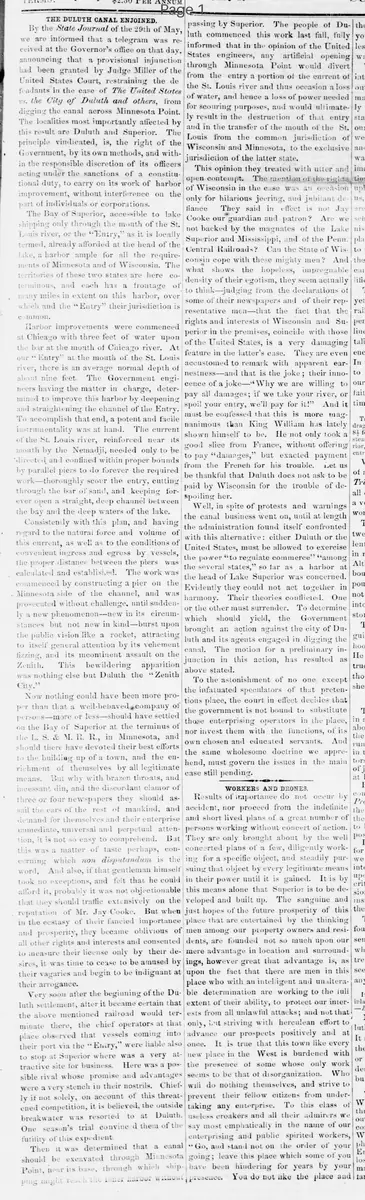
By the State Journal of the 29th of May, we are informed that a telegram was received at the Governor's office on that day, announcing that a provisional injunction had been granted by Judge Miller of the United States Court, restraining the defendants in the case of The United States vs. the City of Duluth and others, from digging the canal across Minnesota Point. The localities most importantly affected by this result are Duluth and Superior. The principle vindicated, is, the right of the Government, by its own methods, and within the responsible discretion of its officers acting under the sanctions of a constitutional duty, to carry on its work of harbor improvement, without interference on the part of individuals or corporations. The Bay of Superior, accessible to lake shipping only through the mouth of the St. Louis river, or the "Entry," as it is locally termed, already afforded at the head of the lake, a harbor ample for all the requirements of Minnesota and of Wisconsin. The territories of these two states are here co-terminous, and each has a frontage of many miles in extent on this harbor, over which and the "Entry" their jurisdiction is common. Harbor improvements were commenced at Chicago with three feet of water upon the bar at the mouth of Chicago river. At our "Entry" at the mouth of the St. Louis river, there is an average normal depth of about nine feet. The Government engineers having the matter in charge, determined to improve this harbor by deepening and straightening the channel of the Entry. To accomplish that end, a potent and facile instrumentality was at hand. The current of the St. Louis river, reinforced near its mouth by the Nemadji, needed only to be directed and confined within proper bounds by parallel piers to do forever the required work—thoroughly scour the entry, cutting through the bar of sand, and keeping forever open a straight, deep channel between the bay and the deep waters of the lake. Consistently with this plan, and having regard to the natural force and volume of this current, as well as to the conditions of convenient ingress and egress by vessels, the proper distance between the piers was calculated and established. The work was commenced by constructing a pier on the Minnesota side of the channel, and was prosecuted without challenge, until suddenly a new phenomenon—new in its circumstances but not new in kind—burst upon the public vision like a rocket, attracting to itself general attention by its vehement fizzing, and its incontinent assault on the Zenith. This bewildering apparition was nothing else but Duluth the "Zenith City." Now nothing could have been more proper than that a well-behaved company of persons—more or less—should have settled on the Bay of Superior at the terminus of the L. S. & M. R. R., in Minnesota, and should there have devoted their best efforts to the building up of a town, and the enrichment of themselves by all legitimate means. But why with brazen throats, and incessant din, and the discordant clamor of three or four newspapers they should assail the ears of the rest of mankind, and demand for themselves and their enterprise immediate, universal and perpetual attention, it is not so easy to comprehend. But this was a matter of taste perhaps, concerning which non disputandum is the word. And also, if that gentleman himself took no exceptions, and felt that he could afford it, probably it was not objectionable that they should traffic extensively on the reputation of Mr. Jay Cooke. But when in the ecstasy of their fancied importance and prosperity, they became oblivious of all other rights and interests and consented to measure their license only by their desires, it was time to cease to be amused by their vagaries and begin to be indignant at their arrogance. Very soon after the beginning of the Duluth settlement, after it became certain that the above mentioned railroad would terminate there, the chief operators at that place observed that vessels coming into their port via the "Entry," were liable also to stop at Superior where was a very attractive site for business. Here was a possible rival whose promise and advantages were a very stench in their nostrils. Chiefly if not solely, on account of this threatened competition, it is believed, the outside breakwater was resorted to at Duluth. One season's trial convinced them of the futility of this expedient. Then it was determined that a canal should be excavated through Minnesota Point, near its base, through which shipping might reach the inner harbor without passing by Superior. The people of Duluth commenced this work last fall, fully informed that in the opinion of the United States engineers, any artificial opening through Minnesota Point would divert from the entry a portion of the current of the St. Louis river and thus occasion a loss of water, and hence a loss of power needed for scouring purposes, and would ultimately result in the destruction of that entry and in the transfer of the mouth of the St. Louis from the common jurisdiction of Wisconsin and Minnesota, to the exclusive jurisdiction of the latter state. This opinion they treated with utter and open contempt. The mention of the rights of Wisconsin in the case was an occasion only for hilarious jeering, and jubilant defiance. They said in effect is not Jay Cooke our guardian and patron? Are we not backed by the magnates of the Lake Superior and Mississippi, and of the Penn. Central Railroads? Can the State of Wisconsin cope with these mighty men? And what shows the hopeless, impregnable density of their egotism, they seem actually to think—judging from the declarations of some of their newspapers and of their representative men—that the fact that the rights and interests of Wisconsin and Superior in the premises, coincide with those of the United States, is a very damaging feature in the latter's case. They are even accustomed to remark with apparent earnestness—and that is the joke; their innocence of a joke—"Why we are willing to pay all damages; if we take your river, or spoil your entry, we'll pay for it!" And it must be confessed that this is more magnanimous than King William has lately shown himself to be. He not only took a good slice from France, without offering to pay "damages," but exacted payment from the French for his trouble. Let us be thankful that Duluth does not ask to be paid by Wisconsin for the trouble of despoiling her. Well, in spite of protests and warnings the canal business went on, until at length the administration found itself confronted with this alternative: either Duluth or the United States, must be allowed to exercise the power "to regulate commerce" "among the several states," so far as a harbor at the head of Lake Superior was concerned. Evidently they could not act together in harmony. Their theories conflicted. One or the other must surrender. To determine which should yield, the Government brought an action against the city of Duluth and its agents engaged in digging the canal. The motion for a preliminary injunction in this action, has resulted as above stated. To the astonishment of no one except the infatuated speculators of that pretentious place, the court in effect decides that the government is not bound to substitute those enterprising operators in the place, nor invest them with the functions, of its own chosen and educated servants. And the same wholesome doctrine we apprehend, must govern the issues in the main case still pending.
What sub-type of article is it?
What keywords are associated?
What entities or persons were involved?
Where did it happen?
Domestic News Details
Primary Location
Duluth
Event Date
29th Of May
Key Persons
Outcome
provisional injunction granted, restraining defendants from digging the canal.
Event Details
A telegram announced that Judge Miller of the United States Court granted a provisional injunction in the case of The United States vs. the City of Duluth and others, stopping the canal excavation across Minnesota Point to protect government plans for improving the harbor at the Entry to Superior Bay using the St. Louis River current.