Thank you for visiting SNEWPapers!
Sign up free
Wheeling Times And Advertiser
Wheeling, Ohio County, West Virginia
What is this article about?
Court of Inquiry on USS Somers: Commander Mackenzie reports a conspiracy led by Midshipman Spencer to mutiny, murder officers, and turn the ship into a pirate vessel. After investigation, Spencer, Cromwell, and Small were executed at sea on December 1 to prevent the plot.
Clipping
OCR Quality
Full Text
FRIDAY, Dec. 30.
The Court met as usual, all present.
The minutes of yesterday was read.
Commander Mackenzie then put in a collated copy of his official report, of which the following is the substance. The first part is taken from the report of the Tribune:
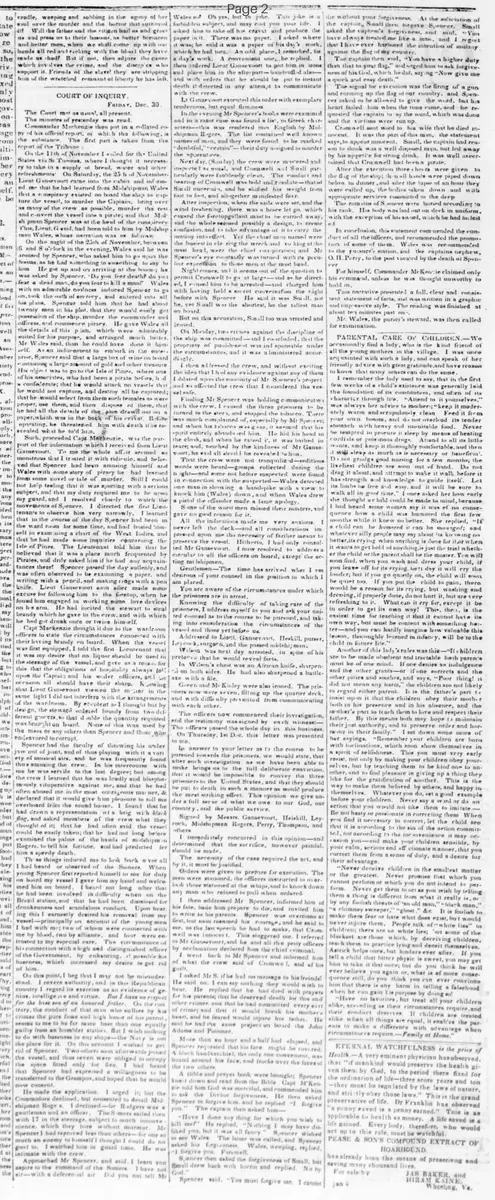
On the 14th of November I sailed for the United States via St Thomas, where I thought it necessary to take in a supply of bread, water and other refreshments. On Saturday, the 25th of November Lieut Gansevoort came into the cabin and informed me that he had learned from Midshipman Wales that a conspiracy existed on board the ship; to capture the vessel, to murder the Captain, bring over as many of the crew as possible, murder the rest and convert the vessel into a pirate; and that Midshipman Spencer was at the head of the conspiracy This, Lieut. G said, had been told to him by Midshipman Wales, whose narration was as follows: On the night of the 25th of November, between 6 and 8 o'clock in the evening, Wales said he was aroused by Spencer, who asked him to go upon the booms, as he had something to communicate to him He got up and on arriving at the booms; he was asked by Spencer, "Do you fear death? do you fear a dead man, do you fear to kill a man?" Wales with an admirable coolness induced Spencer to go on, took the oath of secrecy, and entered into all his plans. Spencer told him that he had about twenty men in his plot., that they would easily get possession of the ship, murder the commander and officers, and commence piracy. He gave Wales all the details of this plan, which were admirably suited for his purpose, and arranged much better. Mr Wales said, than he could have done it himself. As an inducement to embark in the enterprise, Spencer said that a large box of wine on board containing a large amount of gold and other treasure its object was to go to the Isle of Pines, where one of his associates, who had been a pirate before, had a confederate; that he would attack no vessels that he would not capture, and destroy all he captured; that he would select from them such females as were proper, use them, and then dispose of them, that he had all the details of the plan drawn out on paper, which was in the back of his cravat. Before separating, he threatened him with death if he revealed what he told him. Such, proceeded Capt Mackenzie, was the plan. port of the information which I received from Lieut Gansevoort. To me the whole affair seemed so monstrous that I treated it with ridicule, and believed that Spencer had been amusing himself and Wales with --some story of piracy he had learned from some novel or tale of murder. Still I could not help feeling that it was sporting with a serious subject, and. that my duty required me to be upon my guard, and I resolved closely to watch the movements of Spencer. I directed the first Lieutenant's to observe him very narrowly. I learned that in the course of the day Spencer had been in the ward room for some time, and had busied himself in examining a chart of the West Indies, and that he had made some inquiries concerning the Isle of Pines. The Lieutenant told him that he believed that it was a place much frequented by Pirates, and dryly asked him if he had any acquaintances there? Spencer passed the day sullenly, and was often observed to be examining a paper, and writing with a pencil, and making rings with a pen knife. Lieut Gansevoort soon after made some excuse for following him to the foretop, when he found him engaged in working some love devices on his arm. He had incited the steward to steal brandy which he gave to the crew, and with which he had got drunk once or twice himself. Capt Mackenzie thought it due to the ward room officers to state the circumstances connected with their having brandy on board. When the vessel was first equipped, I told the first Lieutenant that it was my desire that no liquor should be used the steerage of the vessel, and give as a reason. for this that the obligations of hospitality always fall upon the Captain and his ward room officers, and on occasion all should have their share. Knowing that Lieut Gansevoort viewed the matter in the same light I did not interfere with the arrangements of the ward room. By accident as I thought but by design, the steward ordered brandy from two different grocers. So that double the quantity required was brought on board. None of this was used by the mess or any others than Spencer and those who endeavored to corrupt. Spencer had the faculty of throwing his under jaw out of joint, and of thus playing with it a variety of musical airs, and he was frequently found thus amusing the crew. In his intercourse with me he was servile to the last degree; but among the crew I learned that he was loudly and blasphemously vituperative against me, and that he had often abused me in the most outrageous manner, & declared that it would give him pleasure to roll me overboard from the round house. I found that he had drawn a representation of a brig with black flag, and asked members of the crew what they thought of it; that he had often said the vessel could be easily taken; that he had not long before examined the palms of the hands of midshipman Rogers, to tell his fortune, and had predicted for him a speedy death. These things induced me to look back over all I had heard or observed of the Somers. When young Spencer first reported himself to me for duty on board my vessel I gave him my hand and welcomed him on board. I heard not long after than he had been involved in difficulty when on the Brazil station, and that he had been dismissed for drunkenness and scandalous conduct. Upon hearing this I earnestly desired his removal from my vessel--principally on account of the young men I had with me; two of whom were connected with me by blood, two by alliance, and four were entrusted to my especial care. The circumstance of his connection with a high and distinguished officer of the Government, by enhancing. if possible his baseness, which increased my desire to get rid of him. On this point, I beg that I may not be misunderstood. I revere authority. and in this Republican country I regard its exercise as an evidence of genius, intelligence and virtue. But I have no respect for the base son of an honored father. On the contrary, the conduct of that man who sullies by his crimes the pure fame and high honor of his parent, seems to me to be far more base than one equally guilty from an humbler station. But I wish nothing to do with baseness in any shape--the Navy is not the place for it. On this account I wished to get rid of Spencer. Two others soon afterwards joined the vessel, and thus seven were obliged to occupy the space fitted only for five. I had heard that Spencer had expressed a willingness to be transferred to the Grampus, and hoped that he would now consent. He made the application. I urged it but the Commodore declined, but consented to detail Mid. shipman Rogers. I declined--for Rogers was a gentleman and an officer. The Somers sailed then with 17 in the steerage, subject to much inconvenience. which they bore without murmur Mr Spencer I had reproved less than others--for one so much an enemy to himself I thought I could do no good to. I watched him in guard time. He was intimate with the crew Approached Mr Spencer, and said. I learn you aspire to the command of the Somers I have not--with a deferential air Did you not tell Mr Woles s? Oh yes, but in joke. This joke is a forbidden subject, and may cost you your life. I asked him to take off his cravat and produce the paper in it. There was no paper. I asked where it was; he said it was a paper of his day's work. which he had torn. An odd place. I remarked. for a day's work. A convenient one..he replied. I then ordered Lieut Gansevoort to put him in irons and place him in the after part--handcuffed also-- and with orders that he should be put to instant death if detected in any attempt to communicate with the crew Li Gansevoort executed this order with exemplary tenderness, but equal firmness In the evening Mr Spencer's books were examined and in a razor case was found a list. in Greek characters--this was rendered into English by Mid. shipman Rogers. The list contained well known names of men. and they were found to be marked doubtful." certain"-- their duty assigned to murder the apprentices. Next day. (Sunday) the crew were mustered and inspected as usual. and Cromwell and Small particularly were faultlessly clean. The conduct and bearing of Cromwell was bold and resolute--that of Small uncertain, and he shifted his weight from foot to foot. and altogether manifested fear. After inspection. when the sails were set. and the wind freshening. there was a brace let go. which caused the foretopgallant mast to be carried away. and the whole seemed possibly a design. to create confusion. and to take advantage of it to carry the mutiny into effect. Yet the chief men named were the busiest in clearing the wreck and working at the mast head. were the chief conspirators; and Mr Spencer's eye constantly was turned with its peculiar expression to those men at the mast head. Night comes. and it seems out of the question to permit Cromwell to go at large--and as he directed. I caused him to be arrested--and charged him with having held a secret conversation the night before with Spencer He said it was Small. not he. yet Small was the shortest, he the tallest man on board. But on this accusation. Small too was arrested and ironed. On Monday, two crimes against the discipline of the ship was committed--and I concluded. that the propriety of punishment was indispensable under the circumstances, and it was administered accordingly. I then addressed the crew, and without exciting the idea that I had any evidence against any of them I dilated upon the enormity of Mr Spencer's project and so affected the crew that I considered the vessel safe. Finding Mr Spencer was holding communication with the crew. I caused the three prisoners to be turned to the steerage. and stopped the tobacco. There was much complained of. especially by Mr Spencer; and when his tobacco was gone. it seemed that his spirit entirely abandoned him. He hid his head under the cloak, and when he raised it. it was bathed in tears; and. touched by the kindness of Mr Gansevoort. he said all should be revealed to him. That the crew were not tranquilized--seditious words were heard--groups collected during the night--and some not before suspected were found in connection with the suspected--Wales detected one man in showing a handspike with a view to knock him (Wales) down. and when Wales drew a pistol the offender made a lame apology. Some of the worst men missed their musters. and gave no good reason for it. All the indications made me very anxious. I never left the deck--and all considerations impressed upon me the necessity of farther means to preserve the vessel. Hitherto. I had only consulted Mr Gansevoort. I now resolved to address a circular to all the officers on board, except the acting midshipmen. Gentlemen--The time has arrived when I am desirous of your counsel in the position in which I am placed. You are aware of the circumstances under which the prisoners are in arrest. Knowing the difficulty of taking care of the prisoners, I address myself to you and ask your united counsel as to the course to be pursued. and taking into consideration the circumstances of the vessel and those yet before us Addressed to Lieut. Gansevoort. Heiskill. purser, Leycock. surgeon. and the passed midshipman. Wilson was next day arrested, in spite of his protest that he would reveal facts. In Wilson's chest was an African knife. sharpened on both sides. He had also sharpened a battle-axe with a file. Green and M. Kiley were also ironed. The prisoners now were seven, filling up the quarter deck. and with difficulty prevented from communicating with each other. The officers now commenced their investigation. and the testimony was signed by each witness:-- The officers passed the whole day in this business. On Thursday. 1st Dec. this letter was presented to me. In answer to your letter of the course to be pursued towards the prisoners, we would state, that after such investigation as we have been able to make brings us to the full deliberate conviction. that it would be impossible to convey the three prisoners to the United States, and that they should be put to death in such a manner as would produce the most striking effect. This opinion we give under a full sense of what we owe to our God, our country. and the public service. Signed by Messrs. Gansevoort, Heiskill. Ley. cock. Midshipmen Rogers, Perry, Thompson, and others I immediately concurred in this opinion--and determined that the sacrifice, however painful. should be made. The necessity of the case required the act, and by it. it must be justified Orders were given to prepare for execution. The men were stationed, the officers instructed to overlook those stationed at the whips. and to knock down any man who refused to pull when ordered I then addressed Mr Spencer, informed him of his fate, bade him prepare to die. and invited him to write to his parents Spencer was overcome at first, but soon resumed his composure, and he said to me. as the last speech he had to make, that Cromwell was innocent. This staggered me. I referred to Mr Gansevoort. and he and all the petty officers by acclamation declared him the chief criminal. I went back to Mr Spencer and informed him of what the crew said of Cromwell, and of his guilt. I asked Mr S. if he had no message to his friends? He said no. I can say nothing they would wish to hear. He replied that he had died with prayers for his parents; that he deserved death for the and other crimes. and that he had committed every sort of crime: and that it would break his mother's heart, and he feared would injure his father's. He said he had the same project on board the John Adams and Potomac. More than an hour and a half had elapsed, and Spencer requested that his face might be covered. A black handkerchief, the only one convenient, was bound around his face, and frocks over the faces of the two other A Bible and prayer book were brought; Spencer knelt down and read from the Bible Capt Mackenzie told him God was merciful, and commended him to ask the Divine forgiveness, He then asked Spencer to forgive him. and he replied "I forgive you" The captain then asked him-- "Have I done any thing for which you wish to kill me?' He replied, "Nothing I may have disliked you, but it was all fancy "Spencer wished to see Wales The latter was called, and Spencer asked his forgiveness Wales, weeping, replied. I forgive you. Farewell Spencer then asked the forgiveness of Small, but Small drew back with horror and replied No by God." Spencer said, "You must forgive me. I cannot die without your forgiveness. At the solicitation of the captain. Small then forgave Spencer. Small asked the captain's forgiveness. and said, "You have always treated me like a man. and I regret that I have ever harbored the intention of mutiny against the flag of my country. The captain then said, "You have a higher duty than that to your flag." and urged him to ask forgiveness of his God, which he did, saying "Now give me a quick and easy death." The signal for execution was the firing of a gun and running up the flag of our country. and Spencer asked to be allowed to give the word. but his heart failed him when the time came, and he requested the captain to say the word, which was done and the victims were run up. Cromwell sent word to his wife that he died innocent. It was the part of this man, the statement says, to appear innocent. Small, the captain had reason to think was a well disposed man, but led away by his appetite for strong drink. It was well ascertained that Cromwell had been a pirate. After the execution three cheers were given to the flag of the ship; then all hands were piped down below to dinner. and after the lapse of an hour they were called up. the bodies taken down and with appropriate services committed to the deep The remains of Spencer were buried according to his rank. His body was laid out on deck in uniform. with the exception of his sword, which he had forfeited In conclusion, this statement commended the conduct of all the officers, and recommended the promotion of some of them. Wales was recommended to the purser's station, and the captain's nephew O. H. Perry. to the post vacated by the death of Spencer For himself. Commander McKenzie claimed only his command. unless he was thought unworthy to hold it. This narrative presented a full, clear and consistent statement of facts. and was written in a graphic and impressive style. The reading was finished at about ten minutes past one. Mr. Wales. the purser's steward, was then called for examination.
What sub-type of article is it?
What keywords are associated?
What entities or persons were involved?
Where did it happen?
Domestic News Details
Primary Location
Uss Somers
Event Date
November 14 To December 1
Key Persons
Outcome
execution by hanging of midshipman spencer, cromwell, and small on december 1; bodies committed to the sea.
Event Details
Commander Mackenzie's report to the Court of Inquiry details a conspiracy uncovered on November 25 aboard the USS Somers, led by Midshipman Spencer to mutiny, murder officers, and engage in piracy. After arrests, investigations, and consultations with officers, the three ringleaders were executed at sea to ensure the safety of the vessel.