Thank you for visiting SNEWPapers!
Sign up free
American Watchman And Delaware Advertiser
Wilmington, New Castle County, Delaware
What is this article about?
An article from the National Intelligencer reprints L. Louaillier's 1826 defense against treason accusations by General Andrew Jackson during the 1815 post-Battle of New Orleans period. Louaillier, a Louisiana legislator, was arrested for opposing martial law and publishing criticism, leading to clashes over habeas corpus and military overreach. Includes background on Jackson's actions and an 1824 Enquirer extract criticizing his usurpations.
Merged-components note: Merged continuation of Mr. Louaillier's Appeal story across pages based on sequential reading order and explicit 'TO BE CONTINUED' indicator.
Clippings
1 of 2
OCR Quality
Full Text
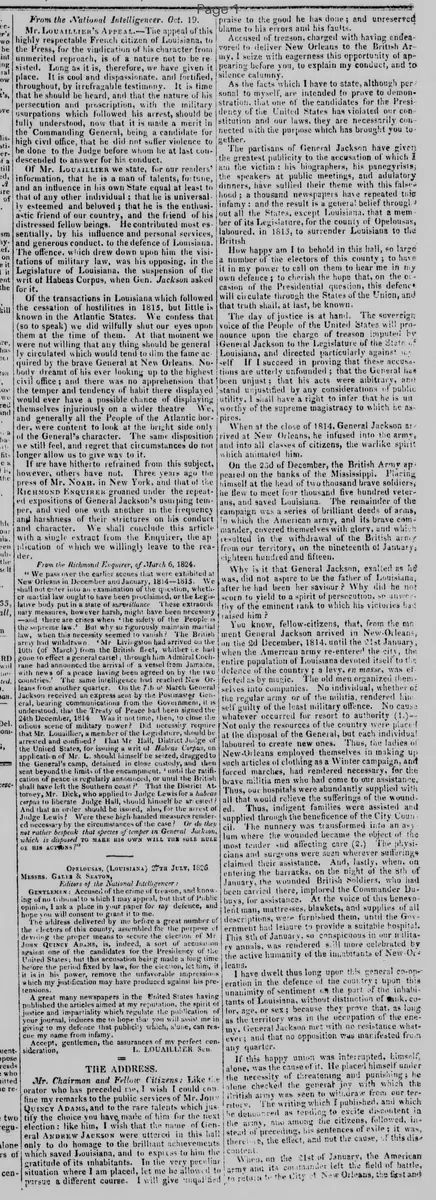
Mr. LOUAILLIER's APPEAL.--The appeal of this highly respectable French citizen of Louisiana, to the Press, for the vindication of his character from unmerited reproach, is of a nature not to be resisted. Long as it is, therefore, we have given it place. It is cool and dispassionate, and fortified throughout, by irrefragable testimony. It is time that he should be heard, and that the nature of his persecution and proscription, with the military usurpations which followed his arrest, should be fully understood, now that it is made a merit in the Commanding General, being a candidate for high civil office, that he did not suffer violence to be done to the Judge before whom he at last condescended to answer for his conduct.
Of Mr. Louaillier we state, for our readers' information, that he is a man of talents, fortune, and an influence in his own State equal at least to that of any other individual; that he is universally esteemed and beloved; that he is the enthusiastic friend of our country, and the friend of his distressed fellow beings. He contributed most essentially, by his influence and personal services, and generous conduct, to the defence of Louisiana.
The offence, which drew down upon him the visitations of military law, was his opposing, in the Legislature of Louisiana, the suspension of the writ of Habeas Corpus, when Gen. Jackson asked for it.
Of the transactions in Louisiana which followed the cessation of hostilities in 1815, but little is known in the Atlantic States. We confess that (so to speak) we did wilfully shut our eyes upon them at the time of them. At that moment we were not willing that any thing should be generally circulated which would tend to dim the fame acquired by the brave General at New Orleans. Nobody dreamt of his ever looking up to the highest civil office; and there was no apprehension that the temper and tendency of habit there displayed would ever have a possible chance of displaying themselves injuriously on a wider theatre. We, and generally all the People of the Atlantic border, were content to look at the bright side only of the General's character. The same disposition we still feel, and regret that circumstances do not longer allow us to give way to it.
If we have hitherto refrained from this subject, however, others have not. Three years ago the press of Mr. Noah, in New York, and that of the Richmond Enquirer groaned under the repeated expositions of General Jackson's usurping temper, and vied one with another in the frequency and harshness of their strictures on his conduct and character. We shall conclude this article with a single extract from the Enquirer, the application of which we willingly leave to the reader.
From the Richmond Enquirer, of March 6, 1824.
"We pass over the earlier scenes that were exhibited at New Orleans in December and January, 1814--1815. We shall not enter into an examination of the question, whether martial law ought to have been proclaimed, or the Legislative body put in a state of surveillance. These extraordinary measures, however harsh, might have been necessary--and there are crises when 'the safety of the People is the supreme law.' But why so rigorously maintain martial law, when this necessity seemed to vanish? The British army had withdrawn. Mr. Livingston had arrived on the 10th (of March) from the British fleet, whither he had gone to effect a general cartel; through him Admiral Cochrane had announced the arrival of a vessel from Jamaica, with news of a peace having been agreed on by the two countries.' The same intelligence had reached New Orleans from another quarter. On the 7th of March General Jackson received an express sent by the Postmaster General, bearing communications from the Government, it is understood, that the Treaty of Peace had been signed the 24th December, 1814. Was it not time, then, to close the odious scene of military power? Did necessity require that Mr. Louaillier, a member of the Legislature, should be arrested and confined? That Mr. Hall, District Judge of the United States, for issuing a writ of Habeas Corpus, on application of Mr. L. should himself be seized, dragged to the General's camp, detained in close custody, and then sent beyond the limit of the encampment, 'until the ratification of peace is regularly announced, or until the British shall have left the Southern coast?' That the District Attorney, Mr. Dick, who applied to Judge Lewis for a habeas corpus to liberate Judge Hall, should himself be arrested? And that an order should be issued, also, for the arrest of Judge Lewis? Were these high-handed measures rendered necessary by the circumstances of the case? Or do they not rather bespeak that species of temper in General Jackson, WHICH IS DISPOSED TO MAKE HIS OWN WILL THE SOLE RULE OF HIS ACTIONS?"
OPELOUSAS, (LOUISIANA) 27TH JULY, 1826
MESSRS. GALE & SEATON,
Editors of the National Intelligencer:
Gentlemen: Accused of the crime of treason, and knowing of no tribunal to which I may appeal, but that of Public opinion, I ask a place in your paper for my defence, and hope you will consent to grant it to me.
The address delivered by me before a great number of the electors of this county, assembled for the purpose of devising the proper means to secure the election of Mr. John Quincy Adams, is, indeed, a sort of accusation against one of the candidates for the Presidency of the United States; but this accusation being made a long time before the period fixed by law, for the election, let him, if it is in his power, remove the unfavorable impressions which my justification may have produced against his pretensions.
A great many newspapers in the United States having published the articles aimed at my reputation, the spirit of justice and impartiality which regulate the publication of your journal, induces me to hope that you will assist me in giving to my defence that publicity which, alone, can rescue my name from infamy.
Accept, gentlemen, the assurances of my perfect consideration,
L. LOUAILLIER Sen.
THE ADDRESS.
Mr. Chairman and Fellow Citizens: Like the orator who has preceded me, I wish I could confine my remarks to the public services of Mr. John Quincy Adams, and to the rare talents which justify the choice you have made of him for the next election: like him, I wish that the name of General Andrew Jackson were uttered in this hall only to do homage to the brilliant achievements which saved Louisiana, and to express to him the gratitude of its inhabitants. In the very peculiar situation where I am placed, let me be allowed to pursue a different course. I will give unqualified praise to the good he has done; and unreserved blame to his errors and his faults.
Accused of treason, charged with having endeavored to deliver New Orleans to the British Army, I seize with eagerness this opportunity of appearing before you, to explain my conduct, and to silence calumny.
As the facts which I have to state, although personal to myself, are intended to prove to demonstration, that one of the candidates for the Presidency of the United States has violated our constitution and our laws, they are necessarily connected with the purpose which has brought you together.
The partisans of General Jackson have given the greatest publicity to the accusation of which I am the victim: his biographers, his panegyrists; the speakers at public meetings, and adulatory dinners, have sullied their theme with this falsehood; a thousand newspapers have repeated this infamy: and the result is a general belief throughout all the States, except Louisiana, that a member of its Legislature, for the county of Opelousas, laboured, in 1815, to surrender Louisiana to the British
How happy am I to behold in this hall, so large a number of the electors of this county; to have it in my power to call on them to hear me in my own defence: to cherish the hope that, on the occasion of the Presidential question, this defence will circulate through the States of the Union, and that truth shall, at last, be known.
The day of justice is at hand. The sovereign voice of the People of the United States will pronounce upon the charge of treason imputed by General Jackson to the Legislature of the State Louisiana, and directed particularly against myself. If I succeed in proving that these accusations are utterly unfounded: that the General has been unjust; that his acts were arbitrary, and stand unjustified by any considerations of public utility, I shall have a right to infer that he is unworthy of the supreme magistracy to which he aspires.
When at the close of 1814, General Jackson arrived at New Orleans, he infused into the army, and into all classes of citizens, the warlike spirit which animated him.
On the 23d of December, the British Army appeared on the banks of the Mississippi. Placing himself at the head of two thousand brave soldiers, he flew to meet four thousand five hundred veterans, and saved Louisiana. The remainder of the campaign was a series of brilliant deeds of arms, in which the American army, and its brave commander, covered themselves with glory, and which resulted in the withdrawal of the British army from our territory, on the nineteenth of January: eighteen hundred and fifteen.
Why is it that General Jackson, exalted as he was, did not aspire to be the father of Louisiana, after he had been her saviour? Why did he not scorn to yield to a spirit of persecution, so unworthy of the eminent rank to which his victories had raised him?
You know, fellow-citizens, that, from the moment General Jackson arrived in New-Orleans, on the 2d December, 1814, until the 21st January, when the American army re-entered the city, the entire population of Louisiana devoted itself to the defence of the country; a levy, en masse, was effected as by magic. The old men organized themselves into companies. No individual, whether of the regular army or of the militia, rendered himself guilty of the least military offence. No cause whatever occurred for resort to authority.--Not only the resources of the country were placed at the disposal of the General, but each individual laboured to create new ones. Thus, the ladies of New-Orleans employed themselves in making up such articles of clothing as a Winter campaign, and forced marches, had rendered necessary, for the brave militia men who had come to our assistance. Thus, our hospitals were abundantly supplied with all that would relieve the sufferings of the wounded. Thus, indigent families were assisted and supplied through the beneficence of the City Council. The nunnery was transformed into an asylum where the wounded became the object of the most tender and affecting care. The physicians and surgeons were seen wherever sufferings claimed their assistance. And, lastly, when, on entering the barracks, on the night of the 8th of January, the wounded British Soldiers, who had been carried there, implored the Commander Dubuy's, for assistance. At the voice of this benevolent man, mattresses, blankets, and supplies of all descriptions, were furnished them, until the Government had leisure to provide a suitable hospital.
This 8th of January, so conspicuous in our military annals, was rendered still more celebrated by the active humanity of the inhabitants of New-Orleans.
I have dwelt thus long upon this general co-operation in the defence of the country; upon this unanimity of sentiment on the part of the inhabitants of Louisiana, without distinction of rank, color, age, or sex; because they prove that, as long as the territory was in the occupation of the enemy, General Jackson met with no resistance whatever; and that no opposition was manifested from any quarter.
If this happy union was interrupted, himself, alone, was the cause of it. He placed himself under the necessity of threatening and punishing: he alone checked the general joy with which the British army was seen to withdraw from our territory. The writing which I published, and which he denounced as tending to excite discontent in the army, and among the citizens, followed, therein, the effect, and not the cause, of this discontent.
When, on the 21st of January, the American army and its commander left the field of battle, to return to the City of New Orleans, the first
Second regiments of the militia of the city received orders to encamp on Villere's plantation. It will be easily imagined how painful such an order must have been for those two regiments, which, as a part of the levy en masse, were composed of the greater part of the citizens of New Orleans, between the ages of eighteen and forty-five years. These militiamen were deeply wounded at being thus deprived of the happiness of returning to the bosom of their families, at the same time that this favor was granted to the battalion of volunteers under the command of Major Plauche, and to that of colored men, under Major Daquin.
While we approve the motives of prudence which induced the General to forbear from disbanding the militia, as long as the British forces remained within our waters, and until the news of peace was officially communicated, we cannot refrain from regretting his having made choice of the first and second regiments of militia to constitute the camp on Villere's plantation, after the departure of the British army. Why did he retain these militiamen without the city, while the others, and even the corps of regulars, were allowed to enter it? These regiments might have been kept on active duty within the city; they might have been daily trained to military exercises; in case of a new invasion, they might have been marched to any threatened point, with equal, and, perhaps, greater rapidity, from the city than from Villere's plantation: and at any hour of the day or night, the General would have found their ranks full. After so glorious a campaign, it was, perhaps, a duty, on the part of the General, to extend the same favors to all the different corps of the levy en masse, of the city of New Orleans. It could certainly be but an act of kindness and of sound policy.
I allude to the manner in which the General disposed of his troops, not so much to censure his proceedings, as for the purpose of setting forth the causes of the discontent which prevailed in the ranks of the militia, after the return of the American army to the city of New Orleans. This discontent, which extended to the Frenchmen who had made the campaign in those ranks, determined them to claim the protection of the consul of their nation.
On the 31st January, Governor Claiborne wrote to General Jackson to apprise him that the militia officers were constantly applying to him for instructions as to the manner in which they were to dispose of the various detachments then in New Orleans: it may be inferred from this communication, that the constant coming in of the new levies, ever since the 8th January, had encumbered the city and its vicinity with crowds of soldiers. If this inference be correct, it would follow that the exclusion from the city of the first and second regiments, was intentional on the part of Gen. Jackson, and wholly unnecessary. Did not this useless aggravation of the hardships attendant on military service, justify the proceeding of the French soldiers? On the first appearance of the British army, they had rallied under our banners; they had performed the campaign which had just terminated so gloriously; and now, all ground of apprehension having ceased, in consequence of the retreat of the enemy, they thought it unjust and cruel, that they should thus be detained, without sufficient cause, in the midst of the marshes of Villere's plantation, a thousand times more deadly than the enemy's fire.
Incensed by their proceeding, the General ordered these brave men to leave New Orleans within three days, and not to approach within a distance of 120 miles from it. It was against this act of violence, that on the 3d March, 1815, I published an article in the Louisiana Courier.
For this publication, the General caused me to be arrested. I directed Mr. Morel, my counsel, to sue out a writ of habeas corpus, which was granted by the Hon. J. A. Hall, Judge of the District Court of the United States.
This arrest, fellow citizens, affords a memorable instance of the evils of the excesses which spring from absolute authority, even when exercised for a limited time of difficulty, and with the best intentions. I am far from suspecting the General's motives in this transaction—yielding to that violence which is natural to his temper, he rushed upon the legislator and upon the judges who dared to oppose him with the same impetuosity he had displayed against the enemies of his country.
Instead of obeying the order of the Court, the General laid a fearless and sacrilegious hand upon the interpreter of the law. At the hour when I was to appear before his tribunal, I saw the judge come towards me to share my imprisonment in the same room, and pay with his liberty for the noble independence with which he had acted.
Mr. Dick, the District Attorney, was likewise arrested for having attempted to liberate Judge Hall, by suing out a writ of habeas corpus; and an order was issued to arrest Judge Lewis who had granted that writ.
I was then carried before a Court Martial. Had I acknowledged its jurisdiction, it would have amounted to a surrender into the hands of a military chieftain in the service of the United States, of the independence and sovereignty guaranteed to the State of Louisiana by the inviolable compact which binds her to her sister States. I therefore observed to the Court that my detention was illegal, since General Jackson, who had given orders to arrest me, had not obeyed the writ of habeas corpus, which had been served on him by the District Court. I represented further, that being a member of the Legislature, I stood beyond the reach of martial law, and that I had a right to claim a trial by jury.
In support of this plea, I cited the 8th section of the 1st article of the Constitution of the United States, Nos. 14 and 15, which reserves to Congress the power of organizing and disciplining the militia;
The 1st section of the act of Congress of the 8th May, 1792, which authorizes the state Legislatures to provide such exemptions from military service as they may think fit;
The 2nd section of the 3d article of the Constitution of the State of Louisiana, which enacts that the militia of the state shall be organized in such a manner as the Legislature shall think proper;
And lastly, the act of the Legislature of Louisiana of the 12th February, 1813, exempting the members of both Houses from military service.
I insisted upon the limits prescribed by the laws above cited, to the authority of the Generals in Chief of the American Armies, under what name soever this authority might be proclaimed, even under that of martial law.
Our laws have wisely enacted, that whenever, in the moment of public danger, all the citizens capable of bearing arms, between the ages of 18 and 45, should be placed at the disposal of a Commander in Chief, this general levy should be subjected to the Military Code of the United States; but whoever dares to pass beyond these legal barriers, by bringing before a Court Martial a Citizen exempt, by law, from doing military duty, by refusing to surrender him to the civil authority when so required, or by depriving him of the trial by jury, renders himself guilty of a violation of the right of individual liberty; of an abuse of power; and, in the case of capital punishment, guilty of an odious assassination.
Notwithstanding these objections, the Court declared itself competent, and then I declined taking any part in the proceedings; I remained silent, as well as my counsel; summoned no witnesses to prove my innocence; and yet I was acquitted.
The General in Chief declined sanctioning the sentence of the Court. By assembling another Court Martial, or, which would have been better still, by surrendering me to the civil tribunals, he would have fulfilled his duty towards his country; he would have been just towards me; a solemn sentence pronounced by these tribunals would either have condemned a traitor, or restored a citizen to the State. He preferred keeping me under arrest until the day on which peace was proclaimed between England and the United States; then martial law expired, a general pardon for all military offences was published, and the doors of my prison were opened.
My first act, after my restoration to freedom, was to protest in the public journals against the amnesty by which they had sought to brand me as a criminal.
Can it be an act of justice towards an individual acquitted by a Court Martial, to publish against him such an article as that which Gen. Jackson caused to be inserted in the part of the Impos, of the 4th April, 1815, which is printed in the English language? Does a General in Chief fulfil his duty towards an individual accused of high treason, and acquitted by a Court Martial appointed and constituted by himself, by first publishing his infamy in his general orders, and then pardoning him? I submit these questions to the People of the United States, now assembled for the purpose of electing their Chief Magistrate.
(TO BE CONTINUED)
What sub-type of article is it?
What themes does it cover?
What keywords are associated?
What entities or persons were involved?
Where did it happen?
Story Details
Key Persons
Location
New Orleans, Louisiana
Event Date
1814 1815
Story Details
Louisiana legislator L. Louaillier recounts his arrest by General Jackson in March 1815 for publishing criticism of military orders post-Battle of New Orleans, opposition to martial law, and habeas corpus violations; he was tried by court-martial, acquitted, but held until peace; defends against treason charges in 1826 address supporting Adams against Jackson.