Thank you for visiting SNEWPapers!
Sign up free
Editorial
February 15, 1950
Laurel Outlook
Laurel, Yellowstone County, Montana
What is this article about?
The editorial expresses doubt about the US ever ending economic aid to Europe, highlighting billions already spent under the Marshall Plan, requests for more, and predictions of perpetual funding due to escalating crises like the H-bomb and Russian threats.
Clipping
OCR Quality
98%
Excellent
Full Text
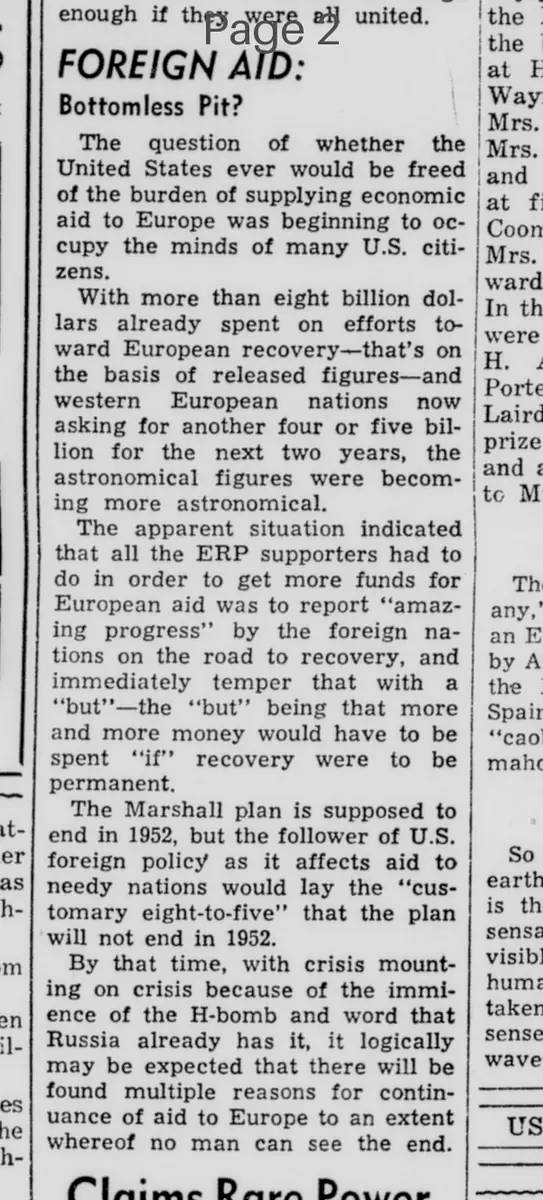
FOREIGN AID:
Bottomless Pit?
The question of whether the United States ever would be freed of the burden of supplying economic aid to Europe was beginning to occupy the minds of many U.S. citizens.
With more than eight billion dollars already spent on efforts toward European recovery--that's on the basis of released figures--and western European nations now asking for another four or five billion for the next two years, the astronomical figures were becoming more astronomical.
The apparent situation indicated that all the ERP supporters had to do in order to get more funds for European aid was to report "amazing progress" by the foreign nations on the road to recovery, and immediately temper that with a "but"--the "but" being that more and more money would have to be spent "if" recovery were to be permanent.
The Marshall plan is supposed to end in 1952, but the follower of U.S. foreign policy as it affects aid to needy nations would lay the "customary eight-to-five" that the plan will not end in 1952.
By that time, with crisis mounting on crisis because of the imminence of the H-bomb and word that Russia already has it, it logically may be expected that there will be found multiple reasons for continuance of aid to Europe to an extent whereof no man can see the end.
Bottomless Pit?
The question of whether the United States ever would be freed of the burden of supplying economic aid to Europe was beginning to occupy the minds of many U.S. citizens.
With more than eight billion dollars already spent on efforts toward European recovery--that's on the basis of released figures--and western European nations now asking for another four or five billion for the next two years, the astronomical figures were becoming more astronomical.
The apparent situation indicated that all the ERP supporters had to do in order to get more funds for European aid was to report "amazing progress" by the foreign nations on the road to recovery, and immediately temper that with a "but"--the "but" being that more and more money would have to be spent "if" recovery were to be permanent.
The Marshall plan is supposed to end in 1952, but the follower of U.S. foreign policy as it affects aid to needy nations would lay the "customary eight-to-five" that the plan will not end in 1952.
By that time, with crisis mounting on crisis because of the imminence of the H-bomb and word that Russia already has it, it logically may be expected that there will be found multiple reasons for continuance of aid to Europe to an extent whereof no man can see the end.
What sub-type of article is it?
Foreign Affairs
Economic Policy
What keywords are associated?
Foreign Aid
Marshall Plan
European Recovery
Endless Spending
Russia Threat
H Bomb
What entities or persons were involved?
United States
Europe
Western European Nations
Erp
Marshall Plan
Russia
Editorial Details
Primary Topic
Skepticism About Endless Us Foreign Aid To Europe
Stance / Tone
Critical And Skeptical Of Perpetual Aid
Key Figures
United States
Europe
Western European Nations
Erp
Marshall Plan
Russia
Key Arguments
Over Eight Billion Dollars Already Spent On European Recovery
Western European Nations Requesting Another Four Or Five Billion For Next Two Years
Erp Supporters Report Progress But Always Qualify With Need For More Funds
Marshall Plan Scheduled To End In 1952 But Unlikely To
Ongoing Crises Like H Bomb And Russian Possession Will Justify Continued Aid Indefinitely