Thank you for visiting SNEWPapers!
Sign up free
Literary
March 27, 1802
The Recorder, Or, Lady's And Gentleman's Miscellany
Richmond, Virginia
What is this article about?
Emily Melville, facing a forced marriage to Grimes arranged by Mr. Tyrrel, reluctantly agrees to escape with Grimes' help at night, despite her fears and the isolation of Tyrrel Place. She navigates anxiety, failed escape attempts, and preparations amid oppressive surveillance.
Clipping
OCR Quality
95%
Excellent
Full Text
CALEB WILLIAMS.
[Continued from our last.]
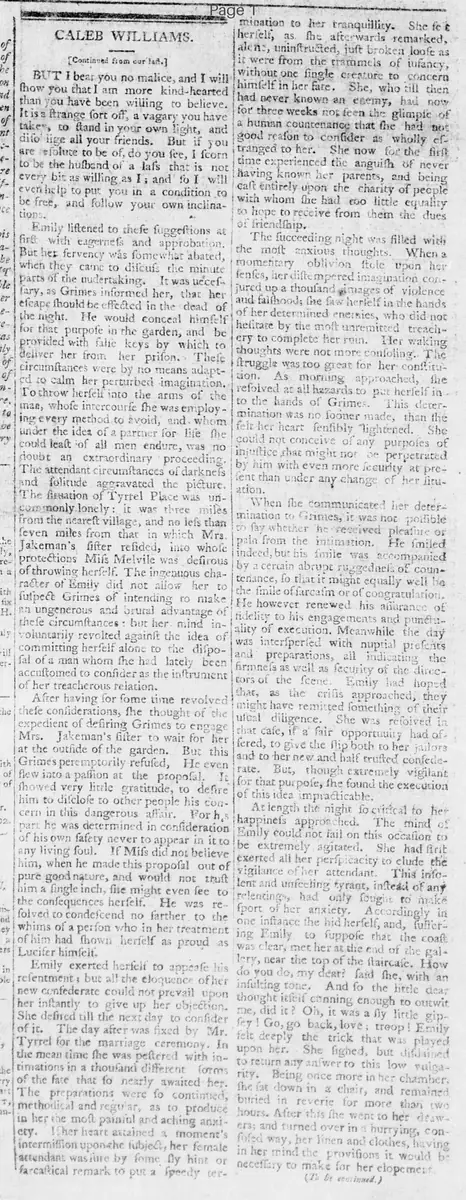
BUT I bear you no malice, and I will show you that I am more kind-hearted than you have been willing to believe. It is a strange sort of vagary you have taken, to stand in your own light, and disoblige all your friends. But if you are resolute to be off, do you see, I scorn to be the husband of a lass that is not every bit as willing as I: and so I will even help to put you in a condition to be free, and follow your own inclinations.
Emily listened to these suggestions at first with eagerness and approbation. But her fervency was somewhat abated, when they came to discuss the minute parts of the undertaking. It was necessary, as Grimes informed her, that her escape should be effected in the dead of the night. He would conceal himself for that purpose in the garden, and be provided with false keys by which to deliver her from her prison. These circumstances were by no means adapted to calm her perturbed imagination. To throw herself into the arms of the man, whose intercourse she was employing every method to avoid, and whom under the idea of a partner for life she could least of all men endure, was no doubt an extraordinary proceeding. The attendant circumstances of darkness and solitude aggravated the picture. The situation of Tyrrel Place was uncommonly lonely: it was three miles from the nearest village, and no less than seven miles from that in which Mrs. Jakeman's sister resided, into whose protection Miss Melville was desirous of throwing herself. The ingenuous character of Emily did not allow her to suspect Grimes of intending to make an ungenerous and brutal advantage of these circumstances: but her mind involuntarily revolted against the idea of committing herself alone to the disposal of a man whom she had lately been accustomed to consider as the instrument of her treacherous situation.
After having for some time revolved these considerations, she thought of the expedient of desiring Grimes to engage Mrs. Jakeman's sister to wait for her at the outside of the garden. But this Grimes peremptorily refused. He even flew into a passion at the proposal. It showed very little gratitude, to desire him to disclose to other people his concern in this dangerous affair. For his part he was determined in consideration of his own safety never to appear in it to any living soul. If Miss did not believe him, when he made this proposal out of pure goodnature, and would not trust him a single inch, she might even see to the consequences herself. He was resolved to condescend no farther to the whims of a person who in her treatment of him had shown herself as proud as Lucifer himself.
Emily exerted herself to appease his resentment, but all the eloquence of her new confederate could not prevail upon her instantly to give up her objection. She desired till the next day to consider of it. The day after was fixed by Mr. Tyrrel for the marriage ceremony. In the mean time she was pestered with intimations in a thousand different forms of the fate that so nearly awaited her. The preparations were so continued, methodical and regular, as to produce in her the most painful and aching anxiety. If her heart attained a moment's intermission upon the subject, her female attendant was still by some sly hint or sarcastical remark to put a speedy termination to her tranquillity. She set herself, as she afterwards remarked, alone, uninstructed, just broken loose as it were from the trammels of infancy, without one single creature to concern himself in her fate. She, who till then had never known an enemy, had now for three weeks not seen the glimpse of a human countenance that she had not good reason to consider as wholly estranged to her. She now for the first time experienced the anguish of never having known her parents, and being cast entirely upon the charity of people with whom she had so little equality to hope to receive from them the dues of friendship.
The succeeding night was filled with the most anxious thoughts. When a momentary oblivion stole upon her senses, her distempered imagination conjured up a thousand images of violence and falsehood: she saw herself in the hands of her determined enemies, who did not hesitate by the most unremitted treachery to complete her ruin. Her waking thoughts were not more consoling. The struggle was too great for her constitution. As morning approached, she resolved at all hazards to put herself into the hands of Grimes. This determination was no sooner made, than she felt her heart sensibly lightened. She could not conceive of any purposes of injustice that might not be perpetrated by him with even more security at present than under any change of her situation.
When she communicated her determination to Grimes, it was not possible to say whether he received pleasure or pain from the intimation. He smiled indeed, but his smile was accompanied by a certain abrupt ruggedness of countenance, so that it might equally well have been the smile of sarcasm or of congratulation. He however renewed his assurance of fidelity to his engagements and punctuality of execution. Meanwhile the day was interspersed with nuptial presents and preparations, all indicating the firmness as well as security of the directors of the scene. Emily had hoped that, as the crisis approached, they might have remitted something of their usual diligence. She was resolved in that case, if a fair opportunity had offered, to give the slip both to her jailors and to her new and half trusted confederate. But, though extremely vigilant for that purpose, she found the execution of this idea impracticable.
At length the night so critical to her happiness approached. The mind of Emily could not fail on this occasion to be extremely agitated. She had first exerted all her perspicacity to elude the vigilance of her attendant. This insolent and unfeeling tyrant, instead of any relentings, had only sought to make sport of her anxiety. Accordingly in one instance she hid herself, and, suffering Emily to suppose that the coast was clear, met her at the end of the gallery, near the top of the staircase. "How do you do, my dear?" said she, with an insulting tone. "And so the little dear thought itself cunning enough to outwit me, did it? Oh, it was a sly little gipsy! Go, go back, love; troop!" Emily felt deeply the trick that was played upon her. She sighed, but disdained to return any answer to this low vulgarity. Being once more in her chamber, she sat down in a chair, and remained buried in reverie for more than two hours. After this she went to her drawers; and turned over in a hurrying, confused way, her linen and clothes, having in her mind the provisions it would be necessary to make for her elopement.
(To be continued.)
[Continued from our last.]
BUT I bear you no malice, and I will show you that I am more kind-hearted than you have been willing to believe. It is a strange sort of vagary you have taken, to stand in your own light, and disoblige all your friends. But if you are resolute to be off, do you see, I scorn to be the husband of a lass that is not every bit as willing as I: and so I will even help to put you in a condition to be free, and follow your own inclinations.
Emily listened to these suggestions at first with eagerness and approbation. But her fervency was somewhat abated, when they came to discuss the minute parts of the undertaking. It was necessary, as Grimes informed her, that her escape should be effected in the dead of the night. He would conceal himself for that purpose in the garden, and be provided with false keys by which to deliver her from her prison. These circumstances were by no means adapted to calm her perturbed imagination. To throw herself into the arms of the man, whose intercourse she was employing every method to avoid, and whom under the idea of a partner for life she could least of all men endure, was no doubt an extraordinary proceeding. The attendant circumstances of darkness and solitude aggravated the picture. The situation of Tyrrel Place was uncommonly lonely: it was three miles from the nearest village, and no less than seven miles from that in which Mrs. Jakeman's sister resided, into whose protection Miss Melville was desirous of throwing herself. The ingenuous character of Emily did not allow her to suspect Grimes of intending to make an ungenerous and brutal advantage of these circumstances: but her mind involuntarily revolted against the idea of committing herself alone to the disposal of a man whom she had lately been accustomed to consider as the instrument of her treacherous situation.
After having for some time revolved these considerations, she thought of the expedient of desiring Grimes to engage Mrs. Jakeman's sister to wait for her at the outside of the garden. But this Grimes peremptorily refused. He even flew into a passion at the proposal. It showed very little gratitude, to desire him to disclose to other people his concern in this dangerous affair. For his part he was determined in consideration of his own safety never to appear in it to any living soul. If Miss did not believe him, when he made this proposal out of pure goodnature, and would not trust him a single inch, she might even see to the consequences herself. He was resolved to condescend no farther to the whims of a person who in her treatment of him had shown herself as proud as Lucifer himself.
Emily exerted herself to appease his resentment, but all the eloquence of her new confederate could not prevail upon her instantly to give up her objection. She desired till the next day to consider of it. The day after was fixed by Mr. Tyrrel for the marriage ceremony. In the mean time she was pestered with intimations in a thousand different forms of the fate that so nearly awaited her. The preparations were so continued, methodical and regular, as to produce in her the most painful and aching anxiety. If her heart attained a moment's intermission upon the subject, her female attendant was still by some sly hint or sarcastical remark to put a speedy termination to her tranquillity. She set herself, as she afterwards remarked, alone, uninstructed, just broken loose as it were from the trammels of infancy, without one single creature to concern himself in her fate. She, who till then had never known an enemy, had now for three weeks not seen the glimpse of a human countenance that she had not good reason to consider as wholly estranged to her. She now for the first time experienced the anguish of never having known her parents, and being cast entirely upon the charity of people with whom she had so little equality to hope to receive from them the dues of friendship.
The succeeding night was filled with the most anxious thoughts. When a momentary oblivion stole upon her senses, her distempered imagination conjured up a thousand images of violence and falsehood: she saw herself in the hands of her determined enemies, who did not hesitate by the most unremitted treachery to complete her ruin. Her waking thoughts were not more consoling. The struggle was too great for her constitution. As morning approached, she resolved at all hazards to put herself into the hands of Grimes. This determination was no sooner made, than she felt her heart sensibly lightened. She could not conceive of any purposes of injustice that might not be perpetrated by him with even more security at present than under any change of her situation.
When she communicated her determination to Grimes, it was not possible to say whether he received pleasure or pain from the intimation. He smiled indeed, but his smile was accompanied by a certain abrupt ruggedness of countenance, so that it might equally well have been the smile of sarcasm or of congratulation. He however renewed his assurance of fidelity to his engagements and punctuality of execution. Meanwhile the day was interspersed with nuptial presents and preparations, all indicating the firmness as well as security of the directors of the scene. Emily had hoped that, as the crisis approached, they might have remitted something of their usual diligence. She was resolved in that case, if a fair opportunity had offered, to give the slip both to her jailors and to her new and half trusted confederate. But, though extremely vigilant for that purpose, she found the execution of this idea impracticable.
At length the night so critical to her happiness approached. The mind of Emily could not fail on this occasion to be extremely agitated. She had first exerted all her perspicacity to elude the vigilance of her attendant. This insolent and unfeeling tyrant, instead of any relentings, had only sought to make sport of her anxiety. Accordingly in one instance she hid herself, and, suffering Emily to suppose that the coast was clear, met her at the end of the gallery, near the top of the staircase. "How do you do, my dear?" said she, with an insulting tone. "And so the little dear thought itself cunning enough to outwit me, did it? Oh, it was a sly little gipsy! Go, go back, love; troop!" Emily felt deeply the trick that was played upon her. She sighed, but disdained to return any answer to this low vulgarity. Being once more in her chamber, she sat down in a chair, and remained buried in reverie for more than two hours. After this she went to her drawers; and turned over in a hurrying, confused way, her linen and clothes, having in her mind the provisions it would be necessary to make for her elopement.
(To be continued.)
What sub-type of article is it?
Prose Fiction
What themes does it cover?
Liberty Freedom
Political
Social Manners
What keywords are associated?
Forced Marriage
Escape
Tyrrel Place
Emily Melville
Grimes
Oppression
Literary Details
Title
Caleb Williams.
Form / Style
Novel Excerpt
Key Lines
But I Bear You No Malice, And I Will Show You That I Am More Kind Hearted Than You Have Been Willing To Believe.
To Throw Herself Into The Arms Of The Man, Whose Intercourse She Was Employing Every Method To Avoid, And Whom Under The Idea Of A Partner For Life She Could Least Of All Men Endure, Was No Doubt An Extraordinary Proceeding.
She Now For The First Time Experienced The Anguish Of Never Having Known Her Parents, And Being Cast Entirely Upon The Charity Of People With Whom She Had So Little Equality To Hope To Receive From Them The Dues Of Friendship.
"How Do You Do, My Dear?" Said She, With An Insulting Tone. "And So The Little Dear Thought Itself Cunning Enough To Outwit Me, Did It? Oh, It Was A Sly Little Gipsy! Go, Go Back, Love; Troop!"