Thank you for visiting SNEWPapers!
Sign up free
Daily National Intelligencer
Washington, District Of Columbia
What is this article about?
Mr. Farrow defends the constitutionality of the Militia Draft Bill in a speech to the Speaker, agreeing with Mr. Stockton on principles but arguing the bill authorizes calling militia to repel invasions amid enemy occupations in Castine, Massachusetts, and other areas. He pledges support for the war and votes for the one-year service term.
Clipping
OCR Quality
Full Text
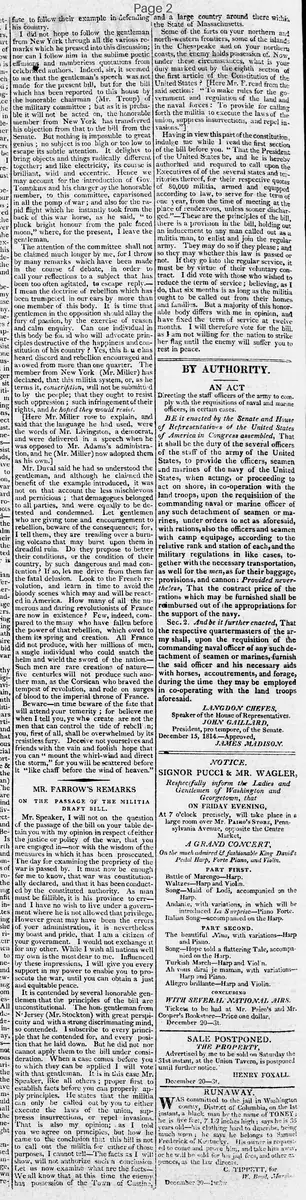
Mr. Speaker, I will not on the question of the passage of the bill on your table detain you with my opinion in respect of either the justice or policy of the war, that you are engaged in—nor with the wisdom of the measures in which it has been prosecuted. The day for examining the propriety of the war is passed by. It must now be enough for me to know, that war was constitutionally declared, and that it has been conducted by the constituted authority. As man must be fallible, it is his province to err—and I have no wish to live under a government where he is not allowed that privilege. However great may have been the errors of your administration, it is nevertheless my boast and pride, that I am a citizen of your government. I would not exchange it for any other. While I wish all nations well my own is the most dear to me. Influenced by these impressions, I will give you every support in my power to enable you to prosecute the war, until you can obtain a just and equitable peace.
It is contended by several honorable gentlemen that the principles of the bill are unconstitutional. The hon. gentleman from N Jersey (Mr. Stockton) with great perspicuity and with a strong discriminating mind, so contended. I subscribe to every principle that he contended for, and every position that he laid down. But he did not nor cannot apply them to the bill under consideration. When a case comes before you to which they can be applied I will vote with that gentleman. It is in this case Mr. Speaker, like all others; proper first to establish facts before you can properly apply principles. He states that the militia can only be called out by you to either execute the laws of the union, suppress insurrections, or repel invasions. That is also my opinion; as I told you we agree on principles, but how he came to the conclusion that this bill is not to call out the militia for either of those purposes, I cannot tell—The facts as I will show, will not authorize such a conclusion. Let us now examine what are the facts—We all know that at this time the enemy has possession of the Town of Castine, and a large country around there within the State of Massachusetts. Some of the forts on your northern and north-western frontiers, some of the islands in the Chesapeake and on your northern coasts, the enemy holds possession of. Now, under these circumstances, what is your duty marked out by the eighth section of the first article of the Constitution of the United States? [Here Mr. F. read from the said section: "To make rules for the government and regulation of the land and the naval forces: To provide for calling forth the militia to execute the laws of the union, suppress insurrections, and repel invasions."]
Having in view this part of the constitution, indulge me while I read the first section of the bill before you. "That the President of the United States be, and he is hereby authorised and required to call upon the Executives of the several states and territories thereof, for their respective quotas of 80,000 militia, armed and equipped according to law, to serve for the term of one year, from the time of meeting at the place of rendezvous, unless sooner discharged." These are the principles of the bill. There is a provision in the bill, holding out an inducement to any man called out as a militia man, to enlist and join the regular army. They may do so if they please; and so they may whether this law is passed or not. If they go into the regular service, it must be by virtue of their voluntary contract. I did vote with those who wished to reduce the term of service; believing, as I do, that six months is as long as the militia ought to be called out from their homes and families. But a majority of this honorable body differs with me in opinion, and have fixed the term of service at twelve months. I will therefore vote for the bill, as I am not willing for the nation to strike her flag until the enemy will suffer you to rest in peace.
What sub-type of article is it?
What keywords are associated?
What entities or persons were involved?
Domestic News Details
Key Persons
Outcome
mr. farrow announces he will vote for the militia draft bill authorizing 80,000 militia for one year to repel invasions.
Event Details
In a speech to the Speaker, Mr. Farrow supports the Militia Draft Bill despite constitutional objections from Mr. Stockton, citing enemy occupations in Castine, Massachusetts, northern frontiers, Chesapeake islands, and northern coasts as justifying the call-up of militia under the U.S. Constitution to repel invasions. He reads relevant constitutional and bill sections, notes provisions for enlisting in the regular army, and prefers a six-month term but accepts the one-year majority decision.