Thank you for visiting SNEWPapers!
Sign up free
The Charleston Daily News
Charleston, Charleston County, South Carolina
What is this article about?
During South Carolina Reconstruction, newly elected officials like Treasurer Niles G. Parker face challenges qualifying due to inadequate bonds and unreliable sureties from 'carpet-baggers.' Article details bond amounts for various positions and doubts the integrity of Radical appointees in Columbia and Charleston.
Clipping
OCR Quality
Full Text
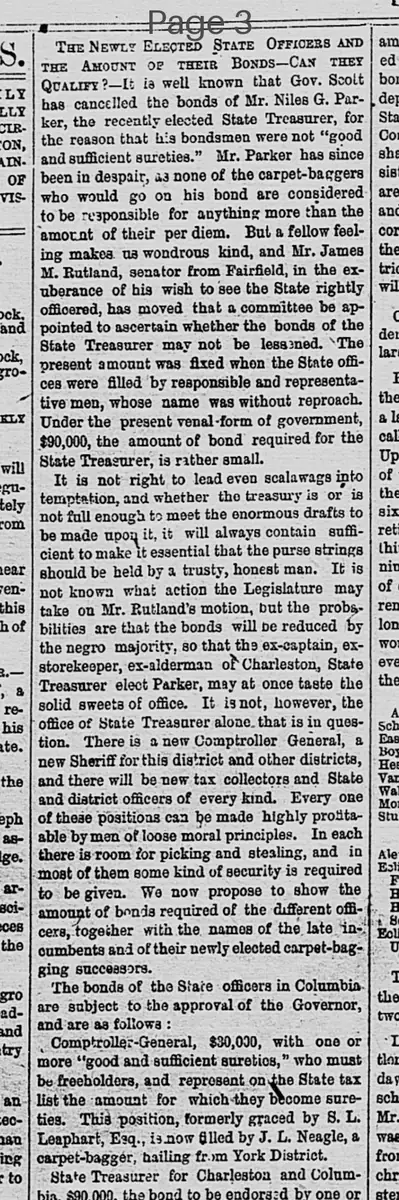
Under the present venal form of government, $90,000, the amount of bond required for the State Treasurer, is rather small.
It is not right to lead even scalawags into temptation, and whether the treasury is or is not full enough to meet the enormous drafts to be made upon it, it will always contain sufficient to make it essential that the purse strings should be held by a trusty, honest man. It is not known what action the Legislature may take on Mr. Rutland's motion, but the probabilities are that the bonds will be reduced by the negro majority, so that the ex-captain, ex-storekeeper, ex-alderman of Charleston, State Treasurer elect Parker, may at once taste the solid sweets of office. It is not, however, the office of State Treasurer alone, that is in question. There is a new Comptroller General, a new Sheriff for this district and other districts, and there will be new tax collectors and State and district officers of every kind. Every one of these positions can be made highly profitable by men of loose moral principles. In each there is room for picking and stealing, and in most of them some kind of security is required to be given. We now propose to show the amount of bonds required of the different officers, together with the names of the late incumbents and of their newly elected carpet-bagging successors.
The bonds of the State officers in Columbia are subject to the approval of the Governor, and are as follows:
Comptroller-General, $30,000, with one or more "good and sufficient sureties," who must be freeholders, and represent on the State tax list the amount for which they become sureties. This position, formerly graced by S. L. Leaphart, Esq., is now filled by J. L. Neagle, a carpet-bagger, hailing from York District.
State Treasurer for Charleston and Columbia, $90,000, the bond to be endorsed by one or more good sureties. This position was acceptably filled by Mr. W. Hood, who still retains his place, Niles G. Parker, the lately elected being unable to furnish the requisite surety.
The Attorney-General gives bonds for $10,000. The Hon. L. W. Hayne having been relieved, this important position is now filled by D. H. Chamberlain, who, whatever his qualifications may be, is certainly not conversant with the South Carolina code of laws, and has never practiced at the bar since his three years residence in this State.
The bonds given by these persons have been signed by A. G. Mackey and others of that stripe, whose names either do not appear on the tax list, or are credited with a sum far below that which they have assumed to represent as bondsmen. Governor Scott has ignored the bondsmen furnished by Parker, but about the same names appear on the bonds of the other State officers.
Leaving Columbia, there are in Charleston a number of State officials whose position requires them to control a large amount of money, and their bonds are proportionally large. The Sheriff of Charleston District is an office that has always been considered one of the best in the State and has always been filled by men of known probity, whose bonds were unexceptionable. At the expiration of Colonel J. E. Carew's term, Mr. W. S. Hastie was appointed by General Sickles. Mr. Hastie promptly furnished the bonds required $50,000 in three sureties, each being jointly and separately responsible for that amount. It would be folly to suppose that E. W. M. Mackey, the sheriff elected by the Radical party, could furnish a moiety of this sum. His father's name appeared on Parker's bond, and was not considered as a good surety by Governor Scott, as it represented barely $5000 on the tax List. None of the bright and shining lights of Radicalism in this city, who would go on a scalawag's bond, have more property than could be concealed in a carpet-bag. They are not freeholders, their names represent nothing, and their chirographical efforts will prove but love's labor lost. Unless E. W. McGregor Mackey can properly qualify, apparently an impossibility, the present incumbent will, it is presumed, be continued in office until a responsible man is elected.
The office of Clerk of the Court of General Sessions and Common Pleas for Charleston District is now filled by Mr. J. W. Brownfield, who was elected to this position by the suffrages of a free white people. He gives bonds for eight thousand dollars in the same way as those of the sheriff. A. C. Richmond, the newly elected clerk, has been a deputy constable, and during the war secured a position as a member of the provost guard. He was subsequently appointed Provost Judge for Berkeley District by the military. He will be hardly able to furnish the required bond, as his connection with the Radical party makes him dependent on the good graces of his carpet-bag friends, who are not tax-payers. This office is one of great importance, and the incumbent should be perfectly qualified both as a legal and a business man, or the interests of the public will suffer. He is the custodian of the most valuable legal papers and records, and should possess the entire esteem and confidence of the community. This officer, in connection with the sheriff, will, under the new regime, hold all funds now held by the Master in Equity. He may have half a million at a time in his possession, and should be made to give three times the bond given by the present clerk.
The coroner's position, filled for the last twelve years by E. M. Whiting, Esq., is soon to be occupied by Timothy Hurley, recently elected by the Radical party. The coroner's bonds are fixed at $10,000, and it is doubtful if Hurley would obtain sureties to that amount (though he is in better odor than many of his associates) if he did not expect, one of these days, to sit upon A. G. Mackey.
The tax collectors, assessors, and the new board of county commissioners, are all bonded officers, who will be compelled to furnish sureties before they occupy the positions to which they were elected. Under the old form of government, a board of commissioners was regularly appointed by the Legislature, whose duty it was to examine the bonds of the State officers for this district, which, on their recommendation, were approved of by the Attorney-General. This board was composed of Messrs. C. M. Furman, J. H. Honour, James Rose, John S. Riggs and Henry Gourdin.
Under the new constitution, the bonds of these officers will, it is presumed, be approved by the Board of County Commissioners lately elected, viz: F. C. Miller, E. P. Wall (colored), and M. McLaughlin. Neither of the white commissioners pays any taxes; but Wall pays a tax to the city upon $1500 of real estate. These are the persons to determine the validity of bonds to the amount of hundreds of thousands of dollars.
What sub-type of article is it?
What themes does it cover?
What keywords are associated?
What entities or persons were involved?
Where did it happen?
Story Details
Key Persons
Location
South Carolina, Columbia, Charleston, York District, Fairfield, Berkeley District
Story Details
Article criticizes newly elected 'carpet-bagger' and 'scalawag' state officers in South Carolina for lacking sufficient bonds and sureties, questioning their ability to qualify amid concerns of corruption and insufficient responsibility under the Radical government.