Thank you for visiting SNEWPapers!
Sign up free
South Carolina Temperance Advocate
Columbia, Richland County, South Carolina
What is this article about?
During the War of 1812, Commodore Rodgers uses captured British naval signals to deceive the schooner Highflyer, posing as the British frigate Sea Horse to obtain their signal book and despatches intended for Admiral Warren, securing vital intelligence that disrupts British operations.
Clipping
OCR Quality
Full Text
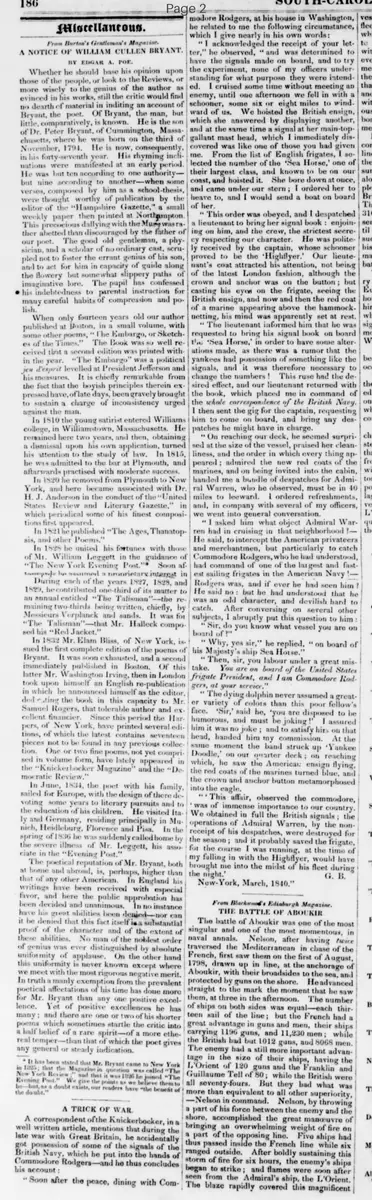
A correspondent of the Knickerbocker, in a well written article, mentions that during the late war with Great Britain, he accidentally got possession of some of the signals of the British Navy, which he put into the hands of Commodore Rodgers—and he thus concludes his account:
"Soon after the peace, dining with Commodore Rodgers, at his house in Washington, he related to me the following circumstance, which I give nearly in his own words:
"I acknowledged the receipt of your letter," he observed, "and was determined to have the signals made on board, and to try the experiment, none of my officers understanding for what purpose they were intended. I cruised some time without meeting an enemy, until one afternoon we fell in with a schooner, some six or eight miles to windward of us. We hoisted the British ensign, which she answered by displaying another, and at the same time a signal at her main-top-gallant mast head, which I immediately discovered was like one of those you had given me. From the list of English frigates, I selected the number of the 'Sea Horse,' one of their largest class, and known to be on our coast, and hoisted it. She bore down at once, and came under our stern; I ordered her to heave to, and I would send a boat on board of her.
"This order was obeyed, and I despatched a lieutenant to bring her signal book enjoining on him, and the crew, the strictest secrecy respecting our character. He was politely received by the captain, whose schooner proved to be the Highflyer.' Our lieutenant's coat attracted his attention, not being of the latest London fashion, although the crown and anchor was on the button: but casting his eyes on the frigate, seeing the British ensign, and now and then the red coat of a marine appearing above the hammock netting, his mind was apparently set at rest.
"The lieutenant informed him that he was requested to bring his signal book on board the 'Sea Horse,' in order to have some alterations made, as there was a rumor that the yankees had possession of something like the signals, and it was therefore necessary to change the numbers! This ruse had the desired effect, and our lieutenant returned with the book, which placed me in command of the whole correspondence of the British Navy. I then sent the gig for the captain, requesting him to come on board, and bring any despatches he might have in charge.
"On reaching our deck, he seemed surprised at the size of the vessel, praised her cleanness, and the order in which every thing appeared; admired the new red coats of the marines, and on being invited into the cabin, handed me a bundle of despatches for Admiral Warren, who he observed, must be in 40 miles to leeward. I ordered refreshments, and, in company with several of my officers, we went into general conversation.
"I asked him what object Admiral Warren had in cruising in that neighborhood? He said, to intercept the American privateers and merchantmen, but particularly to catch Commodore Rodgers, who he had understood, had command of one of the largest and fastest sailing frigates in the American Navy!—Rodgers was, and if ever he had seen him? He said no: but he had understood that he was an odd character, and devilish hard to catch. After conversing on several other subjects, I abruptly put this question to him:
"Sir, do you know what vessel you are on board of?"
"Why, yes sir," he replied, "on board of his Majesty's ship Sea Horse.'"
"Then, sir, you labour under a great mistake. You are on board of the United States frigate President, and I am Commodore Rodgers, at your service."
"The dying dolphin never assumed a greater variety of colors than this poor fellow's face. 'Sir,' said he, 'you are disposed to be humorous, and must be joking!' I assured him it was no joke; and to satisfy him on that head, handed him my commission. At the same moment the band struck up 'Yankee Doodle,' on our quarter deck; on reaching which, he saw the American ensign flying, the red coats of the marines turned blue, and the crown and anchor button metamorphosed into the eagle.
"This affair, observed the commodore, 'was of immense importance to our country. We obtained in full the British signals; the operations of Admiral Warren, by the non-receipt of his despatches, were destroyed for the season; and it probably saved the frigate, for the course I was running, at the time of my falling in with the Highflyer, would have brought me into the midst of his fleet during the night.'"
G. B.
New-York, March, 1840.
What sub-type of article is it?
What themes does it cover?
What keywords are associated?
What entities or persons were involved?
Where did it happen?
Story Details
Key Persons
Location
On The High Seas Off The American Coast
Event Date
During The Late War With Great Britain
Story Details
Commodore Rodgers uses captured British signals to impersonate the frigate Sea Horse, tricking the schooner Highflyer into surrendering their signal book and despatches for Admiral Warren, then reveals his true identity as commander of the U.S. frigate President, obtaining crucial naval intelligence.