Thank you for visiting SNEWPapers!
Sign up free
New York Daily Tribune
New York, New York County, New York
What is this article about?
In a speech at a Republican meeting in Troy on October 26, 1860, A.B. Stanton sharply criticizes former New York Governor Washington Hunt for attempting to form a coalition between Douglas Democrats and old Whigs/Americans, accusing him of political duplicity, betrayal of his anti-slavery past, and irrelevance in the current election, predicting strong support for Lincoln.
Clipping
OCR Quality
Full Text
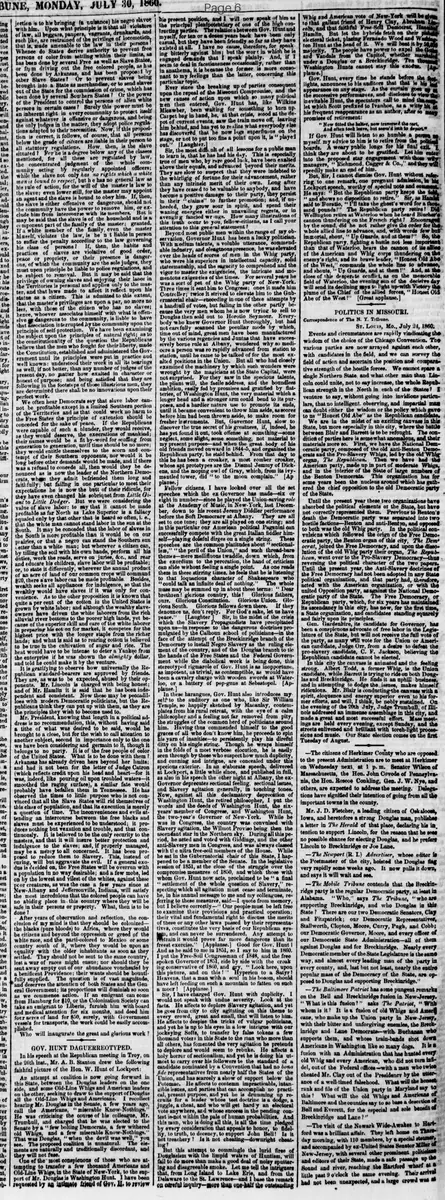
In his speech at the Republican meeting in Troy, on the 26th inst., Mr. A. B. Stanton drew the following faithful picture of the Hon. W. Hunt of Lockport:
An attempt at coalition is now going forward in this State, between the Douglas leaders on the one side, and some Old-Line Whigs and American leaders on the other, seeking to draw to the support of Douglas all the Old-Line Whigs and Americans. I recollect hearing Mr. Douglas in the Senate, a few years ago, call the Americans, miserable Know-Nothings. He was criticising the course of his colleague, Mr. Trumbull, and charged that he was elected to the Senate by a few bolting Democrats, a few withered old Whigs, and a few miserable Know-Nothings. That was Douglas, when the devil was well, you see. The proposed coalition is unnatural. The elements are naturally and traditionally discordant, and they will not fuse.
One of the most conspicuous of those who are attempting to transfer a few thousand Americans and Old-Line Whigs, in the State of New-York, to the support of Mr. Douglas is Washington Hunt. I have been requested by an intimate friend of Gov. H. to review his present position, and I will now speak of him as the principal plenipotentiary of one of the high contracting parties. Their relations between Gov. Hunt and myself, for ten or a dozen years back have been only casual, but they have been friendly so far as they have extended. There are those who are exerting all have cause therefore for speaking bitterly against him; but the work in which he is engaged demands that I speak plainly. And, if I seem to deal in facetiousness occasionally, rather than in anathema, it is because the former is more consonant to my feelings than the latter, concerning this particular topic.
Ever since the breaking up of parties consequent upon the repeal of the Missouri Compromise, and the new causes of action upon which so many political men then entered, Gov. Hunt has, like Wilkins Micawber, been waiting for something to turn up. Carpet bag in hand, he, at that crisis, stood at the depot of current events, saw the train move off, leaving him behind, and has yet to realize what everybody else has discovered that he now lags superfluous on the stage, or not to put too fine a point upon it, is played out. [Laughter.]
Sir, the most difficult of all lessons for a public man to learn is, that he has had his day. This is especially true of men who, by rare good luck, have been exalted above their equals, and advanced beyond their merits. They are slow to suspect that they were indebted to the whirligig of fortune for their advancement, rather than any intrinsic merit of their own. Long after they have ceased to be valuable to anybody and become a positive damage to their party, they persist in their claims to further promotion; and, if unheeded, they grow sour in spirit, and spend their waning energies either in unavailing regrets, or in avenging fancied wrongs.
How many illustrations of this truth occur to you, fellow-citizens, as I call your attention to this general statement? Beyond most public men within the range of my observation, Governor Hunt has been a lucky politician. With medium talents, a voluble utterance, commendable industry, and oleaginous presence, he was elevated over the heads of scores of men in the Whig party who were his superiors in intellectual capacity, solid statesmanship, and the sagacity to comprehend and the vigor to master the exigencies, the intricate and momentous exigencies of the times. For several years he was a sort of pet of the Whig party of New-York. Three times it sent him to Congress; once it made him Controller; twice it strived to elevate him to the Gubernatorial chair—succeeding in one of these attempts by a handful of votes, but failing in the other partly because the very men whom he is now trying to sell to Douglas then sold out to Horatio Seymour. Every body who knew Governor Hunt thoroughly, but had not carefully scanned the peculiar mode by which, time out of mind, great men have been manufactured by the various regencies and Juntas that have successively borne rule at Albany, wondered why so mediocre a person was so rapidly advanced from station to station, until he came to be talked of for the most exalted positions in the Union. But all who had closely examined the machinery by which such wonders were wrought by the magicians at the State Capital, were not surprised. For they saw in the specious talents, the pliant will, the facile address, and the boundless ambition, easily fed by promises and gratified by flatteries, of Washington Hunt, the very material which a longer head and a stronger arm could bend to its purposes, and a harder nature use to promote its ends, until it became convenient to throw him aside, as scores before him had been thrown aside, to make room for fresher instruments. But, Governor Hunt, slow to discover the true secret of his greatness, if, indeed, he has yet found it out, took offense at something—some neglect, some slight, some something, not material to my present purpose—and when the great body of his old friends moved onward in 1854-5, and organized the Republican party, he staid behind. From that day to this he has been a croaker, a most somber croaker, whose apt prototypes are the Dismal Jemmy of Dickens, and the moping owl of Gray, which, from its ivy-mantled tower, did to the moon complain. [Applause.]
Fellow citizens, I have looked over all the set speeches which the ex Governor has made—six or eight in number—since he played the Union-saving role at the Academy of Music, in New-York, last December, down to his recent Jeremy Diddler performance before the Soft Democracy at Albany. They are all set to one tune; they are all played on one string; and in this particular our American political Paganini can successfully compete with the great Italian fiddler himself—playing doleful dirges on a single string.
These speeches are the common platitudes about sectionalism, the peril of the Union, and such thread-bare themes—mere mellifluous twaddle, down which, from the exordium to the peroration, the hand of criticism can slide without feeling a single point. As one reads them in these stirring times, he feels that he is listening to that loquacious character of Shakespeare who could talk an infinite deal of nothing. The whole mass may be summed up in about these terms: Dear brethren! glorious country, this! Glorious fathers, ours. Glorious Constitution. Glorious Union. Glorious South. Glorious fellows down there. If they denounce us, don't reply. For God's sake, let us have peace. [Laughter]
Sir, in the midst of the crisis which the Slavery Propagandists have precipitated upon us—in response to the dangerous doctrines promulgated by the Calhoun school of politicians—in the face of the attempt of the Breckinridge branch of the Democracy to install Negro Slavery as the ruling element of the country, and of the Douglas branch to tie the hands of the Free States and the Federal Government while the diabolical work is being done, this stereotyped rigmarole of Gov. Hunt is as inopportune, as impotent, as trivial, as contemptible, as would have been a cavalry charge with wooden swords at Waterloo, or a battery of pop-guns at Sebastopol. [Applause.]
In these harangues, Gov. Hunt also introduces myself to the auditory as one who, like Sir William Temple, so happily sketched by Macaulay, contemplates from his rural retreat, with the eye of a calm philosopher and a feeling not far removed from pity, the struggles of the common herd of politicians around him. Having thus commended himself to the good graces of all who don't know him, he proceeds to spin his yarn of inanities—to persistently play his direful ditty on his single string. Though he wraps himself in the folds of a most verbose elocution, he is easily seen through by those who suspect how much duplicity, and cunning and intrigue, are concealed under this specious exterior. In an elaborate speech, delivered at Lockport, a little while since, and published in full, as also in his speech the other night at Albany, the ex-Governor deprecates sectional feeling, sectional issues, and Slavery agitation generally, in touching tones.
Now, against all this declamatory deprecation of Washington Hunt, the retired philosopher, I put the words and the deeds of Washington Hunt, the six-years' member of Congress, and Washington Hunt, the two-years' Governor of New-York. While he was in Congress, the country was convulsed with Slavery agitation, the Wilmot Proviso being then the ascendant star in the Northern sky. During all this period, he acted and voted with Giddings, and the other anti-Slavery men in Congress, and was always classed with the ultra free-soil members of the House. While he sat in the Gubernatorial chair of this State, I happened to be a member of the Senate. In the legislative session of 1851, at the close of the struggle over the compromise measures of 1850, and which those with whom Gov. Hunt now acts, proclaimed to be a final settlement of the whole question of Slavery, respecting which all agitation must cease and terminate, he, in his annual message to me and my colleagues, referring to these measures, said—I quote from memory, but I believe correctly—Our people must be left free to examine their provisions and practical operation; their vital and fundamental right to discuss the merits of these or any other laws passed by their representatives, constitutes the very basis of our Republican system, and can never be surrendered. Any attempt to restrain it would prove far more dangerous than its freest exercise. [Applause.] Good for Gov. Hunt!
And as he said to me in 1851, so I say to him in 1860. I put the Free-Soil Congressman of 1848, and the free spoken Governor of 1851, side by side with the croaking conservative of 1860, and cry, Look here, upon this picture, and on this! Hyperion to a Satyr! Heavens, that a man with a soul in his bosom, should have left feeding on such a mountain to fatten on such a muck! [Applause.]
Sir, I have charged Gov. Hunt with duplicity. I would not speak with undue severity. Look at the facts. He affects to deplore Slavery agitation, and yet he goes from city to city agitating on this theme to every crowd, great and small, that will listen to him. He affects to despise the tricks of vulgar politicians, and yet he is up to his eyes in a low intrigue with our jockeying Softs, to transfer by false tokens a few thousand voters in this State to the man who more than all others, has fomented the very agitation he pretends to deplore and would seem to rebuke. He affects a holy horror of sectionalism, and yet he is doing his utmost to carry over his followers to the standard of a candidate nominated by a Convention that had no bona fide representatives from nearly half the States of the Union, and has scarcely a show of support below the Potomac. He affects to contemn impracticable, intangible issues, and parties that can accomplish no practical, present purpose, and yet he is drumming up recruits for a leader whose test doctrine is dodge juggle, a cheat, and who will get hardly an electoral vote anywhere, and whose success in the pending contest is not within the pale of human probabilities. And this man, who is doing all this, is all the time pledged by every consideration that appeals to honor, to fidelity, to truth, to decency, to support John Bell! Is it not treachery? Is it not cheating—downright cheating?
But this attempt to commingle the lurid fires of Douglasism with the limpid waters of Huntism, will fail to do more than make a good deal of noisy sputtering and disagreeable smoke. Let me tell the intriguers that, from Long Island to Lake Erie, and from the Delaware to the St. Lawrence—and I base the remark on careful inquiry—more than one-half the outstanding Whig and American vote of New-York will be given to that gallant friend of Henry Clay, Abraham Lincoln, and that faithful Free-Soil Democrat, Hannibal Hamlin. But let the hybrids fetch on their mongrel ticket, placing Fernando Wood and Washington Hunt at the head of it. We will beat it by four thousand majority. The people have power to expel the Goths and Vandals from the Capitol, whether marshaled under a Douglas or a Breckinridge. Ten thousand Washington Hunts cannot stay this exodus. [Applause.]
Gov. Hunt, every time he stands before the lights, announces to his auditors that that is his last appearance on any stage. As the curtain goes up on the successive performances, and discloses to view the inevitable Hunt, the spectators call to mind the couplet which Scott prefixed to Ivanhoe, as his frequent reappearance as an author, promises of retirement:
Now fitted the halter, now traversed the cart,
And often took leave, but seemed loth to depart.
If Gov. Hunt will listen to so humble a person as myself, my advice to him is to retire from the political boards. A weary public longs for his final exit. I think they are about to be gratified. Let him into the proposed star engagement with those wise managers, Richmond, Cagger & CO., and speedily make an end of him.
But, Sir, I cannot dismiss Gov. Hunt without referring to one remark, one pregnant admission, in his Lockport speech, worthy of special note and comment. He says: But the Republican party keeps the and shows no disposition to retire. Sir, as Hamlet said to Horatio, I'll take the ghost's word for a thousand pounds! The Republican party retire! Did Wellington retire at Waterloo when he heard Blucher's cannon thundering on the French right? Encouraged by the sound, did he not rather give the order for the whole allied line to advance, and, with words few but immortal, shout, Up Guards, and at them! So, the Republican party, fighting a battle not less important than that of Waterloo, hears the cannon of its allies the American and Whig corps thundering on the enemy's right, and its brave leader, Honest Old Abe of the West, commands the whole line to advance and shouts, Up Guards, and at them! And, at the close of this desperate conflict, as on the memorable field of Waterloo, the evening sun of the decisive day will send its declining rays to light up—with Victory the plume of the Chief of the allied forces, Honest Old Abe of the West! [Great applause.]
What sub-type of article is it?
What themes does it cover?
What keywords are associated?
What entities or persons were involved?
Where did it happen?
Story Details
Key Persons
Location
Troy, New York
Event Date
26th Inst.
Story Details
A.B. Stanton delivers a speech at a Republican meeting in Troy criticizing former Governor Washington Hunt as a mediocre politician who rose through luck and is now attempting a duplicitous coalition between Old-Line Whigs, Americans, and Douglas Democrats, betraying his past anti-slavery stance and support for Republicans, while predicting victory for Lincoln.