Thank you for visiting SNEWPapers!
Sign up free
Editorial
March 23, 1805
The Enquirer
Richmond, Henrico County, Virginia
What is this article about?
An anonymous editorial (signed 'M.') advocates for public education in Virginia, emphasizing its benefits for morality, industry, and preserving freedom. It praises Scottish parish schools, critiques religious bias in them, and proposes modifications to a 1779 Virginia bill for free schools, academies, and college support for the poor.
Clipping
OCR Quality
95%
Excellent
Full Text
FOR THE ENQUIRER.
The Rainbow.—Series 2d.
NUMBER VIII.
ON PUBLIC SCHOOLS.
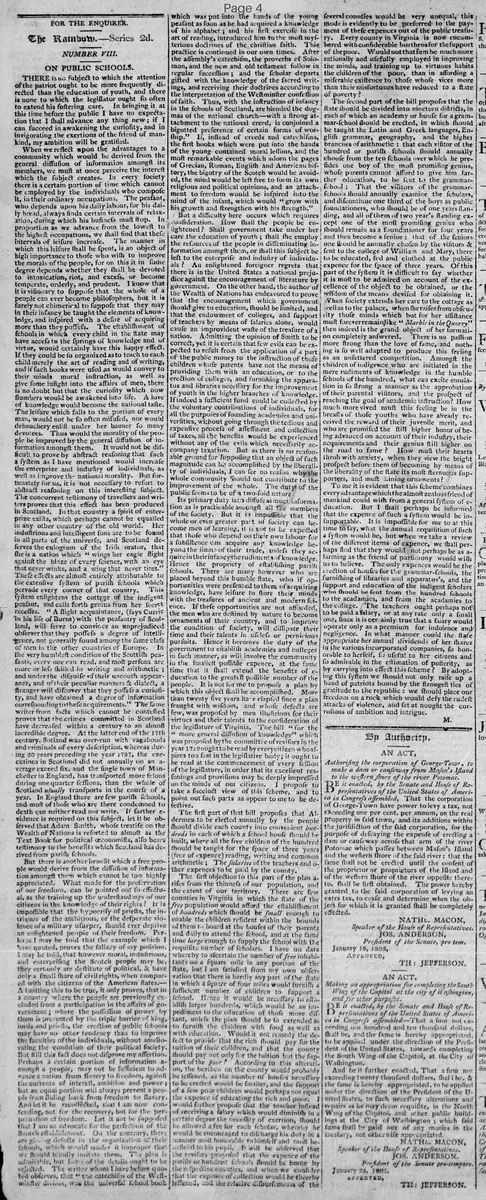
There is no subject to which the attention of the patriot ought to be more frequently directed than the education of youth, and there is none to which the legislator ought so often to extend his fostering care. In bringing it at this time before the public I have no expectation that I shall advance any thing new; if I can succeed in awakening the curiosity, and in invigorating the exertions of the friend of mankind, my ambition will be gratified.
When we reflect upon the advantages to a community which would be derived from the general diffusion of information amongst its members, we must at once perceive the interest which the subject creates. In every society there is a certain portion of time which cannot be employed by the individuals who compose it, in their ordinary occupations. The peasant, who depends upon his daily labour, for his daily bread, always finds certain intervals of relaxation, during which his business must stop. In proportion as we advance from the lowest to the highest occupations, we shall find that these intervals of leisure increase. The manner in which this leisure shall be spent, is an object of high importance to those who wish to improve the morals of the people, for on this it in some degree depends whether they shall be devoted to intoxication, riot, and excess, or become temperate, orderly, and prudent. I know that it is visionary to suppose that the whole of a people can ever become philosophers, but it is surely not chimerical to suppose that they may in their infancy be taught the elements of knowledge, and inspired with a desire of acquiring more than they possess. The establishment of schools in which every child in the state may have access to the springs of knowledge and of virtue, would certainly have this happy effect. If they could be so organized as to teach to each child merely the art of reading and of writing, and if such books were used as would convey to their minds moral instruction, as well as give some insight into the affairs of men, there is no doubt but that the curiosity which now slumbers would be awakened into life. A love of knowledge would become the national taste. The leisure which falls to the portion of every man, would not be so often misused, nor would debauchery enlist under her banner so many devotees. Thus would the morality of the people be improved by the general diffusion of information amongst them. It would not be difficult to prove by abstract reasoning that such a system as I have mentioned would increase the enterprise and industry of individuals, as well as improve the national morality. But fortunately for us, it is not necessary to resort to abstract reasoning on this interesting subject. The concurrent testimony of travellers and writers proves that this effect has been produced in Scotland. In that country a spirit of enterprise exists, which perhaps cannot be equalled in any other country of the old world. Her industrious and intelligent sons are to be found in all parts of the universe, and Scotland deserves the eulogium of the Irish orator, that she is a nation which "wings her eagle flight against the blaze of every science, with an eye that never winks, and a wing that never tires." These effects are almost entirely attributable to the extensive system of parish schools which pervade every corner of that country. This system enlightens the cottage of the indigent peasant, and calls forth genius from her secret recesses. "A slight acquaintance, (says Currie in his life of Burns) with the peasantry of Scotland, will serve to convince an unprejudiced observer that they possess a degree of intelligence, not generally found among the same class of men in the other countries of Europe. In the very humblest condition of the Scottish peasants, every one can read, and most persons are more or less skilled in writing and arithmetic; and under the disguise of their uncouth appearance, and of their peculiar manners & dialect, a stranger will discover that they possess a curiosity, and have obtained a degree of information corresponding to the acquirements." The same writer from facts which cannot be contested proves that the crimes committed in Scotland have decreased within a century to an almost incredible degree. At the latter end of the 17th century, Scotland was over-run with vagabonds and criminals of every description, whereas during 30 years preceding the year 1797, the executions in Scotland did not annually on an average exceed six, and the single town of Manchester in England, has transported more felons during one quarter sessions, than the whole of Scotland usually transports in the course of a year. In England there are few parish schools, and most of those who are there condemned to death can neither read nor write. If farther evidence is required on this subject, let it be observed that Adam Smith, whose treatise on the Wealth of Nations is resorted to almost as the Text Book for political economists, also bears testimony to the benefits which Scotland has derived from parish schools.
But there is another benefit which a free people would derive from the diffusion of information amongst them which cannot be too highly appreciated. What mode for the preservation of our freedom, can be pointed out so effectual, as the training up the understandings of our citizens in the knowledge of their rights? It is impossible that the hypocrisy of priests, the intrigues of the ambitious, or the desperate violence of a military usurper, should ever deprive an enlightened people of their freedom. Perhaps I may be told that the example which I have quoted, proves the fallacy of my position. I may be told, that however moral, industrious, and enterprising the Scotch people may be, they certainly are destitute of political, & have only a small share of civil rights, when compared with the citizens of the American states.—Admitting this to be true, it only proves, that in a country where the people are previously excluded from a participation in the affairs of government; where the possession of power by them is prevented by the triple barrier of king, lords and priests, the erection of public schools may have no other tendency than to improve the faculties of the individuals, without ameliorating the condition of their political society. But still this fact does not disprove my assertion. Perhaps a certain portion of information amongst a people, may not be sufficient to advance a nation from slavery to freedom, against the currents of interest, ambition and power; but an equal portion will always prevent a people from sliding back from freedom to slavery. And let it be recollected, that I am now contending, not for the recovery, but for the perpetuation of freedom. Let it not be supposed that I am an advocate for the perfection of the Scotch establishment. On the contrary, there are glaring defects in the organization of their schools, which would render it improper that we should blindly imitate them. The plan is admirable, but some of the details ought to be rejected. The writer whom I have before quoted observes, that "the catechism of the Westminster divines, was the universal school book which was put into the hands of the young peasant as soon as he had acquired a knowledge of his alphabet: and his first exercise in the art of reading, introduced him to the most mysterious doctrines of the christian faith. This practice is continued in our own times. After the assembly's catechism, the proverbs of Solomon, and the new and old testament follow in regular succession: and the scholar departs gifted with the knowledge of the sacred writings, and receiving their doctrines according to the interpretation of the Westminster confession of faith. Thus, with the instruction of infancy in the schools of Scotland, are blended the dogmas of the national church—with a strong attachment to the national creed. is conjoined a bigotted preference of certain forms of worship." If, instead of creeds and catechisms, the first books which were put into the hands of the young contained moral lessons, and the most remarkable events which adorn the pages of Grecian, Roman, English and American history, the bigotry of the Scotch would be avoided, the mind would be left free to form its own religious and political opinions, and an attachment to freedom would be inspired into the mind of the infant. which would "grow with his growth and strengthen with his strength."
But a difficulty here occurs which requires consideration. How shall the people be enlightened? Shall government take under her care the education of youth; shall she employ the resources of the people in disseminating information amongst them, or shall this subject be left to the enterprise and industry of individuals? An enlightened foreigner regrets that there is in the United States a national prejudice against the encouragement of literature by government. On the other hand, the author of the Wealth of Nations has endeavored to prove that the encouragement which government should give to education, should be limited, and that the endowment of colleges, and support of teachers by means of salaries alone, would cause an improvident waste of the treasure of a nation. Admitting the opinion of Smith to be correct, yet it is certain that few evils can be expected to result from the application of a part of the public money to the instruction of those children whose parents have not the means of providing them with an education, or to the erection of colleges, and furnishing the apparatus and libraries necessary for the improvement of youth in the higher branches of knowledge. If indeed a sufficient fund could be collected by the voluntary contributions of individuals, for all the purposes of founding academies and universities, without going through the tedious and expensive process of assessment and collection of taxes, all the benefits would be experienced without any of the evils which necessarily accompany taxation. But as there is no reasonable ground for supposing that an object of such magnitude can be accomplished by the liberality of individuals, I can see no reason why the whole community should not contribute to the improvement of the whole. The duty of the public seems to be of a two-fold nature. Its primary duty is to diffuse as much information as is practicable amongst all the members of the society. But it is impossible that the whole or even greater part of society can become men of learning, it is not to be expected that those who depend on their own labour for a subsistence can acquire any knowledge beyond the limits of their trade, unless they acquire in their infancy the rudiments of knowledge. Hence the propriety of establishing parish schools. There are many however who are placed beyond this humble state, who if opportunities were presented to them of acquiring knowledge, have leisure to store their minds with the treasures of ancient and modern science. If these opportunities are not afforded, the men who are destined by nature to become ornaments of their country, and to improve the condition of society, will dissipate their time and their talents in useless or pernicious pursuits. Hence it becomes the duty of the government to establish academies and colleges in such manner, as will involve the community in the smallest possible expense, at the same time that it shall extend the benefits of education to the greatest possible number of the people. It is not for me to propose a plan by which this object shall be accomplished. More than twenty five years have elapsed since a plan fraught with wisdom, and whose defects are few, was proposed by men illustrious for their virtues and their talents to the consideration of the legislature of Virginia. The bill "for the more general diffusion of knowledge" which was proposed by the committee of revisors in the year 1779 ought to be read by every citizen who aspires to a seat in the legislative body; it ought to be read at the commencement of every session of the legislature, in order that its excellent reasonings and provisions may be deeply impressed on the minds of our citizens. I propose to take a succinct view of this scheme, and to point out such parts as appear to me to be defective.
The first part of that bill proposes that Aldermen to be elected annually by the people should divide each county into convenient hundreds in each of which a school house should be built, where all the free children of the hundred should be taught for the space of three years (free of expense) reading, writing and common arithmetic; The salaries of the teachers and other expenses to be paid by the county.
The first objection to this part of the plan arises from the thinness of our population, and the extent of our territory. There are few counties in Virginia in which the state of the free population would afford the establishment of hundreds which should be small enough to enable the children resident within the bounds of them to board at the houses of their parents and daily to attend the school, and at the same time large enough to supply the school with the requisite number of scholars. I have no data whereby to ascertain the number of free inhabitants on a square mile in any portion of the state, but I am satisfied from my own observation that there is hardly any part of the state in which a square of four miles would furnish a sufficient number of children to support a school. Hence it would be necessary to establish larger hundreds, which would be an impediment to the education of those more distant, unless the plan should be so extended as to furnish the children with food as well as with education. Would it not remedy the defect to provide that the rich should pay for the tuition of their children, and that the county should pay not only for the tuition but the support of the poor? According to this alteration, the burthen on the county would probably be lessened, as the number of houses necessary to be erected would be smaller, and the support of a few poor children would perhaps not equal the expense of educating the rich and poor. I would farther propose that the teacher instead of receiving a salary which would diminish in a certain degree the necessity of exertion, should be allowed a fee for each scholar, whereby he would be encouraged to discharge his duty in a manner most honorable to himself and most beneficial to his pupils. It will be observed that the revisors proposed that the expense of the parish or hundred schools should be borne by their respective counties, and when we consider that the expense of collection would be thereby lessened, and the relative disbursements of the several counties would be very unequal, this mode is evidently to be preferred to the payment of these expenses out of the public treasury. Every county in Virginia is now encumbered with considerable burthens for the support of the poor. Would not that sum be much more rationally and usefully employed in improving the minds, and training up to virtuous habits the children of the poor, than in affording a miserable existence to those whose vices more than their misfortunes have reduced to a state of poverty?
The second part of the bill proposes that the state should be divided into nineteen districts, in each of which an academy or house for a grammar-school should be erected, in which should be taught the Latin and Greek languages, English grammar, geography, and the higher branches of arithmetic: that each visitor of the hundred or parish schools should annually choose from the ten schools over which he presides one boy of the most promising genius, whose parents cannot afford to give him farther education, to be sent to the grammar-school: That the visitors of the grammar-schools should annually examine the scholars, and discontinue one third of the boys as public foundationers, who should be of one year's standing, and all of them of two year's standing except one of the most promising genius who should remain as a foundationer for four years and then become a senior: that of the seniors one should be annually chosen by the visitors & sent to the college of William and Mary, there to be educated, fed and clothed at the public expense for the space of three years. Of this part of the system it is difficult to say whether it is most to be admired on account of the excellence of the object to be obtained, or the wisdom of the means devised for obtaining it. When society extends her care to the cottage as well as to the palace, when she raises from obscurity those minds which but for her assistance must forever remain like "Marble in the Quarry" then indeed is the grand object of her formation completely answered. There is no passion more strong than the love of fame, and nothing is so well adapted to produce this feeling as an unfettered competition. Amongst the children of indigence who are initiated in the mere rudiments of knowledge in the humble schools of the hundred, what can excite emulation in so strong a manner as the approbation of their parental visitors, and the prospect of reaching the goal of academic instruction? How much more vivid must this feeling be in the breasts of those youths who have already received the reward of their juvenile merit, and who are promised the still higher honor of being advanced on account of their industry, their acquirements and their genius still higher on the road to fame? How must their hearts throb with anxiety, when they view the bright prospect before them of becoming by means of the liberality of the state its most strenuous supporters, and most shining ornaments?
To me it is evident that this scheme combines every advantage which the most zealous friend of mankind could wish from a general system of education. But I shall perhaps be informed that the expense of such a system would be insupportable. It is impossible for me to say, what the annual requisition of such a system would be, but when we take a review of the different items of expense, we shall perhaps find that they would not perhaps be as alarming as the friend of parsimony would wish us to believe. The only expenses would be the erection of houses for the grammar-schools, the furnishing of libraries and apparatus's, and the support and education of the indigent scholars who should be sent from the hundred schools to the academies, and from the academies to the college. The teachers ought perhaps not to be paid a salary, or at any rate only a small one, since it is certainly true that a salary would operate only as a premium for indolence and negligence. In what manner could the state appropriate her annual dividends of her shares in the various incorporated companies, so honorable to herself, so useful to her citizens and so admirable in the estimation of posterity, as by carrying into effect this scheme? By adopting this system we should not only raise up a band of patriots bound by the strongest ties of gratitude to the republic: we should place our freedom on a rock which would defy the rudest attacks of violence, and set at nought the corrosions of ambition and intrigue.
M.
The Rainbow.—Series 2d.
NUMBER VIII.
ON PUBLIC SCHOOLS.
There is no subject to which the attention of the patriot ought to be more frequently directed than the education of youth, and there is none to which the legislator ought so often to extend his fostering care. In bringing it at this time before the public I have no expectation that I shall advance any thing new; if I can succeed in awakening the curiosity, and in invigorating the exertions of the friend of mankind, my ambition will be gratified.
When we reflect upon the advantages to a community which would be derived from the general diffusion of information amongst its members, we must at once perceive the interest which the subject creates. In every society there is a certain portion of time which cannot be employed by the individuals who compose it, in their ordinary occupations. The peasant, who depends upon his daily labour, for his daily bread, always finds certain intervals of relaxation, during which his business must stop. In proportion as we advance from the lowest to the highest occupations, we shall find that these intervals of leisure increase. The manner in which this leisure shall be spent, is an object of high importance to those who wish to improve the morals of the people, for on this it in some degree depends whether they shall be devoted to intoxication, riot, and excess, or become temperate, orderly, and prudent. I know that it is visionary to suppose that the whole of a people can ever become philosophers, but it is surely not chimerical to suppose that they may in their infancy be taught the elements of knowledge, and inspired with a desire of acquiring more than they possess. The establishment of schools in which every child in the state may have access to the springs of knowledge and of virtue, would certainly have this happy effect. If they could be so organized as to teach to each child merely the art of reading and of writing, and if such books were used as would convey to their minds moral instruction, as well as give some insight into the affairs of men, there is no doubt but that the curiosity which now slumbers would be awakened into life. A love of knowledge would become the national taste. The leisure which falls to the portion of every man, would not be so often misused, nor would debauchery enlist under her banner so many devotees. Thus would the morality of the people be improved by the general diffusion of information amongst them. It would not be difficult to prove by abstract reasoning that such a system as I have mentioned would increase the enterprise and industry of individuals, as well as improve the national morality. But fortunately for us, it is not necessary to resort to abstract reasoning on this interesting subject. The concurrent testimony of travellers and writers proves that this effect has been produced in Scotland. In that country a spirit of enterprise exists, which perhaps cannot be equalled in any other country of the old world. Her industrious and intelligent sons are to be found in all parts of the universe, and Scotland deserves the eulogium of the Irish orator, that she is a nation which "wings her eagle flight against the blaze of every science, with an eye that never winks, and a wing that never tires." These effects are almost entirely attributable to the extensive system of parish schools which pervade every corner of that country. This system enlightens the cottage of the indigent peasant, and calls forth genius from her secret recesses. "A slight acquaintance, (says Currie in his life of Burns) with the peasantry of Scotland, will serve to convince an unprejudiced observer that they possess a degree of intelligence, not generally found among the same class of men in the other countries of Europe. In the very humblest condition of the Scottish peasants, every one can read, and most persons are more or less skilled in writing and arithmetic; and under the disguise of their uncouth appearance, and of their peculiar manners & dialect, a stranger will discover that they possess a curiosity, and have obtained a degree of information corresponding to the acquirements." The same writer from facts which cannot be contested proves that the crimes committed in Scotland have decreased within a century to an almost incredible degree. At the latter end of the 17th century, Scotland was over-run with vagabonds and criminals of every description, whereas during 30 years preceding the year 1797, the executions in Scotland did not annually on an average exceed six, and the single town of Manchester in England, has transported more felons during one quarter sessions, than the whole of Scotland usually transports in the course of a year. In England there are few parish schools, and most of those who are there condemned to death can neither read nor write. If farther evidence is required on this subject, let it be observed that Adam Smith, whose treatise on the Wealth of Nations is resorted to almost as the Text Book for political economists, also bears testimony to the benefits which Scotland has derived from parish schools.
But there is another benefit which a free people would derive from the diffusion of information amongst them which cannot be too highly appreciated. What mode for the preservation of our freedom, can be pointed out so effectual, as the training up the understandings of our citizens in the knowledge of their rights? It is impossible that the hypocrisy of priests, the intrigues of the ambitious, or the desperate violence of a military usurper, should ever deprive an enlightened people of their freedom. Perhaps I may be told that the example which I have quoted, proves the fallacy of my position. I may be told, that however moral, industrious, and enterprising the Scotch people may be, they certainly are destitute of political, & have only a small share of civil rights, when compared with the citizens of the American states.—Admitting this to be true, it only proves, that in a country where the people are previously excluded from a participation in the affairs of government; where the possession of power by them is prevented by the triple barrier of king, lords and priests, the erection of public schools may have no other tendency than to improve the faculties of the individuals, without ameliorating the condition of their political society. But still this fact does not disprove my assertion. Perhaps a certain portion of information amongst a people, may not be sufficient to advance a nation from slavery to freedom, against the currents of interest, ambition and power; but an equal portion will always prevent a people from sliding back from freedom to slavery. And let it be recollected, that I am now contending, not for the recovery, but for the perpetuation of freedom. Let it not be supposed that I am an advocate for the perfection of the Scotch establishment. On the contrary, there are glaring defects in the organization of their schools, which would render it improper that we should blindly imitate them. The plan is admirable, but some of the details ought to be rejected. The writer whom I have before quoted observes, that "the catechism of the Westminster divines, was the universal school book which was put into the hands of the young peasant as soon as he had acquired a knowledge of his alphabet: and his first exercise in the art of reading, introduced him to the most mysterious doctrines of the christian faith. This practice is continued in our own times. After the assembly's catechism, the proverbs of Solomon, and the new and old testament follow in regular succession: and the scholar departs gifted with the knowledge of the sacred writings, and receiving their doctrines according to the interpretation of the Westminster confession of faith. Thus, with the instruction of infancy in the schools of Scotland, are blended the dogmas of the national church—with a strong attachment to the national creed. is conjoined a bigotted preference of certain forms of worship." If, instead of creeds and catechisms, the first books which were put into the hands of the young contained moral lessons, and the most remarkable events which adorn the pages of Grecian, Roman, English and American history, the bigotry of the Scotch would be avoided, the mind would be left free to form its own religious and political opinions, and an attachment to freedom would be inspired into the mind of the infant. which would "grow with his growth and strengthen with his strength."
But a difficulty here occurs which requires consideration. How shall the people be enlightened? Shall government take under her care the education of youth; shall she employ the resources of the people in disseminating information amongst them, or shall this subject be left to the enterprise and industry of individuals? An enlightened foreigner regrets that there is in the United States a national prejudice against the encouragement of literature by government. On the other hand, the author of the Wealth of Nations has endeavored to prove that the encouragement which government should give to education, should be limited, and that the endowment of colleges, and support of teachers by means of salaries alone, would cause an improvident waste of the treasure of a nation. Admitting the opinion of Smith to be correct, yet it is certain that few evils can be expected to result from the application of a part of the public money to the instruction of those children whose parents have not the means of providing them with an education, or to the erection of colleges, and furnishing the apparatus and libraries necessary for the improvement of youth in the higher branches of knowledge. If indeed a sufficient fund could be collected by the voluntary contributions of individuals, for all the purposes of founding academies and universities, without going through the tedious and expensive process of assessment and collection of taxes, all the benefits would be experienced without any of the evils which necessarily accompany taxation. But as there is no reasonable ground for supposing that an object of such magnitude can be accomplished by the liberality of individuals, I can see no reason why the whole community should not contribute to the improvement of the whole. The duty of the public seems to be of a two-fold nature. Its primary duty is to diffuse as much information as is practicable amongst all the members of the society. But it is impossible that the whole or even greater part of society can become men of learning, it is not to be expected that those who depend on their own labour for a subsistence can acquire any knowledge beyond the limits of their trade, unless they acquire in their infancy the rudiments of knowledge. Hence the propriety of establishing parish schools. There are many however who are placed beyond this humble state, who if opportunities were presented to them of acquiring knowledge, have leisure to store their minds with the treasures of ancient and modern science. If these opportunities are not afforded, the men who are destined by nature to become ornaments of their country, and to improve the condition of society, will dissipate their time and their talents in useless or pernicious pursuits. Hence it becomes the duty of the government to establish academies and colleges in such manner, as will involve the community in the smallest possible expense, at the same time that it shall extend the benefits of education to the greatest possible number of the people. It is not for me to propose a plan by which this object shall be accomplished. More than twenty five years have elapsed since a plan fraught with wisdom, and whose defects are few, was proposed by men illustrious for their virtues and their talents to the consideration of the legislature of Virginia. The bill "for the more general diffusion of knowledge" which was proposed by the committee of revisors in the year 1779 ought to be read by every citizen who aspires to a seat in the legislative body; it ought to be read at the commencement of every session of the legislature, in order that its excellent reasonings and provisions may be deeply impressed on the minds of our citizens. I propose to take a succinct view of this scheme, and to point out such parts as appear to me to be defective.
The first part of that bill proposes that Aldermen to be elected annually by the people should divide each county into convenient hundreds in each of which a school house should be built, where all the free children of the hundred should be taught for the space of three years (free of expense) reading, writing and common arithmetic; The salaries of the teachers and other expenses to be paid by the county.
The first objection to this part of the plan arises from the thinness of our population, and the extent of our territory. There are few counties in Virginia in which the state of the free population would afford the establishment of hundreds which should be small enough to enable the children resident within the bounds of them to board at the houses of their parents and daily to attend the school, and at the same time large enough to supply the school with the requisite number of scholars. I have no data whereby to ascertain the number of free inhabitants on a square mile in any portion of the state, but I am satisfied from my own observation that there is hardly any part of the state in which a square of four miles would furnish a sufficient number of children to support a school. Hence it would be necessary to establish larger hundreds, which would be an impediment to the education of those more distant, unless the plan should be so extended as to furnish the children with food as well as with education. Would it not remedy the defect to provide that the rich should pay for the tuition of their children, and that the county should pay not only for the tuition but the support of the poor? According to this alteration, the burthen on the county would probably be lessened, as the number of houses necessary to be erected would be smaller, and the support of a few poor children would perhaps not equal the expense of educating the rich and poor. I would farther propose that the teacher instead of receiving a salary which would diminish in a certain degree the necessity of exertion, should be allowed a fee for each scholar, whereby he would be encouraged to discharge his duty in a manner most honorable to himself and most beneficial to his pupils. It will be observed that the revisors proposed that the expense of the parish or hundred schools should be borne by their respective counties, and when we consider that the expense of collection would be thereby lessened, and the relative disbursements of the several counties would be very unequal, this mode is evidently to be preferred to the payment of these expenses out of the public treasury. Every county in Virginia is now encumbered with considerable burthens for the support of the poor. Would not that sum be much more rationally and usefully employed in improving the minds, and training up to virtuous habits the children of the poor, than in affording a miserable existence to those whose vices more than their misfortunes have reduced to a state of poverty?
The second part of the bill proposes that the state should be divided into nineteen districts, in each of which an academy or house for a grammar-school should be erected, in which should be taught the Latin and Greek languages, English grammar, geography, and the higher branches of arithmetic: that each visitor of the hundred or parish schools should annually choose from the ten schools over which he presides one boy of the most promising genius, whose parents cannot afford to give him farther education, to be sent to the grammar-school: That the visitors of the grammar-schools should annually examine the scholars, and discontinue one third of the boys as public foundationers, who should be of one year's standing, and all of them of two year's standing except one of the most promising genius who should remain as a foundationer for four years and then become a senior: that of the seniors one should be annually chosen by the visitors & sent to the college of William and Mary, there to be educated, fed and clothed at the public expense for the space of three years. Of this part of the system it is difficult to say whether it is most to be admired on account of the excellence of the object to be obtained, or the wisdom of the means devised for obtaining it. When society extends her care to the cottage as well as to the palace, when she raises from obscurity those minds which but for her assistance must forever remain like "Marble in the Quarry" then indeed is the grand object of her formation completely answered. There is no passion more strong than the love of fame, and nothing is so well adapted to produce this feeling as an unfettered competition. Amongst the children of indigence who are initiated in the mere rudiments of knowledge in the humble schools of the hundred, what can excite emulation in so strong a manner as the approbation of their parental visitors, and the prospect of reaching the goal of academic instruction? How much more vivid must this feeling be in the breasts of those youths who have already received the reward of their juvenile merit, and who are promised the still higher honor of being advanced on account of their industry, their acquirements and their genius still higher on the road to fame? How must their hearts throb with anxiety, when they view the bright prospect before them of becoming by means of the liberality of the state its most strenuous supporters, and most shining ornaments?
To me it is evident that this scheme combines every advantage which the most zealous friend of mankind could wish from a general system of education. But I shall perhaps be informed that the expense of such a system would be insupportable. It is impossible for me to say, what the annual requisition of such a system would be, but when we take a review of the different items of expense, we shall perhaps find that they would not perhaps be as alarming as the friend of parsimony would wish us to believe. The only expenses would be the erection of houses for the grammar-schools, the furnishing of libraries and apparatus's, and the support and education of the indigent scholars who should be sent from the hundred schools to the academies, and from the academies to the college. The teachers ought perhaps not to be paid a salary, or at any rate only a small one, since it is certainly true that a salary would operate only as a premium for indolence and negligence. In what manner could the state appropriate her annual dividends of her shares in the various incorporated companies, so honorable to herself, so useful to her citizens and so admirable in the estimation of posterity, as by carrying into effect this scheme? By adopting this system we should not only raise up a band of patriots bound by the strongest ties of gratitude to the republic: we should place our freedom on a rock which would defy the rudest attacks of violence, and set at nought the corrosions of ambition and intrigue.
M.
What sub-type of article is it?
Education
Social Reform
Moral Or Religious
What keywords are associated?
Public Schools
Education Reform
Virginia Bill 1779
Scottish Parish Schools
Moral Improvement
Preservation Of Freedom
Diffusion Of Knowledge
What entities or persons were involved?
Virginia Legislature
Committee Of Revisors
Adam Smith
Scottish Parish Schools
College Of William And Mary
Editorial Details
Primary Topic
Establishment Of Public Schools In Virginia
Stance / Tone
Strong Advocacy For Government Supported Education To Improve Morality And Preserve Freedom
Key Figures
Virginia Legislature
Committee Of Revisors
Adam Smith
Scottish Parish Schools
College Of William And Mary
Key Arguments
General Diffusion Of Knowledge Improves Community Morality And Prevents Misuse Of Leisure Time
Scottish Parish Schools Demonstrate Reduced Crime And Increased Enterprise From Education
Education Preserves Freedom By Teaching Citizens Their Rights
Critique Of Religious Indoctrination In Scottish Schools; Advocate Secular Moral And Historical Instruction
Government Should Fund Education For The Poor To Avoid Taxation Burdens And Utilize Existing Funds
Modifications To 1779 Virginia Bill: Charge Rich For Tuition, Fee Based Teachers, County Funding
System Of Advancing Promising Poor Students From Elementary To Grammar Schools To College Fosters Meritocracy And Patriotism