Thank you for visiting SNEWPapers!
Sign up free
The New Hampshire Gazette And Historical Chronicle
Portsmouth, Greenland, Rockingham County, New Hampshire
What is this article about?
British House of Commons debates American resistance as rebellion; Lord North proposes address to King for enforcing laws, temporary trade restrictions on New England, and military reinforcements to Boston. Motion passes; joint address presented to King on Feb 9, 1775, affirming support against rebellion.
Merged-components note: These two components form a single continuous foreign news article reporting on London parliamentary debates regarding American affairs, with text flowing directly from one to the next.
Clipping
OCR Quality
Full Text
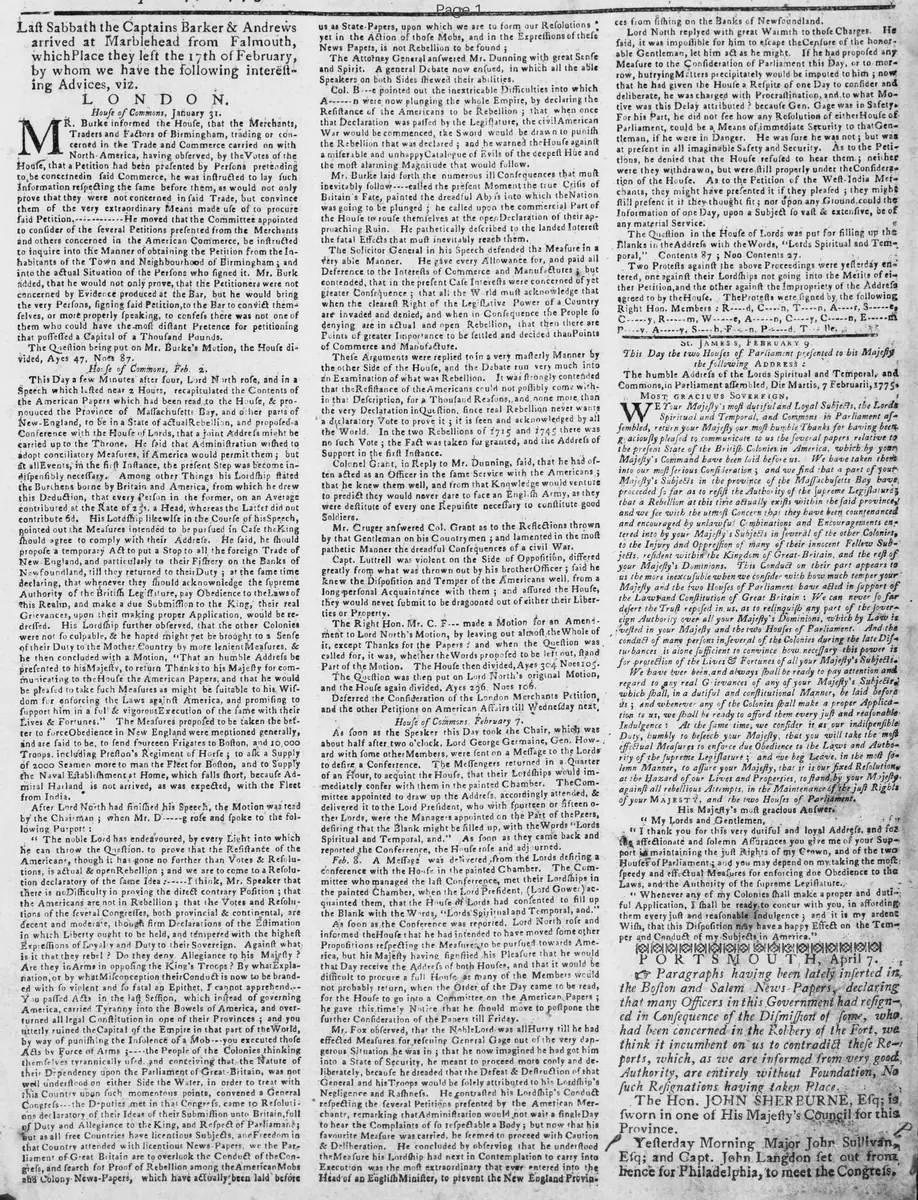
LONDON
House of Commons, January 31.
Mr. Burke informed the House, that the Merchants, Traders and Factors of Birmingham, trading or concerned in the Trade and Commerce carried on with North America, having observed, by the Votes of the House, that a Petition had been presented by Persons pretending to be concerned in said Commerce, he was instructed to lay such Information respecting the same before them, as would not only prove that they were not concerned in said Trade, but convince them of the very extraordinary Means made use of to procure said Petition. He moved that the Committee appointed to consider of the several Petitions presented from the Merchants and others concerned in the American Commerce, be instructed to inquire into the Manner of obtaining the Petition from the Inhabitants of the Town and Neighbourhood of Birmingham; and into the actual Situation of the Persons who Signed it. Mr. Burke added, that he would not only prove, that the Petitioners were not concerned by Evidence produced at the Bar, but he would bring the very Persons signing said Petition, to the Bar to convict themselves, or more properly speaking, to confess there was not one of them who could have the most distant Pretence for petitioning that possessed a Capital of a Thousand Pounds.
The Question being put on Mr. Burke's Motion, the House divided, Ayes 47, Noes 87.
House of Commons, Feb. 2.
This Day a few Minutes after four, Lord North rose, and in a Speech which lasted near 2 Hours, recapitulated the Contents of the American Papers which had been read to the House, & pronounced the Province of Massachusetts Bay, and other parts of New-England, to be in a State of actual Rebellion, and proposed a Conference with the House of Lords, that a joint Address might be carried up to the Throne. He said that Administration wished to adopt conciliatory Measures, if America would permit them; but at all Events, in the first Instance, the present Step was become indispensably necessary. Among other Things his Lordship stated the Burthens borne by Britain and America, from which he drew this Deduction, that every Person in the former, on an Average contributed at the Rate of 2s. a Head, whereas the Latter did not contribute 6d. His Lordship likewise in the course of his Speech, pointed out the Measures intended to be pursued in Case the King should agree to comply with their Address. He said, he should propose a temporary Act to put a Stop to all the foreign Trade of New-England, and particularly to their Fishery on the Banks of Newfoundland, till they returned to their Duty; at the same time declaring, that whenever they should acknowledge the supreme Authority of the British Legislature, pay Obedience to the Laws of this Realm, and make a due Submission to the King, their real Grievances, upon their making proper Application, would be redressed. His Lordship further observed, that the other Colonies were not so culpable, & he hoped might yet be brought to a Sense of their Duty to the Mother Country by more lenient Measures. & he then concluded with a Motion, "That an humble Address be presented to his Majesty, to return Thanks to his Majesty for communicating to the House the American Papers, and that he would be pleased to take such Measures as might be suitable to his Wisdom for enforcing the Laws against America, and promising to support him in a full & vigorous Execution of the same with their Lives & Fortunes." The Measures proposed to be taken the better to force Obedience in New England were mentioned generally, and are said to be, to send fourteen Frigates to Boston, and 10,000 Troops, including Preston's Regiment of Horse; to ask a Supply of 20,000 Seamen more to man the Fleet for Boston, and to Supply the Naval Establishment at Home, which falls short, because Admiral Harland is not arrived, as was expected, with the Fleet from India.
After Lord North had finished his Speech, the Motion was read by the Chairman; when Mr. Dunning rose and spoke to the following Purport:
"The noble Lord has endeavoured, by every Light into which he can throw the Question, to prove that the Resistance of the Americans, though it has gone no further than Votes & Resolutions, is actual & open Rebellion; and we are to come to a Resolution declaratory of the same Idea. I think, Mr. Speaker, that there is no Difficulty in proving the direct contrary Position; that the Americans are not in Rebellion; that the Votes and Resolutions of the several Congresses, both provincial & continental, are decent and moderate, though firm Declarations of the Estimation in which Liberty ought to be held, and tempered with the highest Expressions of Loyalty and Duty to their Sovereign. Against what is it that they rebel? Do they deny Allegiance to his Majesty? Are they in Arms in opposing the King's Troops? By what Explanation, or by what Misconception their Conduct is now to be branded with so violent and so fatal an Epithet, I cannot apprehend. You passed Acts in the last Session, which instead of governing America, carried Tyranny into the Bowels of America, and over-turned all legal Constitution in one of their Provinces; and you utterly ruined the Capital of the Empire in that part of the World, by way of punishing the Insolence of a Mob—you executed those Acts by Force of Arms; the People of the Colonies thinking themselves tyrannically used, and conceiving that the Nature of their Dependency upon the Parliament of Great-Britain, was not well understood on either Side the Water, in order to treat with this Country upon such momentous points, convened a General Congress—the Deputies met in that Congress, came to Resolutions declaratory of their Ideas of their Submission unto Britain, full of Duty and Allegiance to the King, and Respect of Parliament; but as all free Countries have licentious Subjects, and Freedom in that Country attended with licentious News-Papers, we the Parliament of Great Britain are to overlook the Conduct of the Congress, and search for Proof of Rebellion among the American Mobs and Colony-News-Papers, which have actually been laid before us as State Papers, upon which we are to form our Resolutions yet in the Action of those Mobs, and in the Expressions of these News Papers, is not Rebellion to be found;
The Attorney General answered Mr. Dunning with great Sense and Spirit. A general Debate now ensued, in which all the able Speakers on both Sides shewed their abilities.
Col. B..e pointed out the inextricable Difficulties into which A------n were now plunging the whole Empire, by declaring the Resistance of the Americans to be Rebellion; that when once that Declaration was passed by the Legislature, the civil American War would be commenced, the Sword would be drawn to punish the Rebellion that was declared; and he warned the House against a miserable and unhappy Catalogue of Evils of the deepest Hue and the most alarming Magnitude that would follow.
Mr. Burke laid forth the numerous ill Consequences that must inevitably follow—called the present Moment the true Crisis of Britain's Fate, painted the dreadful Abyss into which the Nation was going to be plunged; he called upon the commercial Part of the House to rouse themselves at the open Declaration of their approaching Ruin. He pathetically described to the landed Interest the fatal Effects that must inevitably reach them.
The Solicitor General in his Speech defended the Measure in a very able Manner. He gave every Allowance for, and paid all Deference to the Interests of Commerce and Manufactures; but contended, that in the present Case Interests were concerned of yet greater Consequence; that all the World must acknowledge that when the clearest Right of the Legislative Power of a Country are invaded and denied, and when in Consequence the People of denying are in actual and open Rebellion, that then there are Points of greater Importance to be settled and decided than Points of Commerce and Manufacture.
These Arguments were replied to in a very masterly Manner by the other Side of the House, and the Debate run very much into an Examination of what was Rebellion. It was strongly contended that the Resistance of the Americans could not possibly come within that Description, for a Thousand Reasons, and none more than the very Declaration in Question, since real Rebellion never wants a declaratory Vote to prove it; it is seen and acknowledged by all the World. In the two Rebellions of 1715 and 1745 there was no such Vote; the Fact was taken for granted, and the Address of Support in the first Instance.
Colonel Grant, in Reply to Mr. Dunning, said, that he had often acted as an Officer in the same Service with the Americans; that he knew them well, and from that Knowledge would venture to predict they would never dare to face an English Army, as they were destitute of every one Requisite necessary to constitute good Soldiers.
Mr. Cruger answered Col. Grant as to the Reflections thrown by that Gentleman on his Countrymen; and lamented in the most pathetic Manner the dreadful Consequences of a civil War.
Capt. Luttrell was violent on the Side of Opposition, differed greatly from what was thrown out by his brother Officer; said he knew the Disposition and Temper of the Americans well, from a long personal Acquaintance with them; and assured the House, they would never submit to be dragooned out of either their Liberties or Property.
The Right Hon. Mr. C. F... made a Motion for an Amendment to Lord North's Motion, by leaving out almost the Whole of it, except Thanks for the Papers: and when the Question was called for, it was, whether the Words proposed to be left out, stand Part of the Motion. The House then divided, Ayes 34, Noes 105.
The Question was then put on Lord North's original Motion, and the House again divided. Ayes 206, Noes 106.
Deferred the Consideration of the London Merchants Petition and the other Petitions on American Affairs till Wednesday next.
House of Commons, February 7.
As soon as the Speaker this Day took the Chair, which was about half after two o'clock, Lord George Germaine, Gen. Howard with some other Members, were sent on a Message to the Lords to desire a Conference. The Messengers returned in a Quarter of an Hour, to acquaint the House, that their Lordships would immediately confer with them in the painted Chamber. The Committee appointed to draw up the Address, accordingly attended, & delivered it to the Lord President, who with fourteen or fifteen other Lords, were the Managers appointed on the Part of the Peers, desiring that the Blank might be filled up, with the Words "Lords Spiritual and Temporal, and." As soon as they came back and reported the Conference, the House rose and adjourned.
Feb. 8. A Message was delivered, from the Lords desiring a conference with the House in the painted Chamber. The Committee who managed the last Conference, met their Lordships in the painted Chamber, when the Lord President, (Lord Gower) acquainted them, that the House of Lords had consented to fill up the Blank with the Words. "Lords Spiritual and Temporal, and."
As soon as the Conference was reported, Lord North rose and informed the House that he had intended to have moved some other Propositions respecting the Measures to be pursued towards America, but his Majesty having, signified his Pleasure that he would that Day receive the Address of both Houses, and that it would be difficult to procure a full House as many of the Members would not probably return, when the Order of the Day came to be read, for the House to go into a Committee on the American Papers; he gave this timely Notice that he should move to postpone the further Consideration of the Papers till Friday.
Mr. Fox observed, that the Noble Lord was all Hurry till he had effected Measures for rescuing General Gage out of the very dangerous Situation he was in; that he now imagined he had got him into a State of Security, he meant to proceed more coolly and deliberately, because he dreaded that the Defeat & Destruction of that General and his Troops would be solely attributed to his Lordship's Negligence and Rashness. He contrasted his Lordship's Conduct respecting the several Petitions presented by the American Merchants, remarking that Administration would not wait a single Day to hear the Complaints of so respectable a Body; but now that his favourite Measure was carried, he seemed to proceed with Caution & Deliberation. He concluded by observing that he understood the Measure his Lordship had next in Contemplation to carry into Execution was the most extraordinary that ever entered into the Head of an English Minister, to prevent the New England Provinces from fishing on the Banks of Newfoundland,
Lord North replied with great Warmth to those Charges. He said, it was impossible for him to escape the Censure of the honorable Gentleman, let him act as he might. If he had proposed any Measure to the Consideration of Parliament this Day, or to-morrow, hurrying Matters precipitately would be imputed to him; now that he had given the House a Respite of one Day to consider and deliberate, he was charged with Procrastination, and to what Motive was this Delay attributed? because Gen. Gage was in Safety. For his Part, he did not see how any Resolution of either House of Parliament, could be a Means of immediate Security to that Gentleman, if he were in Danger. He was sure he was not; but was at present in all imaginable Safety and Security. As to the Petitions, he denied that the House refused to hear them; neither were they withdrawn, but were still properly under the Consideration of the House. As to the Petition of the West-India Merchants, they might have presented it if they pleased; they might still present it if they thought fit; nor upon any Ground could the Information of one Day, upon a Subject so vast & extensive, be of any material Service.
The Question in the House of Lords was put for filling up the Blanks in the Address with the Words, "Lords Spiritual and Temporal," Contents 87; Non Contents 27.
Two Protests against the above Proceedings were yesterday entered, one against their Lordships not going into the Merits of either Petition, and the other against the Impropriety of the Address agreed to by the House. The Protests were signed by the following Right Hon. Members: R---d, C-..n, T-.n, A----t, S-----e, C..-.-y, R-.--m, W.-..e, A-...n, C----y, C.-.--n, E-....m, P...y, A-..y, S.-..h, F-x.-n, Pa..d, T.: Ile. 27
ST. JAMES, FEBRUARY 9
This Day the two Houses of Parliament presented to his Majesty the following ADDRESS:
The humble Address of the Lords Spiritual and Temporal, and Commons, in Parliament assembled, Die Martis, 7 Februarii, 1775.
WE, MOST GRACIOUS SOVEREIGN,
The Lords Spiritual and Temporal, and Commons in Parliament assembled, return your Majesty our most humble Thanks for having been graciously pleased to communicate to us the several papers relative to the present State of the British Colonies in America, which by your Majesty's Command have been laid before us. We have taken them into our most serious Consideration; and we find that a part of your Majesty's Subjects in the province of the Massachusetts Bay have proceeded so far as to resist the Authority of the supreme Legislature; that a Rebellion at this time actually exists within the said province; and we see with the utmost Concern that they have been countenanced and encouraged by unlawful Combinations and Encouragements entered into by your Majesty's Subjects in Several of the other Colonies, to the Injury and Oppression of many of their innocent Fellow Subjects, resident within the Kingdom of Great-Britain, and the rest of your Majesty's Dominions. This Conduct on their part appears to us the more inexcusable when we consider with how much Temper your Majesty and the two Houses of Parliament have acted in Support of the Laws and Constitution of Great Britain: We can never so far desert the Trust reposed in us, as to relinquish any part of the sovereign Authority over all your Majesty's Dominions, which by Law is vested in your Majesty and the two Houses of Parliament. And the conduct of many persons in several of the Colonies during the late Disturbances is alone sufficient to convince how necessary this power is for protection of the Lives & Fortunes of all your Majesty's Subjects. We have ever been, and always shall be ready to pay attention and regard to any real Grievances of any of your Majesty's Subjects which shall, in a dutiful and constitutional Manner, be laid before us; and whenever any of the Colonies shall make a proper Application to us, we shall be ready to afford them every just and reasonable Indulgence: At the same time, we consider it as our indispensable Duty, humbly to beseech your Majesty, that you will take the most effectual Measures to enforce due Obedience to the Laws and Authority of the supreme Legislature; and we beg Leave, in the most solemn Manner, to assure your Majesty, that it is our fixed Resolution at the Hazard of our Lives and Properties, to stand by your Majesty against all rebellious Attempts, in the Maintenance of the just Rights of your MAJESTY, and the two Houses of Parliament.
His Majesty's most gracious Answer.
"My Lords and Gentlemen,
I thank you for this very dutiful and loyal Address, and for the affectionate and solemn Assurances you give me of your Support in maintaining the just Rights of my Crown, and of the two Houses of Parliament; and you may depend on my taking the most speedy and effectual Measures for enforcing due Obedience to the Laws, and the Authority of the supreme Legislature.
Whenever any of my Colonies shall make a proper and dutiful Application, I shall be ready, to concur with you, in affording them every just and reasonable Indulgence; and it is my ardent Wish, that this Disposition may have a happy Effect on the Temper and Conduct of my Subjects in America."
What sub-type of article is it?
What keywords are associated?
What entities or persons were involved?
Where did it happen?
Foreign News Details
Primary Location
London
Event Date
January 31 To February 9, 1775
Key Persons
Outcome
house of commons votes: burke's motion ayes 47 noes 87; amendment ayes 34 noes 105; original motion ayes 206 noes 106; lords vote contents 87 non contents 27. address presented to king on feb 9, 1775; king promises effectual measures. proposed: 14 frigates and 10,000 troops to boston, 20,000 seamen, temporary stop to new england trade and fishery.
Event Details
Captains Barker and Andrews bring news from Falmouth of London parliamentary proceedings. On Jan 31, Burke challenges Birmingham petition on American trade. On Feb 2, Lord North declares Massachusetts in rebellion, proposes address to King for enforcing laws, outlines conciliatory measures if submission, temporary trade ban on New England, military reinforcements to Boston. Debate ensues with speeches by Dunning, Attorney General, Col. B..e, Burke, Solicitor General, Colonel Grant, Cruger, Luttrell, Mr. C. F...; motion passes. Petitions deferred. On Feb 7-8, conferences with Lords on address wording. On Feb 8, North postpones further consideration. Fox criticizes haste then delay; North replies. Lords vote on address. Two protests entered. On Feb 9, joint address presented at St. James, affirming rebellion in Massachusetts, support for sovereign authority, promise of loyalty; King's gracious response promises measures for obedience and indulgence if dutiful.