Thank you for visiting SNEWPapers!
Sign up free
Literary
May 4, 1885
Daily Kennebec Journal
Augusta, Kennebec County, Maine
What is this article about?
Over 20 years ago on the St. John River, Mrs. Grace leaves her young children with brave, lame 11-year-old Charly to visit her ill mother. Charly cares for them by telling stories and carving wooden figures to fund her treatment as a snowstorm looms.
Clipping
OCR Quality
95%
Excellent
Full Text
SNOWED IN.
"The Story of a Brave Girl."
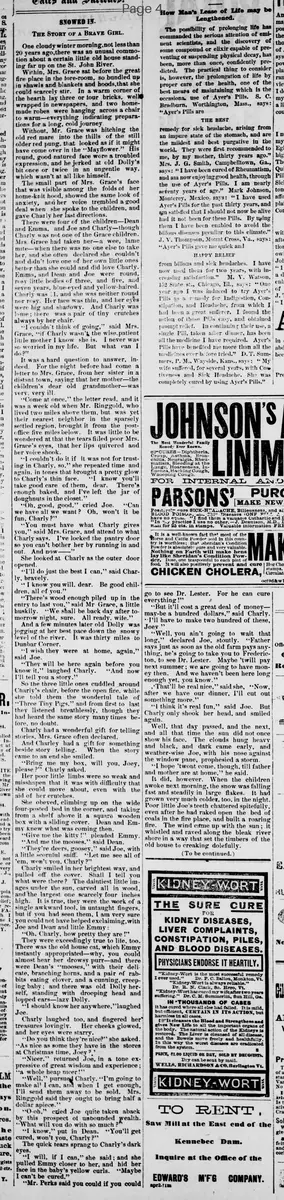
One cloudy winter morning, not less than 20 years ago, there was an unusual commotion about a certain little old house standing far up on the St. John River. Within, Mrs. Grace sat before the great fire-place in the fore-room, so bundled up in shawls and blankets and hoods, that she could scarcely stir. In a warm corner of the hearth lay three or four bricks, well wrapped in newspapers, and two home-made robes were hanging across a chair to warm-everything indicating preparations for a long, cold journey. Without, Mr. Grace was hitching the old red mare into the thills of the still older red pung, that looked as if it might have come over in the Mayflower. His round, good natured face wore a troubled expression, and he jerked at old Dolly's bit once or twice in an ungentle way, which wasn't at all like himself. The small part of Mrs. Grace's face that was visible among the folds of her home-knit hood, showed the same look of anxiety, and her voice trembled a good deal when she spoke to the children, and gave Charly her last directions. There were four of the children-Dean and Emma, and Joe and Charly-though Charly was not one of the Grace children. Mrs. Grace had taken her-a wee, lame mite-when there was no one else to take her, and she often declared she couldn't and didn't love one of her own little ones better than she could and did love Charly. Emma, and Dean and Joe were round, rosy little bodies of three, and five, and seven years, blue-eyed and yellow-haired. Charly was 11, and she was neither round nor rosy. Her face was thin, and her eyes were big and shadowy. And Charly was lame; there was a pair of tiny crutches always by her chair. "I couldn't think of going," said Mrs. Grace, "if Charly wasn't the wise, patient little mother I know she is. I never was so worried in my life. But what can I do?" It was a hard question to answer, indeed. For the night before had come a letter to Mrs. Grace, from her sister in a distant town, saying that her mother-the children's dear old grandmother-was very, very ill. "Come at once," the letter read, and it was a week old when Mr. Ringgold, who lived two miles above them, but was very their nearest neighbor in the sparsely settled region, brought it from the post-office five miles below. It was little to be wondered at that the tears filled poor Mrs. Grace's eyes, that her lips quivered and her voice shook. "I couldn't do it if it was not for trusting in Charly, so," she repeated time and again, in tones that brought a pretty glow to Charly's thin face. "I know you'll take good care of them, dear. There's enough baked, and I've left the jar of doughnuts in the closet." "Oh, good, good," cried Joe. "Can we have all we want? Oh, won't it be fun, Charly?" "You must have what Charly gives you," said Mrs. Grace, "and attend to what Charly says. I've locked the pantry door so you can't bother her by running in and out. And now-" She looked at Charly as the outer door opened. "I'll do just the best I can," said Charly, bravely. "I know you will, dear. Be good children, all of you." "There's wood enough piled up in the entry to last you," said Mr. Grace, a little huskily. "We shall be back day after to-morrow night, sure. All ready, wife." And a few minutes later old Dolly was jogging at her best pace down the snowy level of the river. It was thirty miles to Dunbar Corner. "I wish they were at home, again," said Joe. "They will be here again before you know it," laughed Charly. "And now I'll tell you a story." So the three little ones cuddled around Charly's chair, before the open fire, while she told them the wonderful tale of "Three Tiny Pigs," and from first to last they listened breathlessly, though they had heard the same story many times before, no doubt. Charly had a wonderful gift for telling stories. Mrs. Grace often declared. And Charly had a gift for something beside story telling. When the story came to an end she smiled. "Bring me my box, will you, Joey, please?" Charly asked. Her poor little limbs were so weak and misshapen that it was with difficulty that she could move about, even with the aid of her crutches. She obeyed, climbing up on the wide four-posted bed in the corner, and taking from a shelf above it a square wooden box with a sliding cover. Dean and Emmy knew what was coming then. "Give me the kitty!" pleaded Emmy "And me the mooses," said Dean. "They're deers, goosey," said Joe, with a little scornful sniff. "Let me see all of 'em, won't you, Charly?" Charly smiled in her brightest way, and pulled off the cover. Shall I tell you what were there? The daintiest little images under the sun, carved all in wood, and the largest one scarcely four inches high. It is true, they were the work of a single awkward tool, in untaught fingers, but if you had seen them, I am very sure you could not have helped exclaiming, with Joe and Dean and little Emmy: "Oh, Charly, how pretty they are!" They were exceedingly true to life, too. There was the old house cat, which Emmy instantly appropriated-why, you could almost hear her drowsy purr-and there were Dean's "mooses," with their delicate, branching horns, and a pair of rabbits eating clover, and a cunning, creeping baby; and there was old Dolly her-self, standing with drooping head and lopped ears-lazy Dolly. "I should know her anywhere," laughed Joe. Charly laughed too, and fingered her treasures lovingly. Her cheeks glowed, and her eyes were starry. "Do you think they're nice?" she asked. "As nice as some they have in the stores at Christmas time, Joey?" "Nicer," returned Joe, in a tone expressive of great wisdom and experience; "a whole heap nicer!" "Well," pursued Charly, "I'm going to make all I can, and when I get enough, I'll send them away to be sold. Mrs. Ringgold said they ought to bring half a dollar apiece." "O-oh," cried Joe quite taken aback by this prospect of unbounded wealth. "What will you do with so much?" "I know," put in Dean. "You'll get cured, won't you, Charly?" The quick tears sprang to Charly's dark eyes. "I will, if I can," she said: and she pulled Emmy closer to her, and hid her face in the baby's yellow curls. "Maybe I can't be cured." "Mr. Perks said you could if you could get to Fredericton, to see Dr. Lester," said Joe. "But it'll cost a great deal of money- may-be a hundred dollars," said Charly. "I'll have to make two hundred of these, Joey" "Well, you ain't going to wait that long," declared Joe, stoutly. "Father says just as soon as the old farm pays anything, he's going to take you to Fredericton, to see Dr. Lester. Maybe 'twill pay next summer; we are going to have money then. And we haven't been here long enough yet, you know." "That'll be real nice," said she, "Now, after we have our dinner, I'll cut out something more." "I think it's real fun," said Joe. But Charly only shook her head, and smiled again. Well, that day passed, and the next, and all that time the sun did not once show his face. The clouds hung heavy and black, and dark came early, and weather-wise Joe, with his nose against the window pane, prophesied a storm. "I hope 'twon't come, though, till father and mother are at home," he said. It did, however. When the children awoke next morning, the snow was falling fast and steadily in large flakes. It had grown very much colder, too, in the night. Poor little Joe's teeth chattered spitefully, even after he had raked open the bed of coals in the fire place, and built a roaring fire. The wind came up with the sun; it whistled and raved along the bleak river shore in a way that set the timbers of the old house to creaking dolefully.
(To be continued.)
"The Story of a Brave Girl."
One cloudy winter morning, not less than 20 years ago, there was an unusual commotion about a certain little old house standing far up on the St. John River. Within, Mrs. Grace sat before the great fire-place in the fore-room, so bundled up in shawls and blankets and hoods, that she could scarcely stir. In a warm corner of the hearth lay three or four bricks, well wrapped in newspapers, and two home-made robes were hanging across a chair to warm-everything indicating preparations for a long, cold journey. Without, Mr. Grace was hitching the old red mare into the thills of the still older red pung, that looked as if it might have come over in the Mayflower. His round, good natured face wore a troubled expression, and he jerked at old Dolly's bit once or twice in an ungentle way, which wasn't at all like himself. The small part of Mrs. Grace's face that was visible among the folds of her home-knit hood, showed the same look of anxiety, and her voice trembled a good deal when she spoke to the children, and gave Charly her last directions. There were four of the children-Dean and Emma, and Joe and Charly-though Charly was not one of the Grace children. Mrs. Grace had taken her-a wee, lame mite-when there was no one else to take her, and she often declared she couldn't and didn't love one of her own little ones better than she could and did love Charly. Emma, and Dean and Joe were round, rosy little bodies of three, and five, and seven years, blue-eyed and yellow-haired. Charly was 11, and she was neither round nor rosy. Her face was thin, and her eyes were big and shadowy. And Charly was lame; there was a pair of tiny crutches always by her chair. "I couldn't think of going," said Mrs. Grace, "if Charly wasn't the wise, patient little mother I know she is. I never was so worried in my life. But what can I do?" It was a hard question to answer, indeed. For the night before had come a letter to Mrs. Grace, from her sister in a distant town, saying that her mother-the children's dear old grandmother-was very, very ill. "Come at once," the letter read, and it was a week old when Mr. Ringgold, who lived two miles above them, but was very their nearest neighbor in the sparsely settled region, brought it from the post-office five miles below. It was little to be wondered at that the tears filled poor Mrs. Grace's eyes, that her lips quivered and her voice shook. "I couldn't do it if it was not for trusting in Charly, so," she repeated time and again, in tones that brought a pretty glow to Charly's thin face. "I know you'll take good care of them, dear. There's enough baked, and I've left the jar of doughnuts in the closet." "Oh, good, good," cried Joe. "Can we have all we want? Oh, won't it be fun, Charly?" "You must have what Charly gives you," said Mrs. Grace, "and attend to what Charly says. I've locked the pantry door so you can't bother her by running in and out. And now-" She looked at Charly as the outer door opened. "I'll do just the best I can," said Charly, bravely. "I know you will, dear. Be good children, all of you." "There's wood enough piled up in the entry to last you," said Mr. Grace, a little huskily. "We shall be back day after to-morrow night, sure. All ready, wife." And a few minutes later old Dolly was jogging at her best pace down the snowy level of the river. It was thirty miles to Dunbar Corner. "I wish they were at home, again," said Joe. "They will be here again before you know it," laughed Charly. "And now I'll tell you a story." So the three little ones cuddled around Charly's chair, before the open fire, while she told them the wonderful tale of "Three Tiny Pigs," and from first to last they listened breathlessly, though they had heard the same story many times before, no doubt. Charly had a wonderful gift for telling stories. Mrs. Grace often declared. And Charly had a gift for something beside story telling. When the story came to an end she smiled. "Bring me my box, will you, Joey, please?" Charly asked. Her poor little limbs were so weak and misshapen that it was with difficulty that she could move about, even with the aid of her crutches. She obeyed, climbing up on the wide four-posted bed in the corner, and taking from a shelf above it a square wooden box with a sliding cover. Dean and Emmy knew what was coming then. "Give me the kitty!" pleaded Emmy "And me the mooses," said Dean. "They're deers, goosey," said Joe, with a little scornful sniff. "Let me see all of 'em, won't you, Charly?" Charly smiled in her brightest way, and pulled off the cover. Shall I tell you what were there? The daintiest little images under the sun, carved all in wood, and the largest one scarcely four inches high. It is true, they were the work of a single awkward tool, in untaught fingers, but if you had seen them, I am very sure you could not have helped exclaiming, with Joe and Dean and little Emmy: "Oh, Charly, how pretty they are!" They were exceedingly true to life, too. There was the old house cat, which Emmy instantly appropriated-why, you could almost hear her drowsy purr-and there were Dean's "mooses," with their delicate, branching horns, and a pair of rabbits eating clover, and a cunning, creeping baby; and there was old Dolly her-self, standing with drooping head and lopped ears-lazy Dolly. "I should know her anywhere," laughed Joe. Charly laughed too, and fingered her treasures lovingly. Her cheeks glowed, and her eyes were starry. "Do you think they're nice?" she asked. "As nice as some they have in the stores at Christmas time, Joey?" "Nicer," returned Joe, in a tone expressive of great wisdom and experience; "a whole heap nicer!" "Well," pursued Charly, "I'm going to make all I can, and when I get enough, I'll send them away to be sold. Mrs. Ringgold said they ought to bring half a dollar apiece." "O-oh," cried Joe quite taken aback by this prospect of unbounded wealth. "What will you do with so much?" "I know," put in Dean. "You'll get cured, won't you, Charly?" The quick tears sprang to Charly's dark eyes. "I will, if I can," she said: and she pulled Emmy closer to her, and hid her face in the baby's yellow curls. "Maybe I can't be cured." "Mr. Perks said you could if you could get to Fredericton, to see Dr. Lester," said Joe. "But it'll cost a great deal of money- may-be a hundred dollars," said Charly. "I'll have to make two hundred of these, Joey" "Well, you ain't going to wait that long," declared Joe, stoutly. "Father says just as soon as the old farm pays anything, he's going to take you to Fredericton, to see Dr. Lester. Maybe 'twill pay next summer; we are going to have money then. And we haven't been here long enough yet, you know." "That'll be real nice," said she, "Now, after we have our dinner, I'll cut out something more." "I think it's real fun," said Joe. But Charly only shook her head, and smiled again. Well, that day passed, and the next, and all that time the sun did not once show his face. The clouds hung heavy and black, and dark came early, and weather-wise Joe, with his nose against the window pane, prophesied a storm. "I hope 'twon't come, though, till father and mother are at home," he said. It did, however. When the children awoke next morning, the snow was falling fast and steadily in large flakes. It had grown very much colder, too, in the night. Poor little Joe's teeth chattered spitefully, even after he had raked open the bed of coals in the fire place, and built a roaring fire. The wind came up with the sun; it whistled and raved along the bleak river shore in a way that set the timbers of the old house to creaking dolefully.
(To be continued.)
What sub-type of article is it?
Prose Fiction
What themes does it cover?
Moral Virtue
What keywords are associated?
Brave Girl
Lame Child
Wooden Carvings
Family Care
Snowstorm
Storytelling
Literary Details
Title
Snowed In. "The Story Of A Brave Girl."
Key Lines
"I Couldn't Think Of Going," Said Mrs. Grace, "If Charly Wasn't The Wise, Patient Little Mother I Know She Is."
"I'll Do Just The Best I Can," Said Charly, Bravely.
"Do You Think They're Nice?" She Asked. "As Nice As Some They Have In The Stores At Christmas Time, Joey?"
"Nicer," Returned Joe, In A Tone Expressive Of Great Wisdom And Experience; "A Whole Heap Nicer!"
"I Will, If I Can," She Said: And She Pulled Emmy Closer To Her, And Hid Her Face In The Baby's Yellow Curls.