Thank you for visiting SNEWPapers!
Sign up free
Alexandria Gazette
Alexandria, Alexandria County, District Of Columbia
What is this article about?
An analysis of the decline of religious belief in France, attributed to the misconduct of clergy and upper classes, resulting in loss of patience among the poor and rise of communist ideas, as discussed in a London Examiner article quoting Pierre Leroux.
Merged-components note: These two components form a single continuous article on the topic of religion in France, with the text flowing directly from one to the other.
Clipping
OCR Quality
Full Text
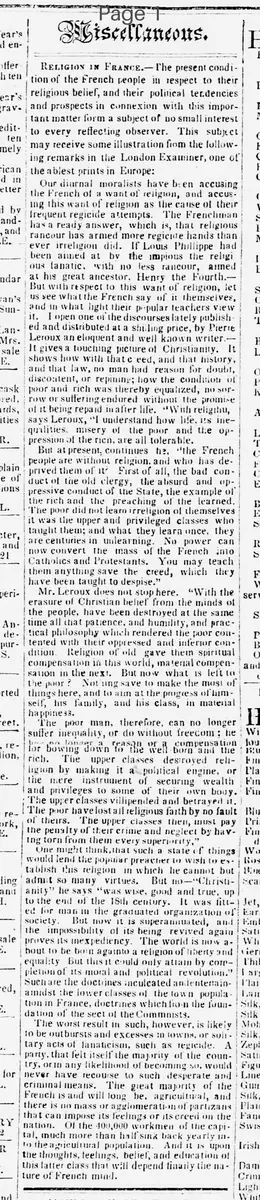
RELIGION IN FRANCE.—The present condition of the French people in respect to their religious belief, and their political tendencies and prospects in connexion with this important matter form a subject of no small interest to every reflecting observer. This subject may receive some illustration from the following remarks in the London Examiner, one of the ablest prints in Europe:
Our diurnal moralists have been accusing the French of a want of religion, and accusing this want of religion as the cause of their frequent regicide attempts. The Frenchman has a ready answer, which is, that religious rancour has armed more regicide hands than ever irreligion did. If Louis Phillippe had been aimed at by the impious the religious fanatic, with no less rancour, aimed at his great ancestor, Henry the Fourth.—
But with respect to this want of religion, let us see what the French say of it themselves, and in what light their popular teachers view it. I open one of the discourses lately published and distributed at a shilling price, by Pierre Leroux an eloquent and well known writer.—
It gives a touching picture of Christianity. It shows how with that creed, and that history, and that law, no man had reason for doubt, discontent, or repining; how the condition of poor and rich was thereby equalized, no sorrow or suffering endured without the promise of it being repaid in after life. "With religion," says Leroux, "I understand how life, its inequalities, misery of the poor and the oppression of the rich, are all tolerable.
But at present, continues he, the French people are without religion, and who has deprived them of it? First of all, the bad conduct of the old clergy, the absurd and oppressive conduct of the State, the example of the rich and the preaching of the learned. The poor did not learn irreligion of themselves it was the upper and privileged classes who taught them; and what they learn once, they are centuries in unlearning. No power can now convert the mass of the French into Catholics and Protestants. You may teach them anything save the creed, which they have been taught to despise."
Mr. Leroux does not stop here. "With the erasure of Christian belief from the minds of the people, have been destroyed at the same time all that patience, and humility, and practical philosophy which rendered the poor contented with their oppressed and inferior condition. Religion of old gave them spiritual compensation in this world, material compensation in the next. But now what is left to the poor? Nothing save to make the most of things here, and to aim at the progress of himself, his family, and his class, in material happiness.
The poor man, therefore, can no longer suffer inequality, or do without freedom: he longer finds a reason or a compensation for bowing down to the well born and the rich. The upper classes destroyed religion by making it a political engine, or the mere instrument of securing wealth and privileges to some of their own body. The upper classes vilipended and betrayed it. The poor have lost all religious faith by no fault of theirs. The upper classes then, must pay the penalty of their crime and neglect by having torn from them every superiority,"
One might think, that such a state of things would lend the popular preacher to wish to establish this religion in which he cannot but admit so many virtues. But no—"Christianity" he says "was wise, good and true, up to the end of the 18th century. It was fitted for man in the graduated organization of society. But now it is superannuated, and the impossibility of its being revived again proves its inexpediency. The world is now about to be born again to a religion of liberty and equality. But this it could only attain by completion of its moral and political revolution."
Such are the doctrines inculcated and entertained amidst the lower classes of the town population in France, doctrines which form the foundation of the sect of the Communists.
The worst result in such, however, is likely to be outbursts and excesses in towns, or solitary acts of fanaticism, such as regicide. A party, that felt itself the majority of the country, or in any likelihood of becoming so, would never have recourse to such desperate and criminal means. The great majority of the French is and will long be, agricultural, and there is no mass or agglomeration of partisans that can impose its feelings or its creed on the nation. Of the 400,000 workmen of the capital, much more than half sink back yearly into the agricultural population. And it is upon the thoughts, feelings, belief, and education of this latter class that will depend finally the nature of French mind.
What sub-type of article is it?
What themes does it cover?
What keywords are associated?
What entities or persons were involved?
Where did it happen?
Story Details
Key Persons
Location
France
Story Details
The article discusses the loss of religious faith among the French people, blamed on the upper classes and clergy, leading to demands for equality and liberty; quotes Pierre Leroux on Christianity's past benefits and its obsolescence, linking to communist doctrines and potential social unrest.