Thank you for visiting SNEWPapers!
Sign up free
Virginia Argus
Richmond, Virginia
What is this article about?
On July 8, 1807, Charleston citizens held a general meeting requesting Governor Pinckney to arm the militia in response to the British ship Leopard's unprovoked attack on the USS Chesapeake. Pinckney issued a circular letter on July 11 urging militia officers and privates to prepare for potential federal call-up, emphasizing national honor and historical resolve.
Clipping
OCR Quality
Full Text
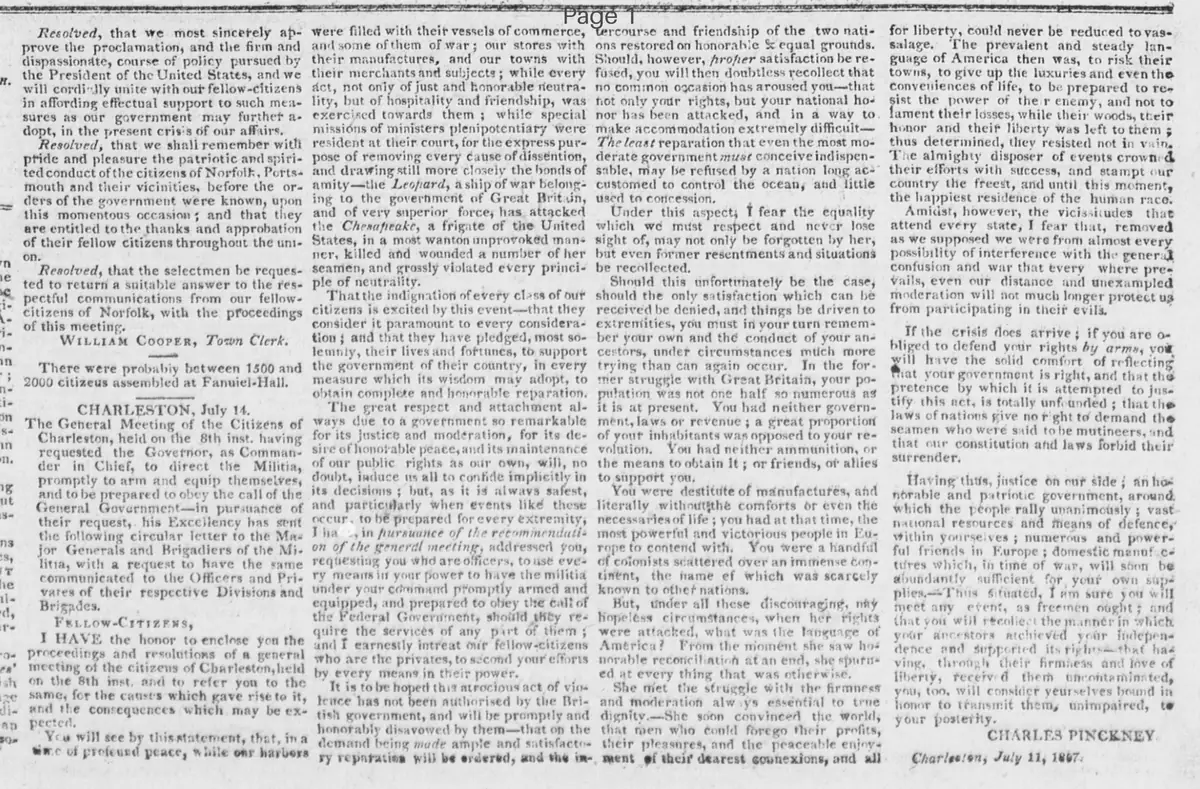
The General Meeting of the Citizens of
Charleston, held on the 8th inst. having
requested the Governor, as Commander
in Chief, to direct the Militia,
promptly to arm and equip themselves,
and to be prepared to obey the call of the
General Government-in pursuance of
their request, his Excellency has sent
the following circular letter to the Major Generals and Brigadiers of the Militia, with a request to have the same
communicated to the Officers and Privates of their respective Divisions and
Brigades.
FELLOW-CITIZENS,
I HAVE the honor to enclose you the
proceedings and resolutions of a general
meeting of the citizens of Charleston, held
on the 8th inst. and to refer you to the
same, for the cause's which gave rise to it,
and the consequences which may be expected.
You will see by this statement, that, in a
time of profound peace, while our harbors
were filled with their vessels of commerce,
and some of them of war; our stores with
their manufactures, and our towns with
their merchants and subjects; while every
act, not only of just and honorable neutrality, but of hospitality and friendship, was
exercised towards them: while special
missions of ministers plenipotentiary were
resident at their court, for the express purpose of removing every cause of dissention,
and drawing still more closely the bonds of
amity the Leopard, a ship of war belonging to the government of Great Britain,
and of very superior force, has attacked
the Chesapeake, a frigate of the United
States, in a most wanton unprovoked manner, killed and wounded a number of her
seamen, and grossly violated every principle of neutrality.
That the indignation of every class of our
citizens is excited by this event-that they
consider it paramount to every consideration; and that they have pledged, most solemnly, their lives and fortunes, to support
the government of their country, in every
measure which its wisdom may adopt, to
obtain complete and honorable reparation.
The great respect and attachment always due to a government so remarkable
for its justice and moderation, for its desire of honorable peace, and its maintenance
of our public rights as our own, will, no
doubt, induce us all to confide implicitly in
its decisions; but, as it is always safest,
and particularly when events like these
occur, to be prepared for every extremity,
I have, in pursuance of the recommendation of the general meeting, addressed you,
requesting you who are officers, to use every means in your power to have the militia
under your command promptly armed and
equipped, and prepared to obey the call of
the Federal Government, should they require the services of any part of them;
and I earnestly intreat our fellow-citizens
who are the privates, to second your efforts
by every means in their power.
It is to be hoped this atrocious act of violence has not been authorised by the British government, and will be promptly and
honorably disavowed by them-that on the
demand being made ample and satisfactory reparation will be ordered, and the intercourse and friendship of the two nations restored on honorable & equal grounds.
Should, however, proper satisfaction be refused, you will then doubtless recollect that
no common occasion has aroused you--that
not only your rights, but your national honor has been attacked, and in a way to
make accommodation extremely difficult--
The least reparation that even the most moderate government must conceive indispensable, may be refused by a nation long accustomed to control the ocean, and little
used to concession.
Under this aspect; I fear the equality
which we must respect and never lose
sight of, may not only be forgotten by her,
but even former resentments and situations
be recollected.
Should this unfortunately be the case,
should the only satisfaction which can be
received be denied, and things be driven to
extremities, you must in your turn remember your own and the conduct of your ancestors, under circumstances much more
trying than can again occur. In the former struggle with Great Britain, your population was not one half so numerous as
it is at present. You had neither government, laws or revenue; a great proportion
of your inhabitants was opposed to your revolution. You had neither ammunition, or
the means to obtain it; or friends, or allies
to support you.
You were destitute of manufactures, and
literally without the comforts or even the
necessaries of life; you had at that time, the
most powerful and victorious people in Europe to contend with. You were a handful
of colonists scattered over an immense Continent, the name of which was scarcely
known to other nations.
But, under all these discouraging, nay
hopeless circumstances, when her rights
were attacked, what was the language of
America? From the moment she saw honorable reconciliation at an end, she spurned at every thing that was otherwise.
She met the struggle with the firmness
and moderation always essential to true
dignity. She soon convinced the world,
that men who could forego their profits,
their pleasures, and the peaceable enjoyment of their dearest connexions, and all
for liberty, could never be reduced to vassalage. The prevalent and steady language of America then was, to risk their
towns, to give up the luxuries and even the
conveniences of life, to be prepared to resist the power of the enemy, and not to
lament their losses, while their woods, their
honor and their liberty was left to them;
thus determined, they resisted not in vain.
The almighty disposer of events crowned
their efforts with success, and stampt our
country the freest, and until this moment,
the happiest residence of the human race.
Amidst, however, the vicissitudes that
attend every state, I fear that, removed
as we supposed we were from almost every
possibility of interference with the general
confusion and war that every where prevails, even our distance and unexampled
moderation will not much longer protect us
from participating in their evils.
If the crisis does arrive: if you are obliged to defend your rights by arms, you
will have the solid comfort of reflecting that your government is right, and that the
pretence by which it is attempted to justify this act, is totally unfounded; that the laws of nations give no right to demand the
seamen who were said to be mutineers, and
that our constitution and laws forbid their
surrender.
Having thus, justice on our side; an honorable and patriotic government, around
which the people rally unanimously; vast
national resources and means of defence
within yourselves; numerous and powerful friends in Europe: domestic manufactures which, in time of war, will soon be
abundantly sufficient for your own supplies. Thus situated, I am sure you will
meet any event, as freemen ought: and
that you will recollect the manner in which
your ancestors achieved your independence and supported its rights that having, through their firmness and love of
liberty, received them uncontaminated,
you, too, will consider yourselves bound in
honor to transmit them, unimpaired, to
your posterity.
CHARLES PINCKNEY
Charleston, July 11, 1807.
What sub-type of article is it?
What keywords are associated?
What entities or persons were involved?
Where did it happen?
Domestic News Details
Primary Location
Charleston
Event Date
July 8, 1807
Key Persons
Outcome
killed and wounded a number of her seamen [referring to the chesapeake incident]; militia to be armed and equipped in preparation for potential federal call-up.
Event Details
General meeting of Charleston citizens on July 8 requested Governor to direct militia to arm and equip themselves in response to British ship Leopard's attack on USS Chesapeake. Governor Pinckney sent circular letter on July 11 to militia officers and privates, enclosing meeting proceedings, expressing indignation, urging preparation, and invoking historical resolve against Britain.