Thank you for visiting SNEWPapers!
Sign up free
Letter to Editor
October 4, 1843
Vermont Telegraph
Brandon, Rutland County, Vermont
What is this article about?
The letter argues that death-bed feelings cannot prove religious doctrines true or false, criticizing orthodox religionists for hypocritically using favorable cases among themselves while dismissing them for infidels and universalists, and selectively handling unfavorable ones to sustain their faith.
Clipping
OCR Quality
98%
Excellent
Full Text
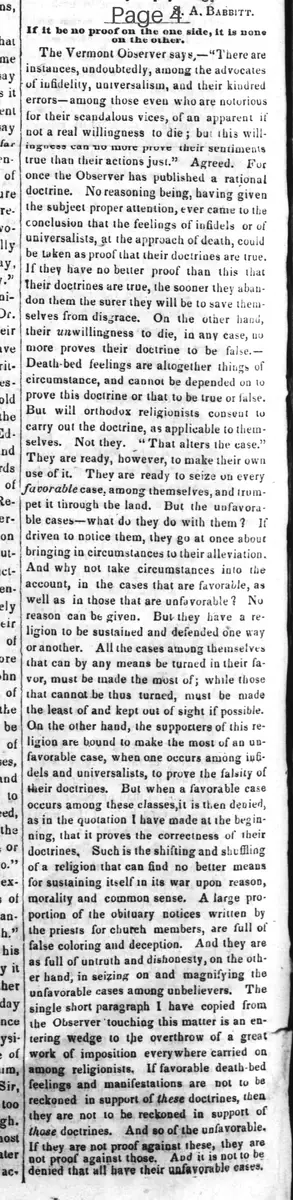
If it be no proof on the one side, it is none on the other.
The Vermont Observer says,-"There are instances, undoubtedly, among the advocates of infidelity, universalism, and their kindred errors-among those even who are notorious for their scandalous vices, of an apparent if not a real willingness to die; but this willingness can no more prove their sentiments true than their actions just." Agreed. For once the Observer has published a rational doctrine. No reasoning being, having given the subject proper attention, ever came to the conclusion that the feelings of infidels or of universalists, at the approach of death, could be taken as proof that their doctrines are true. If they have no better proof than this that their doctrines are true, the sooner they abandon them the surer they will be to save themselves from disgrace. On the other hand, their unwillingness to die, in any case, no more proves their doctrine to be false.
Death-bed feelings are altogether things of circumstance, and cannot be depended on to prove this doctrine or that to be true or false. But will orthodox religionists consent to carry out the doctrine, as applicable to themselves. Not they. "That alters the case." They are ready, however, to make their own use of it. They are ready to seize on every favorable case, among themselves, and trumpet it through the land. But the unfavorable cases-what do they do with them? If driven to notice them, they go at once about bringing in circumstances to their alleviation. And why not take circumstances into the account, in the cases that are favorable, as well as in those that are unfavorable? No reason can be given. But they have a religion to be sustained and defended one way or another. All the cases among themselves that can by any means be turned in their favor, must be made the most of: while those that cannot be thus turned, must be made the least of and kept out of sight if possible. On the other hand, the supporters of this religion are bound to make the most of an unfavorable case, when one occurs among infidels and universalists, to prove the falsity of their doctrines. But when a favorable case occurs among these classes, it is then denied, as in the quotation I have made at the beginning, that it proves the correctness of their doctrines. Such is the shifting and shuffling of a religion that can find no better means for sustaining itself in its war upon reason, morality and common sense. A large proportion of the obituary notices written by the priests or church members, are full of false coloring and deception. And they are as full of untruth and dishonesty, on the other hand, in seizing on and magnifying the unfavorable cases among unbelievers. The single short paragraph I have copied from the Observer touching this matter is an entering wedge to the overthrow of a great work of imposition everywhere carried on among religionists. If favorable death-bed feelings and manifestations are not to be reckoned in support of these doctrines, then they are not to be reckoned in support of those doctrines. And so of the unfavorable. If they are not proof against these, they are not proof against those. And it is not to be denied that all have their unfavorable cases.
The Vermont Observer says,-"There are instances, undoubtedly, among the advocates of infidelity, universalism, and their kindred errors-among those even who are notorious for their scandalous vices, of an apparent if not a real willingness to die; but this willingness can no more prove their sentiments true than their actions just." Agreed. For once the Observer has published a rational doctrine. No reasoning being, having given the subject proper attention, ever came to the conclusion that the feelings of infidels or of universalists, at the approach of death, could be taken as proof that their doctrines are true. If they have no better proof than this that their doctrines are true, the sooner they abandon them the surer they will be to save themselves from disgrace. On the other hand, their unwillingness to die, in any case, no more proves their doctrine to be false.
Death-bed feelings are altogether things of circumstance, and cannot be depended on to prove this doctrine or that to be true or false. But will orthodox religionists consent to carry out the doctrine, as applicable to themselves. Not they. "That alters the case." They are ready, however, to make their own use of it. They are ready to seize on every favorable case, among themselves, and trumpet it through the land. But the unfavorable cases-what do they do with them? If driven to notice them, they go at once about bringing in circumstances to their alleviation. And why not take circumstances into the account, in the cases that are favorable, as well as in those that are unfavorable? No reason can be given. But they have a religion to be sustained and defended one way or another. All the cases among themselves that can by any means be turned in their favor, must be made the most of: while those that cannot be thus turned, must be made the least of and kept out of sight if possible. On the other hand, the supporters of this religion are bound to make the most of an unfavorable case, when one occurs among infidels and universalists, to prove the falsity of their doctrines. But when a favorable case occurs among these classes, it is then denied, as in the quotation I have made at the beginning, that it proves the correctness of their doctrines. Such is the shifting and shuffling of a religion that can find no better means for sustaining itself in its war upon reason, morality and common sense. A large proportion of the obituary notices written by the priests or church members, are full of false coloring and deception. And they are as full of untruth and dishonesty, on the other hand, in seizing on and magnifying the unfavorable cases among unbelievers. The single short paragraph I have copied from the Observer touching this matter is an entering wedge to the overthrow of a great work of imposition everywhere carried on among religionists. If favorable death-bed feelings and manifestations are not to be reckoned in support of these doctrines, then they are not to be reckoned in support of those doctrines. And so of the unfavorable. If they are not proof against these, they are not proof against those. And it is not to be denied that all have their unfavorable cases.
What sub-type of article is it?
Persuasive
Provocative
Philosophical
What themes does it cover?
Religion
Morality
What keywords are associated?
Death Bed Feelings
Infidelity
Universalism
Orthodox Religion
Hypocrisy
Obituary Notices
Religious Imposition
Letter to Editor Details
Main Argument
death-bed feelings are circumstantial and cannot prove religious doctrines true or false; orthodox religionists hypocritically use them selectively to support their own faith while dismissing favorable cases among infidels and universalists.
Notable Details
Quotes Vermont Observer On Willingness To Die Among Infidels
Criticizes Obituary Notices For False Coloring And Deception
Accuses Religionists Of Shifting Arguments To Sustain Their Faith