Thank you for visiting SNEWPapers!
Sign up free
Editorial
August 13, 1842
Richmond Palladium
Richmond, Wayne County, Indiana
What is this article about?
An American editorial praises a London Sun piece defending the Quakers against Lord Abinger's House of Lords criticism of their oath exemption and testimony reliability. It emphasizes Quakers' morality, honesty, and opposition from church, lawyers, and figures like Abinger, while Lords Brougham and Denman support them.
Clipping
OCR Quality
75%
Good
Full Text
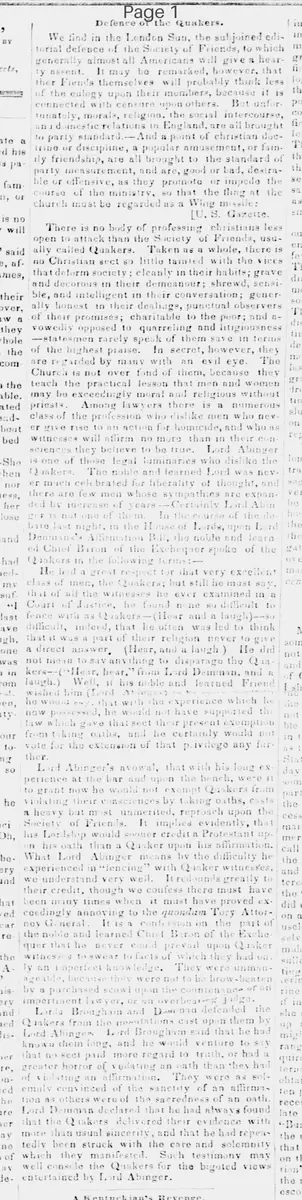
Defence of the Quakers.
We find in the London Sun, the subjoined editorial defence of the Society of Friends, to which generally almost all Americans will give a hearty assent. It may be remarked, however, that the Friends themselves will probably think less of the eulogy upon their members, because it is connected with censure upon others. But unfortunately, morals, religion, the social intercourse, and domestic relations in England, are all brought to party standard.—And a point of christian doctrine or discipline, a popular amusement, or family friendship, are all brought to the standard of party measurement, and are, good or bad, desirable or offensive, as they promote or impede the course of the ministry, so that the thing at the church must be regarded as a Whig missile.
No sect is more open to attack than the Society of Friends, usually called Quakers. Taken as a whole, there is no Christian sect so little tainted with the vices that deform society; cleanly in their habits; grave and decorous in their demeanour; shrewd, sensible, and intelligent in their conversation; generally honest in their dealings, punctual observers of their promises; charitable to the poor; and avowedly opposed to quarreling and litigiousness are regarded by many with an evil eye. The Church is not over fond of them, because they teach the practical lesson that men and women may be exceedingly moral and religious without priests. Among lawyers there is a numerous class of the profession who dislike men who never give rise to an action for homicide, and who as witnesses will affirm no more than in their consciences they believe to be true. Lord Abinger is one of those legal humorists who dislike the Quakers. The noble and learned Lord was never much celebrated for liberality of thought, and there are few men whose sympathies are expanded by increase of years—certainly Lord Abinger is not one of them. In the course of the debate last night, in the House of Lords, upon Lord Denman's amendment, the noble and learned Chief Baron of the Exchequer spoke of the Quakers in the following terms:-
He had a great respect for that very excellent class of men, the Quakers; but still he must say, that of all the witnesses he ever examined in a Court of Justice, he found none so difficult to fence with as Quakers—(hear, and a laugh)—so difficult, indeed, that he often was led to think that it was a part of their religion never to give a direct answer, (hear, and a laugh.) He did not mean to say anything to disparage the Quakers—(Hear, hear, from Lord Denman, and a laugh.) Well, if his noble and learned Friend wished him (hear)—he would say, that with his experience which he now possessed, he would not have supported the law which gave this sect their present exemption from taking oaths, and he certainly would not vote for the extension of that privilege any further.
Lord Abinger's avowal, that with his long experience at the bar and upon the bench, were it to grant now he would not exempt Quakers from violating their consciences by taking oaths, casts a heavy but most unmerited, reproach upon the Society of Friends. It implies evidently, that his Lordship would sooner credit a Protestant upon his oath than a Quaker upon his affirmation. What Lord Abinger means by the difficulty he experienced in "fencing" with Quaker witnesses, we understand very well. It redounds greatly to their credit, though we confess there must have been many times when it must have proved exceedingly annoying to the quondam Tory Attorney General. It is a confession on the part of the noble and learned Chief Baron of the Exchequer that he never could prevail upon Quaker witnesses to swear to facts of which they had only an imperfect knowledge. They were unmanageable because they were not to be brow-beaten by a perjured scoundrel upon the countenance or an impertinent lawyer, or an overbearing judge.
Lords Brougham and Denman defended the Quakers from the animadversions cast upon them by Lord Abinger. Lord Brougham said that he had known them long, and he would venture to say that no sect paid more regard to truth, or had a greater horror of violating an oath than they had of violating an affirmation. They were as solemnly convinced of the sanctity of an affirmation as others were of the sacredness of an oath.
Lord Denman declared that he had always found that the Quakers delivered their evidence with more than usual sincerity, and that he had repeatedly been struck with the care and solemnity which they manifested. Such testimony may well console the Quakers for the bigoted views entertained by Lord Abinger.
We find in the London Sun, the subjoined editorial defence of the Society of Friends, to which generally almost all Americans will give a hearty assent. It may be remarked, however, that the Friends themselves will probably think less of the eulogy upon their members, because it is connected with censure upon others. But unfortunately, morals, religion, the social intercourse, and domestic relations in England, are all brought to party standard.—And a point of christian doctrine or discipline, a popular amusement, or family friendship, are all brought to the standard of party measurement, and are, good or bad, desirable or offensive, as they promote or impede the course of the ministry, so that the thing at the church must be regarded as a Whig missile.
No sect is more open to attack than the Society of Friends, usually called Quakers. Taken as a whole, there is no Christian sect so little tainted with the vices that deform society; cleanly in their habits; grave and decorous in their demeanour; shrewd, sensible, and intelligent in their conversation; generally honest in their dealings, punctual observers of their promises; charitable to the poor; and avowedly opposed to quarreling and litigiousness are regarded by many with an evil eye. The Church is not over fond of them, because they teach the practical lesson that men and women may be exceedingly moral and religious without priests. Among lawyers there is a numerous class of the profession who dislike men who never give rise to an action for homicide, and who as witnesses will affirm no more than in their consciences they believe to be true. Lord Abinger is one of those legal humorists who dislike the Quakers. The noble and learned Lord was never much celebrated for liberality of thought, and there are few men whose sympathies are expanded by increase of years—certainly Lord Abinger is not one of them. In the course of the debate last night, in the House of Lords, upon Lord Denman's amendment, the noble and learned Chief Baron of the Exchequer spoke of the Quakers in the following terms:-
He had a great respect for that very excellent class of men, the Quakers; but still he must say, that of all the witnesses he ever examined in a Court of Justice, he found none so difficult to fence with as Quakers—(hear, and a laugh)—so difficult, indeed, that he often was led to think that it was a part of their religion never to give a direct answer, (hear, and a laugh.) He did not mean to say anything to disparage the Quakers—(Hear, hear, from Lord Denman, and a laugh.) Well, if his noble and learned Friend wished him (hear)—he would say, that with his experience which he now possessed, he would not have supported the law which gave this sect their present exemption from taking oaths, and he certainly would not vote for the extension of that privilege any further.
Lord Abinger's avowal, that with his long experience at the bar and upon the bench, were it to grant now he would not exempt Quakers from violating their consciences by taking oaths, casts a heavy but most unmerited, reproach upon the Society of Friends. It implies evidently, that his Lordship would sooner credit a Protestant upon his oath than a Quaker upon his affirmation. What Lord Abinger means by the difficulty he experienced in "fencing" with Quaker witnesses, we understand very well. It redounds greatly to their credit, though we confess there must have been many times when it must have proved exceedingly annoying to the quondam Tory Attorney General. It is a confession on the part of the noble and learned Chief Baron of the Exchequer that he never could prevail upon Quaker witnesses to swear to facts of which they had only an imperfect knowledge. They were unmanageable because they were not to be brow-beaten by a perjured scoundrel upon the countenance or an impertinent lawyer, or an overbearing judge.
Lords Brougham and Denman defended the Quakers from the animadversions cast upon them by Lord Abinger. Lord Brougham said that he had known them long, and he would venture to say that no sect paid more regard to truth, or had a greater horror of violating an oath than they had of violating an affirmation. They were as solemnly convinced of the sanctity of an affirmation as others were of the sacredness of an oath.
Lord Denman declared that he had always found that the Quakers delivered their evidence with more than usual sincerity, and that he had repeatedly been struck with the care and solemnity which they manifested. Such testimony may well console the Quakers for the bigoted views entertained by Lord Abinger.
What sub-type of article is it?
Moral Or Religious
Legal Reform
What keywords are associated?
Quakers
Lord Abinger
Oath Exemption
Religious Morality
House Of Lords Debate
Quaker Testimony
What entities or persons were involved?
Society Of Friends (Quakers)
Lord Abinger
Lord Brougham
Lord Denman
London Sun
Editorial Details
Primary Topic
Defense Of Quakers Against Criticism On Oath Exemptions
Stance / Tone
Supportive Of Quakers And Critical Of Lord Abinger
Key Figures
Society Of Friends (Quakers)
Lord Abinger
Lord Brougham
Lord Denman
London Sun
Key Arguments
Quakers Are Morally Upright, Honest, And Truthful
Lord Abinger's Remarks Unfairly Criticize Quaker Witnesses
Quakers' Affirmation Is As Sacred As Others' Oaths
Quakers Resist Perjury And Browbeating In Court
Church And Lawyers Oppose Quakers For Challenging Establishments