Thank you for visiting SNEWPapers!
Sign up free
Story
September 28, 1832
Constitutional Whig
Richmond, Virginia
What is this article about?
In 1832, a Virginia newspaper critiques letters from caucus-nominated electors responding to queries about voting for Judge Barbour as Vice President if selected by popular vote. Most prioritize Republican party unity and caucus discretion over direct instructions, sparking outrage over undermining the right of instruction.
Clipping
OCR Quality
95%
Excellent
Full Text
Wednesday Evening, Sept. 26.
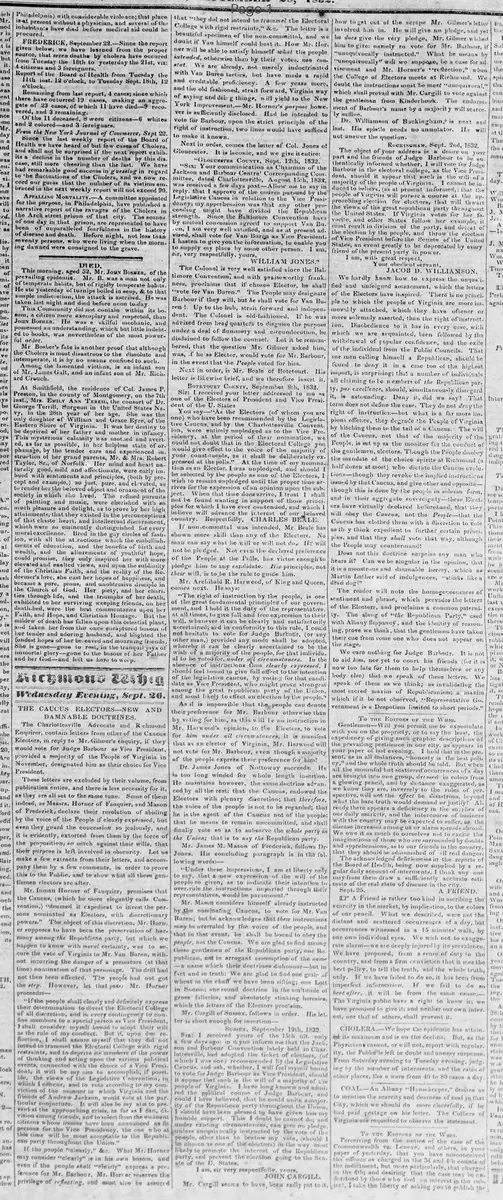
THE CAUCUS ELECTORS—NEW AND DAMNABLE DOCTRINES.
The Charlottesville Advocate and Richmond Enquirer, contain letters from other of the Caucus Electors, in reply to Mr. Gilmer's enquiry, if they would vote for Judge Barbour as Vice President, provided a majority of the People of Virginia in November, designated him as their choice for Vice President.
These letters are excluded by their volume, from publication entire, and there is less necessity for it, as they are all set to the same tune. Some of them indeed, as Messrs. Horner of Fauquier, and Mason of Frederick, declare their resolution of abiding by the voice of the People if clearly expressed, but even they guard the concession so jealously, and it is evidently, extorted from them by the force of the proposition, so much against their wills, that their purpose is left involved in obscurity. Let us make a few extracts from their letters, and accompany them by a few comments, in order to prove this to the Public, and to show what all these gentlemen electors are after.
Mr. Human Horner of Fauquier, premises that the Caucus, (which he more elegantly calls Convention,) "deemed it expedient to invest the persons nominated as Electors, with discretionary powers." The object of this discretion, Mr. Horner supposes to have been the preservation of harmony among the Republican party, but which we happen to know with moral certainty, was to secure the vote of Virginia to Mr. Van Buren, without incurring the danger of a premature (at that time) nomination of that personage. The drill had not then been effected. The people had not got the step. However, let that pass, Mr. Horner proceeds—
"If the people shall clearly and definitely express their determination to divest the Electoral College of all discretion, and in every contingency to confine members to a special person as Vice President, I shall consider myself bound to adopt their will as the rule of my conduct. But if, upon due reflection, I shall assure myself that they did not intend to trammel the Electoral College with rigid restraints, and to deprive its members of the power of thinking and acting upon the various political events, connected with the choice of a Vice President, it will be my aim to accomplish, if possible, the views of the Legislative Convention, in which I concur, and to vote according to my conviction of the manner in which Virginia and the friends of Andrew Jackson, would vote at the particular conjuncture. It will also be my aim to prevent at the approaching crisis, as far as I can, division among friends, and to select from the eminent citizens whose names have been announced as fit persons for the Vice Presidency, the one who at this time will be most acceptable to the Republican party throughout the Union."
If the people "clearly," &c. What Mr. Horner may consider "clearly" is in his own bosom, and even if the people shall "clearly" express a preference for Mr. Barbour, Mr. Horner reserves the privilege of reflecting, and must also be assured that "they did not intend to trammel the Electoral College with rigid restraints," &c. The letter is a beautiful specimen of the non-committal, and we doubt if Van himself could beat it. How Mr. Horner will be able to satisfy himself what the people intended, otherwise than by their votes, non constat. We are already, not merely indoctrinated with Van Buren tactics, but have made a rapid and creditable proficiency. A few years more, and the old fashioned, strait forward, Virginia way of saying and doing things, will yield to the New York Improvement.—Mr. Horner's purpose however is sufficiently disclosed. Had he intended to vote for Barbour, upon the strict principle of the right of instruction, two lines would have sufficed to make it known.
Next in order, comes the letter of Col. Jones of Gloucester. It is laconic, and we give it entire:
"GLOUCESTER COUNTY, Sept. 12th, 1832.
"Sir: Your communication as Chairman of the Jackson and Barbour Central Corresponding Committee, dated Charlottesville, August 15th, 1832, was received a few days past—Allow me to say in reply, that I approve of the course pursued by the Legislative Caucus in relation to the Vice Presidency; my apprehension was that any other proceeding might have divided the Republican strength. Since the Baltimore Convention have by mutual concession agreed to support Van Buren, I am very well satisfied, and as at present advised, shall vote for Van Buren as Vice President.
I hasten to give you the information, to enable you to supply my place by some other person. I am, sir, very respectfully, yours,
WILLIAM JONES."
The Colonel is very well satisfied since the Baltimore Convention, and with praiseworthy frankness, proclaims that if chosen Elector, he shall "vote for Van Buren." The People may designate Barbour if they will, but he shall vote for Van Buren! Up to the hub, strait forward and independent. The Colonel is old-fashioned. If he was advised from head quarters to disguise the purpose under a deal of fummery and circumlocution, he disdained to follow the counsel. Let it be remembered, that the question Mr. Gilmer asked him, was, if he as Elector, would vote for Mr. Barbour, in the event that the People voted for him.
Next in order, is Mr. Beale of Botetourt. His letter is likewise brief, and we therefore insert it.
Botetourt County, September 8th, 1832.
Sir: I received your letter addressed to me as one of the Electors of President and Vice President of the U. States
You say—“As the Electors (of whom you are one) who have been recommended by the Legislative Caucus, and by the Charlottesville Convention, were entirely unpledged as to the Vice Presidency, at the period of their nomination, we could not doubt that in the Electoral College you would give effect to the voice of the majority of your constituents, as it shall be deliberately expressed at the polls." At the time of my nomination as an Elector, I was unpledged, and should I be selected by the people as one of the Electors, I wish to remain unpledged until the proper time arrives for the expression of an opinion upon the subject. When that time does arrive, I trust I shall not be found wanting in support of those principles for which I have ever contended, and which I believe will advance the interest of our beloved country. Respectfully, CHARLES BEALE.
If non-committal was intended, Mr. Beale has shown more skill than any of the Electors. No man can say what he will or will not do He will not be pledged. Not even the declared preference of the People at the Polls, has virtue enough to pledge him to any candidate. His principles, not their will, is to be the rule to guide him.
Mr. Archibald R. Harwood, of King and Queen, comes next. He says:
"The right of instruction by the people, is one of the great fundamental principles of our government, and I hold it the duty of the representative, at all times, to give full and free expression to their will, whenever it can be clearly and satisfactorily ascertained; and in conformity to this rule, I could not hesitate to vote for Judge Barbour, (or any other man,) provided any mode shall be adopted, whereby it can be clearly ascertained to be the wish of a majority of the people, for that individual to be voted for, under all circumstances. In the absence of instructions thus clearly expressed, I should feel bound to give full effect to the intention of the legislative caucus, by voting for that candidate as Vice President, who might prove strongest among the great republican party of the Union, and most likely to effect an election by the people,"
As it is impossible that the people can denote their preference for Mr. Barbour otherwise than by voting for him, as this will be no instruction in Mr. Harwood's opinion, to the Electors, to vote for him under all circumstances, it is manifest that as an elector of Virginia, Mr. Harwood will not vote for Mr. Barbour, even though a majority of the people express their preference for him!
Dr. James Jones of Nottoway succeeds: He is too long winded for whole length insertion. He maintains however, the same doctrine advanced by all the rest: that the Caucus, endowed the Electors with plenary discretion; that therefore, the voice of the people is not to be regarded; that he is the agent of the Caucus not of the people; that he means to remain uncommitted, and shall finally vote so as to subserve the whole party in the Union; that is to say the Republican party.
Mr. James M. Mason of Frederick, follows Dr. Jones. His concluding paragraph is in the following words:
"Under these impressions, I am at liberty only to say, that a new expression of the will of the people so given, as to indicate their intention to over-rule the instructions imparted through their representatives, would be paramount."
Mr. Mason considers himself already instructed by the nominating Caucus, to vote for Mr. Van Buren; but he acknowledges that their instructions may be overruled by the voice of the people, and that in that event, he shall be bound to obey the people, not the Caucus. We are glad to find among these gentlemen of the Republican party, one Republican, not in arrogant assumption of the name —a name which their doctrines dishonour—with in fact and in truth: We are glad to find one grain of wheat in the chaff we have been sifting; one Lot in Sodom; one sound doctrine in the multitude of gross fallacies, and absolutely stinking heresies, which the letters of the Electors proclaim.
Mr. Cargill of Sussex, follows in order. His letter is short enough for insertion—
Sussex, September 10th, 1832.
Sir: I received yours of the 15th ult. only a few days ago: in it you inform me that the Jackson and Barbour Convention lately held in Charlottesville, had adopted the ticket of electors, (of which I was one) recommended by the Legislative Caucus, and ask, whether, I will feel myself bound to vote for Judge Barbour as Vice President, should it appear that such is the will of a majority of the people of Virginia. I have long known and admired the political course of Judge Barbour, and could I have believed, that he could unite a majority of the Republican party throughout the Union, I should have been pleased to have given him my humble support. This I doubt he cannot do; and under existing circumstances, can give no pledge, unless unequivocally instructed by the vote of the people, other than to bestow my vote, (should I be chosen as one of the electors) in the way most likely to promote the interest of the Republican party, and prevent the election going to the Senate of the U. States.
I am, sir very respectfully, yours,
JOHN CARGILL.
how to get out of the scrape Mr. Gilmer's letter involved him in. He will give no pledge, and yet he does give the very pledge, Mr. Gilmer wished him to give: namely to vote for Mr. Barbour, if "unequivocally instructed." What he means by "unequivocally" will we suppose, be a case for advisement and Mr. Horner's "reflection," when the College of Electors meets at Richmond. We doubt the instructions must be most "unequivocal," which shall prevail with Mr. Cargill to vote against the gentleman from Kinderhook. The endorsement of Barbour's name by a majority will scarcely suffice.
Dr. Williamson of Buckingham, is next and last. His epistle needs no annotator. He will not answer the question.
Rockingham, Sept. 2nd, 1832.
The object of your address is a desire on your part and the friends of Judge Barbour to be authentically informed whether, I will vote for Judge Barbour in the electoral college, as the Vice President, should it appear that such is the will of a majority of the people of Virginia. I cannot be induced to believe, (as at present informed,) that the people of Virginia will pursue a course at the approaching election for electors, that will thwart the views of the great republican party throughout the United States. If Virginia votes for her favorite, and other States follow her example, it must result in division of the party, and defeat of the election by the people, and throw the election of Vice President before the Senate of the United States, an event greatly to be deprecated by every friend of the present party in power.
I am, with great respect,
Your obedient servant,
JACOB D. WILLIAMSON.
We hardly know how to express the unqualified and unfeigned amazement, which the letters of the Electors have inspired. There is no principle to which the people of Virginia are more immovably attached, which they have oftener or more solemnly asserted, than the right of instruction. Disobedience to it has in every case, with which we are acquainted, been followed by the withdrawal of popular confidence, and the exile of the individual from the Public Councils. That one man calling himself a Republican, should be found to deny it in a case too of the highest import, is surprising; that a number of individuals all claiming to be members of the Republican party, par excellence, should, simultaneously disregard it, is astounding. Deny it, did we say? That term does not define the case. They do not deny the right of instruction—but what is a far more impious offence, they degrade the People of Virginia by hitching them to the tail of a Caucus. The will of the Caucus, not that of the majority of the People, is set up as the monitor for the conduct of the gentlemen, electors. Though the People disobey the mandate of the choice spirits at Richmond (a half dozen at most) who dictate the Caucus evolutions—though they revoke the implied instructions issued by that Caucus, and give other and opposite—though this is done by the people in solemn form, and in their aggregate sovereignty—these Electors have virtually declared beforehand, that they will obey the Caucus, not the People—that the Caucus has clothed them with a discretion to vote as they think expedient to further certain principles, and that they shall vote that way, although the People may countermand!
Does not this doctrine surprise any man who hears it? Can we be singular in the opinion, that it is a monstrous and damnable heresy, which as Martin Luther said of indulgences, "stinks like a dead dog?"
The reader will note the homogeneousness of sentiment and phrase, which pervades the letters of the Electors, and proclaims a common paternity. The slang of "the Republican Party," used with Albany flippancy, and the identity of reasoning, prove we think, that the gentlemen have taken their cue from some one who does not appear on the stage.
We care nothing for Judge Barbour. It is not to aid him, nor yet to court his friends (for it is now too late for them to help themselves or any body else) that we speak of these letters. We speak of them as we think; as invalidating the most sacred maxim of Republicanism; a maxim which if it be not observed, "Representative Government is a Despotism limited to short periods."
THE CAUCUS ELECTORS—NEW AND DAMNABLE DOCTRINES.
The Charlottesville Advocate and Richmond Enquirer, contain letters from other of the Caucus Electors, in reply to Mr. Gilmer's enquiry, if they would vote for Judge Barbour as Vice President, provided a majority of the People of Virginia in November, designated him as their choice for Vice President.
These letters are excluded by their volume, from publication entire, and there is less necessity for it, as they are all set to the same tune. Some of them indeed, as Messrs. Horner of Fauquier, and Mason of Frederick, declare their resolution of abiding by the voice of the People if clearly expressed, but even they guard the concession so jealously, and it is evidently, extorted from them by the force of the proposition, so much against their wills, that their purpose is left involved in obscurity. Let us make a few extracts from their letters, and accompany them by a few comments, in order to prove this to the Public, and to show what all these gentlemen electors are after.
Mr. Human Horner of Fauquier, premises that the Caucus, (which he more elegantly calls Convention,) "deemed it expedient to invest the persons nominated as Electors, with discretionary powers." The object of this discretion, Mr. Horner supposes to have been the preservation of harmony among the Republican party, but which we happen to know with moral certainty, was to secure the vote of Virginia to Mr. Van Buren, without incurring the danger of a premature (at that time) nomination of that personage. The drill had not then been effected. The people had not got the step. However, let that pass, Mr. Horner proceeds—
"If the people shall clearly and definitely express their determination to divest the Electoral College of all discretion, and in every contingency to confine members to a special person as Vice President, I shall consider myself bound to adopt their will as the rule of my conduct. But if, upon due reflection, I shall assure myself that they did not intend to trammel the Electoral College with rigid restraints, and to deprive its members of the power of thinking and acting upon the various political events, connected with the choice of a Vice President, it will be my aim to accomplish, if possible, the views of the Legislative Convention, in which I concur, and to vote according to my conviction of the manner in which Virginia and the friends of Andrew Jackson, would vote at the particular conjuncture. It will also be my aim to prevent at the approaching crisis, as far as I can, division among friends, and to select from the eminent citizens whose names have been announced as fit persons for the Vice Presidency, the one who at this time will be most acceptable to the Republican party throughout the Union."
If the people "clearly," &c. What Mr. Horner may consider "clearly" is in his own bosom, and even if the people shall "clearly" express a preference for Mr. Barbour, Mr. Horner reserves the privilege of reflecting, and must also be assured that "they did not intend to trammel the Electoral College with rigid restraints," &c. The letter is a beautiful specimen of the non-committal, and we doubt if Van himself could beat it. How Mr. Horner will be able to satisfy himself what the people intended, otherwise than by their votes, non constat. We are already, not merely indoctrinated with Van Buren tactics, but have made a rapid and creditable proficiency. A few years more, and the old fashioned, strait forward, Virginia way of saying and doing things, will yield to the New York Improvement.—Mr. Horner's purpose however is sufficiently disclosed. Had he intended to vote for Barbour, upon the strict principle of the right of instruction, two lines would have sufficed to make it known.
Next in order, comes the letter of Col. Jones of Gloucester. It is laconic, and we give it entire:
"GLOUCESTER COUNTY, Sept. 12th, 1832.
"Sir: Your communication as Chairman of the Jackson and Barbour Central Corresponding Committee, dated Charlottesville, August 15th, 1832, was received a few days past—Allow me to say in reply, that I approve of the course pursued by the Legislative Caucus in relation to the Vice Presidency; my apprehension was that any other proceeding might have divided the Republican strength. Since the Baltimore Convention have by mutual concession agreed to support Van Buren, I am very well satisfied, and as at present advised, shall vote for Van Buren as Vice President.
I hasten to give you the information, to enable you to supply my place by some other person. I am, sir, very respectfully, yours,
WILLIAM JONES."
The Colonel is very well satisfied since the Baltimore Convention, and with praiseworthy frankness, proclaims that if chosen Elector, he shall "vote for Van Buren." The People may designate Barbour if they will, but he shall vote for Van Buren! Up to the hub, strait forward and independent. The Colonel is old-fashioned. If he was advised from head quarters to disguise the purpose under a deal of fummery and circumlocution, he disdained to follow the counsel. Let it be remembered, that the question Mr. Gilmer asked him, was, if he as Elector, would vote for Mr. Barbour, in the event that the People voted for him.
Next in order, is Mr. Beale of Botetourt. His letter is likewise brief, and we therefore insert it.
Botetourt County, September 8th, 1832.
Sir: I received your letter addressed to me as one of the Electors of President and Vice President of the U. States
You say—“As the Electors (of whom you are one) who have been recommended by the Legislative Caucus, and by the Charlottesville Convention, were entirely unpledged as to the Vice Presidency, at the period of their nomination, we could not doubt that in the Electoral College you would give effect to the voice of the majority of your constituents, as it shall be deliberately expressed at the polls." At the time of my nomination as an Elector, I was unpledged, and should I be selected by the people as one of the Electors, I wish to remain unpledged until the proper time arrives for the expression of an opinion upon the subject. When that time does arrive, I trust I shall not be found wanting in support of those principles for which I have ever contended, and which I believe will advance the interest of our beloved country. Respectfully, CHARLES BEALE.
If non-committal was intended, Mr. Beale has shown more skill than any of the Electors. No man can say what he will or will not do He will not be pledged. Not even the declared preference of the People at the Polls, has virtue enough to pledge him to any candidate. His principles, not their will, is to be the rule to guide him.
Mr. Archibald R. Harwood, of King and Queen, comes next. He says:
"The right of instruction by the people, is one of the great fundamental principles of our government, and I hold it the duty of the representative, at all times, to give full and free expression to their will, whenever it can be clearly and satisfactorily ascertained; and in conformity to this rule, I could not hesitate to vote for Judge Barbour, (or any other man,) provided any mode shall be adopted, whereby it can be clearly ascertained to be the wish of a majority of the people, for that individual to be voted for, under all circumstances. In the absence of instructions thus clearly expressed, I should feel bound to give full effect to the intention of the legislative caucus, by voting for that candidate as Vice President, who might prove strongest among the great republican party of the Union, and most likely to effect an election by the people,"
As it is impossible that the people can denote their preference for Mr. Barbour otherwise than by voting for him, as this will be no instruction in Mr. Harwood's opinion, to the Electors, to vote for him under all circumstances, it is manifest that as an elector of Virginia, Mr. Harwood will not vote for Mr. Barbour, even though a majority of the people express their preference for him!
Dr. James Jones of Nottoway succeeds: He is too long winded for whole length insertion. He maintains however, the same doctrine advanced by all the rest: that the Caucus, endowed the Electors with plenary discretion; that therefore, the voice of the people is not to be regarded; that he is the agent of the Caucus not of the people; that he means to remain uncommitted, and shall finally vote so as to subserve the whole party in the Union; that is to say the Republican party.
Mr. James M. Mason of Frederick, follows Dr. Jones. His concluding paragraph is in the following words:
"Under these impressions, I am at liberty only to say, that a new expression of the will of the people so given, as to indicate their intention to over-rule the instructions imparted through their representatives, would be paramount."
Mr. Mason considers himself already instructed by the nominating Caucus, to vote for Mr. Van Buren; but he acknowledges that their instructions may be overruled by the voice of the people, and that in that event, he shall be bound to obey the people, not the Caucus. We are glad to find among these gentlemen of the Republican party, one Republican, not in arrogant assumption of the name —a name which their doctrines dishonour—with in fact and in truth: We are glad to find one grain of wheat in the chaff we have been sifting; one Lot in Sodom; one sound doctrine in the multitude of gross fallacies, and absolutely stinking heresies, which the letters of the Electors proclaim.
Mr. Cargill of Sussex, follows in order. His letter is short enough for insertion—
Sussex, September 10th, 1832.
Sir: I received yours of the 15th ult. only a few days ago: in it you inform me that the Jackson and Barbour Convention lately held in Charlottesville, had adopted the ticket of electors, (of which I was one) recommended by the Legislative Caucus, and ask, whether, I will feel myself bound to vote for Judge Barbour as Vice President, should it appear that such is the will of a majority of the people of Virginia. I have long known and admired the political course of Judge Barbour, and could I have believed, that he could unite a majority of the Republican party throughout the Union, I should have been pleased to have given him my humble support. This I doubt he cannot do; and under existing circumstances, can give no pledge, unless unequivocally instructed by the vote of the people, other than to bestow my vote, (should I be chosen as one of the electors) in the way most likely to promote the interest of the Republican party, and prevent the election going to the Senate of the U. States.
I am, sir very respectfully, yours,
JOHN CARGILL.
how to get out of the scrape Mr. Gilmer's letter involved him in. He will give no pledge, and yet he does give the very pledge, Mr. Gilmer wished him to give: namely to vote for Mr. Barbour, if "unequivocally instructed." What he means by "unequivocally" will we suppose, be a case for advisement and Mr. Horner's "reflection," when the College of Electors meets at Richmond. We doubt the instructions must be most "unequivocal," which shall prevail with Mr. Cargill to vote against the gentleman from Kinderhook. The endorsement of Barbour's name by a majority will scarcely suffice.
Dr. Williamson of Buckingham, is next and last. His epistle needs no annotator. He will not answer the question.
Rockingham, Sept. 2nd, 1832.
The object of your address is a desire on your part and the friends of Judge Barbour to be authentically informed whether, I will vote for Judge Barbour in the electoral college, as the Vice President, should it appear that such is the will of a majority of the people of Virginia. I cannot be induced to believe, (as at present informed,) that the people of Virginia will pursue a course at the approaching election for electors, that will thwart the views of the great republican party throughout the United States. If Virginia votes for her favorite, and other States follow her example, it must result in division of the party, and defeat of the election by the people, and throw the election of Vice President before the Senate of the United States, an event greatly to be deprecated by every friend of the present party in power.
I am, with great respect,
Your obedient servant,
JACOB D. WILLIAMSON.
We hardly know how to express the unqualified and unfeigned amazement, which the letters of the Electors have inspired. There is no principle to which the people of Virginia are more immovably attached, which they have oftener or more solemnly asserted, than the right of instruction. Disobedience to it has in every case, with which we are acquainted, been followed by the withdrawal of popular confidence, and the exile of the individual from the Public Councils. That one man calling himself a Republican, should be found to deny it in a case too of the highest import, is surprising; that a number of individuals all claiming to be members of the Republican party, par excellence, should, simultaneously disregard it, is astounding. Deny it, did we say? That term does not define the case. They do not deny the right of instruction—but what is a far more impious offence, they degrade the People of Virginia by hitching them to the tail of a Caucus. The will of the Caucus, not that of the majority of the People, is set up as the monitor for the conduct of the gentlemen, electors. Though the People disobey the mandate of the choice spirits at Richmond (a half dozen at most) who dictate the Caucus evolutions—though they revoke the implied instructions issued by that Caucus, and give other and opposite—though this is done by the people in solemn form, and in their aggregate sovereignty—these Electors have virtually declared beforehand, that they will obey the Caucus, not the People—that the Caucus has clothed them with a discretion to vote as they think expedient to further certain principles, and that they shall vote that way, although the People may countermand!
Does not this doctrine surprise any man who hears it? Can we be singular in the opinion, that it is a monstrous and damnable heresy, which as Martin Luther said of indulgences, "stinks like a dead dog?"
The reader will note the homogeneousness of sentiment and phrase, which pervades the letters of the Electors, and proclaims a common paternity. The slang of "the Republican Party," used with Albany flippancy, and the identity of reasoning, prove we think, that the gentlemen have taken their cue from some one who does not appear on the stage.
We care nothing for Judge Barbour. It is not to aid him, nor yet to court his friends (for it is now too late for them to help themselves or any body else) that we speak of these letters. We speak of them as we think; as invalidating the most sacred maxim of Republicanism; a maxim which if it be not observed, "Representative Government is a Despotism limited to short periods."
What sub-type of article is it?
Historical Event
What themes does it cover?
Justice
Deception
Moral Virtue
What keywords are associated?
Caucus Electors
Vice Presidency
Right Of Instruction
Republican Party
Van Buren
Barbour
Virginia Election
Political Discretion
What entities or persons were involved?
Mr. Gilmer
Judge Barbour
Mr. Van Buren
Andrew Jackson
Human Horner
James M. Mason
William Jones
Charles Beale
Archibald R. Harwood
James Jones
John Cargill
Jacob D. Williamson
Where did it happen?
Virginia
Story Details
Key Persons
Mr. Gilmer
Judge Barbour
Mr. Van Buren
Andrew Jackson
Human Horner
James M. Mason
William Jones
Charles Beale
Archibald R. Harwood
James Jones
John Cargill
Jacob D. Williamson
Location
Virginia
Event Date
1832
Story Details
Newspaper commentary on letters from Virginia caucus electors refusing to commit to voting for Judge Barbour as Vice President despite potential popular mandate, prioritizing caucus discretion and Republican party unity over the right of instruction, seen as a betrayal of republican principles.