Thank you for visiting SNEWPapers!
Sign up free
Letter to Editor
May 3, 1850
The Liberator
Boston, Suffolk County, Massachusetts
What is this article about?
In a letter dated April 24, 1850, from Boston, Calvin Fairbank defends his anti-slavery commitment to William L. Garrison against accusations of recantation after prison release. He explains influences on Miss Webster's book, his own cautious letters, and includes a testimonial affirming his unchanged views on slavery.
Clipping
OCR Quality
88%
Good
Full Text
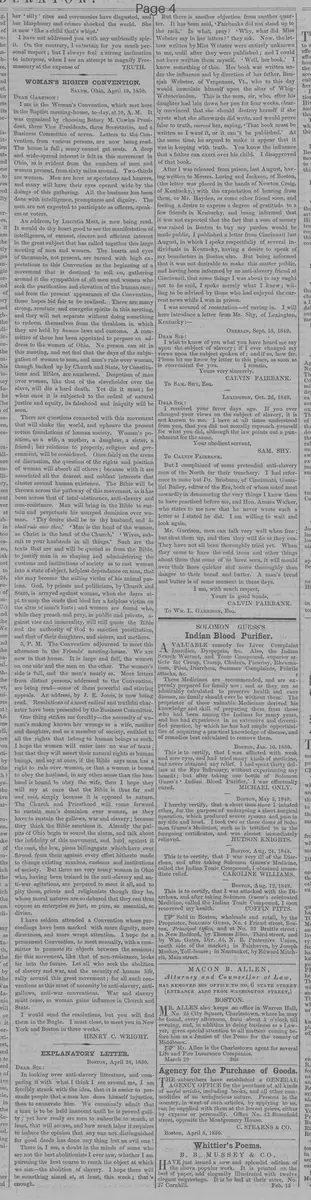
EXPLANATORY LETTER
Boston, April 24, 1850.
DEAR SIR:
In looking over anti-slavery literature, and comparing it with what I think I see around me, I am forcibly struck with the idea, that it is easier to persuade people that a man has done himself injustice, than to exonerate him. We commonly admit that a man is to be held innocent until he is proved guilty; yet how ready are men to subscribe to much, at least, that will accuse, and how much labor it requires to induce the opinion that any one not distinguished for good deeds has done any thing but an evil one!
There is, I see, a doubt in the minds of some who are not the best abolitionists I ever saw, whether I am pursuing the best course to reach the object at which we aim-the abolition of slavery. I hope there will be something aimed at, at least, this week; that's enough.
But there is another objection from another quarter. It has been said, 'Fairbanks did not stand up to the rack.' In what, pray? Why, what did Miss Webster say in her letters?' they ask. Now, the letters written by Miss Webster were entirely unknown to me, until after they were published; and I could not have written them myself. Well, her book.' I know something of this. Her book was written under the influence and by direction of her father, Benajah Webster, of Vergennes, Vt., who to this day would immolate himself upon the altar of Whig-Websterianism. This is the man, sir, who, after his daughter had lain down her pen for four weeks, clearly convinced that she should destroy herself if she wrote what she afterwards did write, and would prove false to truth, coerced her, saying, 'That book must be written as I want it, or it can't be published.' At the same time, he argued to make it appear that it was in keeping with truth. You know the influence that a father can exert over his child. I disapproved of that book.
After I was released from prison, last August, having written to Messrs. Loring and Jackson, of Boston, (the letter was placed in the hands of Newton Craig, of Kentucky,) with the expectation of hearing from them, or Mr. Hayden, or some other friend soon, and feeling a desire to express a degree of gratitude to a few friends in Kentucky, and being informed that it was not expected that the fact that a sum of money was raised in Boston to buy my pardon would be made public, I published a letter from Cincinnati last August, in which I spoke respectfully of several individuals in Kentucky, having a desire to speak of my benefactors in Boston also. But being informed that it was not desirable to make this matter public, and having been informed by an anti-slavery friend at Cincinnati, that some things I was about to say ought not to be said, I spoke merely what I knew; willing to be advised by those who had enjoyed the current news while I was in prison.
I was accused of recantation—of caving in. I will here introduce a letter from Mr. Shy, of Lexington, Kentucky:
OBERLIN, Sept. 15, 1849.
Dear Sir:
I wish to know of you what you have heard me say upon the subject of slavery; if I ever changed my views upon the subject spoken of: and if so, how far. Please let me know by letter to this place, as soon as is convenient for you.
I remain,
Yours very sincerely,
CALVIN FAIRBANK.
To SAM. SHY, Esq.
LEXINGTON, Oct. 2d, 1849.
Dear Sir:
I received your favor days ago. If you ever changed your views on the subject of slavery, it is not known to me. I have at all times understood from you, that you did not morally reproach yourself for what you did, although the law points out a punishment for the same.
Your obedient servant,
SAM SHY.
To Calvin Fairbank.
But I complained of some pretended anti-slavery men of the North for their treachery. I had reference to none but Dr. Brisbane, of Cincinnati, Gamaliel Bailey, editor of the Era, both of whom acted most cowardly in denouncing the very things I know them to have practised before me, and Hon. Amasa Walker, who states to me now that he never wrote such a letter as I stated he did. I am willing to wait and look again.
Mr. Garrison, men can talk very well when free; but shut them up, and then they will do as they can. They have not all been thoroughly tried yet. When they come to have the cold irons and other things about them that some of us have seen, it will mould over their faces quicker and more thoroughly than danger to their bread and butter. A man's bread and butter is of some moment in these days.
I am, with much respect,
Yours in good bonds,
CALVIN FAIRBANK.
To WM. L. GARRISON, Esq.
Boston, April 24, 1850.
DEAR SIR:
In looking over anti-slavery literature, and comparing it with what I think I see around me, I am forcibly struck with the idea, that it is easier to persuade people that a man has done himself injustice, than to exonerate him. We commonly admit that a man is to be held innocent until he is proved guilty; yet how ready are men to subscribe to much, at least, that will accuse, and how much labor it requires to induce the opinion that any one not distinguished for good deeds has done any thing but an evil one!
There is, I see, a doubt in the minds of some who are not the best abolitionists I ever saw, whether I am pursuing the best course to reach the object at which we aim-the abolition of slavery. I hope there will be something aimed at, at least, this week; that's enough.
But there is another objection from another quarter. It has been said, 'Fairbanks did not stand up to the rack.' In what, pray? Why, what did Miss Webster say in her letters?' they ask. Now, the letters written by Miss Webster were entirely unknown to me, until after they were published; and I could not have written them myself. Well, her book.' I know something of this. Her book was written under the influence and by direction of her father, Benajah Webster, of Vergennes, Vt., who to this day would immolate himself upon the altar of Whig-Websterianism. This is the man, sir, who, after his daughter had lain down her pen for four weeks, clearly convinced that she should destroy herself if she wrote what she afterwards did write, and would prove false to truth, coerced her, saying, 'That book must be written as I want it, or it can't be published.' At the same time, he argued to make it appear that it was in keeping with truth. You know the influence that a father can exert over his child. I disapproved of that book.
After I was released from prison, last August, having written to Messrs. Loring and Jackson, of Boston, (the letter was placed in the hands of Newton Craig, of Kentucky,) with the expectation of hearing from them, or Mr. Hayden, or some other friend soon, and feeling a desire to express a degree of gratitude to a few friends in Kentucky, and being informed that it was not expected that the fact that a sum of money was raised in Boston to buy my pardon would be made public, I published a letter from Cincinnati last August, in which I spoke respectfully of several individuals in Kentucky, having a desire to speak of my benefactors in Boston also. But being informed that it was not desirable to make this matter public, and having been informed by an anti-slavery friend at Cincinnati, that some things I was about to say ought not to be said, I spoke merely what I knew; willing to be advised by those who had enjoyed the current news while I was in prison.
I was accused of recantation—of caving in. I will here introduce a letter from Mr. Shy, of Lexington, Kentucky:
OBERLIN, Sept. 15, 1849.
Dear Sir:
I wish to know of you what you have heard me say upon the subject of slavery; if I ever changed my views upon the subject spoken of: and if so, how far. Please let me know by letter to this place, as soon as is convenient for you.
I remain,
Yours very sincerely,
CALVIN FAIRBANK.
To SAM. SHY, Esq.
LEXINGTON, Oct. 2d, 1849.
Dear Sir:
I received your favor days ago. If you ever changed your views on the subject of slavery, it is not known to me. I have at all times understood from you, that you did not morally reproach yourself for what you did, although the law points out a punishment for the same.
Your obedient servant,
SAM SHY.
To Calvin Fairbank.
But I complained of some pretended anti-slavery men of the North for their treachery. I had reference to none but Dr. Brisbane, of Cincinnati, Gamaliel Bailey, editor of the Era, both of whom acted most cowardly in denouncing the very things I know them to have practised before me, and Hon. Amasa Walker, who states to me now that he never wrote such a letter as I stated he did. I am willing to wait and look again.
Mr. Garrison, men can talk very well when free; but shut them up, and then they will do as they can. They have not all been thoroughly tried yet. When they come to have the cold irons and other things about them that some of us have seen, it will mould over their faces quicker and more thoroughly than danger to their bread and butter. A man's bread and butter is of some moment in these days.
I am, with much respect,
Yours in good bonds,
CALVIN FAIRBANK.
To WM. L. GARRISON, Esq.
What sub-type of article is it?
Persuasive
Reflective
What themes does it cover?
Slavery Abolition
Morality
What keywords are associated?
Calvin Fairbank
Anti Slavery Defense
Slavery Abolition
Prison Release
Recantation Accusation
Miss Webster Book
Benajah Webster Influence
William Garrison
What entities or persons were involved?
Calvin Fairbank
Wm. L. Garrison, Esq.
Letter to Editor Details
Author
Calvin Fairbank
Recipient
Wm. L. Garrison, Esq.
Main Argument
fairbank defends his anti-slavery stance against accusations of recantation, explaining external influences on criticized writings and including testimony that his views on slavery remain unchanged.
Notable Details
Accusations Regarding Miss Webster's Letters And Book Influenced By Her Father Benajah Webster
Fairbank's Cautious Letter From Cincinnati After Prison Release To Avoid Publicizing Boston Benefactors
Testimonial Letter From Sam Shy Affirming No Change In Fairbank's Views
Criticism Of Dr. Brisbane, Gamaliel Bailey, And Amasa Walker For Treachery