Thank you for visiting SNEWPapers!
Sign up free
Story
January 25, 1879
Colored Citizen
Fort Scott, Topeka, Bourbon County, Shawnee County, Kansas
What is this article about?
Lieut. Brown details the progress of Cheyenne Indians at Dakota Territory agency in domesticating through livestock provision, farming, housing, and employment since 1877, crediting moral suasion with physical force and fair treatment.
Clipping
OCR Quality
98%
Excellent
Full Text
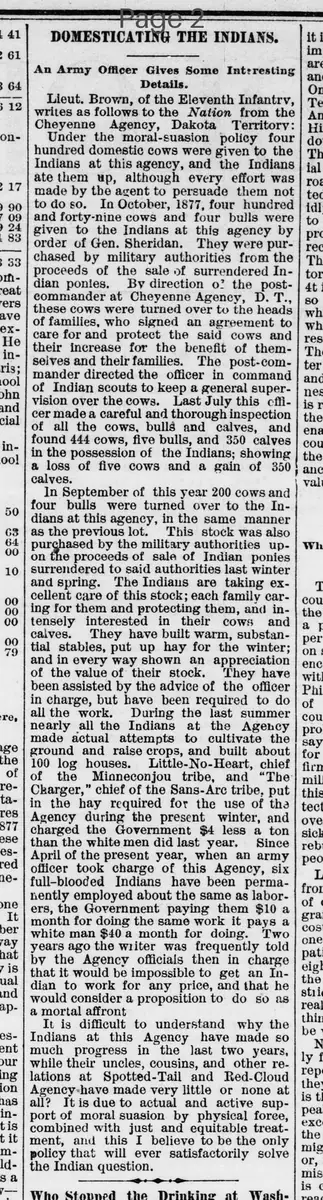
DOMESTICATING THE INDIANS.
An Army Officer Gives Some Interesting Details.
Lieut. Brown, of the Eleventh Infantry, writes as follows to the Nation from the Cheyenne Agency, Dakota Territory:
Under the moral-suasion policy four hundred domestic cows were given to the Indians at this agency, and the Indians ate them up, although every effort was made by the agent to persuade them not to do so. In October, 1877, four hundred and forty-nine cows and four bulls were given to the Indians at this agency by order of Gen. Sheridan. They were purchased by military authorities from the proceeds of the sale of surrendered Indian ponies. By direction of the post-commander at Cheyenne Agency, D. T., these cows were turned over to the heads of families, who signed an agreement to care for and protect the said cows and their increase for the benefit of themselves and their families. The post-commander directed the officer in command of Indian scouts to keep a general supervision over the cows. Last July this officer made a careful and thorough inspection of all the cows, bulls and calves, and found 444 cows, five bulls, and 350 calves in the possession of the Indians; showing a loss of five cows and a gain of 350 calves.
In September of this year 200 cows and four bulls were turned over to the Indians at this agency, in the same manner as the previous lot. This stock was also purchased by the military authorities upon the proceeds of sale of Indian ponies surrendered to said authorities last winter and spring. The Indians are taking excellent care of this stock; each family caring for them and protecting them, and intensely interested in their cows and calves. They have built warm, substantial stables, put up hay for the winter; and in every way shown an appreciation of the value of their stock. They have been assisted by the advice of the officer in charge, but have been required to do all the work. During the last summer nearly all the Indians at the Agency made actual attempts to cultivate the ground and raise crops, and built about 100 log houses. Little-No-Heart, chief of the Minneconjou tribe, and "The Charger," chief of the Sans-Arc tribe, put in the hay required for the use of the Agency during the present winter, and charged the Government $4 less a ton than the white men did last year. Since April of the present year, when an army officer took charge of this Agency, six full-blooded Indians have been permanently employed about the same as laborers, the Government paying them $10 a month for doing the same work it pays a white man $40 a month for doing. Two years ago the writer was frequently told by the Agency officials then in charge that it would be impossible to get an Indian to work for any price, and that he would consider a proposition to do so as a mortal affront.
It is difficult to understand why the Indians at this Agency have made so much progress in the last two years, while their uncles, cousins, and other relations at Spotted-Tail and Red-Cloud Agency have made very little or none at all? It is due to actual and active support of moral suasion by physical force, combined with just and equitable treatment, and this I believe to be the only policy that will ever satisfactorily solve the Indian question.
An Army Officer Gives Some Interesting Details.
Lieut. Brown, of the Eleventh Infantry, writes as follows to the Nation from the Cheyenne Agency, Dakota Territory:
Under the moral-suasion policy four hundred domestic cows were given to the Indians at this agency, and the Indians ate them up, although every effort was made by the agent to persuade them not to do so. In October, 1877, four hundred and forty-nine cows and four bulls were given to the Indians at this agency by order of Gen. Sheridan. They were purchased by military authorities from the proceeds of the sale of surrendered Indian ponies. By direction of the post-commander at Cheyenne Agency, D. T., these cows were turned over to the heads of families, who signed an agreement to care for and protect the said cows and their increase for the benefit of themselves and their families. The post-commander directed the officer in command of Indian scouts to keep a general supervision over the cows. Last July this officer made a careful and thorough inspection of all the cows, bulls and calves, and found 444 cows, five bulls, and 350 calves in the possession of the Indians; showing a loss of five cows and a gain of 350 calves.
In September of this year 200 cows and four bulls were turned over to the Indians at this agency, in the same manner as the previous lot. This stock was also purchased by the military authorities upon the proceeds of sale of Indian ponies surrendered to said authorities last winter and spring. The Indians are taking excellent care of this stock; each family caring for them and protecting them, and intensely interested in their cows and calves. They have built warm, substantial stables, put up hay for the winter; and in every way shown an appreciation of the value of their stock. They have been assisted by the advice of the officer in charge, but have been required to do all the work. During the last summer nearly all the Indians at the Agency made actual attempts to cultivate the ground and raise crops, and built about 100 log houses. Little-No-Heart, chief of the Minneconjou tribe, and "The Charger," chief of the Sans-Arc tribe, put in the hay required for the use of the Agency during the present winter, and charged the Government $4 less a ton than the white men did last year. Since April of the present year, when an army officer took charge of this Agency, six full-blooded Indians have been permanently employed about the same as laborers, the Government paying them $10 a month for doing the same work it pays a white man $40 a month for doing. Two years ago the writer was frequently told by the Agency officials then in charge that it would be impossible to get an Indian to work for any price, and that he would consider a proposition to do so as a mortal affront.
It is difficult to understand why the Indians at this Agency have made so much progress in the last two years, while their uncles, cousins, and other relations at Spotted-Tail and Red-Cloud Agency have made very little or none at all? It is due to actual and active support of moral suasion by physical force, combined with just and equitable treatment, and this I believe to be the only policy that will ever satisfactorily solve the Indian question.
What sub-type of article is it?
Historical Event
Biography
What themes does it cover?
Triumph
Justice
Moral Virtue
What keywords are associated?
Indian Domestication
Cattle Distribution
Agricultural Progress
Moral Suasion
Cheyenne Agency
What entities or persons were involved?
Lieut. Brown
Gen. Sheridan
Little No Heart
The Charger
Where did it happen?
Cheyenne Agency, Dakota Territory
Story Details
Key Persons
Lieut. Brown
Gen. Sheridan
Little No Heart
The Charger
Location
Cheyenne Agency, Dakota Territory
Event Date
October 1877 To Present Year
Story Details
Lieut. Brown reports on the success of providing cows to Cheyenne Indians, leading to their care of livestock, building stables, hay production, crop cultivation, log house construction, and employment, attributed to moral suasion backed by physical force and equitable treatment.