Thank you for visiting SNEWPapers!
Sign up free
Virginia Argus
Richmond, Virginia
What is this article about?
J.B. Colvin publishes a defense against public insinuations of misconduct in a chancery suit over his grandfather William Andrews' estate. He details receiving a bond from Dr. John Simpson, attempting to sell it, and exposing potential fraud by filing documents in court, asserting his honorable conduct. Includes testimony, letters from Simpson, and a postscript on his acquittal in an unrelated insolvency trial.
Merged-components note: This is a single letter to the editor continued across pages and split into two components due to parsing; merging for coherent logical unit.
Clippings
1 of 2
OCR Quality
Full Text
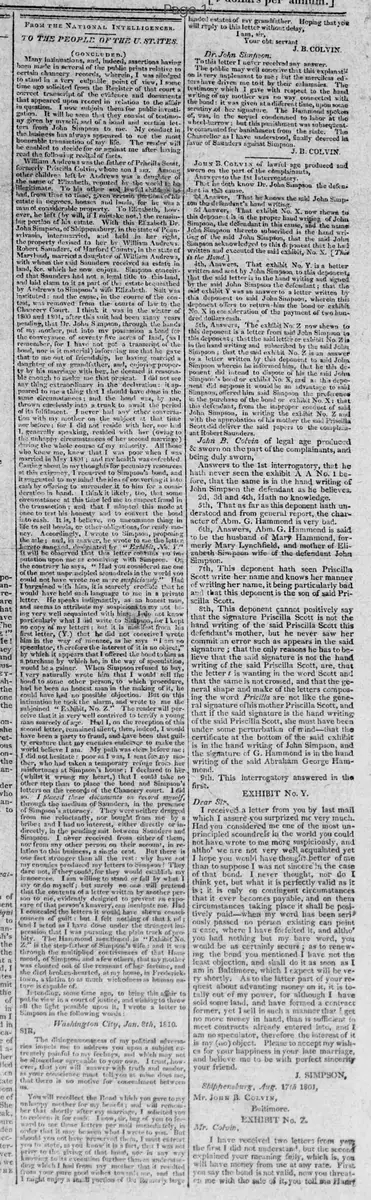
TO THE PEOPLE OF THE U. STATES.
(Concluded.)
Many insinuations, and, indeed, assertions having been made in several of the public prints relative to certain chancery records, wherein, I was alleged to stand in a very culpable, point of view, I some time ago solicited from the Register of that court a correct transcript of the evidence and documents that appeared upon record in relation to the affair in question. I now subjoin them for public investigation. It will be seen that they consist of testimony given by myself, and of a bond and certain letters from John Simpson to me. My conduct in the business has always appeared to me the most honorable transaction of my life. The reader will be enabled to decide for or against me after having read the following recital of facts.
William Andrews was the father of Priscilla Scott, formerly Priscilla Colvin, whose son I am. Among other children left by Andrews was a daughter of the name of Elizabeth, reputed by the world to be illegitimate. To his other and lawful children he had, from time to time, given certain portions of his estate in negroes, houses and lands, for he was a man of considerable property. To Elizabeth, however, he left (by will, if I mistake not,) the remaining portion of his estate. With this Elizabeth Dr. John Simpson, of Shippensburg, in the state of Pennsylvania, intermarried, and held in her right, the property devised to her by William Andrews.
Robert Saunders, of Harford County, in the state of Maryland, married a daughter of William Andrews, with whom the said Saunders received an estate in land, &c. which he now enjoys. Simpson conceived that Saunders had not a legal title to this land, and laid claim to it as part of the estate bequeathed by Andrews to Simpson's wife Elizabeth. Suit was instituted: and the cause, in the course of the contest, was removed from the courts of law to the Chancery Court. I think it was in the winter of 1800 and 1801, after this suit had been many years pending, that Dr. John Simpson, through the hands of my mother, put into my possession a bond for the conveyance of seventy five acres of land, (as I remember, for I have not got a transcript of the bond, nor is it material) informing me that he gave that to me out of friendship, he having married a daughter of my grandfather, and, enjoying property by his marriage with her, he deemed it reasonable enough to make me that present. I did not see any thing extraordinary in the declaration: it appeared to me a thing that I should have done in the same circumstances; and the bond was, by me, thrown carelessly into a trunk to await the period of its fulfillment. I never had any other conversation with my mother on the subject at that time nor before; for I did not reside with her, nor had I, generally speaking, resided with her (owing to the unhappy circumstances of her second marriage) during the whole course of my minority. All those who knew me, knew that I was poor when I was married in May 1801: and my health was enfeebled. Casting about in my thoughts for pecuniary resources at this exigency, I recurred to Simpson's bond, and it suggested to my mind the idea of converting it into cash by offering to surrender it to him for a consideration in hand. I think it likely, too, that some circumstance at this time led me to suspect fraud in the transaction; and that I adopted this mode at once to test his honesty and to convert the bond into cash. It is, I believe, no uncommon thing in life to sell bonds, or other obligations, for ready money. Accordingly, I wrote to Simpson, proposing the sale; and, in answer, he wrote to me the letter hereto annexed, designated by "Exhibit, No. Y."
It will be observed that this letter contains no imputation upon me as conniving with Simpson. On the contrary he says, "Had you considered me one of the most unprincipled scoundrels in the world you could not have wrote me more suspiciously." Had I bargained with him, it is scarcely credible that he would have held such language to me in a private letter. He speaks indignantly, as an honest man, and seems to attribute my suspicions to my not being very well acquainted with him. I do not know particularly what I did write to Simpson, for I kept no copy of my letters; but it is manifest from his first letter, (Y.) that he did not conceive I wrote him in the way of menace, as he says "I am no speculator, therefore the interest of it is no object," by which it appears that I offered the bond to him as a purchase by which he, in the way of speculation, would be a gainer. When Simpson refused to buy, I very naturally wrote him that I would sell the bond to some other person, to which procedure, had he been an honest man in the making of it, he could have had no possible objection. But on this intimation he took the alarm, and wrote to me the subjoined "Exhibit, No. Z." The reader will perceive that it is very well contrived to terrify a young man scarcely of age. Had I, on the reception of this second letter, remained silent, then, indeed, I would have been a party to fraud, and have been that guilty creature that my enemies endeavor to make the world believe I am. My path was clear before me; I did not hesitate: poor as I was, I sent for my mother, who had taken a temporary refuge from her misfortunes at Simpson's house; I declared to her (whilst it wrung my heart,) that I could take no other step than to place the bond and Simpson's letters on the records of the Chancery court. I did so. I placed these documents on record myself, through the medium of Saunders, in the presence of Simpson's attorney. They were neither dragged from me reluctantly, nor bought from me by a bribe: and I had no interest, either directly or indirectly, in the pending suit between Saunders and Simpson. I never received from either of them, nor from any other person on their account, in relation to this business, a single cent. But there is one fact stronger than all the rest: why have not my enemies produced my letters to Simpson? They dare not, if they could, for they would establish my innocence. I am willing to stand or fall by what I say or do myself; but surely no one will pretend that the contents of a letter written by another person to me, evidently designed to prevent an exposure of that person's knavery, can inculpate me. Had I concealed the letters it would have shewn consciousness of guilt : but I felt nothing of that kind; and I acted as I have done under the strongest impression that I was pursuing the plain track of probity. The Hammond mentioned in "Exhibit No. Z." is the step-father of Simpson's wife : and it was through the multiplied contrivances of that Hammond, of Simpson, and a few others, that my mother was cheated out of the remnant of her fortune, and she died broken-hearted, at my house, in Fredericktown, a victim to as much wickedness as human nature is capable of.
Intending, some time ago, to bring this affair to public view in a court of justice, and wishing to throw all the light possible upon it, I wrote a letter to Simpson in the following words:
Washington City, Jan. 8th, 1810.
SIR,
The disingenuousness of my political adversaries impels me to address you upon a subject extremely painful to my feelings, and which may not be altogether agreeable to your own. I trust, however, that you will answer with truth and candor, as your conscience must tell you as mine does me, that there is no motive for concealment between us.
You will recollect the Bond which you gave to my unhappy mother for my benefit; and will remember that shortly after my marriage, I solicited you to certain it for cash. I now, sir, beg of you to forward to me those letters per mail immediately, in order that it may be seen what I wrote to you. But should you not have preserved them, I must entreat you to state, as you know it is a fact, that I was not privy to the giving of that bond, nor in any way knowing to its execution further than an understanding which I had from my mother that it resulted from your pure good wishes towards me, and that I might enjoy a small portion of the fancy large landed estates of my grandfather. Hoping that you will reply to this letter without delay,
I am, sir,
Your obt. servant
J. B. COLVIN.
Dr. John Simpson.
To this letter I never received any answer.
The public may well conceive that this explanation is very unpleasant to me; but the merciless editors have driven me to it by their calumnies. The testimony which I gave with respect to the hand writing of my mother was no way connected with the bond: it was given at a different time, upon some scrutiny of her signature. The Hammond spoken of, was, in the sequel condemned to labor at the wheel-barrow: but this punishment was subsequently commuted for banishment from the state. The Chancellor as I have understood, finally decreed in favor of Saunders against Simpson.
J. B. COLVIN.
John B. Colvin of lawful age produced and sworn on the part of the complainants,
Answers to the 1st Interrogatory.
That he doth know Dr. John Simpson the defendant in this cause.
2d Answer, That he knows the said John Simpson the defendant's hand writing.
3d Answer, That exhibit No. X. now shewn to this deponent is in the proper hand writing of John Simpson, the defendant in this cause, and the name John Simpson thereto subscribed is the hand writing of the said John Simpson, that the said John Simpson acknowledged to this deponent that he had written and executed the said exhibit, No. X. [This is the Bond.]
4th, Answers, That exhibit No. Y. is a letter written and sent by John Simpson to this deponent that the said letter is in the hand writing and signed by the said John Simpson the defendant; that the said exhibit Y was an answer to a letter written by this deponent to said John Simpson, wherein this deponent offers to return—him the bond or exhibit No. X in consideration of the payment of two hundred dollars cash.
5th, Answers, The exhibit No. Z now shewn to this deponent is a letter from said John Simpson to this deponent; that the said letter or exhibit No. Z is in the hand writing and subscribed by the said John Simpson; that the said exhibit No. Z is an answer to a letter written by this deponent to said John Simpson wherein he informed him, that he this deponent did intend to dispose of his the said John Simpson's bond or exhibit No. X, and as this deponent did suppose it would be an advantage to said Simpson, offered him said Simpson the preference in the purchase of the bond or exhibit No. X: that this defendant, from the improper conduct of said John Simpson, in writing the exhibit No. Z and with the approbation of his mother the said Priscilla Scott did deliver the said papers to the complainant Robert Saunders.
John B. Colvin of legal age produced & sworn on the part of the complainants, and being duly sworn,
Answers to the 1st interrogatory, that he hath never seen the exhibit A A No. I before, that the same is in the hand writing of John Simpson the defendant as he believes.
2d, 3d and 4th, Hath no knowledge.
5th, That as far as this deponent hath understood and from general report, the character of Abm. G. Hammond is very bad.
6th, Answers, Abm. G. Hammond is said to be the husband of Mary Hammond, formerly Mary Lynchfield, and mother of Elizabeth Simpson wife of the defendant John Simpson.
7th, This deponent hath seen Priscilla Scott write her name and knows her manner of writing her name, it being particularly bad and that this deponent is the son of said Priscilla Scott.
8th, This deponent cannot positively say that the signature Priscilla Scott is not the hand writing of the said Priscilla Scott this defendant's mother, but he never saw her commit an error such as appears in the said signature ; that the only reasons he has to believe that the said signature is not the hand writing of the said Priscilla Scott, are, that the letter t is wanting in the word Scott and that the same is not crossed, and that the general shape and make of the letters composing the word Priscilla are not like the general signature of his mother Priscilla Scott, and that if the said signature is the hand writing of the said Priscilla Scott, she must have been under some perturbation of mind—that the certificate at the bottom of the said exhibit is in the hand writing of John Simpson, and the signature of G. Hammond is in the hand writing of the said Abraham George Hammond.
9th. This interrogatory answered in the first.
EXHIBIT No. Y.
Dear Sir
I received a letter from you by last mail which I assure you surprized me very much. Had you considered me one of the most unprincipled scoundrels in the world you could not have wrote to me more suspiciously, and altho' we are not very well acquainted yet I hope you would have thought better of me than to suppose I was not sincere in the case of that bond. I never thought, nor do I think yet, but what it is perfectly valid as it is; it is only on contingent circumstances that it ever becomes payable, and on them circumstances taking place it shall be positively paid—when my word has been seriously passed no person existing can point a case, where I have forfeited it, and altho' you had nothing but my bare word, you would be as certainly secure; as to renewing the bond you mentioned I have not the least objection, and shall do it as soon as I am in Baltimore, which I expect will be very shortly. As to the latter part of your request about advancing money on it, it is totally out of my power, for although I have sold some land, and have formed a contract former, yet I sell in such a manner that get no more money in hand, than is sufficient to meet contracts already entered into, and I am no speculator, therefore the interest of it is my (no) object. Please to accept my wishes for your happiness in your late marriage, and believe me to be with perfect sincerity
your friend.
J. SIMPSON
Shippensburg, Aug. 17th 1801,
Mr. John B. Colvin,
Baltimore.
EXHIBIT No. Z.
Mr. Colvin,
I have received two letters from you the first I did not understand, but the second explained your meaning fully, which is, you will have money from me at any rate. First you say the bond is not valid, now you threaten me with the sale of it, you tell me Hammond
Monday and I am in collusion, I tell you that it is more probable that he and you are in collusion. Was not every thing that was done about that business at the particular request of you and your mother, and pray how is my interest connected with Hammonds? Exactly in the same way that I am connected with you and every other person who has ever done any thing for me in Maryland, by paying an extravagant price for it all, or obligating myself so to do--you ask if I expect you to keep the bond until it becomes due that I deceive myself one thing I am sure not deceived, that I shall not pay it twice, and I do not conceive it will be more expensive to pay it to another than to you, but you seem to think I must pay it to you whether I will or not. In this let me tell you you deceive yourself, and grossly too. You seem to think I cannot do without your mother's testimony, and that it is of essential importance to me. In this you are wrong; you never knew for what purpose I wanted her testimony, nor does she understand it herself; neither would I ever have told any of you, but it seems necessary to inform you to prevent you running yourself into infamy, and such difficulties that it will be impossible to extricate you from. The real intention on my part was to make her testimony good for nothing, which is done, she having already sworn on both sides of the question.
Now you expose my bond for sale, the thing becomes public, it must and will be considered as a bribe, for which she has perjured herself. To prevent any consequence of this kind was my inducement for exacting a promise from you of keeping this thing an inviolate secret, and which you promised your sacred honor to perform--it was a measure I disliked in every stage, but your characters and interest being both connected with keeping the secret and your most positive promises so to do. I thought you might be trusted without risk to yourselves, but it appears as if avarice was superior to every other consideration with you, and that without looking forward at all. Would you have a little patience, the business is in such train that it cannot be long until you will get the money, but such imprudence on your part may put it off to a later period, how do you suppose that in justice to myself I can pay any more money, when there is any uncertainty, that I may never get any thing in return for it, and you will positively receive more clear profit on the final issue of this business than I shall. This suit has already cost me upwards of four hundred dollars, and will yet cost me a sum I cannot calculate besides a great loss of time. What you get you get clear and that without trouble or expense.
Had you me in your power in such manner that you could force money from me in this way, would it not amount to absolute robbery, and do I deserve it at your hand in any respect. I have felt myself under obligations to your mother for her friendship, but if she is privy to this business it is well calculated to cancel them all. I shall be in Baltimore in two or three weeks, and hope in the mean time you will think more prudently about this business, otherwise you must make your best of it, and I shall never have any connection with either of you again.
Yours, &c.
J. SIMPSON.
Mr. John B. Colvin, Printer,
Baltimore.
True Copy from the testimony of John B. Colvin, in a suit Robert Saunders and wife vs. John Simpson and wife and the exhibits Y Z filed in the same cause.
Test,
NICHOLAS BREWER, Reg. Cur. Can.
P.S. Since the preceding was prepared for the press, I have seen the Federal Republican of the 6th inst. It contains a copy of the presentment against me at June term, 1810, tried in the circuit court for this district. The true answer to this publication is, that there is no law to support such a presentment; that it only alleges that I got in debt and could not pay; that it was my own voluntary act to go to trial instanter on the morality of the charge; that five or six, at least, of the grand jury were my creditors; that all the witnesses mentioned in the presentment, except one, were my creditors; that not one single witness proved any thing except that I owed him and did not (because I could not) pay him; that not a single allegation was made of my having been guilty of fraud in taking the benefit of the insolvent law; that several respectable federal witnesses testified in my favor; that the petit jury was composed partly of federalists; that I did not except to a single witness or a single juror, and that I was honorably acquitted without hesitation; that not a single voice in Court was against me--not one but considered it a malignant prosecution; that I was a clerk in Robert Smith's office at the time of the trial, continued there till he left it, and continue there still; that in June last I was admitted attorney in the very court and by the very judges before whom I was tried; that since my acquittal I have been gradually paying my old debts, receipts for which payments I have now in my possession to show; and that I defy any respectable man to disprove, under his name, and with fair evidence, the statement which this postscript contains.
L.B.C.
What sub-type of article is it?
What themes does it cover?
What keywords are associated?
What entities or persons were involved?
Letter to Editor Details
Author
J. B. Colvin
Recipient
To The People Of The U. States.
Main Argument
j.b. colvin asserts his conduct regarding a bond from dr. john simpson was honorable, denying involvement in fraud and explaining his decision to file documents in chancery court to expose simpson's potential knavery, driven by political adversaries' calumnies.
Notable Details