Thank you for visiting SNEWPapers!
Sign up free
Domestic News
October 3, 1811
Virginia Argus
Richmond, Virginia
What is this article about?
The Connecticut Agricultural Society publishes detailed instructions on making superior cider, covering fruit selection and sorting by color and ripeness, grinding, pressing, fermentation management, and storage to preserve sweetness for years.
Clipping
OCR Quality
98%
Excellent
Full Text
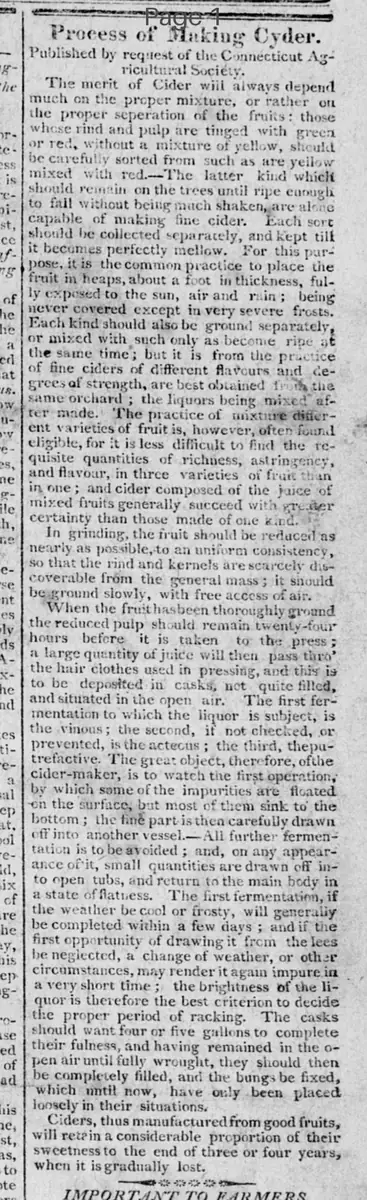
Process of Making Cyder.
Published by request of the Connecticut Agricultural Society.
The merit of Cider will always depend much on the proper mixture, or rather on the proper separation of the fruits: those whose rind and pulp are tinged with green or red, without a mixture of yellow, should be carefully sorted from such as are yellow mixed with red.—The latter kind which should remain on the trees until ripe enough to fall without being much shaken, are alone capable of making fine cider. Each sort should be collected separately, and kept till it becomes perfectly mellow. For this purpose, it is the common practice to place the fruit in heaps, about a foot in thickness, fully exposed to the sun, air and rain; being never covered except in very severe frosts.
Each kind should also be ground separately, or mixed with such only as become ripe at the same time; but it is from the practice of fine ciders of different flavours and degrees of strength, are best obtained from the same orchard; the liquors being mixed after made. The practice of mixture different varieties of fruit is, however, often found eligible, for it is less difficult to find the requisite quantities of richness, astringency, and flavour, in three varieties of fruit than in one; and cider composed of the juice of mixed fruits generally succeed with greater certainty than those made of one kind.
In grinding. the fruit should be reduced as nearly as possible,—to an uniform consistency, so that the rind and kernels are scarcely discoverable from the general mass; it should be ground slowly, with free access of air.
When the fruit has been thoroughly ground the reduced pulp should remain twenty-four hours before it is taken to the press; a large quantity of juice will then pass thro' the hair clothes used in pressing, and this is to be deposited in casks, not quite filled, and situated in the open air. The first fermentation to which the liquor is subject, is the vinous; the second, if not checked, or prevented, is the acetous; the third, the putrefactive. The great object, therefore, of the cider-maker, is to watch the first operation, by which some of the impurities are floated on the surface, but most of them sink to the bottom; the fine part is then carefully drawn off into another vessel. All further fermentation is to be avoided; and, on any appearance of it, small quantities are drawn off into open tubs, and return to the main body in a state of flatness. The first fermentation, if the weather be cool or frosty, will generally be completed within a few days ; and if the first opportunity of drawing it from the lees be neglected, a change of weather, or other circumstances, may render it again impure in a very short time ; the brightness of the liquor is therefore the best criterion to decide the proper period of racking. The casks should want four or five gallons to complete their fulness, and having remained in the open air until fully wrought, they should then be completely filled, and the bungs be fixed, which until now, have only been placed loosely in their situations.
Ciders, thus manufactured from good fruits, will retain a considerable proportion of their sweetness to the end of three or four years, when it is gradually lost.
Published by request of the Connecticut Agricultural Society.
The merit of Cider will always depend much on the proper mixture, or rather on the proper separation of the fruits: those whose rind and pulp are tinged with green or red, without a mixture of yellow, should be carefully sorted from such as are yellow mixed with red.—The latter kind which should remain on the trees until ripe enough to fall without being much shaken, are alone capable of making fine cider. Each sort should be collected separately, and kept till it becomes perfectly mellow. For this purpose, it is the common practice to place the fruit in heaps, about a foot in thickness, fully exposed to the sun, air and rain; being never covered except in very severe frosts.
Each kind should also be ground separately, or mixed with such only as become ripe at the same time; but it is from the practice of fine ciders of different flavours and degrees of strength, are best obtained from the same orchard; the liquors being mixed after made. The practice of mixture different varieties of fruit is, however, often found eligible, for it is less difficult to find the requisite quantities of richness, astringency, and flavour, in three varieties of fruit than in one; and cider composed of the juice of mixed fruits generally succeed with greater certainty than those made of one kind.
In grinding. the fruit should be reduced as nearly as possible,—to an uniform consistency, so that the rind and kernels are scarcely discoverable from the general mass; it should be ground slowly, with free access of air.
When the fruit has been thoroughly ground the reduced pulp should remain twenty-four hours before it is taken to the press; a large quantity of juice will then pass thro' the hair clothes used in pressing, and this is to be deposited in casks, not quite filled, and situated in the open air. The first fermentation to which the liquor is subject, is the vinous; the second, if not checked, or prevented, is the acetous; the third, the putrefactive. The great object, therefore, of the cider-maker, is to watch the first operation, by which some of the impurities are floated on the surface, but most of them sink to the bottom; the fine part is then carefully drawn off into another vessel. All further fermentation is to be avoided; and, on any appearance of it, small quantities are drawn off into open tubs, and return to the main body in a state of flatness. The first fermentation, if the weather be cool or frosty, will generally be completed within a few days ; and if the first opportunity of drawing it from the lees be neglected, a change of weather, or other circumstances, may render it again impure in a very short time ; the brightness of the liquor is therefore the best criterion to decide the proper period of racking. The casks should want four or five gallons to complete their fulness, and having remained in the open air until fully wrought, they should then be completely filled, and the bungs be fixed, which until now, have only been placed loosely in their situations.
Ciders, thus manufactured from good fruits, will retain a considerable proportion of their sweetness to the end of three or four years, when it is gradually lost.
What sub-type of article is it?
Agriculture
What keywords are associated?
Cider Making
Apple Sorting
Fermentation Process
Connecticut Agriculture
What entities or persons were involved?
Connecticut Agricultural Society
Where did it happen?
Connecticut
Domestic News Details
Primary Location
Connecticut
Key Persons
Connecticut Agricultural Society
Event Details
Instructions on selecting, sorting, grinding, pressing, fermenting, and storing apples to produce high-quality cider that retains sweetness for years.