Thank you for visiting SNEWPapers!
Sign up free
The Laurens Advertiser
Laurens, Laurens County, South Carolina
What is this article about?
Agricultural report from Tallulah, La., in March 1923 predicts lower boll weevil emergence due to winter cold snaps, offering hope for reduced damage to cotton crop; includes historical data table and notes on government research and poison warnings.
Merged-components note: The table provides data integral to the agricultural news article on boll weevil emergence; merging table into domestic_news as it supports the narrative on local farming conditions.
Clipping
OCR Quality
Full Text
(By N. L. Willett)
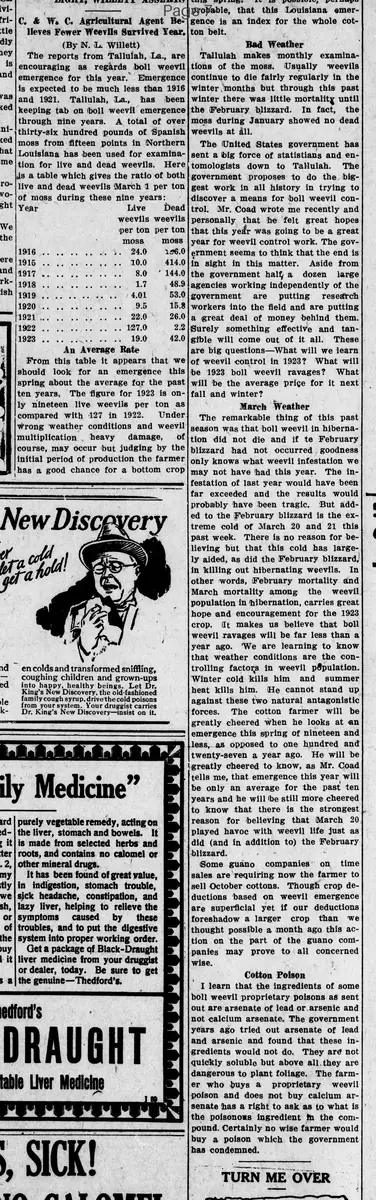
The reports from Tallulah, La., are encouraging as regards boll weevil emergence for this year. Emergence is expected to be much less than 1916 and 1921. Tallulah, La., has been keeping tab on boll weevil emergence through nine years. A total of over thirty-six hundred pounds of Spanish moss from fifteen points in Northern Louisiana has been used for examination for live and dead weevils. Here is a table which gives the ratio of both live and dead weevils March 1 per ton of moss during these nine years:
An Average Rate 1 :
From this table it appears that we should look for an emergence this spring about the average for the past ten years. The figure for 1923 is only nineteen live weevils per ton as compared with 127 in 1922. Under wrong weather conditions and weevil multiplication, heavy damage, of course, may occur but judging by the initial period of production the farmer has a good chance for a bottom crop.
Tallulah makes monthly examinations of the moss. Usually weevils continue to die fairly regularly in the winter months but through this past winter there was little mortality until the February blizzard. In fact, the moss during January showed no dead weevils at all.
The United States government has sent a big force of statisticians and entomologists down to Tallulah. The government proposes to do the biggest work in all history in trying to discover a means for boll weevil control. Mr. Coad wrote me recently and personally that he felt great hopes that this year was going to be a great year for weevil control work. The government seems to think that the end is in sight in this matter. Aside from the government half a dozen large agencies working independently of the government are putting research workers into the field and are putting a great deal of money behind them. Surely something effective and tangible will come out of it all. These are big questions-What will we learn of weevil control in 1923? What will be 1923 boll weevil ravages? What will be the average price for it next fall and winter?
March Weather
The remarkable thing of this past season was that boll weevil in hibernation did not die and if the February blizzard had not occurred goodness only knows what weevil infestation we may not have had this year. The infestation of last year would have been far exceeded and the results would probably have been tragic. But added to the February blizzard is the extreme cold of March 20 and 21 this past week. There is no reason for believing but that this cold has largely aided, as did the February blizzard, in killing out hibernating weevils. In other words, February mortality and March mortality among the weevil population in hibernation, carries great hope and encouragement for the 1923 crop. It makes us believe that boll weevil ravages will be far less than a year ago. We are learning to know that weather conditions are the controlling factors in weevil population. Winter cold kills him and summer heat kills him. He cannot stand up against these two natural antagonistic forces. The cotton farmer will be greatly cheered when he looks at an emergence this spring of nineteen and less, as opposed to one hundred and twenty-seven a year ago. He will be greatly cheered to know, as Mr. Coad tells me, that emergence this year will be only an average for the past ten years and he will be still more cheered to know that there is the strongest reason for believing that March 20 played havoc with weevil life just as did (and in addition to) the February blizzard.
Some guano companies' on time sales are requiring now the farmer to sell October cottons. Though crop deductions based on weevil emergence are superficial yet if our deductions foreshadow a larger crop than we thought possible a month ago this action on the part of the guano companies may prove to all concerned wise.
Cotton Poison
I learn that the ingredients of some boll weevil proprietary poisons as sent out are arsenate of lead or arsenic and not calcium arsenate. The government years ago tried out arsenate of lead and arsenic and found that these ingredients would not do. They are not quickly soluble but above all they are dangerous to plant foliage. The farmer who buys a proprietary weevil poison and does not buy calcium arsenate has a right to ask as to what is the poisonous ingredient in the compound. Certainly no wise farmer would buy a poison which the government has condemned.
TURN ME OVER
| Year | Live | Dead |
| weevils | weevils | weevils |
| per ton | per ton | per ton |
| moss | moss | moss |
| 1916 | 24.0 | 196.0 |
| 1915 | 10.0 | 414.0 |
| 1917 | 8.0 | 144.0 |
| 1918 | 1.7 | 48.9 |
| 1919 | 4.01 | 53.0 |
| 1920 | 9.5 | 15.8 |
| 1921 | 22.0 | 26.0 |
| 1922 | 127.0 | 2.2 |
| 1923 | 19.0 | 42.0 |
What sub-type of article is it?
What keywords are associated?
What entities or persons were involved?
Where did it happen?
Domestic News Details
Primary Location
Tallulah, La.
Event Date
March 1923
Key Persons
Outcome
fewer live boll weevils emerged in 1923 (19 per ton of moss) compared to 1922 (127 per ton), due to february blizzard and march cold, leading to hopes for reduced ravages and better cotton crop.
Event Details
Reports from Tallulah, La., indicate lower boll weevil emergence in 1923 than in 1916 and 1921, based on examinations of Spanish moss over nine years. Table shows live and dead weevils per ton of moss. Weather conditions, including February blizzard and March 20-21 cold, killed many hibernating weevils. U.S. government and agencies are researching control methods. Warnings about proprietary cotton poisons using arsenate of lead instead of calcium arsenate.