Thank you for visiting SNEWPapers!
Sign up free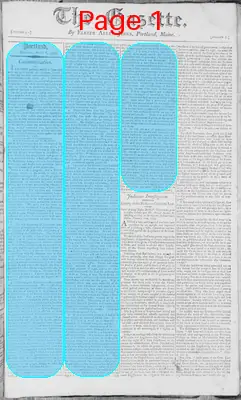
Editorial
April 8, 1799
The Gazette
Portland, Cumberland County, Maine
What is this article about?
An editorial communication denounces Jacobins as an incurable societal ulcer, tracing their opposition to U.S. federal policies from 1790, including debt funding, neutrality proclamation, and British treaty, led by figures like Madison and Genet.
Clipping
OCR Quality
95%
Excellent
Full Text
Portland,
MONDAY, APRIL 8, 1799.
Communication.
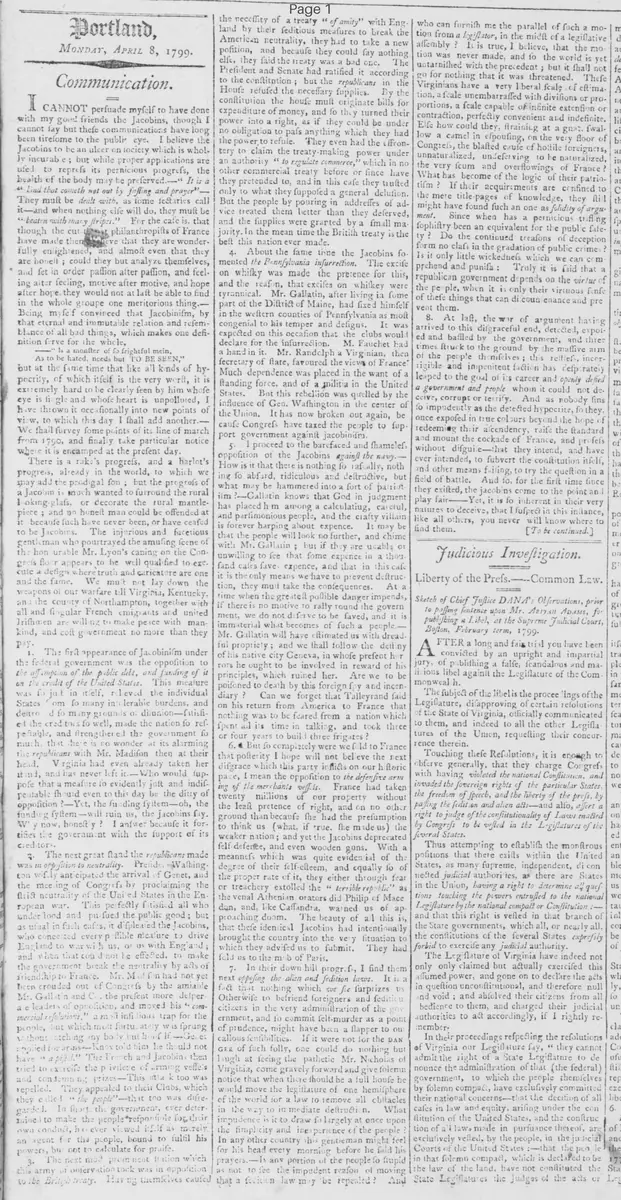
I CANNOT persuade myself to have done with my good friends the Jacobins, though I cannot but these communications have long been tiresome to the public eye. I believe the Jacobins to be an ulcer on society which is wholly incurable; but while proper applications are useful to repress its pernicious progress, the health of the body may be preserved. It is a kind that cometh not out by fasting and prayer—They must be dealt with, as some sectaries call it—and when nothing else will do, they must be beaten with many stripes. For the case is, that though the canting as philanthropists of France have made them believe that they are wonderfully enlightened, and almost even that they are honest; could they but analyze themselves, and set in order passion after passion, and feeling after feeling, motive after motive, and hope after hope, they would not at last be able to find in the whole group one meritorious thing.—Being myself convinced that Jacobinism, by that eternal and immutable relation and resemblance of all bad things, which makes one definition serve for the whole,
"is a monster of so frightful mein,
As to be hated, needs but TO BE SEEN,"
out at the same time that like all kinds of hypocrisy, of which itself is the very worst, it is extremely hard to be clearly seen by him whose eye is single and whose heart is unpolluted, I have thrown it occasionally into new points of view, to which this day I shall add another.—We shall survey some points of its line of march from 1790, and finally take particular notice where it is encamped at the present day.
There is a rake's progress, and a harlot's progress, already in the world, to which we may add the prodigal son; but the progress of a Jacobin is much wanted to surround the rural looking-glass, or decorate the rural mantle piece; and no honest man could be offended at it because such have never been, or have ceased to be Jacobins. The injurious and facetious gentleman who portrayed the amusing scene of the honourable Mr. Lyon's caning on the Congress floor appears to be well qualified to execute a design where truth and caricature are one and the same. We must not lay down the weapons of our warfare till Virginia, Kentucky, and the county of Northampton, together with all and singular French emigrants and united Irishmen are willing to make peace with mankind, and cost government no more than they pay.
1. The first appearance of Jacobinism under the federal government was the opposition to the assumption of the public debt, and funding of it on the credit of the United States. This measure was just in itself, relieved the individual States from so many intolerable burdens, and destroyed so many grounds of disunion—satisfied the creditors so well, made the nation so respectable, and strengthened the government so much, that there is no wonder at its alarming the republicans with Mr. Madison then at their head. Virginia had even already taken her stand, and has never left it.—Who would supposethat a measure so evidently just and indisputable should even to this day be the ditty of opposition?—Yet, the funding system—oh, the funding system—will ruin us, the jacobins say. Why now, honesty? I answer because it fortifies the government with the support of its creditors.
2. The next great stand the republicans made was in opposition to neutrality. President Washington wisely anticipated the arrival of Genet, and the meeting of Congress by proclaiming the strict neutrality of the United States in the European war. This perfectly satisfied all who understood and pursued the public good; but as usual in such cases, it displeased the Jacobins, who concerted every possible measure to drive England to war with us, or us with England; and when that could not be effected, to make the government break the neutrality by acts of friendship to France. Mr. Madison had not yet been crowded out of Congress by the amiable Mr. Gallatin and Co. the present more helpful leaders of opposition, and moved his "commercial resolutions." a most insidious trap for the people, but which most fortunately was sprung without touching any body but himself—Genet cooed it trans—Knox told him he should not have "appalled." The Irish and Jacobin, then tried to exercise the privilege of arming vessels and condemning prizes—This attack too was repelled. They appealed to their Clubs, which they called "the people"—this too was disregarded. Lastly of the government, ever determined to make the people responsible for their own conduct, but ever viewed itself as merely an agent for the people, bound to fulfil his powers, but not to calculate for praise.
3. The next prominent action which this army of observation took was in opposition to the British treaty. Faring themselves caused
MONDAY, APRIL 8, 1799.
Communication.
I CANNOT persuade myself to have done with my good friends the Jacobins, though I cannot but these communications have long been tiresome to the public eye. I believe the Jacobins to be an ulcer on society which is wholly incurable; but while proper applications are useful to repress its pernicious progress, the health of the body may be preserved. It is a kind that cometh not out by fasting and prayer—They must be dealt with, as some sectaries call it—and when nothing else will do, they must be beaten with many stripes. For the case is, that though the canting as philanthropists of France have made them believe that they are wonderfully enlightened, and almost even that they are honest; could they but analyze themselves, and set in order passion after passion, and feeling after feeling, motive after motive, and hope after hope, they would not at last be able to find in the whole group one meritorious thing.—Being myself convinced that Jacobinism, by that eternal and immutable relation and resemblance of all bad things, which makes one definition serve for the whole,
"is a monster of so frightful mein,
As to be hated, needs but TO BE SEEN,"
out at the same time that like all kinds of hypocrisy, of which itself is the very worst, it is extremely hard to be clearly seen by him whose eye is single and whose heart is unpolluted, I have thrown it occasionally into new points of view, to which this day I shall add another.—We shall survey some points of its line of march from 1790, and finally take particular notice where it is encamped at the present day.
There is a rake's progress, and a harlot's progress, already in the world, to which we may add the prodigal son; but the progress of a Jacobin is much wanted to surround the rural looking-glass, or decorate the rural mantle piece; and no honest man could be offended at it because such have never been, or have ceased to be Jacobins. The injurious and facetious gentleman who portrayed the amusing scene of the honourable Mr. Lyon's caning on the Congress floor appears to be well qualified to execute a design where truth and caricature are one and the same. We must not lay down the weapons of our warfare till Virginia, Kentucky, and the county of Northampton, together with all and singular French emigrants and united Irishmen are willing to make peace with mankind, and cost government no more than they pay.
1. The first appearance of Jacobinism under the federal government was the opposition to the assumption of the public debt, and funding of it on the credit of the United States. This measure was just in itself, relieved the individual States from so many intolerable burdens, and destroyed so many grounds of disunion—satisfied the creditors so well, made the nation so respectable, and strengthened the government so much, that there is no wonder at its alarming the republicans with Mr. Madison then at their head. Virginia had even already taken her stand, and has never left it.—Who would supposethat a measure so evidently just and indisputable should even to this day be the ditty of opposition?—Yet, the funding system—oh, the funding system—will ruin us, the jacobins say. Why now, honesty? I answer because it fortifies the government with the support of its creditors.
2. The next great stand the republicans made was in opposition to neutrality. President Washington wisely anticipated the arrival of Genet, and the meeting of Congress by proclaiming the strict neutrality of the United States in the European war. This perfectly satisfied all who understood and pursued the public good; but as usual in such cases, it displeased the Jacobins, who concerted every possible measure to drive England to war with us, or us with England; and when that could not be effected, to make the government break the neutrality by acts of friendship to France. Mr. Madison had not yet been crowded out of Congress by the amiable Mr. Gallatin and Co. the present more helpful leaders of opposition, and moved his "commercial resolutions." a most insidious trap for the people, but which most fortunately was sprung without touching any body but himself—Genet cooed it trans—Knox told him he should not have "appalled." The Irish and Jacobin, then tried to exercise the privilege of arming vessels and condemning prizes—This attack too was repelled. They appealed to their Clubs, which they called "the people"—this too was disregarded. Lastly of the government, ever determined to make the people responsible for their own conduct, but ever viewed itself as merely an agent for the people, bound to fulfil his powers, but not to calculate for praise.
3. The next prominent action which this army of observation took was in opposition to the British treaty. Faring themselves caused
What sub-type of article is it?
Partisan Politics
Foreign Affairs
What keywords are associated?
Jacobinism
Federal Opposition
Debt Funding
Neutrality
British Treaty
Republicans
What entities or persons were involved?
Jacobins
Mr. Madison
President Washington
Genet
Mr. Gallatin
Mr. Lyon
Virginia
Kentucky
French Emigrants
United Irishmen
Editorial Details
Primary Topic
Critique Of Jacobin Opposition To Federal Policies
Stance / Tone
Strongly Anti Jacobin
Key Figures
Jacobins
Mr. Madison
President Washington
Genet
Mr. Gallatin
Mr. Lyon
Virginia
Kentucky
French Emigrants
United Irishmen
Key Arguments
Jacobins Are An Incurable Societal Ulcer Requiring Repression
Opposition To Public Debt Assumption And Funding System Fortifies Government
Neutrality Proclamation Opposed To Provoke War With England Or Aid France
British Treaty Opposed By Jacobins Fearing Loss Of Influence