Thank you for visiting SNEWPapers!
Sign up free
Literary
May 29, 1905
The Seattle Star
Seattle, King County, Washington
What is this article about?
The narrator, a spy disguised after an accident, converses with Napoleon and Talleyrand about bribing English politicians and the opposition's potential aid in revolution. He flatters the emperor, securing favor for his mission to England.
Merged-components note: These components form a single serialized literary story ('A Sword Mislaid'), split during initial parsing; merged in reading order for coherence.
Clipping
OCR Quality
95%
Excellent
Full Text
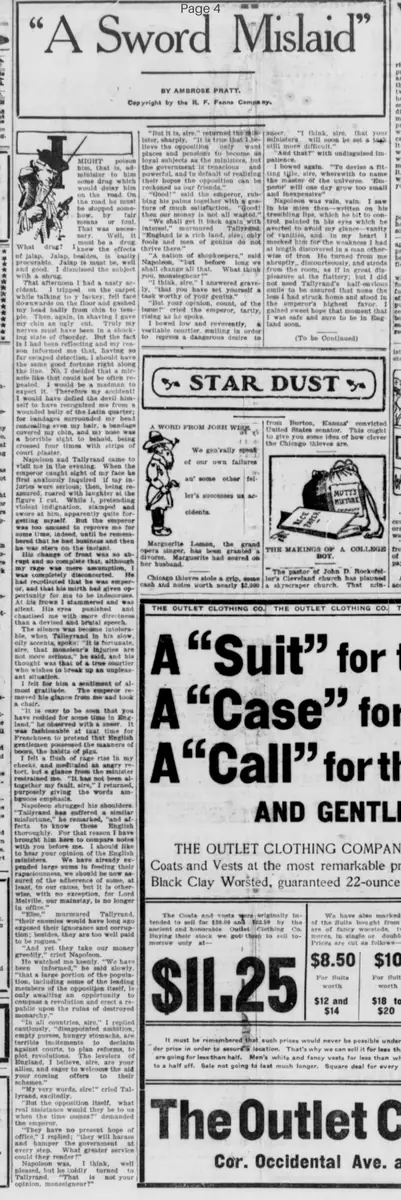
MIGHT poison him, that is, administer to him some drug which would delay him on the road. On the road he must be stopped somehow, by fair means or foul. That was necessary.
Well, it must be a drug. What drug? I knew the effects of jalap. Jalap, besides, is easily procurable. Jalap it must be, well and good, I dismissed the subject with a shrug.
That afternoon I had a nasty accident. I tripped on the carpet while talking to my lackey, fell face downwards on the floor and gashed my head badly from chin to temple. Then, again, in shaving I gave my chin an ugly cut. Truly my nerves must have been in a shocking state of disorder. Not the fact is I had been reflecting and my reason informed me that, having so far escaped detection, I should have the same good fortune right along the line. "No," I decided that a miracle like that could not be often repeated. I would be a madman to expect it. Therefore my accident!
I would have defied the devil himself to have recognized me from a wounded bully of the Latin quarter: for bandages surrounded my head concealing even my hair, a bandage covered my chin, and my nose was a horrible sight to behold, being crossed four times with strips of court plaster.
Napoleon and Talleyrand came to visit me in the evening. When the emperor caught sight of my face he first anxiously inquired if my injuries were serious; then, being reassured, roared with laughter at the figure I cut. While I, pretending violent indignation, stamped and swore at him, apparently quite forgetting myself. But the emperor was too amused to reprove me for some time, indeed, until he remembered that he had business and then he was stern on the instant.
His change of front was so abrupt and so complete that, although my rage was mere assumption, I was completely disconcerted. He had recollected that he was emperor, and that his mirth had given opportunity for me to be indecorous.
At his frown I stammered and was silent. His eyes punished and chastised me with more directness than a devised and brutal speech.
The silence was become intolerable, when Talleyrand in his slow, oily accents, spoke: "It is fortunate, sire, that monsieur's injuries are not more serious," he said, and his thought was that of a true courtier who wishes to break up an unpleasant situation.
I felt for him a sentiment of almost gratitude.
The emperor removed his glance from me and took a chair.
"It is easy to see that you have resided for some time in England," he observed with a sneer. It was fashionable at that time for Frenchmen to pretend that English gentlemen possessed the manners of boors, the habits of pigs.
I felt a flush of rage rise in my cheeks, and meditated an angry retort, but a glance from the minister restrained me. "It has not been altogether my fault, sire," I returned, purposely giving the words ambiguous emphasis.
Napoleon shrugged his shoulders.
"Talleyrand has suffered a similar misfortune," he remarked, "and affects to know these English thoroughly. For that reason I have brought him here to compare notes with you before me. I should like to hear your opinion of the English ministers.
We have already expended large sums in feeding their rapaciousness, we should be now assured of the adherence of some, at least, to our cause, but it is otherwise, with no exception, for Lord Melville, our mainstay, is no longer in office."
"Else," murmured Talleyrand, "their enemies would have long ago exposed their ignorance and corruption: besides, they are too well paid to be rogues."
"And yet they take our money greedily," cried Napoleon.
He watched me keenly. "We have been informed," he said slowly, "that a large portion of the population, including some of the leading members of the opposition itself, is only awaiting an opportunity to compass a revolution and erect a republic upon the ruins of destroyed monarchy."
"In all countries, sire," I replied cautiously, "disappointed ambition, empty purses, hungry stomachs, are terrible incitements to declaim against courts, to plan reforms, to plot revolutions.
The levelers of England, I believe, sire, are your allies, and eager to welcome the aid your coming offers to their schemes."
"My very words, sire!" cried Talleyrand, excitedly.
"But the opposition itself, what real assistance would they be to us when the time comes?" demanded the emperor.
"They have no present hope of office," I replied; "they will harass and hamper the government at every step. What greater service could they render?"
Napoleon was, I think, well pleased, but he coldly turned to Talleyrand.
"That is not your opinion, monseigneur?"
A Sword Mislaid
By AMBROSE PRATT
Copyright by the R.F. Fenno Company
"But it is, sire," returned the minister, sharply,
"It is true that I believe the opposition only want places and pensions to become as loyal subjects as the ministers, but the government is tenacious and powerful, and in default of realizing their hopes the opposition can be reckoned as our friends."
"Good!" said the emperor, rubbing his palms together with a gesture of much satisfaction.
"Good! then our money is not all wasted."
"We shall get it back again with interest," murmured Talleyrand.
"England is a rich land, sire; only fools and men of genius do not thrive there.
"A nation of shopkeepers," said Napoleon,
"but before long we shall change all that. What think you, monseigneur?"
"I think, sire," I answered gravely, "that you have set yourself a task worthy of your genius."
"But your opinion, count, of the issue?" cried the emperor, tartly, rising as he spoke.
I bowed low and reverently, a veritable courtier, managing in order to repress a dangerous desire to sneer.
"I think, sire, that your ministers will soon be set a task still more difficult."
"And that?" with undisguised impatience.
I bowed again.
"To devise a fitting title, sire, wherewith to name the master of the universe. 'Emperor' will one day grow too small and inexpensive."
Napoleon was vain, vain. I saw in his mien then - written on his trembling lips, which he bit to control, painted in his eyes which he averted to avoid my glance - vanity of vanities, and in my heart I mocked him for the weakness I had at length discovered in a man otherwise of iron.
He turned from me abruptly, discourteously, and strode from the room, as if in great displeasure at the flattery; but I did not need Talleyrand's half-envious smile to be assured that none the less I had struck home and stood in the emperor's highest favor. I gained sweet hope that moment that I was safe and sure to be in England soon.
(To be Continued)
Well, it must be a drug. What drug? I knew the effects of jalap. Jalap, besides, is easily procurable. Jalap it must be, well and good, I dismissed the subject with a shrug.
That afternoon I had a nasty accident. I tripped on the carpet while talking to my lackey, fell face downwards on the floor and gashed my head badly from chin to temple. Then, again, in shaving I gave my chin an ugly cut. Truly my nerves must have been in a shocking state of disorder. Not the fact is I had been reflecting and my reason informed me that, having so far escaped detection, I should have the same good fortune right along the line. "No," I decided that a miracle like that could not be often repeated. I would be a madman to expect it. Therefore my accident!
I would have defied the devil himself to have recognized me from a wounded bully of the Latin quarter: for bandages surrounded my head concealing even my hair, a bandage covered my chin, and my nose was a horrible sight to behold, being crossed four times with strips of court plaster.
Napoleon and Talleyrand came to visit me in the evening. When the emperor caught sight of my face he first anxiously inquired if my injuries were serious; then, being reassured, roared with laughter at the figure I cut. While I, pretending violent indignation, stamped and swore at him, apparently quite forgetting myself. But the emperor was too amused to reprove me for some time, indeed, until he remembered that he had business and then he was stern on the instant.
His change of front was so abrupt and so complete that, although my rage was mere assumption, I was completely disconcerted. He had recollected that he was emperor, and that his mirth had given opportunity for me to be indecorous.
At his frown I stammered and was silent. His eyes punished and chastised me with more directness than a devised and brutal speech.
The silence was become intolerable, when Talleyrand in his slow, oily accents, spoke: "It is fortunate, sire, that monsieur's injuries are not more serious," he said, and his thought was that of a true courtier who wishes to break up an unpleasant situation.
I felt for him a sentiment of almost gratitude.
The emperor removed his glance from me and took a chair.
"It is easy to see that you have resided for some time in England," he observed with a sneer. It was fashionable at that time for Frenchmen to pretend that English gentlemen possessed the manners of boors, the habits of pigs.
I felt a flush of rage rise in my cheeks, and meditated an angry retort, but a glance from the minister restrained me. "It has not been altogether my fault, sire," I returned, purposely giving the words ambiguous emphasis.
Napoleon shrugged his shoulders.
"Talleyrand has suffered a similar misfortune," he remarked, "and affects to know these English thoroughly. For that reason I have brought him here to compare notes with you before me. I should like to hear your opinion of the English ministers.
We have already expended large sums in feeding their rapaciousness, we should be now assured of the adherence of some, at least, to our cause, but it is otherwise, with no exception, for Lord Melville, our mainstay, is no longer in office."
"Else," murmured Talleyrand, "their enemies would have long ago exposed their ignorance and corruption: besides, they are too well paid to be rogues."
"And yet they take our money greedily," cried Napoleon.
He watched me keenly. "We have been informed," he said slowly, "that a large portion of the population, including some of the leading members of the opposition itself, is only awaiting an opportunity to compass a revolution and erect a republic upon the ruins of destroyed monarchy."
"In all countries, sire," I replied cautiously, "disappointed ambition, empty purses, hungry stomachs, are terrible incitements to declaim against courts, to plan reforms, to plot revolutions.
The levelers of England, I believe, sire, are your allies, and eager to welcome the aid your coming offers to their schemes."
"My very words, sire!" cried Talleyrand, excitedly.
"But the opposition itself, what real assistance would they be to us when the time comes?" demanded the emperor.
"They have no present hope of office," I replied; "they will harass and hamper the government at every step. What greater service could they render?"
Napoleon was, I think, well pleased, but he coldly turned to Talleyrand.
"That is not your opinion, monseigneur?"
A Sword Mislaid
By AMBROSE PRATT
Copyright by the R.F. Fenno Company
"But it is, sire," returned the minister, sharply,
"It is true that I believe the opposition only want places and pensions to become as loyal subjects as the ministers, but the government is tenacious and powerful, and in default of realizing their hopes the opposition can be reckoned as our friends."
"Good!" said the emperor, rubbing his palms together with a gesture of much satisfaction.
"Good! then our money is not all wasted."
"We shall get it back again with interest," murmured Talleyrand.
"England is a rich land, sire; only fools and men of genius do not thrive there.
"A nation of shopkeepers," said Napoleon,
"but before long we shall change all that. What think you, monseigneur?"
"I think, sire," I answered gravely, "that you have set yourself a task worthy of your genius."
"But your opinion, count, of the issue?" cried the emperor, tartly, rising as he spoke.
I bowed low and reverently, a veritable courtier, managing in order to repress a dangerous desire to sneer.
"I think, sire, that your ministers will soon be set a task still more difficult."
"And that?" with undisguised impatience.
I bowed again.
"To devise a fitting title, sire, wherewith to name the master of the universe. 'Emperor' will one day grow too small and inexpensive."
Napoleon was vain, vain. I saw in his mien then - written on his trembling lips, which he bit to control, painted in his eyes which he averted to avoid my glance - vanity of vanities, and in my heart I mocked him for the weakness I had at length discovered in a man otherwise of iron.
He turned from me abruptly, discourteously, and strode from the room, as if in great displeasure at the flattery; but I did not need Talleyrand's half-envious smile to be assured that none the less I had struck home and stood in the emperor's highest favor. I gained sweet hope that moment that I was safe and sure to be in England soon.
(To be Continued)
What sub-type of article is it?
Prose Fiction
Dialogue
Satire
What themes does it cover?
Political
Liberty Freedom
War Peace
What keywords are associated?
Napoleon
Talleyrand
English Opposition
Political Intrigue
Espionage
Flattery
Disguise
What entities or persons were involved?
By Ambrose Pratt
Literary Details
Title
A Sword Mislaid
Author
By Ambrose Pratt
Key Lines
"In All Countries, Sire," I Replied Cautiously, "Disappointed Ambition, Empty Purses, Hungry Stomachs, Are Terrible Incitements To Declaim Against Courts, To Plan Reforms, To Plot Revolutions."
"They Have No Present Hope Of Office," I Replied; "They Will Harass And Hamper The Government At Every Step. What Greater Service Could They Render?"
"To Devise A Fitting Title, Sire, Wherewith To Name The Master Of The Universe. 'Emperor' Will One Day Grow Too Small And Inexpensive."